Getting stronger and building muscle are closely connected, but they are not exactly the same goal.
Larger muscles generally have greater potential to produce force, which is one reason gaining muscle can help you become stronger. But strength also depends on your nervous system, coordination, technique, leverage, and how skilled you are at performing a particular movement. Someone can therefore become considerably stronger without their muscles growing at the same rate.
This is why effective strength training requires more than simply making exercises difficult. If you want to improve your squat, bench press, pull-up, or another specific movement, you need enough exposure to that movement or closely related variations to become better at producing force through it. Heavier loads also become more important when maximal strength is the goal.
FitCalc favors a straightforward approach: practice the movements you want to improve, train them with challenging but manageable loads, perform enough quality work, rest long enough to maintain performance, progressively increase the demand when you've earned it, and recover before doing it again.
You do not need to test your maximum every week or follow an advanced powerlifting program to become significantly stronger. You need a program appropriate for your current ability that can continue evolving as you improve.
This guide is for generally healthy adults and focuses on improving strength, especially performance in chosen lifts. The 2026 ACSM position stand covers healthy adults aged 18 and older; its results are not a rehabilitation prescription. If you have a medical condition, an injury or symptoms that affect exercise, get individualized guidance. Start with manageable training and build gradually. CDC guidance on starting activity
What Strength Actually Is
Strength is commonly described as the ability to produce force, but what you can lift in the gym depends on more than the size of your muscles.
Consider someone beginning the bench press for the first time. During their first few months, their bench might improve rapidly even if their chest, shoulders, and triceps have not dramatically increased in size. Part of that progress comes from learning how to perform the movement more efficiently and improving the nervous system's ability to coordinate the muscles involved.
Over longer periods, increasing muscle size becomes increasingly valuable because larger muscles provide greater potential for force production. Strength development is therefore a combination of building the physical machinery and becoming better at using it.
How Your Body Gets Stronger
Skeletal muscle produces force when the nervous system signals muscle fibers to contract. Becoming stronger involves adaptations throughout that entire system rather than one isolated change.
One major component is muscle size. Increasing the cross-sectional area of a muscle generally increases its potential to produce force. This is one reason hypertrophy training and strength training overlap so heavily. Building larger quadriceps can eventually provide more physical capacity for a stronger squat, while larger chest, shoulder, and triceps muscles can contribute to greater pressing strength.
But muscle size alone does not determine how much weight you can lift.
The nervous system also adapts to resistance training. In a four-week study of ankle-dorsiflexor training, improved force production was accompanied by changes in motor-unit recruitment and firing rates. This provides direct evidence of neural adaptation; it does not establish exactly how much of a person’s squat or bench-press gain comes from the nervous system. Del Vecchio et al., 2019
Technique adds another major component. A squat is not simply a test of how strong your legs are. You have to stabilize the load, coordinate multiple joints, maintain an effective bar path, control your body position, and produce force at the appropriate times. Repeated practice makes those actions more efficient.
Leverage and anatomy influence performance as well. Limb lengths, joint structure, muscle attachment points, torso proportions, and other individual characteristics can make particular movements more or less mechanically favorable. Two people with similar amounts of muscle may therefore perform differently on the same exercise.
This is why FitCalc views strength as the result of several factors working together rather than simply asking who has the largest muscles.

Strength vs. Muscle Growth
Strength and hypertrophy have a large amount of overlap because resistance training can produce both. The difference is primarily in what you are trying to optimize.
Hypertrophy training focuses on making muscle tissue larger. The Building Muscle Guide covers how to organize challenging training volume for that goal. Moderate-repetition sets can contribute to both muscle growth and strength; the best emphasis depends on the outcome you want.
Maximal strength is more specific.
For maximal strength, the 2026 ACSM synthesis favors heavier loading, including at least 80% of one-repetition maximum, while higher weekly volume is a more prominent variable for hypertrophy. These are ways to refine training, not minimum thresholds below which exercise stops working. ACSM 2026 position stand
This helps explain why two athletes can train the same muscles but produce different outcomes.
A bodybuilder may perform substantial amounts of moderate-repetition training designed to accumulate high-quality hypertrophy volume. A powerlifter may spend more training time practicing heavy squats, bench presses, and deadlifts because performance in those specific movements determines competition results.
Both athletes can become muscular and strong. Their training simply emphasizes different adaptations.
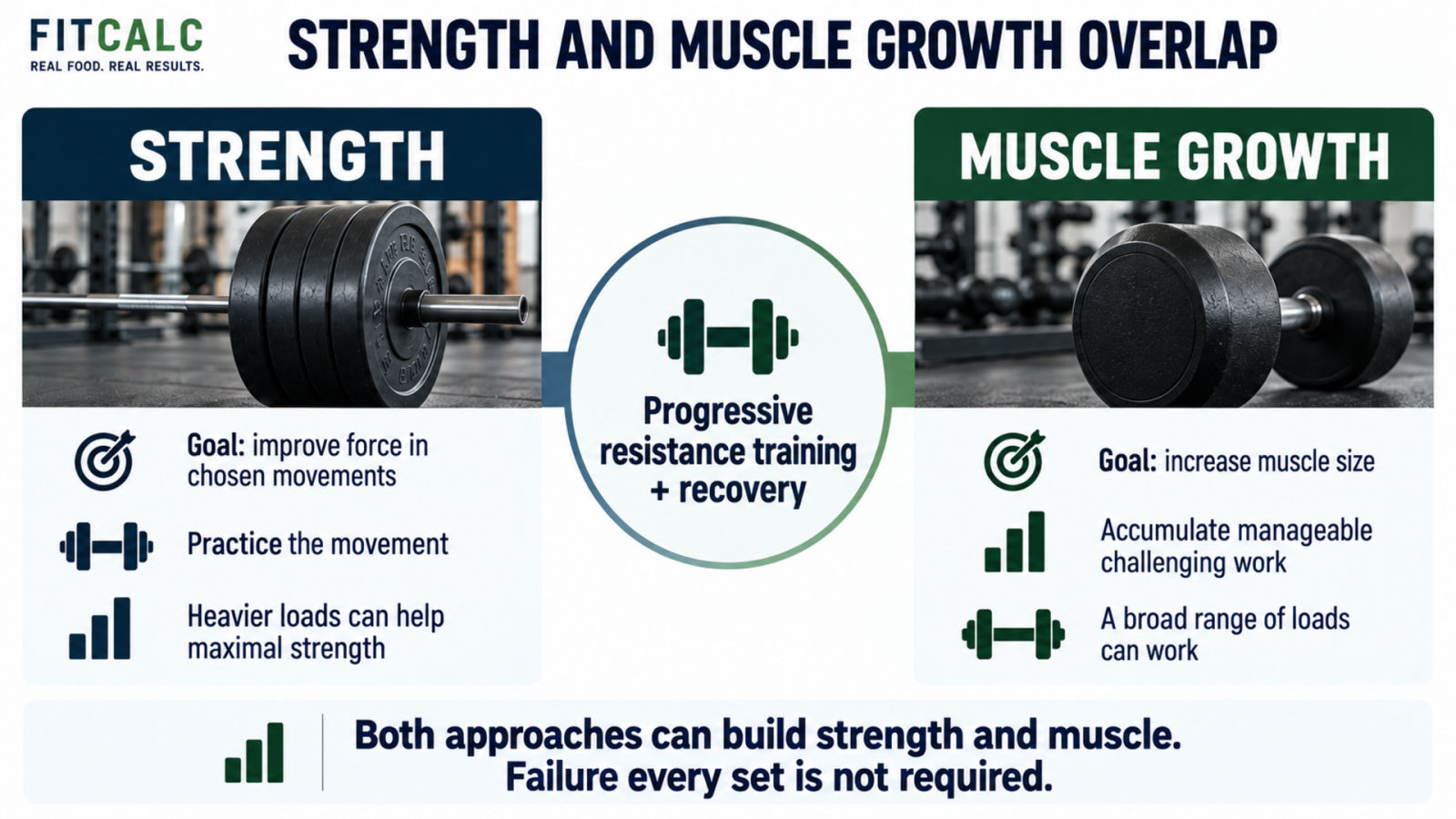
FitCalc does not believe someone pursuing general strength needs to choose between being stronger and more muscular. For most recreational lifters, a good program can contain heavier strength-focused work alongside moderate-repetition training that helps build additional muscle.
The distinction becomes important when deciding what deserves priority. If increasing your bench press is the main goal, your program should not look identical to a program designed solely to maximize chest hypertrophy.
Specificity and Why Practice Matters
Strength is highly specific to the task being performed.
If you become dramatically stronger at a leg press, some of that increased capacity may transfer to other lower-body movements because the same muscles contribute to them. But it does not guarantee an equally dramatic increase in your barbell squat. The squat requires its own coordination, positioning, balance, range of motion, and technical skill.
The same principle applies to load. Someone who performs only high-repetition sets can certainly become stronger, particularly as a beginner, but they are not regularly practicing the skill of producing maximal force against very heavy resistance.
This is the principle of specificity: adaptations are influenced by the demands repeatedly placed on the body.
If your goal is a stronger bench press, the bench press or a closely related variation should appear regularly in your training. If your goal is more pull-ups, you should actually practice pull-ups. Assistance exercises can strengthen contributing muscles and address weaknesses, but they support the primary movement rather than completely replacing it.
Specificity does not mean performing only one exercise forever. Variations can be valuable for building muscle, addressing weak positions, managing joint stress, or accumulating additional training volume. A close-grip bench press may help strengthen the triceps and pressing pattern, while rows and upper-back work can support the musculature involved in stable pressing.
The hierarchy remains important: practice the movement you want to improve, then use additional exercises to support it.
This is also why constantly changing your main exercises can make strength difficult to evaluate. If you bench press for three weeks, switch to dumbbells, move to a machine two weeks later, and then return to barbell benching months afterward, you have given yourself very little consistent practice or performance data.
Strength is partly a skill. Like other skills, it improves when you practice it consistently enough to become better at performing it.
Loads, Sets, Reps and Exercise Selection
Strength training becomes more effective when the program matches the specific adaptation you are trying to improve. If the goal is maximal strength, you need regular exposure to relatively heavy loads, enough quality sets to drive progress, and exercises that let you practice the movements and force-production patterns that matter most.
FitCalc does not recommend turning every workout into a max-effort test. Heavy training should still be repeatable, technically sound, and recoverable. The goal is to build strength over time, not prove your strength every session.
How Heavy Should You Train?
One-repetition maximum, or 1RM, describes the heaviest load you can lift for one successful repetition with acceptable technique. Strength programs often use percentages of that number to describe training intensity.
For maximal strength development, heavier loading becomes useful once you have the technique and tolerance to use it. The ACSM finding described above is not a reason for a beginner to start with near-maximal weights.
FitCalc uses roughly 3–8 repetitions as a practical range for much of an experienced recreational lifter’s strength-focused compound work. This is a coaching choice, not a precise conversion from repetitions to percentage of 1RM: exercise, individual capacity and repetitions left in reserve all affect that relationship.
That range is a practical recommendation, not a magical boundary. Sets of 10 can still increase strength. Sets of 2 can be useful. Singles can have a place for advanced lifters practicing heavy skill. The important point is that if your goal is to become stronger with heavy weights, you need to spend some time actually training with heavy weights.
Heavy training does not require grinding near your limit every session. Repeated maximum attempts leave less room for repeatable working sets and technical practice. Keep true-max testing separate from most day-to-day training.
Most strength progress is built with submaximal but challenging work. A set of five performed with solid technique and one or two repetitions still available can be far more productive than repeatedly missing max attempts.
Moderate-repetition work also remains useful. Sets in the 6–12 range can help build muscle, accumulate additional volume, and strengthen supporting musculature. Since muscle size contributes to long-term force potential, a good strength program often combines heavier primary work with moderate-repetition assistance work rather than choosing only one style.
The practical question is not, “What is the strongest rep range?” It is, “Does my training include enough heavy, specific work to improve the kind of strength I care about?”
Warm up with the movement and progressively heavier, non-fatiguing sets before the working weight. For a new lift, begin lighter and learn a controlled, comfortable range of motion. Use appropriate rack safeties or a competent spotter where a failed repetition could trap you, and do not force a painful repetition. A coach can help with setup and technique.
Use the 1 Rep Max Calculator to estimate from a recorded set rather than attempting a maximum just to obtain a number. An estimate is a planning aid, not clearance to attempt that weight.
How Many Sets and How Close to Failure?
A single hard set can produce adaptation, but most people will benefit from more than one working set when strength is the goal.
ACSM identifies 2–3 sets as a useful strength-oriented prescription. FitCalc’s practical 2–4 working-set range allows adjustment for training experience, exercise demands and the rest of the week. Warm-up sets are separate; begin with less work if needed and increase only when you are recovering and progressing. ACSM 2026 position stand
The goal is not to accumulate sets simply because a higher number looks more serious.
Consider the whole workload rather than treating every set as equivalent. Several hard compound sets may demand more recovery than the same number of small-muscle accessory sets. Four deadlift sets are an example of a workload to evaluate, not a universal requirement.
Training to momentary muscular failure was not consistently necessary for better outcomes in ACSM’s review. FitCalc therefore does not use failure on every set as a default strength-training requirement. ACSM 2026 position stand
Leaving approximately 1–3 repetitions in reserve on many heavy working sets is a practical FitCalc starting point, not a proven optimum for every lifter. A beginner can stay farther from failure while learning. Repetitions in reserve means the number of additional controlled repetitions you estimate you could complete; it is a judgment, not an exact measurement.
That gives you room to maintain technique, preserve bar speed, and accumulate quality volume without creating unnecessary fatigue. A lifter performing five repetitions while knowing they probably could have completed seven has still performed a meaningful strength-training set.
There are times when heavier effort is useful. Advanced lifters may occasionally train very close to failure, and some accessory work can safely be pushed harder. But for large compound lifts, failure should not be treated as proof that the set was productive.
Failure can carry a recovery cost. In a study of 12 resistance-trained men, squat sessions taken to failure produced greater and longer-lasting peripheral fatigue than the compared non-failure sessions; central-fatigue measures were similar. The protocols also differed in repetitions completed, so the study does not isolate the effect of the final missed repetition or establish a universal recovery time. González-Hernández et al., 2021
Strength training should feel challenging, but challenge and exhaustion are not the same thing.
Choosing Exercises That Build Strength
Exercise selection should reflect what you actually want to become stronger at.
If your goal is a stronger barbell bench press, the bench press deserves a central place in the program. If your goal is more pull-ups, you need regular pull-up practice. If general lower-body strength is the goal, squats, split squats, deadlift variations, leg presses, and other lower-body movements can all contribute depending on the exact outcome you care about.
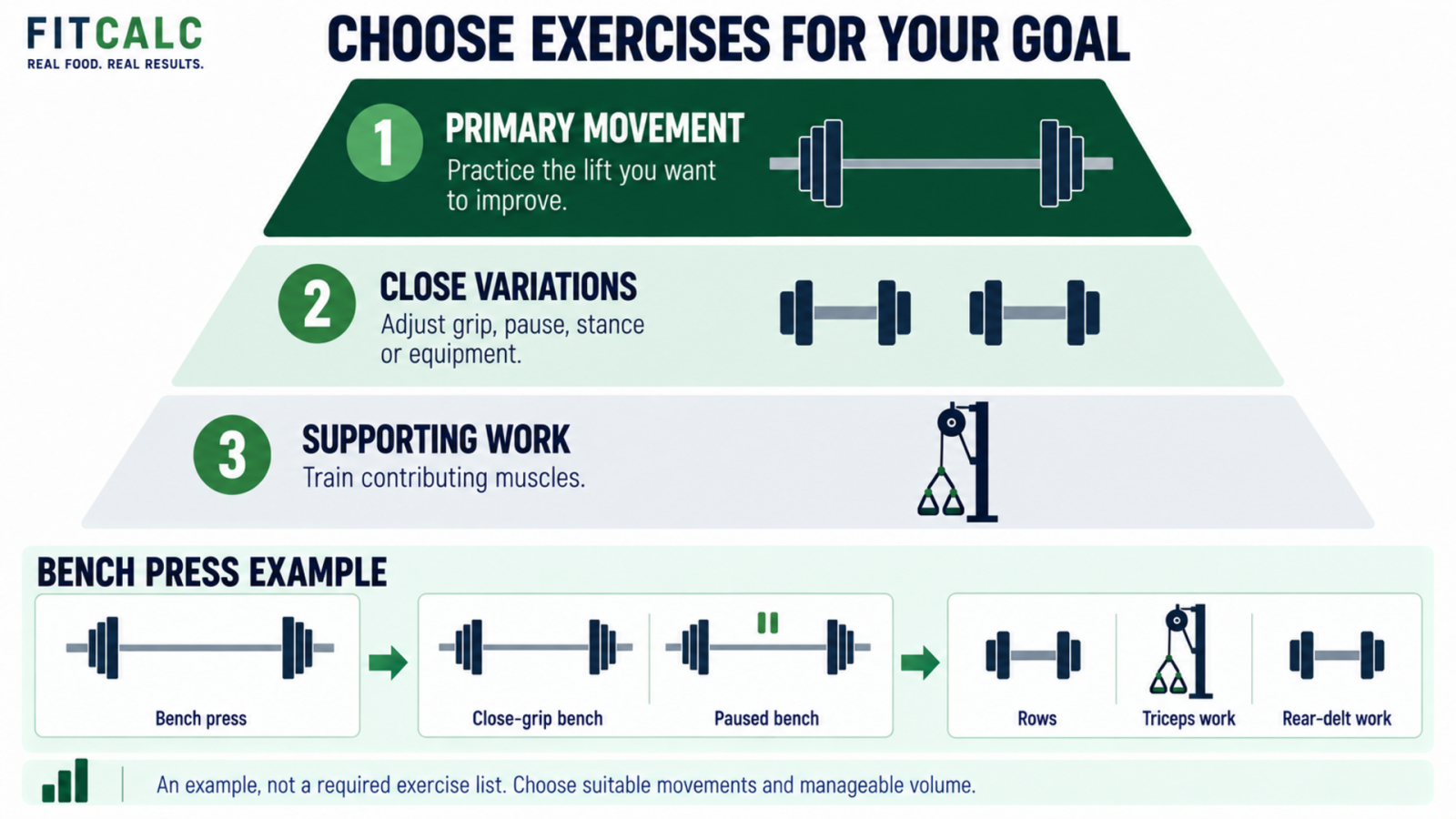
FitCalc likes to think of exercise selection in three layers: the primary movement, close variations, and supporting accessory work.
The primary movement is the exercise or pattern you most want to improve. A close variation trains something very similar while changing one variable, such as grip, stance, range of motion, pause, or equipment. Accessory work strengthens muscles that contribute to the main lift or addresses areas that need more direct training.
For example, someone focused on bench strength might use the barbell bench press as the primary lift, a paused or close-grip bench as a variation, and rows, triceps work, and rear-delt training as supporting work. The accessories matter, but they should support the main goal rather than overwhelm it.
Free weights and machines can both build strength. The idea that machines “do not count” is too simplistic. A machine chest press can absolutely make the pressing muscles stronger. What it does not do as well is improve the specific skill of balancing and performing a barbell bench press.
That distinction matters.
Strength is partly general and partly specific. Building stronger triceps can transfer to pressing. Stronger quadriceps can support squatting. But the more specific the goal becomes, the more specific some portion of training should become too.
Exercise order follows the same logic. ACSM’s synthesis supports placing exercises you most want to strengthen early in the session. That is a useful priority rule, not a requirement that a barbell lift must always come first. ACSM 2026 position stand
FitCalc therefore recommends placing your most important strength movement first or near the beginning, then using the remaining exercises to build the qualities that support it.
A strength program does not need dozens of movements. It needs the right movements performed consistently enough to improve them.
Building a Strength Program
A strength program needs to organize individual exercises into a structure you can repeat, recover from, and progressively improve. The best exercises in the world will not produce much long-term progress if they are arranged randomly or changed so frequently that you never become better at them.
FitCalc favors simple programming with a clear purpose. Decide which movements you want to improve, practice them often enough to develop skill, add enough supporting work to build the muscles involved, and distribute everything across a weekly schedule that fits your life and recovery.
For many recreational lifters, two to four well-organized weekly sessions can fit a useful strength program. More training days can help distribute work, but they are not automatically an upgrade. The right starting schedule is one you can repeat and recover from.
Training Frequency and Weekly Structure
Training frequency describes how often you train during a given period, whether that means total gym sessions or how frequently a particular movement or muscle group is trained.
In a nine-week trial completed by 21 resistance-trained men and women, distributing equal weekly training volume over two versus four sessions produced no detected between-group difference in strength or muscle-growth outcomes. This small study supports flexibility; it does not prove that every frequency is interchangeable for every lifter. Hamarsland et al., 2022
That makes frequency primarily a programming tool.
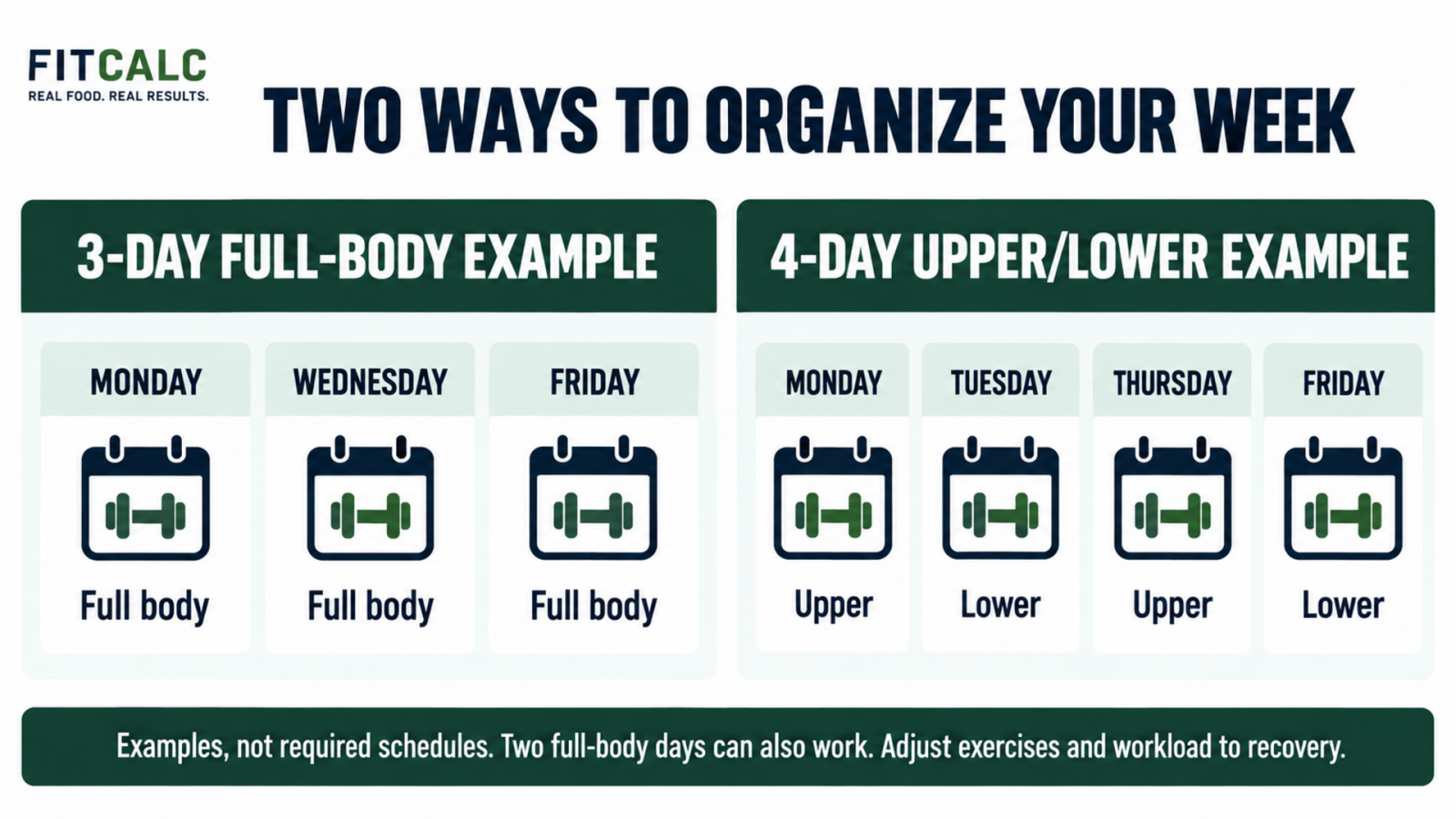
Someone training three days per week might use a full-body structure. The squat, bench press, deadlift or hinge pattern, pulling movements, and accessory exercises can be distributed across those three sessions so the major movements receive regular exposure without requiring daily training.
A four-day upper/lower structure provides another effective option. Two upper-body and two lower-body sessions create room to practice major lifts more than once per week while distributing fatigue and assistance work across additional sessions.
Neither approach is universally superior.
A three-day program may work better for someone with limited time, recreational sports, a physically demanding job, or greater recovery needs. A four-day program may allow another lifter to distribute the same or greater workload across shorter sessions and obtain additional practice with important movements.
Three-day full-body and four-day upper/lower schedules are useful options, not mandatory defaults. Two full-body days can be a sensible starting point when time or recovery is limited. Public-health guidance recommends muscle-strengthening activity on at least two days each week; optimizing a particular lift can require a more individual plan. CDC activity guidance
The same logic applies to individual lifts. If improving your bench press is a high priority, practicing it or a close variation twice per week may provide more useful skill exposure than benching once every seven days. That does not mean every lift must be performed with the same frequency.
The schedule should serve the training goals, not become the goal itself.
For a simple two-day starting structure, spread sessions apart and include a manageable knee-dominant movement, hip hinge, push and pull across the week. Choose versions you can perform comfortably, record a repeatable starting load and leave room to improve. This is a flexible framework rather than a complete individualized program; you do not have to copy the example barbell lifts to benefit.
Progressive Overload and When to Add Weight
Progressive overload means increasing the training demand as your ability improves. In strength training, the most obvious form is adding weight to the bar, but effective progression does not require forcing a load increase every workout.
Imagine your program calls for three sets of 5–8 repetitions on a particular lift.
You begin with 185 pounds and perform 8, 7, and 6 repetitions with good technique. Over the next several sessions, those sets might eventually become 8, 8, and 8 at a similar level of effort.
At that point, increasing the weight slightly and returning toward the lower end of the repetition range provides a simple way to continue progressing.
This is commonly called double progression: improve repetitions within a target range, then increase load once you can consistently perform the upper end.
For strength-focused compound exercises, progression can also be simpler. A beginner might perform three sets of five and add a small amount of weight whenever all prescribed repetitions are completed with good technique and appropriate effort.
The 2009 ACSM progression model suggested increasing load by roughly 2–10% when someone could exceed the repetition target by one or two reps. That older rule is a useful illustration of performance-led progression, not a command to take a 10% jump. Use the smallest practical increase that keeps the next session within the intended effort and technique. ACSM 2009 progression guidance
FitCalc prefers this approach to adding weight simply because another week has passed.
If you performed 225 pounds for five difficult repetitions last week and barely completed them, moving to 235 solely because your spreadsheet says "+10" may not represent useful progression. Repeating 225 with cleaner technique, better speed, or an additional repetition can demonstrate progress without changing the load.
Beginners can often add weight quickly because their nervous system, technique, and muscles are adapting simultaneously. That pace eventually slows. An experienced lifter may spend weeks trying to turn five repetitions into six or add five pounds to an established lift.
That is not failure. The stronger you become, the harder additional strength becomes to earn.
Progressive overload should therefore be viewed as a long-term upward trend rather than a requirement that every workout outperform the previous one.
The Plate Calculator can help assemble a chosen barbell load. Its arithmetic does not decide whether that load is appropriate for you. Count the bar, load both sides evenly and check the actual equipment before lifting.
Rest Periods and Exercise Order
Strength training requires enough recovery during the workout, not only between workouts.
A demanding set temporarily reduces your ability to produce force. If you begin the next set before sufficiently recovering, you may perform fewer repetitions, move the weight more slowly, or need to reduce the load. Short rest periods can be useful in certain training contexts, but deliberately staying exhausted is usually counterproductive when maximal strength is the priority.
In an eight-week trial of 21 young resistance-trained men, three-minute rests produced greater squat and bench-press strength improvements than one-minute rests. That supports allowing enough recovery between demanding sets; it does not prove that everyone needs exactly three minutes. Schoenfeld et al., 2016
FitCalc uses approximately 2–5 minutes between demanding compound sets as a practical range. Take more or less when needed to maintain the intended repetitions, technique and effort rather than treating the clock as the goal.
A heavy set of squats or deadlifts may justify four or five minutes. A moderate bench press set might require closer to two or three. Smaller accessory exercises can usually use shorter rest periods because they create less systemic fatigue and maximal force production is not necessarily the primary goal.
You do not receive extra strength benefits simply because you are breathing heavily throughout the entire workout. If another minute of rest allows you to perform a stronger, cleaner set, take the minute.
Exercise order follows a similar principle.
Put the exercise you most want to improve early in the session, as discussed above. Fatiguing the same muscles with several accessories first can reduce what you can do on the priority lift.
If bench press strength is your highest upper-body priority, performing several sets of chest flyes, triceps extensions, and shoulder presses before benching makes little sense. You have fatigued many of the muscles required for the movement before practicing the thing you actually care about.
That does not mean the same lift must always be first forever. Priorities can change, and programs may intentionally manipulate exercise order. But the general FitCalc rule is simple: put your highest-priority strength work near the beginning, give demanding sets enough rest, and perform accessory work afterward.
Good strength programming is often less complicated than it appears. Train important movements consistently, distribute them across a manageable week, add weight or repetitions when performance earns it, and give yourself enough recovery to perform quality work.
The difficulty is not understanding those principles. It is applying them consistently for long enough that the small improvements accumulate into substantial strength.
For examples of adjusting rest to the task, see how long to rest between sets.
Plateaus, Fatigue and Long-Term Progress
Strength progress is rarely linear forever. Beginners can often add weight or repetitions rapidly because nearly everything is improving at once: technique, coordination, neural efficiency, muscle size, and confidence under load. Eventually those easy adaptations become harder to earn.
That slowdown is normal. It does not automatically mean your program has stopped working.
As you become stronger, progress needs to be evaluated over longer periods. An advanced lifter adding five pounds to an established lift after several months may have made meaningful progress, even though the same five-pound increase might have taken a beginner only one workout.
Long-term strength training therefore requires learning when to keep pushing the existing plan, when to recover, and when something actually needs to change.
Why Strength Eventually Stalls
A plateau should not be confused with one bad workout.
Performance fluctuates. You may sleep poorly, eat less than usual, train after a stressful workday, or simply have a session where the weights feel unusually heavy. None of that means you need a new program.
A genuine plateau is a persistent lack of progress despite consistent training and adequate opportunities to improve.
Early in training, increasing strength is relatively easy because the body has enormous room to adapt. You are learning the movements, improving coordination, becoming more comfortable with heavy resistance, and often building muscle simultaneously.
As training experience accumulates, those adaptations become increasingly developed. Technique is already competent. The nervous system has years of practice with the movement. Muscle mass is greater. Adding another meaningful amount of strength now requires a smaller improvement on top of an already highly trained system.
Linear progression cannot continue indefinitely. In a purely hypothetical calculation, a 100-pound bench press plus 52 weekly increases of 5 pounds reaches 360 pounds. That is arithmetic, not a realistic one-year forecast or a target beginners should chase.
When progress slows, first examine the fundamentals. Are you training consistently? Is technique still stable? Are you eating enough to support your goal? Are you sleeping adequately? Has your bodyweight changed substantially? Are you actually following the progression system?
If those pieces are in place, the program itself may eventually need adjustment. That could mean changing training volume, altering intensity, using a variation to address a weak position, or progressing over a longer time frame rather than expecting improvement every session.
The stronger you become, the more patience becomes part of programming.
Fatigue, Deloads and Recovery
Training creates both fitness and fatigue.
A productive workout can make you stronger over time while temporarily reducing your ability to express that strength. This is why you generally cannot perform a demanding squat workout and then immediately demonstrate your best possible squat five minutes later.
Over a training week, fatigue accumulates from lifting alongside work, sports, sleep disruption, stress, and normal life. A good program manages that fatigue well enough that adaptation can continue.
Sometimes recovery falls behind.
Performance may remain suppressed across several workouts. Loads that were normally manageable begin feeling unusually difficult. Motivation can decline, soreness may linger longer than usual, and technique can become harder to maintain.
A few poor sessions do not diagnose overtraining syndrome. Persistent fatigue or unexplained performance decline can also have causes outside the training plan. If symptoms persist, or you feel unwell, seek appropriate clinical advice rather than assuming a deload will solve everything.
A deload is one tool for addressing that situation. A deload temporarily reduces training stress by lowering volume, load, effort, or some combination of the three.
FitCalc does not believe everyone needs to deload automatically every fourth week simply because a calendar says so.
The evidence does not establish one deload schedule that works for everyone. A trial in 39 young trained adults found that taking a full week off midway through nine weeks of training did not improve muscle growth and resulted in less lower-body strength improvement than continuous training. A week without training is not the same intervention as a lighter training week. Coleman et al., 2024
FitCalc prefers using performance and recovery trends to help determine when a deload is appropriate. If several workouts show unusual performance decline, fatigue remains elevated, and normal recovery habits are already in place, a short reduction in training stress can be useful.
A deload also does not mean doing nothing. You might temporarily perform fewer working sets, use lighter loads, remain farther from failure, or combine those approaches before returning to normal training.
Recovery outside the gym matters too. Eat enough for your goals and include protein, carbohydrate-containing foods, fluids and regular sleep. The ISSN position stand gives roughly 1.4–2.0 g protein/kg/day as sufficient for most exercising adults. FitCalc’s roughly 1 g/lb (about 2.2 g/kg) approach is a higher-protein planning preference, not a requirement for everyone. ISSN protein guidance
You cannot program your way around consistently poor recovery.
Build meals from foods you enjoy: for example, eggs, fish, meat, dairy, beans or tofu for protein, alongside potatoes, rice, oats, fruit and vegetables. Fit portions to your needs rather than treating a supplement or one specific food as essential. The Protein Guide explains the range and how to apply it.
For sleep, CDC recommends at least seven hours for adults aged 18–60, with age-specific ranges for older adults. Adequate sleep includes quality and consistency, not just time in bed. CDC sleep recommendations
How to Track Strength Progress
If getting stronger is the goal, record your training.
Memory is unreliable, particularly when the difference between progress and stagnation may be one repetition performed several weeks apart. A simple training log gives you objective evidence of what you actually did.
At minimum, record the exercise, load, repetitions, and working sets. Repetitions in reserve can also be useful because they add context to the performance.
Suppose you bench press 225 pounds for five repetitions today and eventually perform the same weight for eight repetitions with similar technique and effort. You have become stronger even though the weight on the bar never changed.
Likewise, moving from 225 × 5 to 235 × 5 represents clear progress.
Estimated one-repetition maximum can help compare recorded sets without frequent maximal testing. FitCalc’s 1 Rep Max Calculator uses the Epley formula for 1–10 repetitions, with a one-rep set returning the entered load. For example, 225 × 5 gives 225 × (1 + 5/30) = 262.5 lb, displayed as 263 lb after rounding. This is an estimate, not a demonstrated lift, and error depends on technique, exercise, effort and fatigue. FitCalc methodology
Technique needs to remain part of the comparison. A 315-pound squat performed through a full, controlled range of motion cannot honestly be compared with a later 335-pound squat performed substantially shallower simply because the second number is larger.
Your log should therefore tell the story of better performance under comparable conditions.

The purpose of tracking is not to turn every workout into a spreadsheet competition. It is to give yourself enough information to know whether the program is actually working.
Practical Takeaways
Strength comes from more than muscle size. Neural adaptations, technique, coordination, leverage, and repeated practice all contribute to how much force you can express in a particular movement.
For strength-focused compound training, use challenging, manageable loads suited to your experience. FitCalc’s 3–8-repetition range is an option for lifters ready for heavier work, not a beginner entry requirement. You do not need to test a maximum or reach failure every session.
Choose a repeatable weekly structure. Two full-body days can work; three- and four-day routines provide other ways to distribute training. Practice important movements, recover between sessions and increase the challenge when performance shows that you are ready.
Rest long enough between demanding sets to maintain performance. Track your training so progression is based on evidence rather than memory. When progress slows, evaluate recovery, technique, nutrition, fatigue, and programming before assuming you simply need to train harder.
Conclusion
Getting stronger is a process of building physical capacity and becoming increasingly skilled at expressing it.
Muscle matters. So do your nervous system, technique, coordination, and familiarity with the movements you perform. This is why the strongest program is not necessarily the one containing the most exercises, training days, or advanced programming techniques.
FitCalc's approach is simpler: practice the movements you want to improve, use heavy but manageable resistance, perform enough quality sets, support the main lifts with useful accessory work, rest long enough to perform well, progress when you've earned it, and recover before doing it again.
Beginners can progress quickly. Experienced lifters cannot expect the same rate forever. As strength increases, improvements become smaller and take longer to produce, which makes consistency and intelligent programming increasingly important.
You also do not need to prove your strength every workout. A successful training session is not defined by a new personal record. Many ordinary sessions are simply opportunities to accumulate the high-quality work that eventually produces one.
Train. Record what you did. Recover. Improve what you can. Then repeat the process.
That is how small increases in repetitions and weight eventually become a much stronger body.
Sources
CDC. Adding Physical Activity as an Adult.
Jäger et al. (2017). International Society of Sports Nutrition Position Stand: protein and exercise.