How Much Muscle Can You Actually Gain in a Month?
If you start a muscle-building phase at 170 pounds and weigh 175 pounds a month later, it is tempting to say you gained five pounds of muscle.
You almost certainly did not.
The scale measures your total bodyweight, not skeletal muscle. During a gaining phase, changes in bodyweight can come from new muscle tissue, body fat, glycogen, water, and simply having more food moving through your digestive system. Increasing calories and carbohydrates can cause some of those changes within days, while building meaningful amounts of new muscle takes much longer.
That makes the question "How much muscle can I gain in a month?" more complicated than many online charts make it seem. There is no universal monthly number that applies to everyone. Your training experience, genetics, starting body composition, nutrition, training quality, recovery, and several other factors all influence the rate at which you can grow.
What we can say confidently is that muscle growth becomes progressively slower as you become more trained, and trying to force faster scale gain with an enormous calorie surplus does not make your body capable of building unlimited muscle.
The goal of a good gaining phase is not to make the scale rise as quickly as possible. It is to create an environment that supports muscle growth without accumulating unnecessary body fat along the way.
There Is No Universal "Muscle Per Month" Number
You have probably seen charts claiming that a beginner can gain a certain number of pounds of muscle each month, an intermediate can gain half as much, and an advanced lifter can gain some tiny predetermined amount.
Those numbers can be useful as rough coaching expectations, but they should not be mistaken for biological laws.
Resistance-training studies consistently show that people can increase muscle size, but the magnitude of that growth varies substantially between individuals. A meta-analysis examining whole-body skeletal muscle changes across 111 resistance-training studies involving 1,927 men found an average increase of approximately 1.53 kilograms across the training interventions. Importantly, that was across entire interventions of varying lengths, not 1.53 kilograms per month.
There is also a measurement problem. Studies may assess changes using DEXA-derived lean mass, MRI, ultrasound muscle thickness, circumference measurements, or other methods. Those measurements are not perfectly interchangeable, and changes in "lean mass" do not necessarily represent an identical amount of newly constructed skeletal muscle.
This is why FitCalc does not recommend setting a goal such as "I must gain exactly 1.5 pounds of muscle this month." You cannot measure natural muscle growth accurately enough at home to manage a gaining phase with that level of precision.
A much better approach is to create the conditions known to support muscle growth, monitor several indicators of progress, and evaluate the trend over months rather than trying to assign every pound on the scale to a specific tissue.
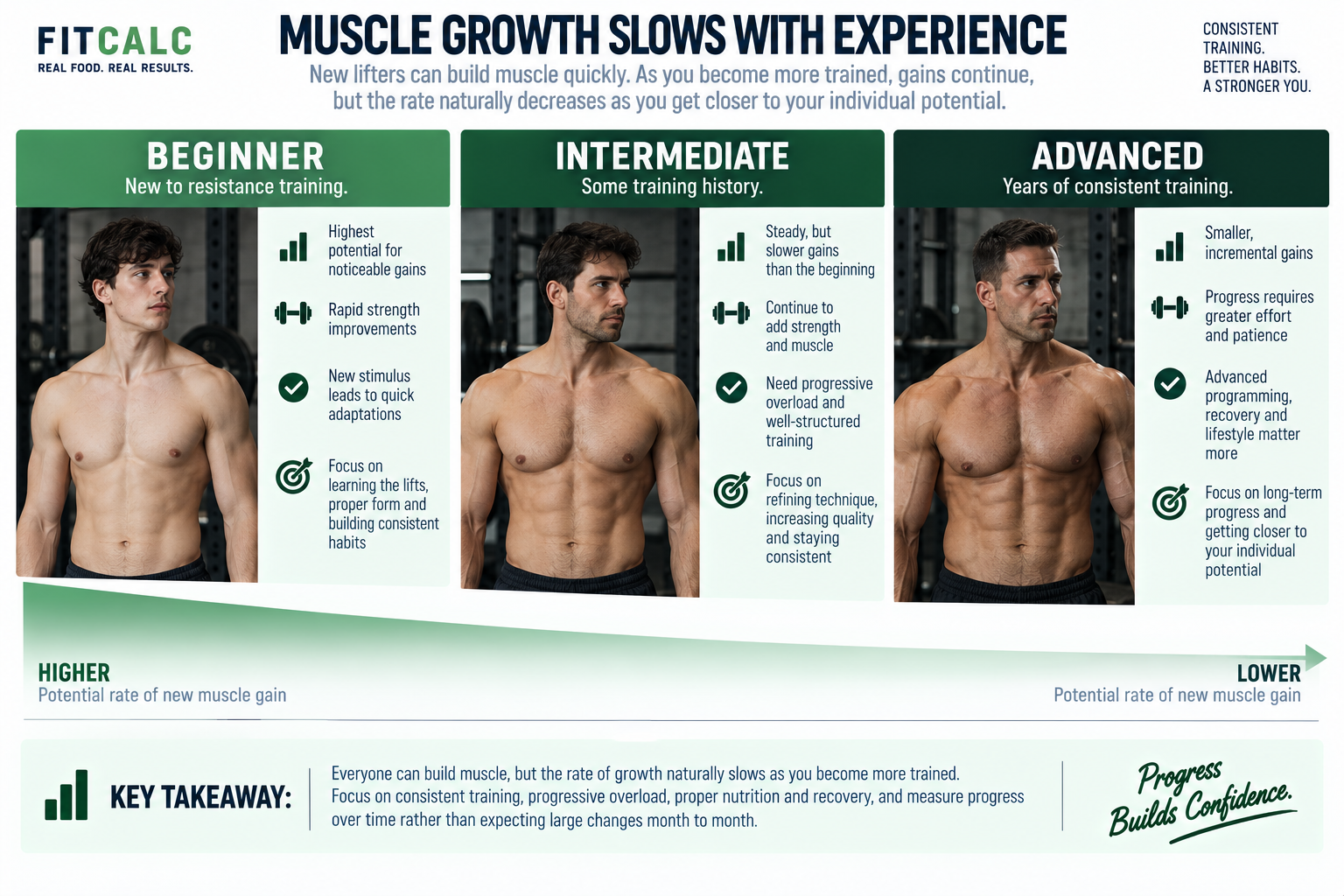
Beginners and Advanced Lifters Grow at Very Different Rates
Training experience is one of the biggest reasons a universal monthly muscle-gain target does not work.
A true beginner has enormous room to adapt. Resistance training is a new stimulus, technique improves rapidly, strength increases quickly, and the muscles have not yet undergone years of hypertrophic adaptation. Someone in this stage can often make visible progress within their first several months of consistent training.
An advanced natural lifter is in a completely different situation. They may already have spent years progressively training, eating adequately, and building substantial muscle. The closer someone moves toward their individual muscular potential, the harder additional tissue becomes to add.
That does not mean advanced lifters stop growing. It means the time scale changes. Progress that would have seemed insignificant during someone's first year may represent an excellent result after eight years of serious training.
Genetics create another major source of variation. People do not respond identically to the same resistance-training program. Differences in muscle architecture, skeletal structure, recovery, biological characteristics, and individual responsiveness can produce meaningfully different results even when two people train similarly.
There is also an important exception to the beginner-versus-advanced framework: muscle memory. Someone who previously carried considerably more muscle, stopped training, lost some of it, and then returned is not equivalent to a true beginner. Previously developed muscle can often be regained much faster than it took to build originally. Research increasingly supports persistent cellular adaptations following prior resistance training that may contribute to this phenomenon.
So when someone online claims they gained an extraordinary amount of muscle within a few months, context matters. They may be new to training, returning after a layoff, genetically responsive, regaining lost tissue, or simply counting total weight gain as muscle.
Scale Weight Is Not Muscle Gain
This is the most important distinction in the entire discussion.
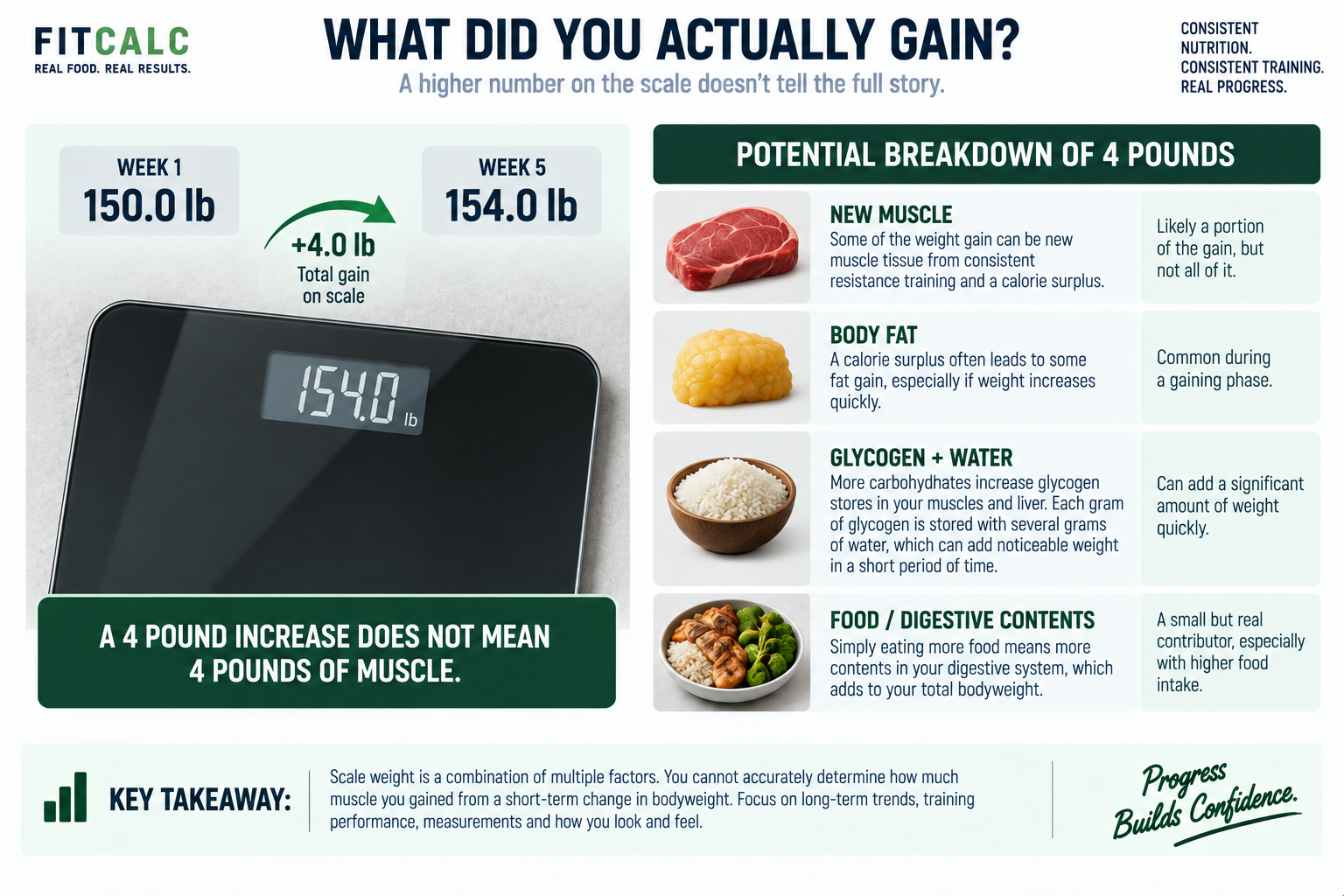
If you gain four pounds during a month of bulking, the scale can tell you that your body is four pounds heavier. It cannot tell you that you built four pounds of muscle. When calorie intake increases, several things can happen simultaneously.
Muscle tissue may gradually increase if your training provides an effective hypertrophic stimulus. Some additional energy may be stored as body fat. Higher carbohydrate intake can increase glycogen stored in skeletal muscle and the liver, and glycogen is stored alongside water. Eating more total food can also increase the amount of material physically present in your digestive system.
The glycogen effect can be particularly noticeable when someone moves from dieting or eating relatively few carbohydrates into a higher-calorie muscle-building diet. Research examining carbohydrate loading has reported increases in body water associated with glycogen storage, with approximately 2.7–4 grams of water associated with each gram of glycogen under studied conditions.
That means the scale can rise rapidly before enough time has passed to build anything close to that amount of new muscle tissue. This is not a problem. Fuller glycogen stores and better hydration can support training and make muscles appear fuller. The mistake is simply labeling all of that additional weight as muscle.
The same principle is why short-term body-composition readings should be treated cautiously. A smart scale or even a more sophisticated body-composition assessment can be influenced by hydration and other variables. Looking at several months of trends is much more informative than trying to determine exactly how many ounces of muscle appeared during the last four weeks.
Why Eating More Doesn't Keep Accelerating Muscle Growth
Building new tissue requires energy, which is why FitCalc recommends a calorie surplus for most people whose primary goal is maximizing muscle gain.
But there is an important limit to that logic.
If a 250-calorie surplus supports muscle growth, it does not follow that a 1,000-calorie surplus will build muscle four times faster. Your body can only construct new muscle tissue at a limited rate, regardless of how much additional food you provide.
Research in resistance-trained individuals illustrates the problem. A study comparing maintenance intake with moderate and larger energy surpluses found that faster rates of bodyweight gain were associated primarily with greater increases in skinfold thickness rather than clearly greater increases in muscle thickness across the measured sites.
In other words, more scale gain increasingly became more fat gain rather than proportionally more muscle.
This fits FitCalc's approach to gaining phases. For most people deliberately trying to build muscle, we recommend starting around 200–300 calories above maintenance per day and adjusting from there based on actual results.
That number is a FitCalc practical recommendation, not a scientifically established perfect surplus. Someone highly active, very large, or unusually resistant to weight gain may eventually need more. Someone gaining too quickly may need less.
What we do not recommend is deliberately overeating by enormous amounts because you believe every extra calorie is accelerating hypertrophy.
A muscle-building phase should still prioritize quality food. Build your diet primarily around high-quality animal proteins such as beef, eggs, poultry, and fish; quality carbohydrate sources such as rice, potatoes, and fruit; and appropriate sources of dietary fat. FitCalc also recommends approximately 1 gram of protein per pound of bodyweight per day for healthy adults serious about building muscle and improving body composition.
For active people, we also favor plenty of quality carbohydrates, generally at least around 200 grams per day, with more as body size, activity, and training demands increase. That is a FitCalc practical recommendation rather than a claim that 200 grams represents a universal scientific threshold for hypertrophy.
The purpose of eating more is to support productive training and muscle growth, not to see how quickly you can make your bodyweight increase.
How to Tell Whether You're Actually Building Muscle
Because the scale cannot isolate muscle tissue, FitCalc recommends looking at several forms of evidence together.
Your average bodyweight should generally trend upward during a dedicated gaining phase, but it should not be the only measurement you follow. Gym performance is particularly useful. If you are gradually performing more repetitions, using heavier loads with comparable technique, or handling more productive training volume over time, your body is adapting.
Muscular measurements can add another piece of information. If your arms, thighs, chest, shoulders, or other trained areas gradually increase while waist circumference remains relatively controlled, that pattern is more encouraging than rapid increases everywhere accompanied by a rapidly expanding waist.
Progress photographs are useful for the same reason. Take them under similar lighting, distance, positioning, and conditions. You see yourself every day, which makes gradual muscular changes difficult to recognize in the mirror.
Body-composition testing can provide additional context, but do not expect it to perfectly determine how much muscle you gained during a short period. DEXA, BIA, skinfolds, and other methods all contain sources of uncertainty.
The strongest evidence comes when multiple trends agree: bodyweight is gradually increasing, gym performance is improving, muscular measurements are moving upward, photographs show development, and body-fat accumulation remains controlled.
That tells you much more than a single scale reading ever could.
What a Good Rate of Weight Gain Looks Like
Rather than setting a precise monthly muscle-gain target, control the variable you can actually measure reasonably well: your rate of total bodyweight gain. FitCalc favors starting conservatively.
Establish your approximate maintenance calories, add around 200–300 calories per day, train consistently, consume enough protein and carbohydrates, and monitor average bodyweight over several weeks.
Do not react to the first few days. Increasing food and carbohydrate intake can produce an early rise from glycogen, water, and digestive contents. Give the trend enough time to become meaningful.
If average bodyweight remains completely unchanged for several weeks and you are confident your calorie intake is consistent, adding another roughly 100–200 calories per day can be reasonable. If weight is climbing rapidly while your waist and visible body fat are increasing quickly, the opposite adjustment may be appropriate.
The goal is slow, controlled progress, particularly as you become more experienced.
Beginners have more room to grow and may see faster changes. Intermediate lifters should expect slower progress. Advanced natural lifters need even more patience. At a high level of development, adding a relatively small amount of genuine muscle across an entire year can represent meaningful success.
Trying to force the process by eating more does not change that reality. It mostly increases how much fat you will eventually need to lose.
The Bottom Line
There is no universal answer to exactly how many pounds of muscle you can gain in a month.
Beginners generally have the greatest potential for rapid growth, while intermediate and advanced lifters experience progressively slower returns. Genetics, training quality, nutrition, recovery, previous training history, and starting body composition all influence the result.
More importantly, monthly scale gain is not monthly muscle gain. A rising scale during a bulk can reflect muscle, body fat, glycogen, water, and additional digestive contents at the same time.
FitCalc's approach is therefore not to chase a predetermined number of pounds every month. Train progressively, eat a controlled calorie surplus, consume approximately 1 gram of protein per pound, eat plenty of quality carbohydrates, prioritize whole and minimally processed foods, sleep and recover properly, and monitor several indicators of progress.
If your training performance is improving, your physique is becoming more muscular, and your bodyweight is gradually increasing without body fat climbing unnecessarily fast, the plan is doing what it is supposed to do.
Your goal during a bulk is not to gain weight as fast as possible. It is to create the conditions for muscle growth while gaining no more unnecessary body fat than you need to.