THE FITCALC PLAN
Your Personalized Plan Starts Here
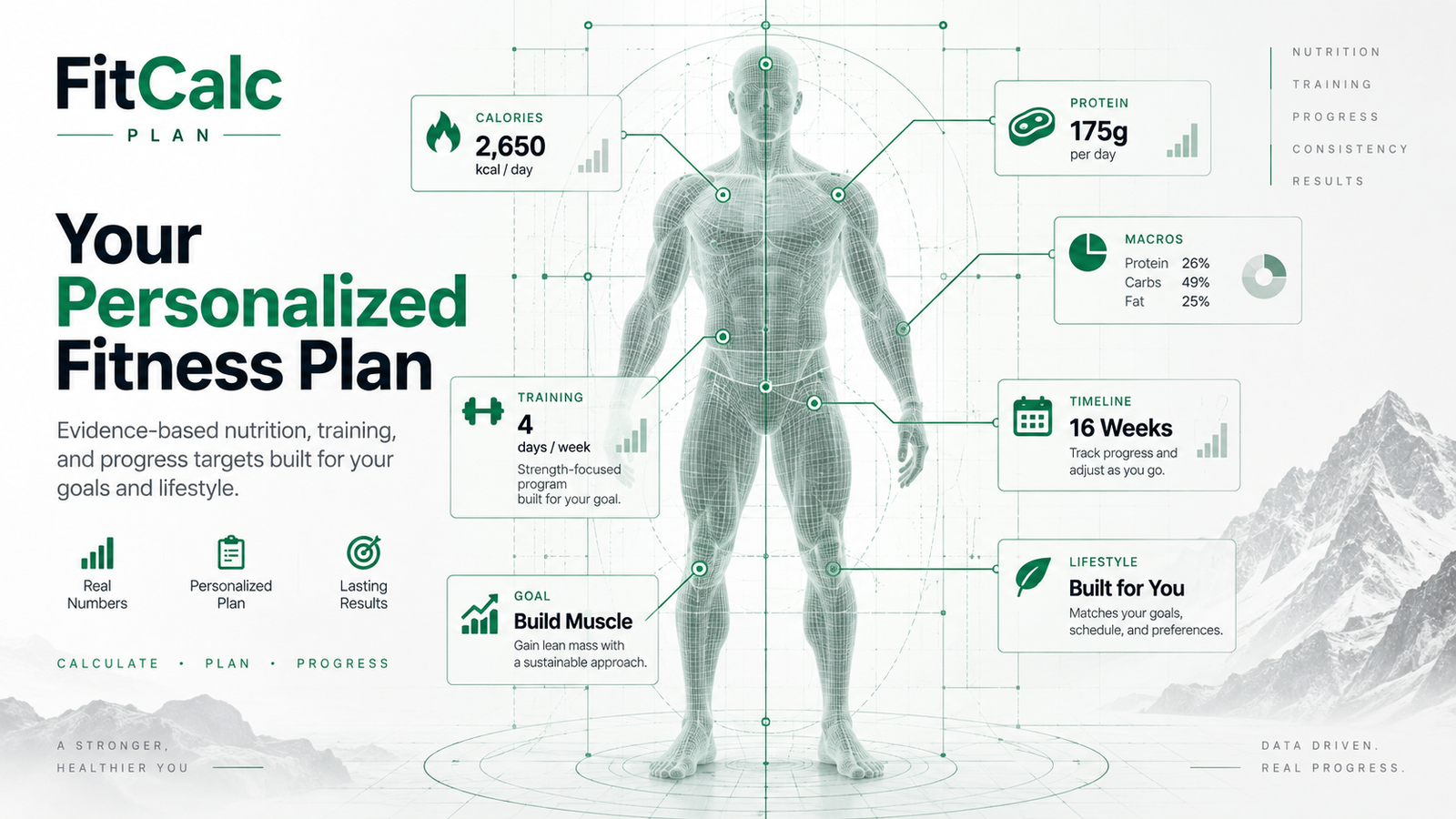
Answer a few questions about your body, activity, and goal. FitCalc will build your calorie target, protein, macros, body-composition insights, and progress roadmap.
Free · No account · No email · No photo required
- 01
Tell Us About You
Share your goal, stats, activity, training, and optional body-composition information.
- 02
Get Your FitCalc Plan
FitCalc connects your information with its calorie, protein, macro, and planning tools.
- 03
Follow Your Roadmap
See your starting targets, progress roadmap, and how to monitor and adjust over time.
THE FITCALC PLAN
 thefitcalc.com
Your FitCalc starting plan
Your FitCalc Plan
Generated
- Estimated maintenance
- BMR estimate
Adjust Your Plan
Change one input and see the specific parts of your Plan respond.
Move calories between fat and carbohydrate while keeping the same calorie and protein targets.
Progress roadmap
| Checkpoint | Date | Weight |
|---|
Body composition estimate
- Estimated body fat
- Lean body mass
- Fat mass
Lean mass is not all muscle. Measurement error carries through to these estimates. No future body composition is predicted.
Monitor and calibrate
Monitor average calorie intake, average body weight, training performance, hunger, and recovery. Use approximately 2–3 weeks as an initial review checkpoint, not a guarantee. Avoid reacting to a single weigh-in or automatically cutting calories.
Understand and continue
Why these calories?
Mifflin–St Jeor estimates resting energy needs; your selected activity factor estimates maintenance. Goal adjustments use existing FitCalc deficit choices or a 5–10% planning surplus.
Why this protein target?
FitCalc Plan intentionally uses approximately 1 gram per pound of current body weight. This practical high-protein editorial target is memorable; it is not a universal physiological minimum. Adequate intake may be lower depending on context, and more protein does not automatically produce more muscle growth. The standalone Protein Calculator uses its own contextual recommendations.
Why these carbs and fats?
Protein and total calories stay fixed. Fat defaults to 25% of calories; the preference slider trades fat against carbohydrate. FitCalc retains its preferred 0.6 g/kg fat constraint and narrows the supported range when needed. Whole-gram rounding can leave up to 3 kcal unallocated.
How accurate is maintenance?
Energy equations are population estimates. Routine, adherence, and individual variation affect real maintenance. Compare consistent intake with multiweek trends.
How accurate is my Roadmap?
The iterative FitCalc planning model recalculates estimated maintenance as projected weight changes while planned intake and activity stay constant. It is informed by dynamic energy-balance research, but does not reproduce the complete NIH Body Weight Planner. Its ±10% effective-deficit scenario range is not a confidence interval or promise.
What does my target weight mean when building muscle?
Your target is a scale-weight destination. Weight gained may include muscle, fat, glycogen and stored carbohydrate, water, and other tissue. FitCalc does not assume every pound or kilogram gained will be muscle, and it does not predict an exact muscle-gain completion date.
What should I adjust first?
Review consistency, measurement quality, intake, and your activity selection before changing the plan. Consider sustained trends alongside hunger, training, and recovery; seek individualized guidance for unusually low intake or clinical needs.
Useful next steps
Assessment summary
Confirm this target to use it in your saved Plan.
FitCalc Plan provides educational estimates, not medical advice or clinically validated individualized predictions. Dates and ranges are planning estimates, not guarantees.
ONE CONNECTED PLAN
One assessment. Numbers that work together.
Your calorie target, protein, macro preference, optional body-composition context, and progress Roadmap all start from the same assessment, so you are not piecing together disconnected calculator results.
Assessment → Targets → Roadmap
INTERACTIVE BY DESIGN
Your Plan changes when your goals do.
Adjust pace to update calories and your Roadmap. Shift macro preference to balance fat and carbohydrates. Move your target weight to explore a different destination without changing your daily calorie target.
TRANSPARENT BY DESIGN
Know where your numbers come from.
FitCalc combines established calorie equations with clearly labeled Plan recommendations, optional measurements, and a dynamic planning model. Assumptions and limitations stay visible.
COMMON QUESTIONS
Before you build your Plan
Can FitCalc predict exactly when I will reach my goal?
No. Fat-loss timelines are planning scenarios based on your selected pace and changing estimated maintenance, not guarantees or confidence intervals.
Do I need a body-fat estimate?
No. Body-fat information is optional; the calorie, protein, and macro Plan works without it.
Why does FitCalc Plan use 1 gram of protein per pound?
It is FitCalc's memorable high-protein starting recommendation based on current body weight, not a universal physiological minimum.
Can I adjust my Plan after it is created?
Yes. Pace updates calories and the Roadmap, macro preference adjusts fat and carbohydrates, and target weight changes your destination and fat-loss projection.
Do I need an account?
No. The assessment runs in your browser without signup.