Can You Build the Same Amount of Muscle Training 3 Days Instead of 5?
Five or six days in the gym can look more serious than three. More workouts must mean more opportunities to build muscle, right?
Not necessarily.
When the goal is muscle growth, the number of days you walk into the gym matters much less than what you accomplish across the entire training week. A person training three days with enough quality volume, appropriate effort, progressive overload, and adequate recovery can build an impressive amount of muscle. Someone training five days with poor programming and a collection of low-quality sets isn't automatically going to grow faster.
At FitCalc, we view training frequency primarily as a way to organize your weekly workload. If you can fit enough productive training into three or four days without allowing fatigue to destroy the quality of your sets, there's no rule saying you need five.
For someone limited to three days, however, program design becomes particularly important.
Weekly Volume Matters More Than the Number of Training Days
Muscles don't know whether it's Monday, Wednesday, or Friday. They respond to mechanical tension and a sufficiently challenging training stimulus, followed by recovery and adaptation.
This is why research on hypertrophy increasingly focuses on weekly training volume rather than simply counting workouts. A 2026 meta-regression examining resistance-training volume and frequency found a clear positive relationship between weekly set volume and muscle hypertrophy, although the additional benefit became progressively smaller as volume increased. Frequency itself appeared to have a much less pronounced independent relationship with hypertrophy.
This fits with earlier research. A meta-analysis comparing different resistance-training frequencies found that when weekly training volume was equated, higher frequencies did not produce a significant hypertrophy advantage. In other words, training a muscle more frequently can be useful, but much of that usefulness comes from giving you additional opportunities to distribute your weekly work.
As we discussed in our article on weekly training volume, roughly 10–20 challenging working sets per muscle per week is a useful practical range, depending on the lifter, muscle group, training experience, recovery, and quality of those sets. You don't automatically need the upper end, and piling on more sets indefinitely eventually produces diminishing returns.
If you can accomplish the volume you need in three days while keeping those sets productive, three days can work extremely well.
The Best Three-Day Approach: Full-Body Training
For someone primarily interested in hypertrophy who can only train three days per week, a full-body routine is one of the best ways to structure the week.
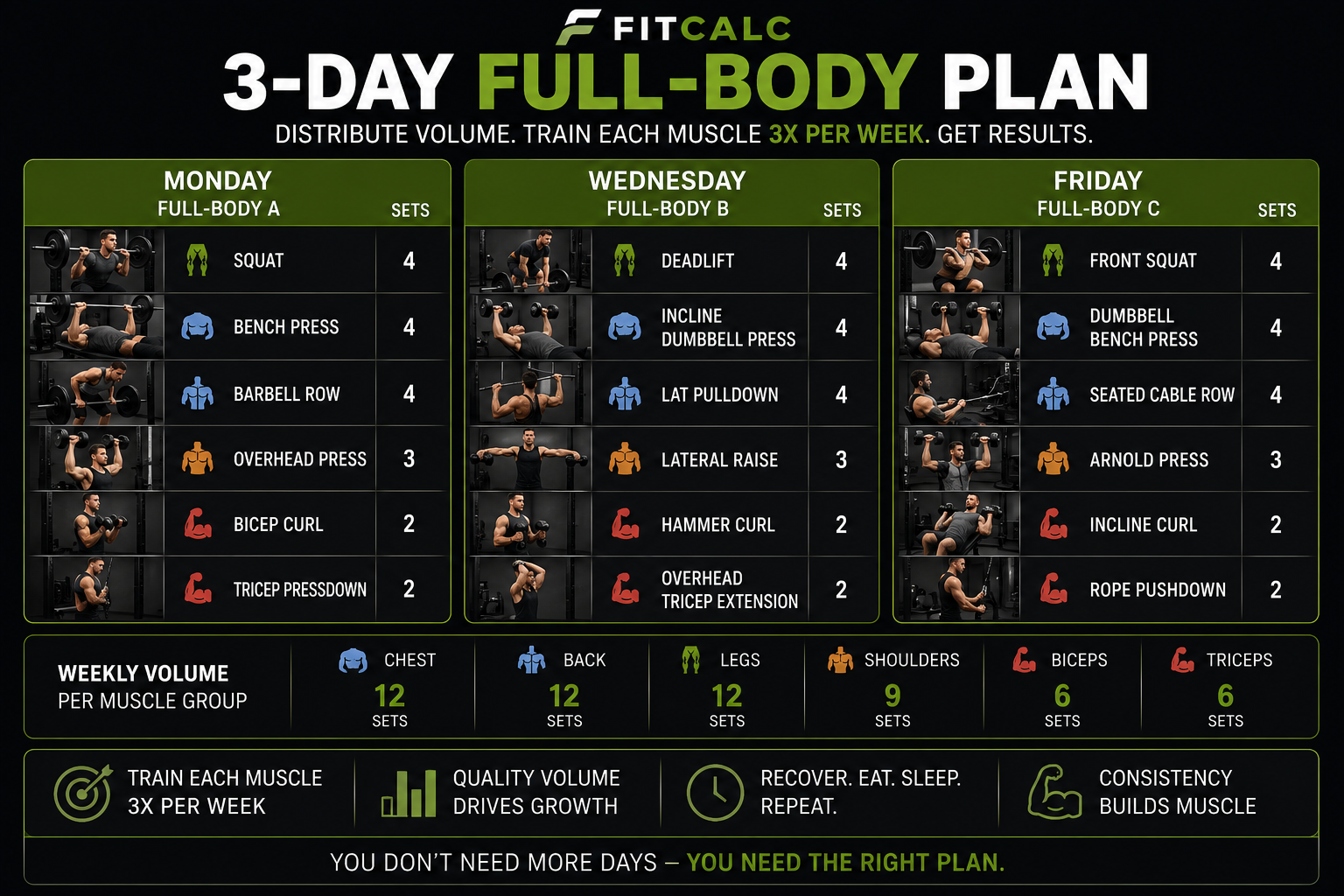
Imagine training Monday, Wednesday, and Friday. Instead of having a dedicated chest day, back day, and leg day, each workout trains several major muscle groups. Chest might receive four quality sets Monday, another four Wednesday, and another four Friday. By the end of the week, you've accumulated 12 sets without ever having to perform a marathon chest workout.
The same principle can be applied to back, legs, shoulders, arms, and other muscle groups. Exercise selection and set numbers have to be managed intelligently because trying to perform 25 exercises every workout defeats the purpose. A full-body program doesn't mean doing every exercise you know three times per week. It means distributing the necessary work across three balanced sessions.
A simple structure could include a squat or leg press, a hip-hinge or hamstring movement, a press, a row or pulldown, and selected isolation work. Exercises can also rotate between sessions so that every workout isn't identical.
For example, Monday might emphasize a flat press and squat pattern, Wednesday an incline press and different leg movement, and Friday another variation. The muscle receives repeated quality stimulation while the exact exercises and fatigue demands can be distributed intelligently.
Why a Traditional Three-Day Split Can Be Less Effective
There is another way to train three days: chest on Monday, back on Wednesday, legs on Friday, for example.
Can that build muscle? Of course.
But if maximizing hypertrophy is the objective, it can make programming more difficult. If you're trying to accumulate an entire week's worth of quality chest volume on Monday, the later sets may become less productive as local and systemic fatigue accumulate. You might technically complete 15 sets, but set 15 probably doesn't look or perform like set three.
This is where a four- or five-day routine can have an advantage. The advantage isn't the additional calendar days themselves. It's the ability to distribute more quality volume.
Someone training five days can divide 12 weekly chest sets across two sessions, spread leg training across multiple days, and add direct arm or shoulder work without making individual workouts excessively long. For an advanced bodybuilder with substantial volume requirements, that additional scheduling flexibility can be valuable.
So if your three-day routine trains each muscle only once per week and forces you to cram enormous amounts of work into each session, moving to four or five days may improve the program. Alternatively, restructure those same three days as full-body sessions and distribute the workload more effectively.
Three Days vs. Five Days: What Does the Research Show?
Direct studies comparing different training schedules generally support the idea that volume is the major variable to watch.
A randomized trial comparing full-body and split-body resistance training found similar increases in muscle thickness and strength when weekly set volume was equated between routines. More recent systematic reviews have reached similar conclusions: split routines and full-body training appear capable of producing comparable muscle and strength gains when total training volume is matched.
This doesn't prove every three-day program is equivalent to every five-day program. A poorly designed three-day routine may provide substantially less useful volume than a good five-day routine. Conversely, simply adding two workouts doesn't guarantee additional growth if those workouts only add fatigue and junk volume.
The practical question is therefore not:
How many days do I train?
It's "Am I giving each muscle enough high-quality work across the week, progressing that work over time, and recovering well enough to repeat it?"
If the answer is yes, the calendar becomes much less important.
More Days Can Still Be Useful
None of this means three days is inherently better than five.
Training four or five days can make sense for someone who enjoys being in the gym, has enough time to recover, or needs additional sessions to distribute higher training volumes. Workouts can be shorter, individual muscle groups can receive more attention, and advanced lifters may find it easier to accumulate enough high-quality sets without turning three sessions into extremely long workouts.
The mistake is assuming those additional days create hypertrophy simply because they exist.
If a five-day lifter performs 12 productive weekly sets for a muscle and a three-day lifter also performs 12 similarly productive sets while both progressively overload and recover adequately, we wouldn't expect the number of gym visits alone to create a dramatic difference in muscle growth.
On the other hand, if the three-day schedule forces someone to perform less volume than they personally need or causes set quality to deteriorate because too much work is packed into each session, the five-day schedule may produce better results.
Frequency is a programming tool. Use enough of it to make your volume work.

Don't Confuse Hypertrophy With Strength Training
Muscle growth and strength are related, but they aren't identical goals.
Increasing muscle cross-sectional area can contribute to greater strength, but maximal strength also depends heavily on neural adaptations, technique, familiarity with particular movements, and the ability to produce force with heavy loads. Someone specifically trying to maximize a squat, bench press, or deadlift may therefore organize training frequency differently from someone whose primary goal is making their chest, back, shoulders, and legs larger.
Hypertrophy can occur across a relatively broad range of loads when sets are sufficiently challenging, whereas maximizing one-repetition strength places greater importance on regularly practicing heavy lifts.
For this article, we're concerned with maximizing muscle growth. That means sufficient weekly volume, hard working sets, progressive overload, appropriate exercise selection, and recovery remain the priorities.
Recovery Still Sets the Limit
The ability to fit 15 sets for every muscle into a training week doesn't mean you'll benefit from doing it.
Training creates the stimulus for growth, but adaptation occurs while you recover from that training. Sleep, calorie intake, protein, stress, training experience, and the amount of fatigue generated by your exercise selection all influence how much work you can productively perform.
This is another reason three or four days can work extremely well for natural lifters. Rest days provide plenty of time between demanding sessions, particularly with a Monday-Wednesday-Friday structure.
If adding more training days allows you to perform better-quality work and recover appropriately, use them. If adding days simply gives you more opportunities to accumulate fatigue, more isn't automatically better.
The FitCalc Approach
You can build a substantial amount of muscle training only three days per week, and a well-designed three-day program can provide everything many natural lifters need for excellent hypertrophy.
If you're going to train three days, we recommend strongly considering a full-body structure. It allows you to spread weekly volume across multiple sessions, train each muscle repeatedly, and avoid cramming an entire week's worth of work for one body part into a single workout.
Four or five days can still be beneficial, particularly for advanced lifters who need more room to distribute higher volumes. But those extra days are useful because of what they allow you to accomplish, not because five days possesses some special muscle-building effect that three days doesn't.
Focus on the variables that actually matter: quality weekly volume, challenging working sets, progressive overload, adequate protein and calories, and enough recovery to continue progressing.
If you can accomplish those things in three days, you're good.
If you need four or five days to distribute the same quality of work effectively, use four or five.
The days don't build the muscle. The training you put into them does.
Sources
Pelland JC, et al. The Resistance Training Dose-Response: Meta-Regressions Exploring the Effects of Weekly Volume and Frequency on Muscle Hypertrophy and Strength Gain. Sports Medicine. 2026. The analysis found a positive dose-response relationship between weekly set volume and hypertrophy with diminishing returns, while training frequency showed a less pronounced independent relationship with muscle growth. PubMed
Schoenfeld BJ, Ogborn D, Krieger JW. Effects of Resistance Training Frequency on Measures of Muscle Hypertrophy: A Systematic Review and Meta-Analysis. Sports Medicine. Examines whether resistance-training frequency independently affects hypertrophy when weekly volume is considered. PubMed
Schoenfeld BJ, Ratamess NA, Peterson MD, Contreras B, Tiryaki-Sonmez G. Influence of Resistance Training Frequency on Muscular Adaptations in Well-Trained Men. Journal of Strength and Conditioning Research. Compared different training-frequency structures while examining hypertrophy and strength outcomes. PubMed
Ramos-Campo DJ, et al. Efficacy of Split Versus Full-Body Resistance Training on Strength and Muscle Growth: A Systematic Review With Meta-Analysis. Journal of Strength and Conditioning Research. 2024. Found no significant differences in strength or muscle growth between split and full-body routines when training volume was equated. PubMed
Currier BS, McLeod JC, Banfield L, et al. Resistance training prescription for muscle strength and hypertrophy in healthy adults: a systematic review and Bayesian network meta-analysis. British Journal of Sports Medicine. 2023. Examined how load, sets, and training frequency influence strength and hypertrophy outcomes. PubMed