Should You Train to Failure to Build Muscle?
There is a persistent idea in lifting culture that a set only truly counts if you push until another repetition is physically impossible. If you stop while you still have something left, you did not train hard enough. If you reach failure, you gave the muscle everything you had.
There is some logic behind the idea. Muscle growth requires sufficiently challenging resistance training, and consistently stopping sets while they are still easy is unlikely to maximize hypertrophy. But that does not mean every productive set needs to end with a failed repetition.
Research increasingly points toward a more useful distinction: how close you train to failure appears to matter for muscle growth, but actually reaching failure does not appear necessary. Training to failure also creates additional fatigue, which can affect subsequent sets, exercises, and recovery.
FitCalc therefore views failure as a training tool rather than the goal of every set. Most of your hypertrophy training should be genuinely difficult. You simply don't need to prove that difficulty by failing every time.
What Does "Training to Failure" Actually Mean?
Before deciding whether you should train to failure, it helps to define what failure actually means.
In resistance-training research, momentary muscular failure generally refers to reaching the point where you cannot complete another full repetition with appropriate technique despite attempting to do so. If you perform a set of curls and complete repetition 12 but cannot finish repetition 13, you have reached failure under that definition.
That is different from stopping because the muscle is burning, because your breathing has become uncomfortable, or because the repetitions have started slowing down. Those sensations often occur before actual muscular failure.
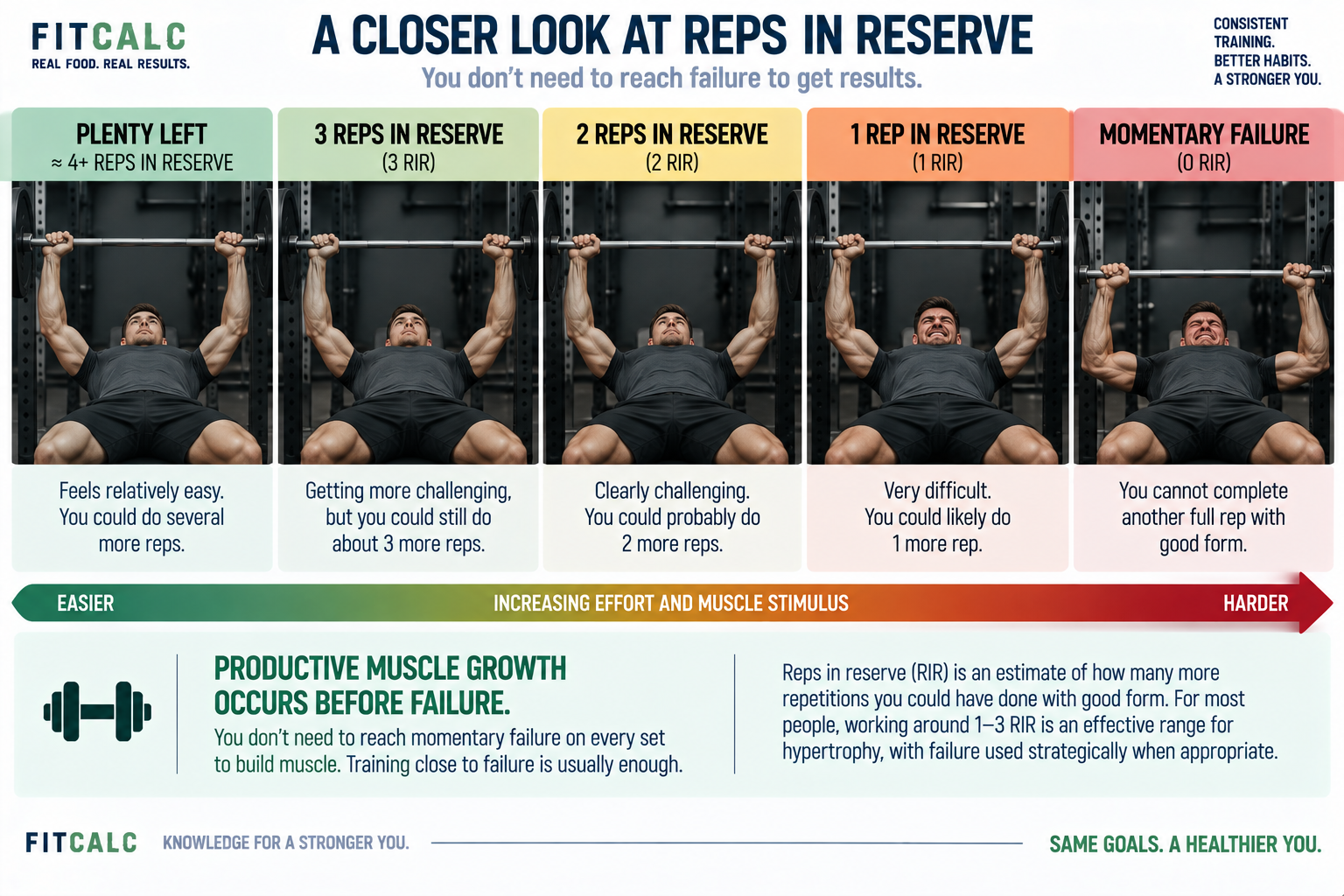
This is where repetitions in reserve, usually shortened to RIR, becomes useful. RIR estimates how many additional repetitions you could have performed before reaching failure. If you stop a set and believe you could have completed two more good repetitions, that set ended at approximately 2 RIR. If you probably had one remaining, you were around 1 RIR. At 0 RIR, you have essentially reached the limit of what you can complete.
The system is useful, but it should not create false precision. Lifters are not perfectly accurate at predicting how many repetitions they have left, particularly when they are inexperienced or still relatively far from failure. Someone may believe they stopped at 2 RIR when they actually had four or five repetitions available.
For that reason, FitCalc does not recommend becoming obsessed with whether every set ended at precisely 1 RIR or 2 RIR. The larger purpose is learning what genuinely challenging training feels like and developing a better sense of your actual proximity to failure over time.
Do You Need to Reach Failure to Build Muscle?
The evidence does not show that reaching momentary muscular failure on every set is necessary for hypertrophy.
Earlier systematic reviews and meta-analyses comparing failure with non-failure resistance training generally found no clear advantage to consistently training to failure for muscle growth, particularly when training volume was appropriately considered. A newer 2026 systematic review and meta-analysis involving 20 studies and 556 participants likewise found no significant hypertrophy advantage for failure training compared with stopping short.
That does not mean you can stop sets whenever you feel like it and expect the same result.
A 2024 meta-regression approached the question differently by examining estimated repetitions in reserve as a continuous variable. The researchers found that hypertrophy tended to improve as sets were terminated closer to failure, although the exact shape of that relationship remains uncertain. Interestingly, strength gains appeared much less dependent on proximity to failure.
This gives us a more useful way to think about hypertrophy training. There is an important difference between stopping a set when you could have performed another one or two repetitions and stopping when you could have performed another eight.
The first set was still extremely challenging. The second probably was not.
A 2024 study in resistance-trained participants provides a practical example. Researchers compared training to momentary muscular failure with training that stopped approximately 1–2 repetitions in reserve. After eight weeks, quadriceps hypertrophy was similar between conditions, while the failure condition produced greater acute neuromuscular fatigue.
This fits FitCalc's practical recommendation well. For most hypertrophy-focused working sets, finishing somewhere around 1–3 repetitions from failure is a useful target. That range is not a scientifically established magic zone, and there will be situations where training farther from or all the way to failure makes sense. It is simply a practical way to make sets sufficiently challenging without requiring maximum effort every time.
Why Failure Creates More Fatigue
If failure produced dramatically more muscle growth than stopping one repetition short, the extra fatigue might be an easy trade to accept. The problem is that the hypertrophy advantage appears small or nonexistent under many conditions while the additional fatigue can be substantial.
A 2022 review examining the acute effects of failure training found that reaching failure generally produces greater neuromuscular fatigue, muscle damage, metabolic stress, and perceived exertion than stopping short. That fatigue does not disappear when the set ends. It can affect the work you perform afterward and potentially increase the recovery demands of the session.
Imagine that you plan to perform four challenging sets of squats. On the first set, you grind until another repetition is physically impossible. The final repetition slows dramatically, your technique begins deteriorating, and you finish completely exhausted. You may have pushed that first set harder, but you have also made it more difficult to perform the remaining three sets at the same level.
Stopping the first set with one or two good repetitions available could allow you to maintain better performance across the entire exercise. The same principle can extend to the rest of the workout. If taking every movement to failure causes repetitions, load, technique, and overall training quality to collapse, the workout did not necessarily become better simply because it became harder.
This connects with the same principle FitCalc uses when discussing rest periods: more fatigue does not automatically mean a more productive workout. Fatigue is an unavoidable consequence of hard training, but accumulating the maximum possible fatigue is not the goal.
There are situations where pushing through to failure makes sense. The important distinction is whether the additional effort contributes enough useful stimulus to justify its cost.
Should You Take Compound Exercises to Failure?
The fatigue cost of reaching failure is not identical across every exercise.
Taking a set of dumbbell lateral raises to failure is very different from reaching absolute failure during a heavy barbell squat. Both involve working muscles until they can no longer complete the intended movement, but the amount of muscle involved, total load, technical complexity, systemic fatigue, and consequences of a failed repetition can differ substantially.
For demanding compound exercises such as squats, deadlifts, barbell rows, and heavy presses, FitCalc generally recommends stopping slightly short of true failure during most working sets. Finishing around 1–3 RIR keeps the set challenging while providing some margin for maintaining technique and managing fatigue.
This is particularly useful when multiple working sets remain. Taking the first set of heavy squats to absolute failure may compromise everything that follows, whereas stopping slightly short can allow several productive sets to accumulate.
Stable machines and isolation exercises change the calculation. A set of machine curls, lateral raises, triceps extensions, leg curls, or another controlled movement can often be taken to failure with less overall disruption to the workout. There is usually less technical complexity, and reaching the end of the set may simply mean the machine or weight stops moving rather than requiring someone to escape from underneath a heavily loaded bar.
That makes occasional failure training perfectly reasonable. An experienced lifter might perform the first few sets of an isolation exercise slightly short of failure and then take the final set all the way. Someone using a stable machine may also choose to reach failure when they want a clear reference point for how many repetitions they actually have available.
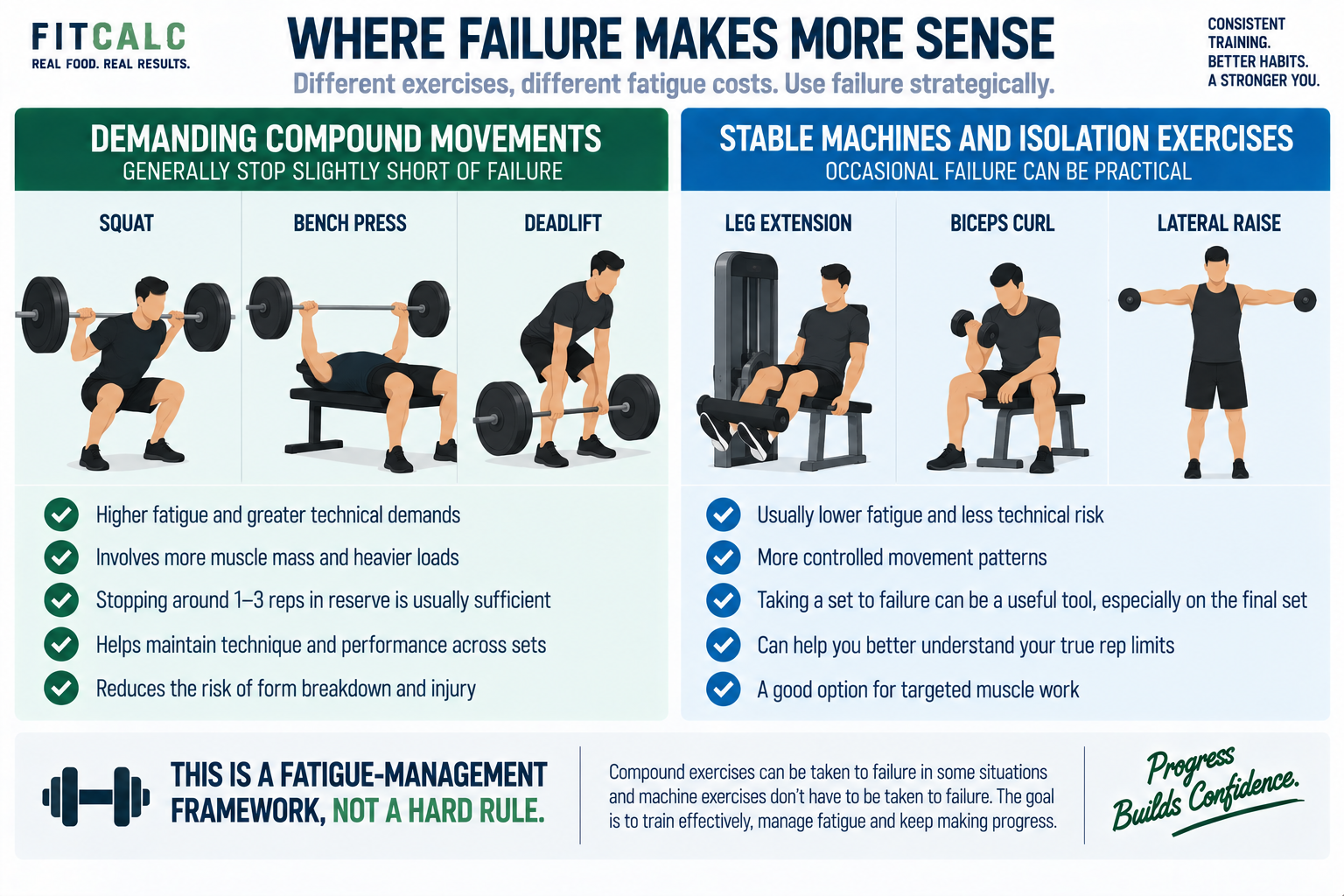
There is no biological switch that makes failure beneficial on curls but harmful on squats. The distinction is primarily about fatigue, safety, technique, and how much the failed set affects the rest of your training.
Does Rep Range Change How Close to Failure You Need to Train?
Muscle can grow across a fairly broad range of resistance-training loads when sets are sufficiently challenging. Research comparing higher and lower loads has generally found similar hypertrophy potential across different loading ranges when effort is high enough, while heavier loads remain better for maximizing one-repetition maximum strength.
This becomes important when using lighter weights.
Suppose you select a weight you could lift for approximately 30 repetitions. If you voluntarily stop after 10, the set probably did not require very much of the muscle relative to its capacity. The repetitions may have been technically perfect, but you remained far from failure.
If you instead perform 26, 27, or 28 repetitions, the situation changes dramatically. The final repetitions become slower and more difficult as fatigue accumulates, and you are now training much closer to the limit of what the muscle can produce with that load.
This is one reason a set should not be judged entirely by the number of repetitions written in a program. A 20-repetition set can be extremely demanding or relatively easy depending on the load and how many repetitions you actually had available.
Heavier sets can become challenging much sooner because the resistance itself requires a large percentage of your available force. With lighter loads, more repetitions may be necessary before enough fatigue accumulates for the set to approach failure.
That does not mean every high-repetition set must end in literal failure. The same principle still applies: get reasonably close enough that the set becomes genuinely challenging.
Rep range, load, and proximity to failure work together. None should be interpreted in isolation.
What About Training to Failure for Strength?
Muscle growth and maximal strength overlap, but they are not identical adaptations.
Strength depends not only on muscle size but also on technique, coordination, neural adaptations, and the ability to produce force against heavy loads. Constantly taking heavy compound movements to failure can introduce fatigue and technical breakdown without necessarily improving those qualities.
The 2024 proximity-to-failure meta-regression found that strength improvements were relatively similar across a broad range of repetitions in reserve, unlike hypertrophy, where training closer to failure appeared more important. The 2026 failure-versus-non-failure meta-analysis also found a small advantage for non-failure training for dynamic strength.
That fits the approach used in FitCalc's strength-training guidance. Heavy strength work should generally involve challenging but manageable loads that allow repeated practice with good technique. Testing how much weight you can grind through is not the same thing as training to become stronger.
A strength-focused lifter may occasionally perform maximal or near-maximal efforts, but those sessions have a specific purpose. They should not be confused with making every ordinary working set a test of absolute failure.
What FitCalc Recommends
For most people primarily interested in hypertrophy, FitCalc recommends performing the majority of productive working sets roughly 1–3 repetitions from failure. That should be treated as a practical starting framework rather than a rigid rule.
The final repetitions of a productive set should usually feel difficult. Rep speed may slow, and completing another few repetitions should require substantial effort. If you consistently finish sets knowing you could have performed another eight repetitions, simply adding more sets may not solve the underlying problem. The training itself needs to become challenging enough to provide a meaningful stimulus.
At the same time, there is little reason to turn every exercise into a test of absolute muscular failure. Demanding compound movements generally benefit from leaving a small margin so technique and subsequent performance can be preserved. Stable machines and isolation exercises provide better opportunities to use failure selectively because the additional fatigue and technical consequences are often easier to manage.
Beginners should be especially careful about becoming obsessed with exact RIR targets. Someone who has only been resistance training for a few weeks may not yet know what 1 RIR actually feels like. Learning proper technique, gradually increasing effort, and occasionally discovering where genuine failure occurs on a safe exercise can help calibrate that perception over time.
More experienced lifters can use failure strategically. They may know that taking the final set of lateral raises or leg curls to failure works well for them while keeping heavy squats and presses slightly farther away. That is intelligent programming, not a lack of effort.
The goal is to create enough stimulus to grow while managing enough fatigue to keep training productively.
The Bottom Line
You do not need to take every set to muscular failure to build muscle.
Research suggests that hypertrophy generally benefits from training reasonably close to failure, but consistently reaching absolute failure does not appear necessary for maximizing growth. Failure also creates additional fatigue that can reduce subsequent performance and increase recovery demands.
For most hypertrophy training, FitCalc recommends using approximately 1–3 repetitions in reserve as a practical starting point. Push stable machines and isolation movements to failure occasionally when it makes sense, while generally leaving a little more margin on demanding compound exercises.
Most importantly, do not confuse stopping short of failure with training easily. Your working sets still need to be challenging enough to stimulate adaptation.
Train close enough to failure to make the set count. You don't need to fail the repetition to prove that it counted.
Sources
Refalo MC, Helms ER, Trexler ET, Hamilton DL, Fyfe JJ. Influence of Resistance Training Proximity-to-Failure on Skeletal Muscle Hypertrophy: A Systematic Review with Meta-analysis. Sports Medicine. 2023.
Effects of Resistance Training Performed to Repetition Failure or Non-Failure on Muscular Strength and Hypertrophy: A Systematic Review and Meta-Analysis. 2026.
Robinson ZP, Pelland JC, Remmert JF, et al. Exploring the Dose-Response Relationship Between Estimated Resistance Training Proximity to Failure, Strength Gain, and Muscle Hypertrophy: A Series of Meta-Regressions. Sports Medicine. 2024.
Similar Muscle Hypertrophy Following Eight Weeks of Resistance Training to Momentary Muscular Failure or With Repetitions-in-Reserve in Resistance-Trained Individuals. 2024.
Refalo MC, Helms ER, Hamilton DL, Fyfe JJ. Towards an Improved Understanding of Proximity-to-Failure in Resistance Training and Its Influence on Skeletal Muscle Hypertrophy, Neuromuscular Fatigue, Muscle Damage, and Perceived Discomfort: A Scoping Review. Journal of Sports Sciences. 2022.
Schoenfeld BJ, Grgic J, Ogborn D, Krieger JW. Strength and Hypertrophy Adaptations Between Low- vs. High-Load Resistance Training: A Systematic Review and Meta-Analysis.