How Long Should You Rest Between Sets for Muscle Growth and Strength?
You finish a hard set of squats, start a 60-second timer, and before your breathing has returned to normal, you are already preparing for the next set. The shorter rest makes the workout harder, keeps your heart rate elevated, and creates an intense burn, so it feels like you must be getting a better workout.
But feeling more fatigued does not automatically mean your training is more productive.
Rest periods influence how much force you can produce, how many repetitions you can complete, how much weight you can use, and how well you maintain technique from one set to the next. Rest too little, and your next set may be limited more by accumulated fatigue than by the muscles you are actually trying to train.
Longer is not automatically better either. You probably do not need five minutes after a set of curls or lateral raises. The appropriate rest period depends on what you are training, how demanding the exercise is, and whether your primary goal is strength or muscle growth.
FitCalc's approach is straightforward: rest long enough to make the next set productive.
Why Rest Between Sets Matters
A hard set temporarily reduces your ability to perform another hard set.
During high-intensity muscular contractions, your body relies heavily on the phosphagen energy system, which includes stored ATP and phosphocreatine. These resources begin recovering after the set ends, while your muscles and nervous system also recover from the immediate fatigue created by the work you just performed.
That recovery takes time.
If you begin the next set before enough recovery has occurred, the consequences are usually obvious. You may complete fewer repetitions, need to reduce the weight, move the load more slowly, or find that your technique deteriorates earlier in the set.
Imagine performing 225 pounds on the bench press for eight challenging repetitions. After only 45 seconds of rest, you attempt another set and manage five. Given several minutes instead, you might have been capable of seven or eight quality repetitions.
The shorter rest period made the second set feel harder, but it also reduced the amount of productive work you could perform.
That distinction matters for both strength and hypertrophy. Strength training benefits from being able to produce high levels of force against heavy resistance. Muscle growth benefits from accumulating sufficient challenging training volume. In both cases, cutting rest periods too aggressively can interfere with the thing you are trying to improve.
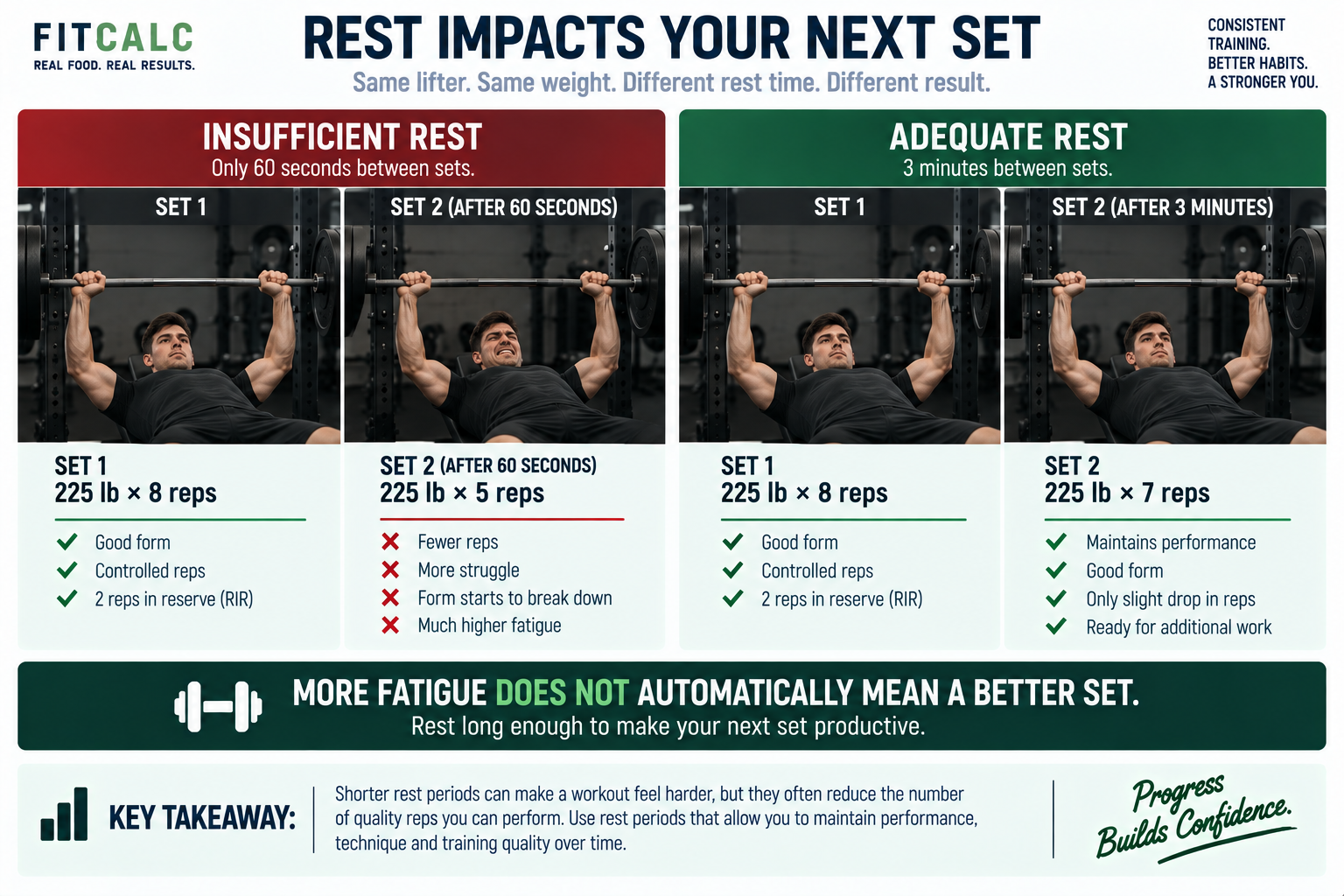
Rest is therefore not wasted time between the important parts of your workout. Rest is part of the workout.
How Long Should You Rest for Strength?
Strength-focused training places a premium on force production. If you are performing heavy squats, bench presses, deadlifts, overhead presses, or similar movements, you want enough recovery between working sets to handle heavy resistance effectively.
Research generally supports longer rest periods when maximizing strength is the goal. A systematic review examining rest intervals and strength development found that trained individuals appeared to require more than two minutes between sets to maximize strength gains.
FitCalc recommends roughly 2–5 minutes between demanding compound strength sets as a practical starting range.
That does not mean every heavy set requires exactly five minutes. A relatively manageable set of five bench presses might leave you ready again after two or three minutes. A very demanding set of squats or deadlifts may justify four or five.
The goal is not to wait for an arbitrary number on a timer. It is to recover enough that cardiovascular fatigue, breathlessness, or residual muscular fatigue does not unnecessarily compromise the next important set.
This is also why strength training does not always look particularly intense to someone watching from across the gym. A strength athlete might perform a difficult set, sit down for four minutes, and then perform another. They are not being lazy. They are preparing to produce another high-quality effort.
Heavy strength training should not be turned into cardio simply to make the workout feel harder.
How Long Should You Rest for Muscle Growth?
Hypertrophy training gives us more flexibility, but the old assumption that very short rests are automatically superior for muscle growth does not hold up particularly well.
A 2024 systematic review and Bayesian meta-analysis examining inter-set rest intervals found a small hypertrophy advantage when rest periods exceeded 60 seconds. The available evidence showed little additional hypertrophy benefit from progressively extending rest beyond roughly 90 seconds, although the researchers also emphasized limitations in the evidence base.
That finding should not be interpreted as proof that exactly 90 seconds is the perfect muscle-building rest period.
The practical benefit of longer rest is that it can help preserve performance. If you can perform more high-quality repetitions with an appropriate load because you rested another minute, that additional productive work may be more valuable than deliberately keeping yourself exhausted.
A controlled study in resistance-trained men illustrates the point. Participants using three-minute rest intervals produced greater strength gains and greater increases in some measures of muscle thickness than participants resting only one minute during an eight-week resistance-training program.
For demanding compound exercises performed primarily for hypertrophy, FitCalc generally recommends approximately 2–3 minutes between working sets.
Again, that is a practical recommendation rather than a biological requirement. You can absolutely build muscle using shorter or longer rests. The purpose of the range is to give you enough recovery to maintain productive performance without turning a normal workout into an unnecessarily long session.
If you finish a hard set of leg presses and are still breathing heavily at the two-minute mark, taking another minute is perfectly reasonable. There is no muscle-building prize for starting the next set while you are still exhausted.
Why Shorter Rest Isn't Automatically Better
Short rest periods create several sensations people associate with a good workout. Your muscles burn. The pump increases. Your heart rate stays elevated. You sweat more. The workout may feel brutally difficult. None of those things, by itself, proves that you stimulated more muscle growth.
Shorter rests can increase metabolic stress and metabolite accumulation, which historically contributed to bodybuilding recommendations favoring brief rest intervals. Short rests can also produce larger acute hormonal responses after training.
The problem is that an acute response during or immediately after a workout is not necessarily the same thing as greater long-term hypertrophy. Research reviewing rest intervals has not supported the idea that muscle growth requires shorter rest periods than strength development, and longer rests may allow greater loads and training volume to be maintained.
This does not mean metabolic stress or the pump is meaningless. A good pump can tell you that blood is reaching the trained tissue, and short-rest training can be useful in certain situations. The mistake is making fatigue itself the objective.
Suppose you perform three sets of an exercise. With very short rests, you manage 12, 8, and 6 repetitions. With sufficient rest, you manage 12, 11, and 10. The first version may feel substantially harder because fatigue accumulates faster, but the second allows considerably more quality work with the same resistance. More exhaustion is not automatically more stimulus.
Your muscles do not know whether you followed a hardcore-looking timer. They respond to the mechanical and physiological demands created by the training you actually performed.
Compounds and Isolation Exercises Should Not Always Use the Same Rest
A hard set of squats and a hard set of biceps curls are both resistance training, but they do not create the same recovery demands.
Large compound exercises involve multiple joints, large amounts of muscle mass, and often substantially heavier absolute loads. Squats, deadlifts, presses, rows, and similar movements can create considerable local and whole-body fatigue. These exercises generally deserve longer rest periods.
Isolation exercises usually involve less total muscle mass and create less systemic fatigue. After a set of lateral raises, curls, triceps extensions, calf raises, or leg extensions, you may feel ready to perform another productive set considerably sooner.
FitCalc therefore uses different practical starting ranges depending on the exercise and goal.
Heavy compound strength work: 2–5 minutes
Compound hypertrophy work: 2–3 minutes
Isolation/accessory work: 1–2 minutes
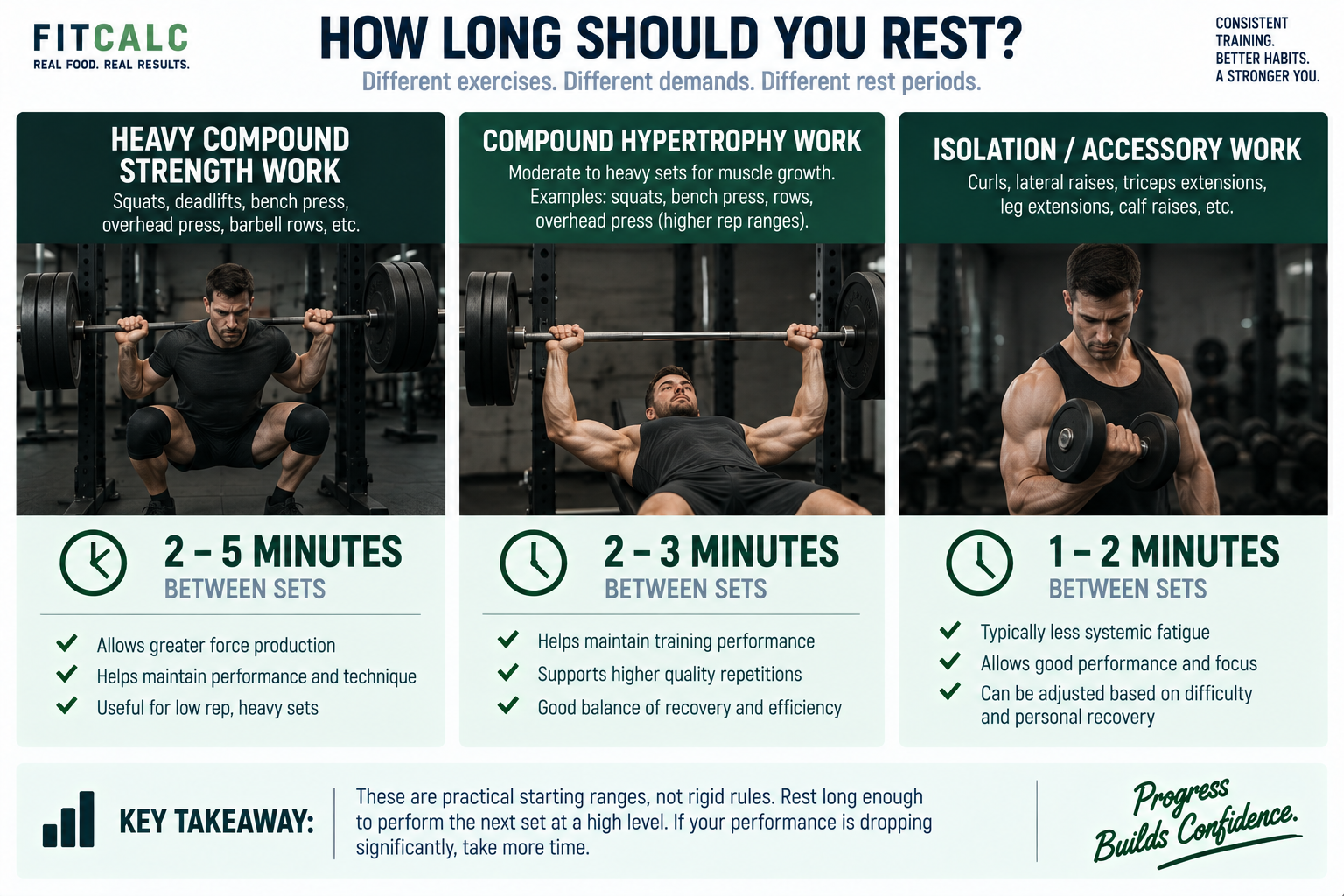
These categories can overlap. A brutally difficult set of leg extensions may justify more than one minute. A relatively easy warm-up set of bench presses certainly does not require five. An experienced lifter may also know from practice that they personally recover faster or slower on particular exercises.
The important variable is whether the rest period allows you to perform the next set at the quality the program requires.
Should You Use a Timer?
A timer can be extremely useful because humans are terrible at estimating rest periods during a workout. What feels like two minutes may have been 45 seconds when you are eager to train, or six minutes when you become distracted by your phone.
Using a timer makes training more consistent. If you normally rest three minutes between heavy bench sets, maintaining roughly that rest period makes it easier to compare performance from one workout to another.
But the timer should be a guide, not a command.
If your planned rest is two minutes and you reach that point still breathing heavily with your heart racing after a difficult set of squats, there is nothing wrong with waiting another 30 or 60 seconds. Likewise, if you are performing a small isolation movement and feel completely recovered sooner, you may not need to stare at the clock waiting for an arbitrary deadline.
This is a simple form of auto-regulation. The program provides a general structure, while your actual recovery determines whether a small adjustment makes sense. The longer and heavier the set, the more valuable this flexibility becomes.
You can also use performance itself as feedback. If repetitions consistently collapse from one set to the next despite similar effort, your rest periods may be too short. Adding another minute and seeing whether performance improves is an easy experiment. The goal is not to maximize rest. It is to use enough rest.
The Bottom Line
There is no single perfect rest period for every exercise and every goal.
For heavy compound strength work, FitCalc recommends starting around 2–5 minutes between working sets. For demanding compound hypertrophy training, roughly 2–3 minutes is a useful starting point. Smaller isolation and accessory exercises can often be performed effectively with approximately 1–2 minutes of rest.
These are practical ranges, not rigid rules.
Research does not support the idea that extremely short rests are inherently superior for muscle growth. Longer rest can help preserve load, repetitions, technique, and overall training quality, particularly during demanding exercises.
Use a timer if it helps you stay consistent, but pay attention to your performance as well. If another minute of rest allows you to perform a substantially better set, taking that minute is not making your workout easier in a negative sense. It is helping you train more effectively.
More fatigue does not automatically mean more productive training. Rest long enough to make the next set count.
Sources
Grgic J, Schoenfeld BJ, Skrepnik M, Davies TB, Mikulic P. Effects of Rest Interval Duration in Resistance Training on Measures of Muscular Strength: A Systematic Review. Sports Medicine. 2018.
Singer A, et al. Give it a Rest: A Systematic Review with Bayesian Meta-Analysis on the Effect of Inter-Set Rest Interval Duration on Muscle Hypertrophy. 2024.
Schoenfeld BJ, Pope ZK, Benik FM, et al. Longer Interset Rest Periods Enhance Muscle Strength and Hypertrophy in Resistance-Trained Men. Journal of Strength and Conditioning Research. 2016.
Henselmans M, Schoenfeld BJ. The Effect of Inter-Set Rest Intervals on Resistance Exercise-Induced Muscle Hypertrophy. Sports Medicine. 2014.