Does Cardio Kill Muscle Gains? How to Combine Cardio and Strength Training
For decades, lifters have been warned that too much cardio will interfere with muscle growth. The advice usually sounds simple: if you want to get big and strong, save your energy for the weights and stay away from the treadmill.
There is a legitimate scientific concept behind that concern, known as the interference effect. But the gym version of the idea has become far more absolute than the evidence supports. Combining resistance training with cardiovascular exercise does not automatically prevent you from gaining muscle or strength, and for most recreational lifters, there is little reason to choose between being muscular and having good cardiovascular fitness.
The real issue is how the training is programmed. Running several hard sessions each week while performing demanding lower-body resistance training creates very different recovery demands from adding a couple of moderate cycling or incline-walking sessions to an otherwise well-designed lifting program.
FitCalc's position is straightforward: cardio isn't the enemy of muscle growth. Poorly managed training volume, fatigue, recovery, and nutrition can be.
Does Cardio Actually Kill Muscle Gains?
The modern research on concurrent training—the combination of resistance and aerobic exercise—is considerably more reassuring than the conventional gym warning suggests.
A 2021 systematic review and meta-analysis examined 43 studies comparing concurrent training with resistance training alone. Overall, combining aerobic and resistance exercise did not significantly compromise muscle hypertrophy or maximal strength. Explosive strength appeared somewhat more susceptible to interference, particularly when aerobic and resistance exercise were performed within the same training session.
An even broader 2026 umbrella review evaluated 17 meta-analyses covering 144 studies and 1,492 healthy participants. Concurrent training produced strength, power, and hypertrophy outcomes broadly comparable with resistance training while producing substantially greater improvements in aerobic fitness than resistance training alone. The authors concluded that concurrent training is an effective approach for developing comprehensive physical fitness, particularly among recreationally trained people.
That doesn't mean cardio can never interfere with resistance-training goals. It means the statement "cardio kills gains" is far too broad.
Someone lifting four days per week and doing two reasonable cardio sessions is not facing the same training demands as someone performing high-volume endurance training while simultaneously trying to maximize lower-body strength and hypertrophy. The amount, intensity, modality, timing, nutrition, and recovery surrounding the cardio all matter.
Cardiovascular fitness also has value of its own. The goal should not be to perform the least cardiovascular exercise you can possibly get away with because you are afraid of losing muscle. For most people, a better goal is to become stronger and more muscular while maintaining a capable cardiovascular system.
What the Interference Effect Actually Means
The interference effect refers to the possibility that combining substantial endurance and resistance training can reduce some adaptations compared with performing resistance training alone.
The concept has legitimate research behind it. An influential 2012 meta-analysis found that concurrent endurance and strength training could interfere with strength and hypertrophy under certain conditions. Greater endurance-training frequency and duration were associated with more interference, and running appeared more problematic than cycling in that particular analysis.
Later evidence has made the picture less alarming. The larger 2021 analysis did not find significant overall reductions in maximal strength or whole-muscle hypertrophy from concurrent training, while the 2026 umbrella review reached similarly reassuring conclusions.
Rather than treating those findings as contradictory, it makes more sense to look at what concurrent training actually asks the body to do. Resistance training requires recovery. Endurance training requires recovery. As the volume and intensity of both increase, eventually the total workload can become difficult to tolerate while maximizing every adaptation simultaneously.
This is particularly relevant when the same muscles are repeatedly stressed. Someone performing high-volume running while trying to maximize squat strength and leg hypertrophy has to recover their lower body from both training demands. Calories and carbohydrates also need to support the additional work, and the athlete still has the same number of hours available for sleep and recovery.
At some point, specialization matters. An elite marathon runner and an elite powerlifter cannot optimize their training for both sports simultaneously because the demands are fundamentally different. Most people reading this article are nowhere near that extreme.
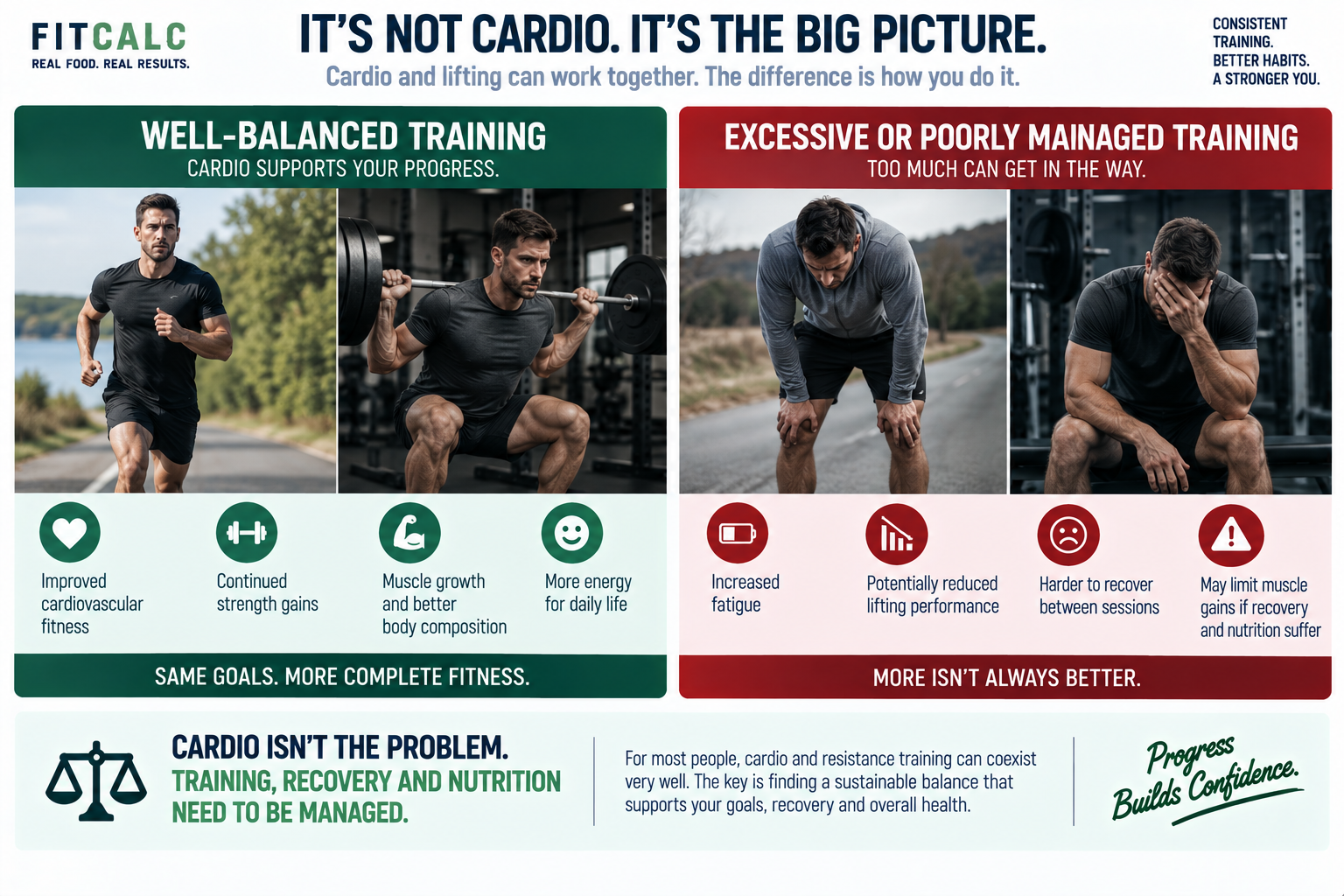
For the average person who wants to build muscle, become stronger, remain lean, and have good cardiovascular fitness, the interference effect should be viewed as a programming consideration rather than a reason to avoid cardio.
Running, Cycling, or HIIT: Does the Type of Cardio Matter?
Not all cardiovascular exercise creates the same recovery demands.
The older 2012 concurrent-training meta-analysis found that running was associated with interference in strength and hypertrophy while cycling was not. A later analysis examining muscle-fiber hypertrophy also found evidence of reduced type I fiber hypertrophy when resistance training was combined with running but not cycling.
However, newer evidence makes it difficult to justify a blanket statement that running hurts muscle growth while cycling does not. The 2021 meta-analysis did not find a significant overall effect of endurance modality on maximal strength or whole-muscle hypertrophy.
FitCalc therefore does not recommend avoiding running simply because you lift weights.
From a practical recovery perspective, cycling can sometimes be easier to integrate into a muscle-focused program. Running involves repeated impact and substantial eccentric loading, particularly as volume or intensity rises. Easy cycling generally creates less impact and can therefore be easier to recover from between demanding lower-body resistance sessions. That does not make running inherently catabolic; it simply means the recovery cost can differ.
High-intensity interval training deserves similar consideration. HIIT is often promoted as the ideal cardio for lifters because sessions can be short, but shorter does not necessarily mean easier to recover from. A meta-analysis examining concurrent HIIT and resistance training found broadly similar hypertrophy and upper-body strength compared with resistance training alone, although lower-body strength gains were slightly attenuated overall.
Hard intervals are hard training. Ten rounds of demanding cycling sprints can create significant fatigue even if the workout only lasts a fraction of the time required for a long steady-state session.
If muscle and strength are your primary goals, FitCalc sees little reason to make every cardio session HIIT. Walking, incline walking, moderate cycling, swimming, easy jogging, and other lower-to-moderate intensity activities can improve cardiovascular fitness while generally being easier to layer onto a demanding resistance-training program.
HIIT can absolutely have a place. It simply needs to be counted as a demanding training stimulus rather than treated as free exercise because the session is short.
Should You Do Cardio Before or After Lifting?
When resistance training and cardio have to occur in the same session, the simplest rule is to prioritize the activity that matters most to your goal.
If building muscle and strength is the priority, FitCalc recommends performing your resistance training first and cardio afterward.
This is less about cardio somehow shutting off muscle growth and more about basic training quality. If you perform a demanding 45-minute run before heavy squats, you begin the resistance-training portion of the workout with fatigued legs. Your squat performance may decline because you have already spent some of the physical resources you wanted available for the higher-priority activity.
Research examining concurrent-training sequence has found evidence favoring resistance-before-endurance training for lower-body strength in some circumstances, although the broader literature does not show a large universal sequencing effect across every adaptation.
Context matters here too. A short, easy cycling warm-up before lifting is completely different from a hard endurance workout. There is no reason to become afraid of walking for ten minutes or performing some light aerobic work before touching a barbell.
When both the cardio and resistance sessions are demanding, separating them can make programming easier. The 2021 concurrent-training meta-analysis found that interference with explosive strength was more apparent when endurance and resistance work occurred in the same session, whereas the effect was not significant when sessions were separated by at least several hours.
You do not need to obsess over an exact number of hours. Different days are an easy option. Cardio in the morning and lifting later in the day can also work. If your schedule requires both in the same session, lift first when muscle and strength are the priority.
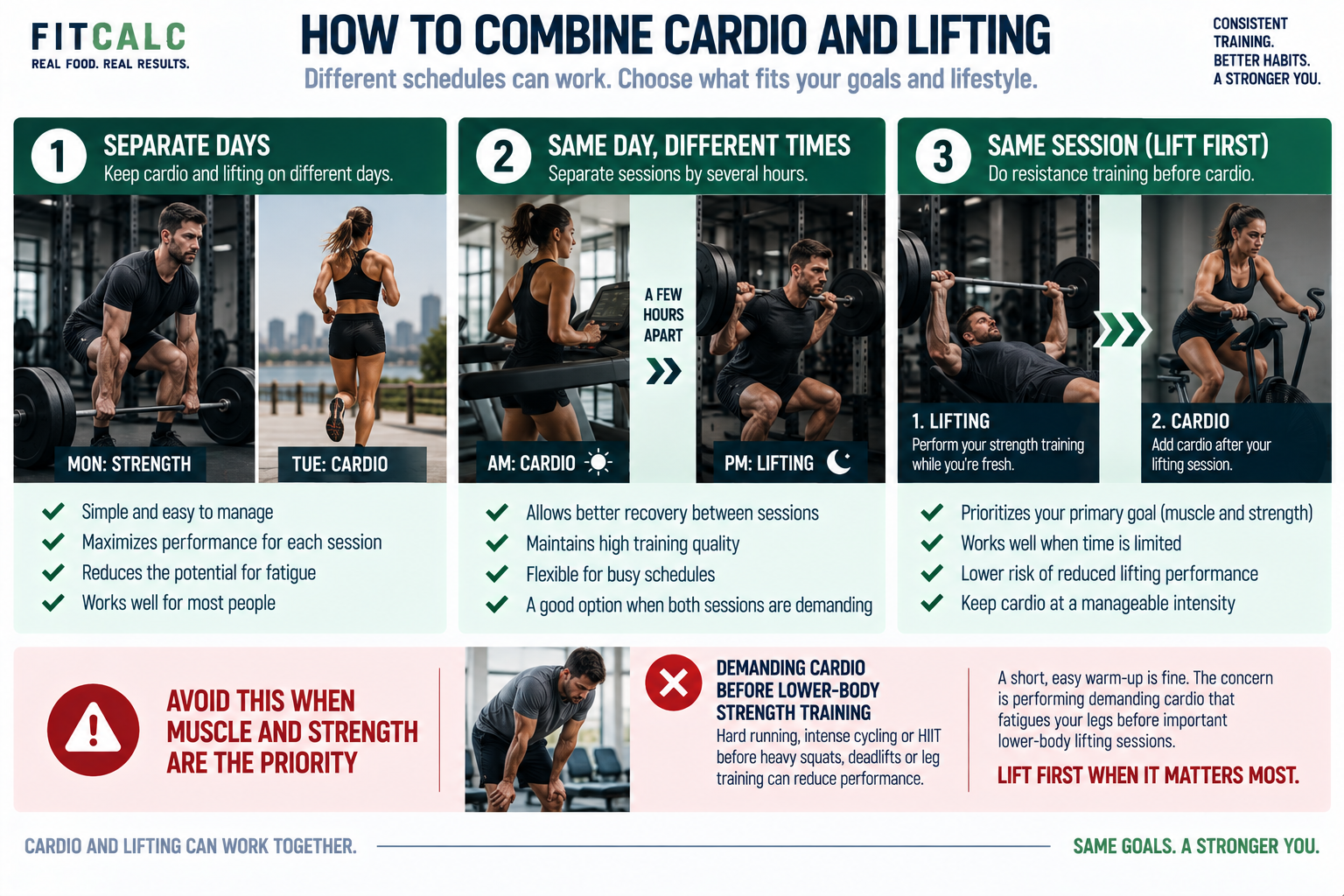
The schedule should help you perform your most important training well without making exercise unnecessarily difficult to fit into your life.
How Much Cardio Should You Do While Building Muscle?
There is no universal amount of cardio where muscle growth suddenly stops.
Twenty minutes is not automatically safe while 40 minutes is harmful. The recovery cost of cardio depends on its intensity, duration, modality, frequency, your conditioning, your resistance-training program, your nutrition, your sleep, and what you are actually trying to accomplish.
For someone whose primary goals are muscle and strength but who also wants good cardiovascular fitness, FitCalc considers two or three low-to-moderate intensity cardio sessions of roughly 20–30 minutes per week a reasonable starting point. This is a practical FitCalc recommendation, not a scientifically established maximum or minimum.
Someone can certainly do more. If you enjoy running three times per week, your gym performance is progressing, your legs recover well, and your nutrition supports the workload, there is no reason to reduce cardio simply because another lifter says it is bad for gains. Conversely, someone already performing an extremely demanding resistance program may need less additional training to achieve their current goals.
Daily movement should not become another thing you fear either. Walking, recreational activity, taking the stairs, hiking, and generally being an active human are not threats to hypertrophy. The body is designed to move.
Nutrition becomes particularly important when cardio is added during a muscle-building phase. FitCalc generally recommends beginning a dedicated gaining phase around 200–300 calories above estimated maintenance, consuming approximately 1 gram of protein per pound of bodyweight per day, and eating plenty of quality carbohydrates to support an active lifestyle.
Adding several cardio sessions increases energy expenditure. If you were gaining weight slowly at 3,000 calories and additional activity raises your actual maintenance needs, the calorie surplus may shrink or disappear. When bodyweight subsequently stops increasing, it is easy to blame "cardio interference" when the more obvious explanation is that you are simply no longer eating in a surplus.
Carbohydrates matter here as well. Resistance training and demanding endurance exercise both rely substantially on carbohydrate-derived energy and muscle glycogen. Someone performing both forms of training has even less reason to unnecessarily restrict quality carbohydrate sources such as rice, potatoes, fruit, and other foods that fit their diet.
Cardio does not exempt you from the basic muscle-building equation. You still need productive resistance training, enough total energy, sufficient protein and carbohydrates, and adequate recovery.
Signs Your Cardio May Be Interfering With Your Training
The best way to determine whether your cardio is excessive is not to compare your program with an arbitrary weekly-minute limit. Look at what is actually happening to your training and recovery.
If lower-body performance has been declining for several weeks, your legs constantly feel fatigued, soreness carries from one session into the next, and important resistance-training sessions repeatedly suffer after endurance work, the overall workload may need adjustment. The solution could involve reducing cardio volume or intensity, changing the modality, separating sessions, or simply rearranging the weekly schedule.
Nutrition can produce similar symptoms. Someone who substantially increases activity without increasing calorie intake may struggle to gain weight, feel increasingly fatigued, and recover poorly. In that situation, the answer might be more food rather than less cardio.
Sleep and total life stress matter too. Four lifting sessions, three cardio sessions, a physically demanding job, five hours of sleep, and insufficient calories create a very different recovery situation from the same training program performed by someone sleeping eight hours and eating enough to support it.
One poor workout is not evidence of an interference effect. Training performance naturally fluctuates. Look for a persistent pattern, just as FitCalc recommends when evaluating strength plateaus, calorie intake, bodyweight changes, or other training decisions.
The goal is not to eliminate fatigue. Productive training creates fatigue. The goal is to keep total fatigue manageable enough that your highest-priority training continues moving forward.
The Bottom Line
Cardio does not automatically kill muscle gains.
Modern concurrent-training research indicates that most people can combine aerobic and resistance exercise without meaningfully compromising muscle hypertrophy or maximal strength. Interference becomes more relevant as endurance volume, intensity, and overall training demands increase, particularly when recovery and nutrition fail to keep pace.
If muscle and strength are your primary goals, prioritize resistance training. Use mostly manageable cardio, treat HIIT as hard training, and separate demanding endurance and lifting sessions when doing so improves recovery or performance. If both have to occur in the same workout, lifting first is generally the most practical choice when resistance training is the priority.
Most importantly, eat enough to support the activity you are performing. Additional cardio increases energy expenditure, and a muscle-building calorie surplus can disappear if your activity rises while food intake stays the same.
You do not need to choose between being strong and muscular or having good cardiovascular fitness. For most people, a well-designed program should pursue both.
Cardio isn't the enemy of muscle growth. Unmanaged fatigue is.
Sources
Schumann M, Feuerbacher JF, Sünkeler M, et al. Compatibility of Concurrent Aerobic and Strength Training for Skeletal Muscle Size and Function: An Updated Systematic Review and Meta-Analysis. Sports Medicine. 2022.
Murlasits Z, et al. Compatibility of Concurrent Training and Its Effects on Strength, Power, Hypertrophy, and Aerobic Fitness: An Umbrella Review. 2026.
Wilson JM, Marin PJ, Rhea MR, Wilson SMC, Loenneke JP, Anderson JC. Concurrent Training: A Meta-Analysis Examining Interference of Aerobic and Resistance Exercises. Journal of Strength and Conditioning Research. 2012.
Lundberg TR, et al. Effects of Concurrent Aerobic and Strength Training on Muscle Fiber Hypertrophy: A Systematic Review and Meta-Analysis. 2022.
Sabag A, Najafi A, Michael S, Esgin T, Halaki M, Hackett D. The Compatibility of Concurrent High Intensity Interval Training and Resistance Training for Muscular Strength and Hypertrophy: A Systematic Review and Meta-Analysis. Journal of Sports Sciences. 2018.
Eddens L, van Someren K, Howatson G. The Role of Intra-Session Exercise Sequence in the Interference Effect: A Systematic Review with Meta-Analysis. Sports Medicine. 2018.