
Is Zone 2 Cardio Actually Special? What It Does and How Much You Need
Zone 2 cardio has gone from endurance-training terminology to one of the most popular recommendations in mainstream fitness. Depending on who you listen to, it is the ideal intensity for improving mitochondrial function, burning fat, building endurance, supporting longevity, and developing cardiovascular fitness without compromising recovery.
There is plenty of truth underneath the hype. Steady aerobic exercise can improve cardiorespiratory fitness and produce meaningful adaptations inside skeletal muscle, and a relatively moderate intensity makes it possible to accumulate substantial aerobic work without generating the fatigue of repeated high-intensity intervals.
The problem is that Zone 2 is not even defined identically across every training system, and there is little evidence that one narrowly defined intensity produces a completely unique collection of benefits that disappear if you exercise slightly above or below it. A 2025 expert consensus on Zone 2 specifically acknowledged both the lack of a universal definition and the likelihood that many adaptations attributed to Zone 2 are not exclusive to it.
FitCalc views Zone 2 as a useful aerobic-training framework, not a magical heart-rate target.
What Is Zone 2 Cardio?
The first problem with discussing Zone 2 is that two people can use the term while referring to somewhat different exercise intensities.
Consumer fitness devices commonly divide heart rate into five zones based on percentages of estimated maximum heart rate or heart-rate reserve. Under those systems, Zone 2 is simply the second of five predefined ranges. Different watches and apps can use different equations or percentages, so two devices may not even assign the same heart rate to the same zone.
Exercise physiologists and endurance coaches may approach the subject differently. Some use three zones, others five or more, while laboratory testing can identify physiological landmarks such as lactate and ventilatory thresholds rather than relying solely on a percentage of maximum heart rate.
A 2025 expert consensus involving sport scientists and professional coaches proposed that Zone 2 is best understood physiologically as exercise performed immediately below the first lactate or ventilatory threshold. At this intensity, exercise remains sustainable and predominantly aerobic, but you are clearly working harder than you would during casual everyday activity.
This distinction matters because a smartwatch displaying "Zone 2" is estimating where that intensity probably lies. It has not measured your blood lactate or directly determined your ventilatory threshold.
That does not make the watch useless. Heart rate is still valuable information, especially when you repeatedly perform the same type of cardio and learn how particular heart rates correspond with your perceived effort. It simply means you should not assume that crossing from 129 to 130 beats per minute suddenly activates a different metabolic state.
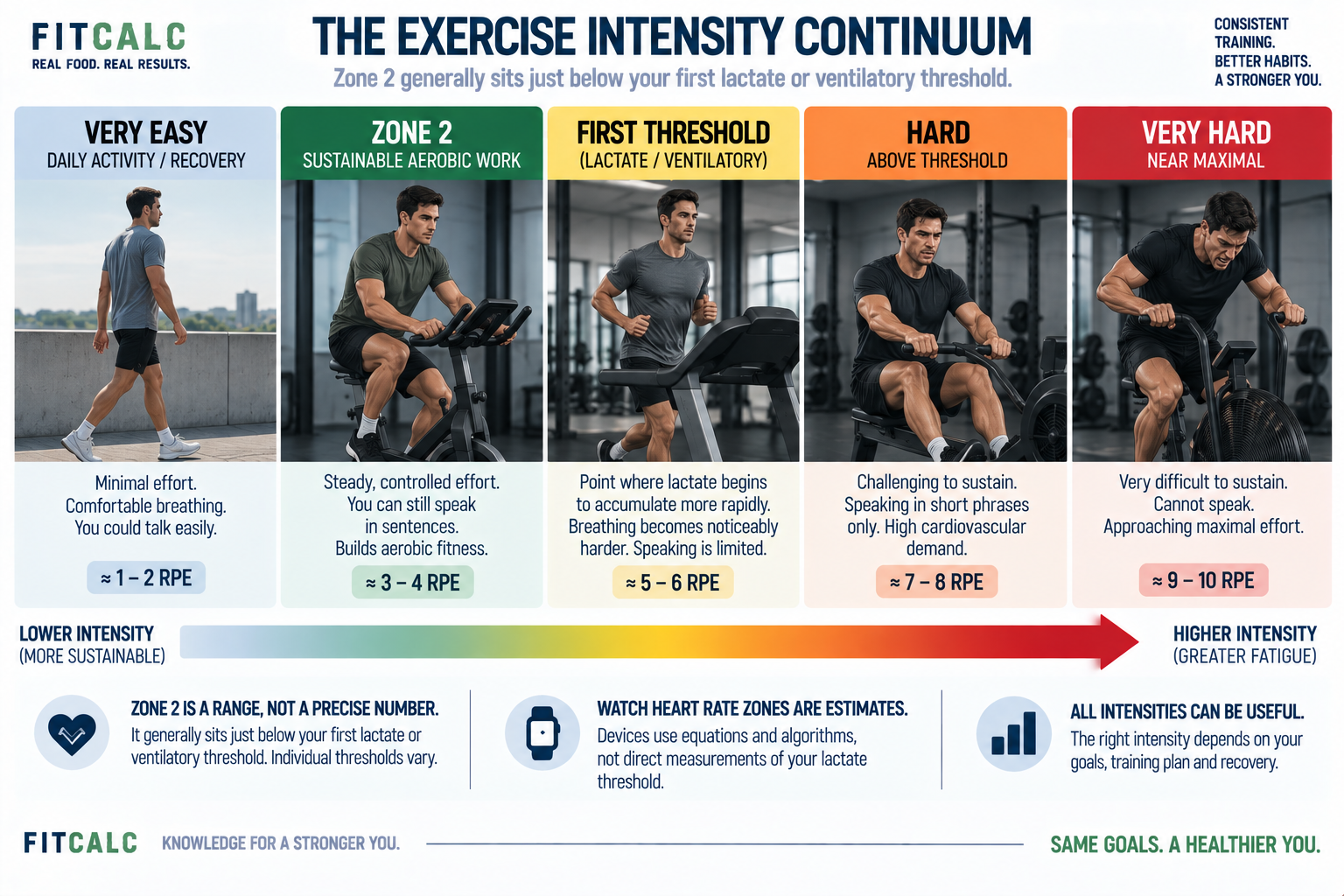
Zone 2 is better thought of as a region of sustainable aerobic intensity than one exact heart rate you must perfectly maintain.
How Do You Know If You're in Zone 2?
Unless you have undergone laboratory testing, you are going to estimate your Zone 2 intensity. Fortunately, that is perfectly adequate for most recreational exercisers.
One of the simplest tools is the talk test. At an appropriate steady aerobic intensity, your breathing should clearly be elevated compared with rest, but you should generally still be able to speak in sentences. Conversation requires more effort than it would while sitting down, but you should not be gasping between individual words.
The effort should also feel sustainable. If you begin a cycling session and feel as though you could maintain the pace for quite a while, you are probably much closer to the intended intensity than if your legs are burning and you are counting down the seconds until you can stop.
Heart rate can provide additional context. Your watch may estimate your zones from age, maximum heart rate, resting heart rate, or previous activity data. Over time, you can combine those readings with breathing and perceived effort to develop a useful personal reference.
What FitCalc does not recommend is becoming obsessed with keeping your heart rate inside a tiny numerical window. Maximum-heart-rate equations themselves are estimates, individuals vary considerably, and different zone models can classify the same intensity differently.
If your watch briefly says Zone 3 while you climb a hill, you have not ruined the workout. Likewise, slowing down for a minute and dropping slightly below your estimated Zone 2 does not erase the aerobic work you already performed.
The purpose is to accumulate sustainable aerobic training, not to win a heart-rate-monitoring game.
What Does Zone 2 Actually Improve?
The physiological case for aerobic training is strong even if the case for one uniquely optimal zone is not.
Repeated endurance exercise challenges the cardiovascular system to deliver oxygen to working tissue and challenges skeletal muscle to use that oxygen effectively. Over time, aerobic training can improve cardiorespiratory fitness while producing adaptations in the machinery involved in aerobic energy production.
Mitochondria receive particular attention in discussions of Zone 2. These structures play a central role in aerobic energy metabolism, and endurance training can increase mitochondrial content and alter mitochondrial function within skeletal muscle.
A 2026 systematic review and meta-analysis examining moderate-intensity continuous training found improvements in mitochondrial density and cardiorespiratory fitness, including VO₂max, alongside changes in several other mitochondrial characteristics. The researchers also noted that certainty surrounding some of the molecular outcomes remained limited.
The important qualification is that these adaptations are not exclusive to Zone 2.
A large systematic review examining endurance-training intensity found mitochondrial adaptations following low-to-moderate continuous training, high-intensity interval training, and sprint interval training. Likewise, broader research comparing exercise intensities shows that multiple forms of aerobic training can improve VO₂max, with the exact magnitude depending on factors such as training volume, intensity, program design, and the population being studied.
A 2025 Sports Medicine review specifically questioned claims that Zone 2 is uniquely optimal for mitochondrial development or cardiometabolic health in the general population. The authors argued that much of the enthusiasm surrounding Zone 2 has been extrapolated from the training practices of highly trained endurance athletes, despite evidence that higher-intensity exercise can produce many similar adaptations.
That does not make Zone 2 less useful. It simply changes why it is useful.
The major advantage is that moderate aerobic work can provide a meaningful cardiovascular stimulus while remaining sustainable enough to repeat frequently and accumulate substantial training volume.
Is Zone 2 Really the Best "Fat-Burning Zone"?
The phrase fat-burning zone is one of the easiest ways to misunderstand aerobic exercise.
Your body uses a mixture of carbohydrate and fat for energy. The relative contribution of each changes with exercise intensity, nutrition, training status, and other factors. During lower and moderate intensity exercise, a greater proportion of energy expenditure can come from fat oxidation than during very intense exercise.
That physiological fact is real. The common conclusion drawn from it is often wrong.
Burning a greater percentage of fat during one workout does not automatically mean you will lose more body fat over the following weeks. Body-fat loss is governed by the larger energy-balance picture rather than which fuel happened to provide the highest percentage of energy during one 30-minute session.
Imagine one workout derives a relatively high percentage of its energy from fat while another burns more total energy but relies more heavily on carbohydrate. Looking only at the percentage of fat being oxidized during the exercise does not tell you which person will ultimately lose more body fat.
This is consistent with FitCalc's broader approach to weight loss. A sustained calorie deficit drives the reduction in stored body energy over time. Exercise can help create that deficit, improve fitness, support health, and increase total energy expenditure, but there is no need to engineer every workout around maximizing acute fat oxidation.
Zone 2 can still be extremely useful during fat loss because it is relatively easy to recover from. Someone may be able to perform several moderate sessions each week while continuing to resistance train effectively, maintain daily activity, and avoid the fatigue that would come from turning every cardio session into an all-out interval workout.
The benefit is repeatable activity and increased energy expenditure, not a special fat-loss switch that activates inside one heart-rate zone.
Why Zone 2 Works So Well With Strength Training
For someone who primarily cares about building muscle and strength, one of Zone 2's biggest advantages is exactly what makes it less exciting to watch: it usually is not brutally difficult.
High-intensity interval training can be an effective way to improve cardiovascular fitness, but hard intervals create meaningful fatigue. Sprinting on a bike, running hard intervals, or repeatedly rowing near maximal effort adds another demanding training stimulus that needs to be recovered from alongside resistance training.
Moderate aerobic work is generally easier to fit around lifting. Cycling, incline walking, steady jogging where appropriate, rowing at a controlled pace, and similar activities can improve cardiovascular fitness without requiring every cardio session to become another major recovery event.
That does not mean Zone 2 is inherently better than HIIT. The two forms of training simply offer different combinations of intensity, duration, and fatigue.
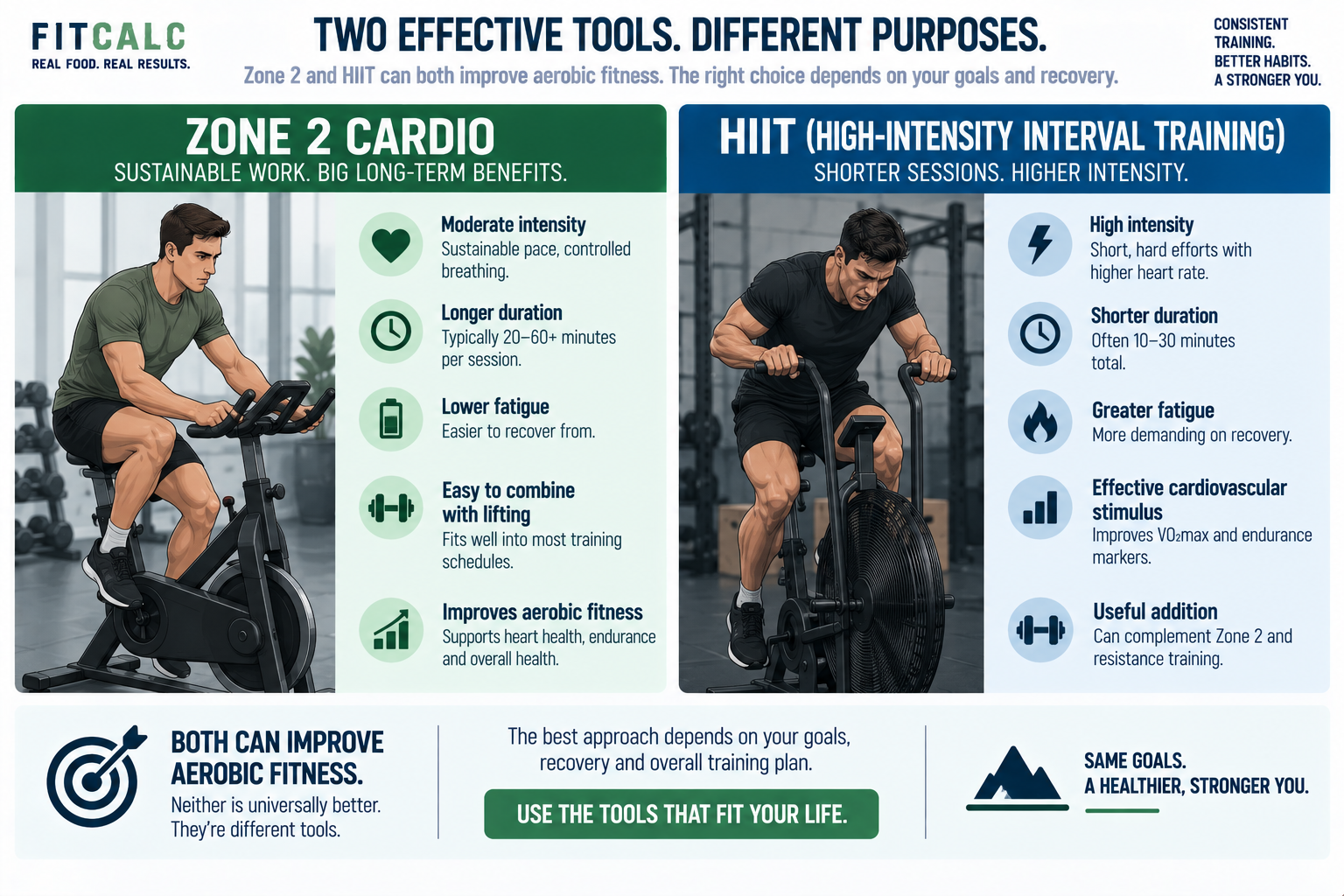
This is particularly relevant after the broader concurrent-training evidence we've covered elsewhere on FitCalc. Combining cardio and resistance training does not inherently prevent muscle growth or strength development when total training stress and recovery are managed appropriately.
For a lifter who wants better cardiovascular fitness without substantially increasing fatigue, Zone 2-style training is therefore an excellent default. You can still include intervals if you enjoy them or have performance goals that justify them, but there is little reason to make every cardio session as difficult as possible.
Zone 2 works well not because the body refuses to adapt at other intensities, but because you can get useful aerobic training without paying an enormous recovery cost for every session.
How Much Zone 2 Should You Do?
There is no scientifically established number of weekly Zone 2 minutes that everyone needs.
General physical-activity recommendations provide a useful reference point. Current U.S. guidelines recommend that adults accumulate approximately 150–300 minutes of moderate-intensity aerobic activity per week, or 75–150 minutes of vigorous activity, or an equivalent combination of the two. Muscle-strengthening activity is also recommended on at least two days per week.
Those guidelines are broader than Zone 2 training. They do not mean every adult needs to accumulate 150 minutes inside a watch-defined Zone 2.
Someone primarily focused on cardiovascular endurance may eventually perform several hours of lower-intensity aerobic training each week. A person whose main priority is resistance training may need much less dedicated cardio to begin improving their aerobic fitness.
For a lifter who currently performs little structured cardiovascular exercise, FitCalc recommends starting with approximately two or three sessions of 20–30 minutes of manageable aerobic work per week. This is a FitCalc practical starting point, not a research-established minimum.
That could mean cycling at a sustainable pace after an upper-body workout, incline walking on separate days, or performing another aerobic activity you enjoy enough to repeat consistently. If your fitness improves and cardiovascular development becomes a larger priority, session duration or weekly frequency can gradually increase.
Walking can sometimes provide an appropriate aerobic stimulus, particularly for less-conditioned individuals or when performed briskly or uphill. As fitness improves, ordinary flat walking may no longer raise intensity enough to resemble Zone 2. Cycling, incline treadmill walking, jogging, rowing, swimming, and similar activities can make controlling the effort easier.
The best modality is usually one you can perform consistently without creating unnecessary joint discomfort or interfering with higher-priority training.
You also do not need every cardio session to be Zone 2. A week can contain easy activity, moderate aerobic work, resistance training, and occasional higher-intensity exercise. Human fitness does not need to be confined to one zone.
The Bottom Line
Zone 2 cardio is valuable, but its benefits have become more mystical than the evidence justifies.
Moderate aerobic training can improve cardiorespiratory fitness and produce meaningful adaptations inside skeletal muscle, including mitochondrial adaptations. Its relatively manageable intensity also makes it easier to accumulate aerobic training without generating the fatigue associated with repeated high-intensity sessions.
Those benefits are real. They are simply not exclusive to one perfectly defined Zone 2.
Different heart-rate systems define zones differently, consumer devices estimate rather than directly measure physiological thresholds, and multiple exercise intensities can improve cardiovascular fitness. There is little reason for a recreational exerciser to become anxious about maintaining one exact heart rate.
For someone primarily focused on lifting, FitCalc considers two or three 20–30 minute moderate aerobic sessions per week an excellent starting point. Increase that amount when cardiovascular fitness becomes a greater priority, and include harder work when your goals and recovery support it.
Use Zone 2 because it is effective, sustainable, and recoverable—not because crossing into one precise heart-rate range unlocks a special set of adaptations.
Sources
San-Millán I, et al. Zone 2 Training: Definition and Contemporary Understanding — An Expert Consensus. 2025.
Effects of Moderate-Intensity Continuous Training on Skeletal Muscle Mitochondrial Adaptations and Cardiorespiratory Fitness: A Systematic Review and Meta-Analysis. 2026.
The Effect of Endurance Training Intensity on Skeletal Muscle Mitochondrial Adaptations: A Systematic Review and Meta-Regression. 2024.
Effects of Exercise Training Intensity on VO₂max: An Overview of Systematic Reviews and Meta-Analyses. 2024.
Zone 2 Training and the Myth of a Unique Exercise Intensity for Mitochondrial and Cardiometabolic Health. Sports Medicine. 2025.
U.S. Department of Health and Human Services, Office of Disease Prevention and Health Promotion. Physical Activity Guidelines for Americans.