Are Carbs Actually Necessary for Building Muscle?
When people talk about nutrition for building muscle, protein usually dominates the conversation. That makes sense. Muscle tissue requires amino acids, and consuming enough high-quality protein is one of the most important nutritional factors for supporting hypertrophy.
But focusing exclusively on protein misses another important part of the equation: you still need enough energy to train hard enough to give that protein a reason to become new muscle.
That is where carbohydrates become particularly useful.
At FitCalc, we recommend at least around 200 grams of carbohydrates per day as a practical baseline for healthy, active adults trying to build muscle, with higher intakes often making sense for larger people, athletes, highly active individuals, and lifters performing substantial training volume. We're also selective about where those carbohydrates come from. Fruit, potatoes, white rice, honey, 100% fruit juice, and other simple whole or minimally processed foods are very different from building your carbohydrate intake around candy, pastries, sugary cereal, and ultra-processed food.
Carbohydrates aren't technically required to construct muscle tissue in the same way essential amino acids are. People can resistance train and gain muscle while eating relatively little carbohydrate. But if the question is what we recommend for someone trying to maximize training performance, recovery, calorie intake, and hypertrophy, unnecessarily restricting quality carbohydrates makes little sense.
Carbohydrates Help Fuel the Training That Builds Muscle
Muscle isn't built simply because you ate enough protein. Resistance training provides the stimulus that tells the body it needs to adapt, and productive hypertrophy training requires energy.
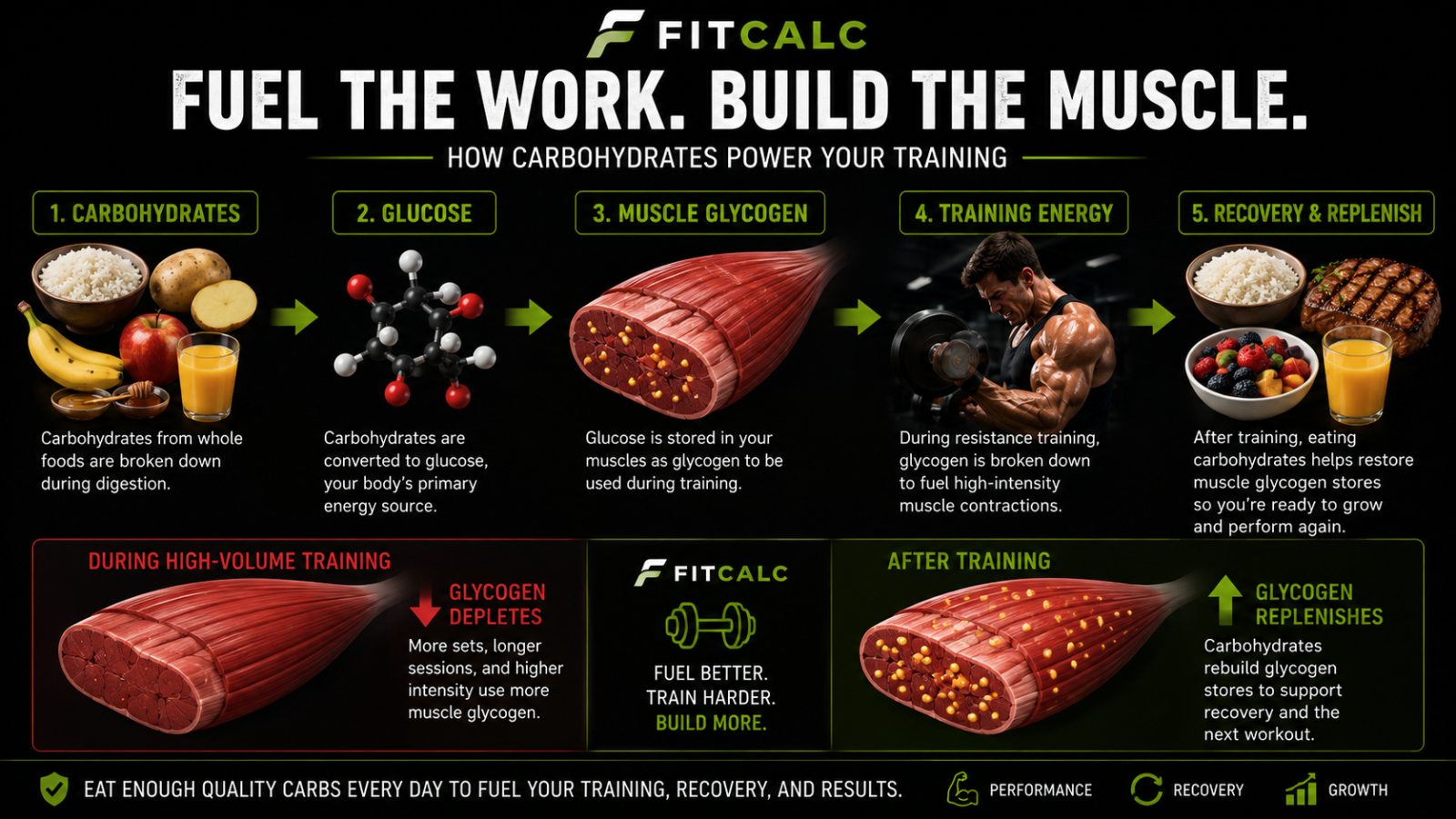
Carbohydrates are broken down into glucose, which can be used immediately for energy or stored primarily in the liver and skeletal muscle as glycogen. During demanding resistance training, muscle glycogen contributes energy to repeated muscular contractions. The more sets you perform and the longer a session continues, the more relevant those stores can become.
A recent systematic review and meta-analysis examining glycogen use during resistance exercise found a significant reduction in muscle glycogen following training. Importantly, glycogen depletion became greater as the number of sets and workout duration increased.
That makes carbohydrates particularly relevant to bodybuilding-style training. A person performing several exercises and 15–20 challenging sets across a long session creates different energy demands than someone walking into the gym, performing three heavy singles, and leaving.
This connects directly with our previous discussion of hypertrophy training volume. If accumulating enough high-quality working sets is important for muscle growth, fueling your ability to perform those sets matters too.
More Carbs Don't Automatically Mean More Muscle
This distinction is important because we don't want to turn carbohydrates into something they're not.
A new 2026 systematic review and meta-analysis directly examined whether higher carbohydrate intake independently produces greater hypertrophy during resistance training when protein intake is matched. Across 11 included studies, the researchers found no statistically significant independent hypertrophy advantage from simply consuming more carbohydrate, although they rated the certainty of the evidence as low.
That finding makes sense.
Carbohydrates aren't a magic anabolic substance where eating another 100 grams automatically adds muscle. If someone already consumes sufficient calories and carbohydrate to train effectively, increasing carbohydrate indefinitely won't necessarily make their biceps grow faster.
The FitCalc argument is different: carbohydrates help support the conditions under which hypertrophy occurs. They provide readily available energy, contribute to muscle glycogen, can support demanding training, and make consuming sufficient total calories considerably easier.
That's especially valuable when you're trying to gain weight and your daily calorie requirement becomes high.
What Does the Performance Research Show?
Research specifically examining carbohydrates and resistance-training performance is more nuanced than the common advice to "eat carbs or your workout will be terrible."
A systematic review covering 49 studies found that additional carbohydrate did not consistently improve resistance-training performance under every condition. Benefits were more apparent when participants trained fasted, performed more than 10 sets per muscle group, had depleted glycogen beforehand, or performed multiple demanding sessions in a short period.
That's useful because it tells us when carbohydrate availability becomes particularly relevant.
If you're performing a relatively short resistance-training session after eating normally throughout the day, drinking a giant carbohydrate shake immediately before lifting may not transform your performance. Your muscle glycogen stores aren't empty simply because you haven't eaten a banana in the last hour.
But as training volume increases, glycogen becomes depleted, sessions become longer, or multiple training bouts occur close together, carbohydrate availability becomes increasingly relevant. Research on acute carbohydrate feeding has similarly found that the performance effect depends heavily on workout characteristics and the nutritional state of the athlete.
So our recommendation isn't based on the idea that you need sugar between every set. It's based on keeping an active, hard-training body adequately fueled across the entire day.
Why We Recommend at Least 200 Grams Per Day
There is no universal carbohydrate number that every person needs for muscle growth. A 140-pound person training three days per week has different requirements from a 220-pound bodybuilder training five days and playing basketball on the weekend.
For that reason, 200 grams isn't a biological threshold where muscle growth suddenly begins.
It is our practical starting recommendation.
Two hundred grams of carbohydrate provides roughly 800 calories. That leaves plenty of room in most active adults' diets for sufficient animal protein and quality dietary fats while providing a meaningful amount of carbohydrate for training and everyday activity.
Someone with greater energy demands can go substantially higher. If you're training hard, playing sports, working an active job, walking 10,000+ steps, or deliberately gaining weight, 250, 300, 400 grams or more may fit your calorie requirements perfectly well.
The amount should ultimately reflect your bodyweight, total calorie target, training volume, and activity level. We simply don't see a reason for a healthy lifter to deliberately force carbohydrates extremely low when there is no specific need to do so.
Low-Carb Diets Can Build Muscle, but That's Not Our Preferred Approach
It's possible to build muscle while consuming relatively little carbohydrate.
Research involving ketogenic diets demonstrates that resistance training and muscle gain aren't physiologically impossible without a high-carbohydrate intake. A 2022 systematic review and meta-analysis found no statistically significant difference in fat-free-mass changes between ketogenic and non-ketogenic diets among resistance-trained participants, although only five studies involving 111 participants were available.
Other evidence gives us reason to prefer a carbohydrate-inclusive diet when hypertrophy is the goal. A separate meta-analysis of resistance-training studies found ketogenic diets produced a greater reduction in fat mass but also a greater reduction in fat-free mass compared with non-ketogenic diets. A controlled eight-week study in trained men also found that the non-ketogenic group increased muscle mass during an energy surplus while the ketogenic group did not significantly increase muscle mass.
The literature isn't strong enough to say someone cannot maximize muscle on a low-carbohydrate diet. But that isn't a strategy FitCalc recommends for someone whose primary objective is hypertrophy.
Being able to build muscle without many carbohydrates doesn't mean restricting carbohydrates provides an advantage.
The Quality of Your Carbohydrates Still Matters
Recommending carbohydrates does not mean recommending every food that contains them.
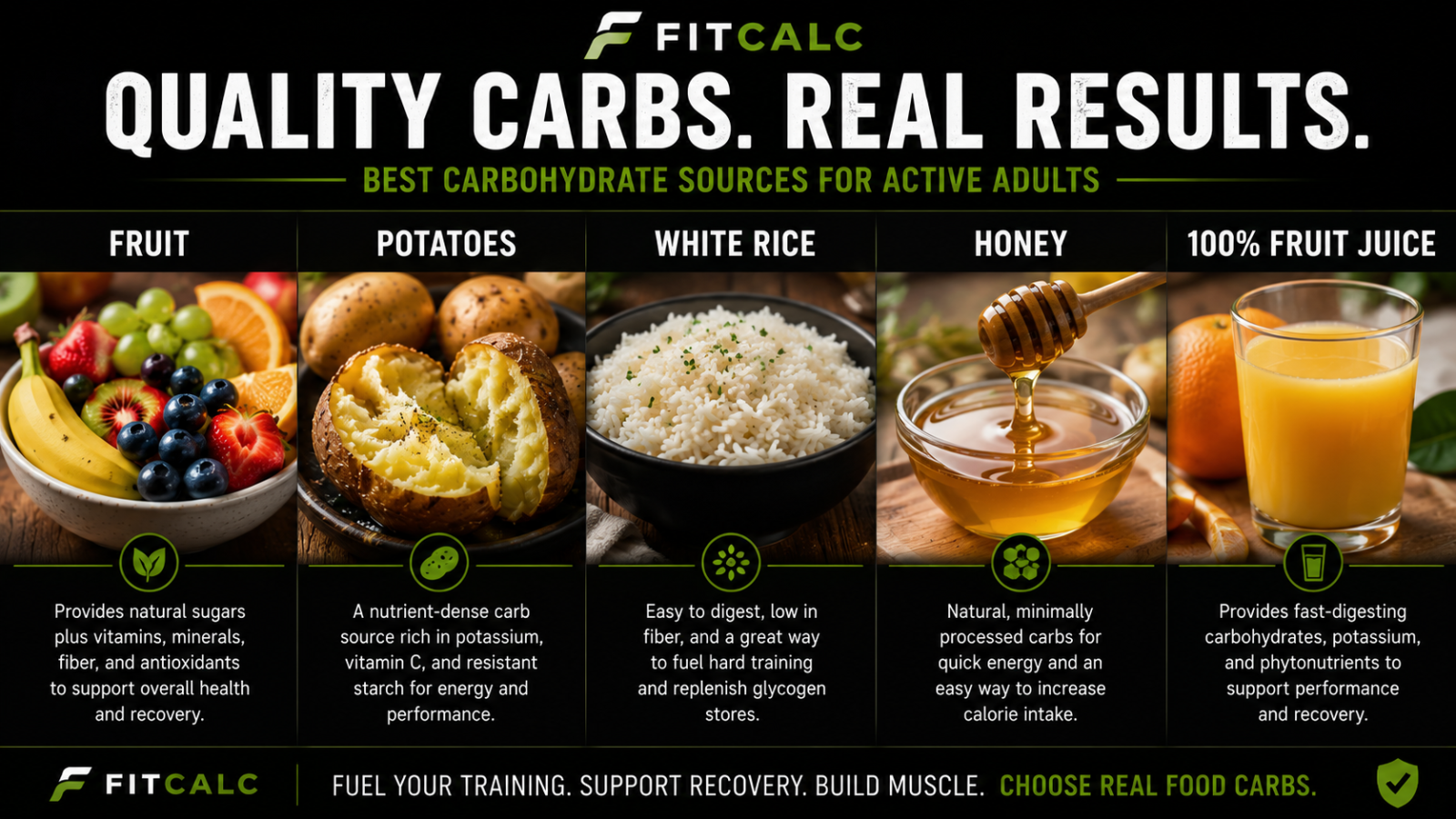
At FitCalc, our preferred carbohydrate sources are foods such as fruit, white rice, potatoes, honey, 100% fruit juice, and quality dairy for people who tolerate it. These foods make it relatively easy to adjust carbohydrate intake depending on your goals without building the diet around ultra-processed products.
Fruit is especially useful because it provides carbohydrates alongside water, vitamins, minerals, and other naturally occurring compounds. Potatoes provide substantial carbohydrate and potassium. White rice is simple, easy to digest for many people, and easy to scale upward when calorie requirements increase.
Honey and 100% fruit juice are also useful for active adults. They're more concentrated carbohydrate sources, which can actually become an advantage when someone needs more energy but doesn't want to eat another enormous meal. Fresh-squeezed fruit juice remains our preference when practical.
What we don't recommend is using "I need carbs for muscle" as justification for consuming most of them through candy, cookies, sugary cereal, pastries, and other ultra-processed foods. You can reach 300 grams of carbohydrate that way, but hitting a macro target doesn't erase the importance of food quality.
Carbohydrates Make a Calorie Surplus Easier
Building muscle requires more than protein and training. Total energy availability matters too.
Someone attempting to gain weight needs enough calories to support both everyday energy requirements and the creation of new tissue. For naturally skinny people, that can become surprisingly difficult once calorie targets climb above 3,000 calories per day.
Carbohydrates make those numbers much easier to reach.
Imagine trying to eat 3,500 calories while keeping carbohydrates extremely low. Protein eventually reaches the point where adding more provides little practical benefit, which leaves enormous amounts of dietary fat as the primary remaining energy source. There is no reason we consider that inherently superior.
Adding another serving of rice, potatoes, fruit, honey, or juice can increase calories without requiring absurd amounts of either protein or fat. Carbohydrates give you another useful lever for matching food intake to your energy demands.
This is especially important for people who struggle to gain weight. If appetite is already the limiting factor, unnecessarily removing an entire category of useful whole foods makes the job harder.
Do You Need Carbs Immediately Before and After Training?
Not necessarily.
The idea that you need carbohydrates within a tiny pre- or post-workout window is overstated for someone eating enough food across the day. Muscle glycogen isn't completely depleted during an ordinary lifting session, and glycogen replenishment continues for many hours after training.
Carbohydrate timing becomes more important when recovery time is short, such as an athlete training twice in one day or performing another demanding activity soon afterward. Carbohydrate ingestion after resistance training supports glycogen resynthesis, which can help restore fuel for subsequent sessions.
For most recreational lifters, the simpler strategy works fine: eat quality carbohydrates throughout the day and include them reasonably close to training when convenient. Fruit and honey before training, rice or potatoes with a pre-workout meal, or fruit juice alongside a meal can all work.
There is no need to turn carbohydrate timing into another complicated fitness ritual.
The FitCalc Approach
If you're healthy, active, and seriously trying to build muscle, we recommend eating carbohydrates rather than unnecessarily restricting them.
Start around 200 grams per day as a practical baseline, then increase carbohydrate intake as your activity level, bodyweight, training volume, and calorie requirements demand. Someone training hard and consuming 3,500 calories may need considerably more than 200 grams, and that's perfectly fine.
Keep protein high, preferably around our usual 1 gram per pound target when appropriate, and build that protein primarily around high-quality animal foods. Then use fruit, rice, potatoes, honey, fruit juice, and other quality carbohydrate sources to provide energy and help meet your total calorie needs.
Carbohydrates don't directly guarantee additional muscle growth. The newest meta-analysis examining carbohydrate intake independently found no significant hypertrophy advantage when protein was matched. But resistance training clearly uses muscle glycogen, with depletion becoming greater as training volume and session duration increase.
That distinction is important.
Protein provides the building material. Training provides the stimulus. Carbohydrates help fuel the work.
You can build muscle while eating very few carbohydrates.
If maximizing muscle growth and training performance is the goal, we simply don't see a good reason to make the process harder than it needs to be.
Sources
Henselmans M, Bjørnsen T, Hedderman R, Vårvik FT. The Effect of Carbohydrate Intake on Strength and Resistance Training Performance: A Systematic Review. Nutrients. 2022. The review included 49 studies and found that carbohydrate intake was particularly likely to benefit resistance-training performance under conditions including fasted training, high-volume sessions, depleted glycogen, and closely spaced workouts. PubMed
The Effect of Carbohydrate Intake on Muscle Hypertrophy: A Systematic Review and Meta-analysis. 2026. Eleven studies were included, with the pooled analysis finding no significant independent hypertrophy advantage from higher carbohydrate intake under protein-matched conditions; the certainty of evidence was rated low. PubMed
Acute effects of resistance exercise on skeletal muscle glycogen depletion: A systematic review and meta-analysis. Physiological Reports. 2025. Resistance exercise significantly reduced muscle glycogen, with greater depletion associated with more sets and longer training sessions. PubMed
Vargas-Molina S, Gómez-Urquiza JL, García-Romero J, Benítez-Porres J. Effects of the Ketogenic Diet on Muscle Hypertrophy in Resistance-Trained Men and Women: A Systematic Review and Meta-Analysis. International Journal of Environmental Research and Public Health. 2022. The analysis found no significant difference in fat-free mass between ketogenic and non-ketogenic groups, while emphasizing the small evidence base. PubMed
Ashtary-Larky D, Bagheri R, Asbaghi O, et al. Effects of resistance training combined with a ketogenic diet on body composition: a systematic review and meta-analysis. Critical Reviews in Food Science and Nutrition. 2022. Ketogenic diets reduced body mass and fat mass but were also associated with lower fat-free mass compared with non-ketogenic diets in resistance-training studies. PubMed
Escobar KA, VanDusseldorp TA, Kerksick CM. Carbohydrate supplementation and resistance training. Reviews carbohydrate availability, resistance exercise, muscle glycogen, and post-exercise glycogen restoration, particularly in high-volume training. PubMed
[IMAGE: FitCalc graphic displaying preferred carbohydrate sources for active adults: fruit, potatoes, white rice, honey, and 100% fruit juice.]
[IMAGE: FitCalc graphic showing carbohydrates → glucose → muscle glycogen → resistance training energy, with glycogen decreasing during a high-volume workout and being replenished afterward.]