
Why You're Not Gaining Weight Even Though You Think You Eat a Lot
If you've always been skinny, you've probably heard the same advice countless times:
just eat more.
It's frustrating advice when you already feel like you eat plenty. Maybe you can put away a huge dinner, regularly order more food than your friends, or feel like you're constantly eating without seeing much difference on the scale. Eventually, it's easy to conclude that you simply have an impossibly fast metabolism and can't gain weight.
There are genuine differences in how much energy people expend, and some naturally thin people may require considerably more food than others to gain weight. Research on overfeeding also shows individual variation in how bodies respond to excess energy. But the underlying requirement doesn't change: bodyweight cannot consistently increase without enough energy coming in to support that increase. Controlled overfeeding research consistently produces weight gain when excess energy is sustained over time.
For most otherwise healthy people struggling to gain weight, we would investigate four things before blaming genetics: you're not tracking your calories, you're tracking them incorrectly, you simply need more calories, or you haven't given the process enough time.
Those problems are all fixable.
1. You're Not Actually Tracking Your Calories
Saying "I eat a lot" and knowing your average calorie intake are two completely different things.
You might genuinely eat large meals. That doesn't necessarily mean you eat enough throughout the entire day. Someone can eat a 1,300-calorie dinner and still finish the day around maintenance because breakfast consisted of coffee, lunch was small, and several hours passed without eating anything.
This pattern is extremely common among people who struggle to gain weight. The meals they remember are large, so their overall diet feels large. What matters for weight gain, however, is the total amount of energy consistently consumed across the day and week.
If you've never tracked your food, spend at least a couple of weeks doing it accurately. Don't drastically change what you eat on the first day. Track your normal diet first so you can see what "I eat a lot" actually means in numbers.
You may discover that you thought you were eating 3,000 calories but regularly finish closer to 2,300. Or perhaps you really are eating 3,000, but your activity level means 3,000 is close to maintenance for you.
You can't troubleshoot a calorie target you don't know.
A TDEE calculator can give you an initial estimate of your daily energy expenditure, but treat that number as a starting point rather than a personalized laboratory measurement. Your scale trend will eventually tell you whether the estimate is close.
2. You're Tracking Calories, but You're Tracking Them Wrong
Tracking food isn't automatically accurate simply because an app displays a number.
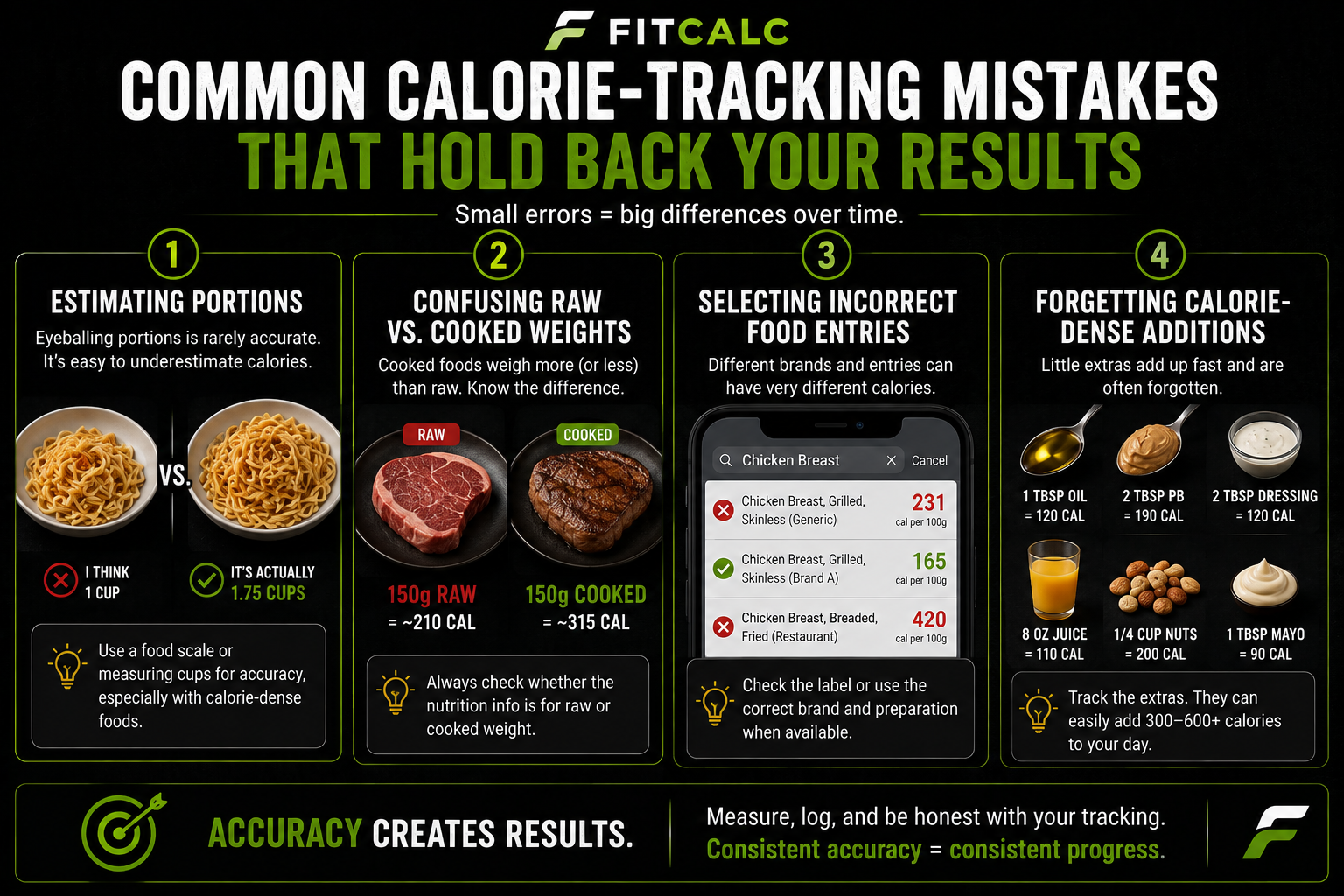
One of the easiest mistakes is estimating portions instead of measuring them. A bowl of rice that looks like one cup might actually contain considerably more or less. A large serving of ground beef entered as four ounces could easily be six or eight. If enough of these errors happen throughout the day, the final calorie total can be far from reality.
Cooked versus uncooked measurements create another common problem. Rice, pasta, meat, and other foods change weight during cooking because they gain or lose water. If you weigh cooked meat but use the nutrition information for its raw weight, or measure dry rice and select a cooked-rice entry, your tracking can become inaccurate quickly.
Nutrition databases introduce their own problems. User-submitted entries can be wrong, serving sizes can differ between brands, and similar-looking products can contain substantially different amounts of calories. When possible, use the nutrition label from the food you're actually eating and weigh portions with a basic kitchen scale.
Then be consistent about the little things. Cooking fats, peanut butter, honey, juice, sauces, nuts, and other calorie-dense foods can contribute meaningful energy. For someone trying to gain weight, forgetting to track them may not prevent progress, but it does prevent you from knowing what intake is actually producing that progress.
Accuracy doesn't mean you need to weigh every piece of food for the rest of your life. The goal is to spend enough time tracking carefully that you understand your portions and establish a reliable calorie baseline.
3. If You're Still Not Gaining Weight, You Need More Calories
This is the part people often overcomplicate.
Let's say you estimate that your maintenance intake is 2,600 calories. You decide to eat 2,900 calories every day because you believe that creates a 300-calorie surplus. You track accurately for several weeks, your morning weigh-ins remain essentially unchanged, and your weekly average bodyweight isn't moving.
At that point, it doesn't really matter whether a calculator says 2,900 should be enough.
Eat more.
Increase your intake to perhaps 3,100 or 3,200 calories and continue monitoring your weight. If your average weight begins climbing at a reasonable rate, you've found an intake that actually produces a surplus for your current body and activity level.
Sports-nutrition recommendations for intentional weight gain commonly suggest adding roughly 300–500 calories per day, alongside adequate protein and resistance training. A review of intentional weight-gain strategies also identified larger portions, energy-dense foods, and liquid calories as practical ways to increase energy intake.
Those numbers are useful starting points, not laws. Your body doesn't know what your calorie calculator predicted. Your actual energy expenditure is affected by body size, movement, exercise, work, genetics, and numerous other variables. Some people also respond to overfeeding by unconsciously increasing energy expenditure or everyday movement, which can make predicted weight gain slower than expected.
That's why the scale trend ultimately matters more than the original estimate.
Make the Extra Calories Easier to Eat
Needing more calories doesn't mean you need to start living on fast food and ultra-processed snacks.
Use calorie-dense whole foods to make your existing diet larger without creating enormous meals. Choose 80/20 ground beef instead of extremely lean meat. Add eggs to breakfast. Increase your serving of rice or potatoes. Use olive oil, avocado, nuts, or peanut butter. Drink 100% fruit juice with a meal or add honey where it fits.
A tablespoon of olive oil adds roughly 120 calories without adding much food volume. Two tablespoons of peanut butter can add around 190 calories. A glass of fruit juice can contribute another 100 calories or more. Small additions across several meals can turn a diet that maintains your weight into one that finally supports weight gain.
Our article on calorie-dense whole foods goes deeper into those options, but the principle is simple: make your meals more energy dense before assuming you need to force yourself through gigantic portions of food.
4. You Haven't Given It Enough Time
Weight gain isn't a seven-day project.
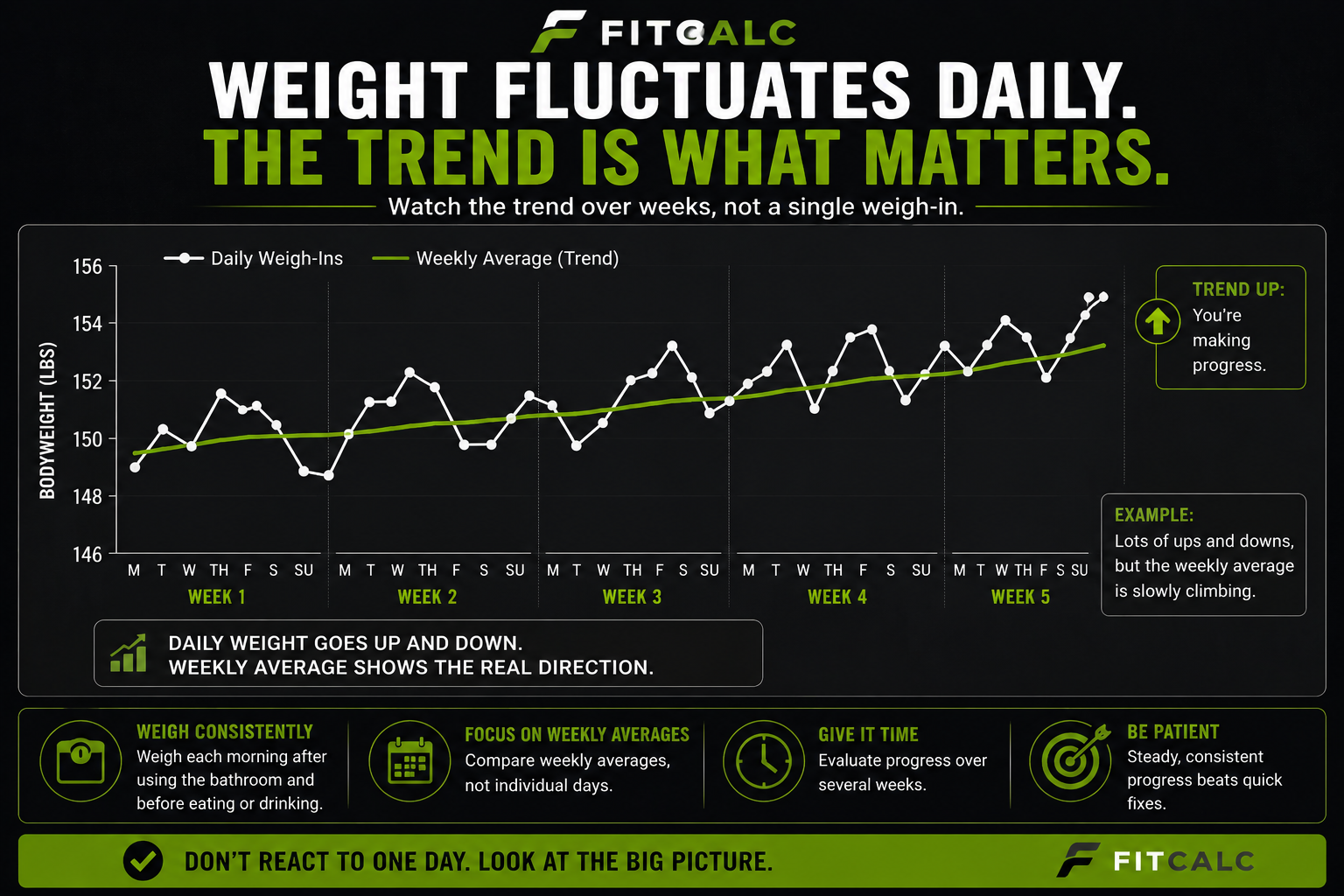
Your bodyweight can move several pounds in either direction because of water, glycogen, sodium intake, food still being digested, bowel contents, and hydration. That makes individual weigh-ins surprisingly noisy.
If you increase your calories on Monday, weigh yourself Friday, and decide the diet failed because you're the same weight, you haven't learned very much.
Instead, weigh yourself consistently under similar conditions. First thing in the morning after using the bathroom and before eating or drinking is a practical method. Record those weights and pay attention to your weekly average, not whether Tuesday morning happened to be 0.8 pounds lighter than Monday.
Then compare averages across several weeks.
Research on intentional weight gain also makes clear that gaining substantial lean mass takes time. Although recommendations have historically targeted increases approaching one pound per week in some athletic settings, a critical review found that gaining weight primarily as lean tissue at that rate can be difficult to achieve. If you're resistance training and want a meaningful portion of the gain to be muscle, there is no benefit to treating the process like a race.
Give your calorie target enough time to produce a trend. If you're consistently eating the target and the trend still isn't moving, then increase calories.
If You're Lifting, Give the Extra Calories Somewhere Useful to Go
For someone who simply needs to restore bodyweight, gaining weight itself may be the immediate priority. But if you're healthy, naturally skinny, and trying to build a stronger physique, resistance training should be part of the process.
A sustained energy deficit makes gaining lean mass more difficult. A meta-analysis examining resistance training under energy restriction found that energy deficits impaired gains in lean mass even when strength improvements could still occur. Providing adequate energy creates a better nutritional environment for adding tissue, while progressive resistance training gives the body a reason to devote resources toward building muscle.
Keep protein high as well. Our general FitCalc recommendation for someone seriously trying to build muscle is roughly 1 gram of protein per pound of bodyweight, primarily from high-quality animal foods such as meat, eggs, fish, poultry, and dairy when tolerated.
The calorie surplus provides the energy. Protein provides building material. Training provides the stimulus.
You need all three if the goal is more than simply making the scale heavier.
A Simple FitCalc Weight-Gain Process
If you're tired of guessing, make the process objective.
Start by estimating your maintenance calories with the FitCalc TDEE Calculator. Add a reasonable calorie surplus, often somewhere around 300–500 calories per day as an initial target. Track your food accurately and consistently rather than estimating how much you think you're eating.
At the same time, weigh yourself under similar conditions and calculate weekly averages. Give the plan enough time to establish a real trend rather than reacting to a handful of measurements.
If several weeks pass and your average bodyweight still isn't increasing, add more calories. You don't need to search for a secret metabolism hack or completely redesign your diet. Increase the variable that directly addresses the problem and continue monitoring the result.
Once weight begins increasing consistently, stay with that intake until the trend changes.
As you become heavier, your energy needs can also increase. The calorie intake that helped you move from 140 to 150 pounds may eventually stop producing the same surplus at 160. That's normal. Reassess and increase food again when necessary.
The FitCalc Approach
If you're otherwise healthy and constantly saying, "
I eat so much but I can't gain weight,
" start by replacing perception with data.
Track your calories. Track them correctly. Increase them when the scale shows you need more. Then give the process enough time to work.
Some people genuinely require more food than others. You may have a high activity level, naturally move a lot throughout the day, play sports, work an active job, or simply have higher energy expenditure than the person sitting next to you. None of that means you're incapable of gaining weight.
It means your calorie target needs to reflect your body and your lifestyle.
Use quality whole foods as the foundation. Make meals more calorie dense instead of relying on junk food. Eat enough protein, resistance train if building muscle is part of the goal, and stop judging the success of a weight-gain phase by what happened over five days.
If your average bodyweight isn't increasing after several weeks of accurate tracking, eat more and repeat the process.
There is one important exception. If you're accurately documenting a substantial food intake yet continuing to lose weight unintentionally, or unexplained low bodyweight is accompanied by other concerning symptoms, that's different from ordinary difficulty gaining weight and deserves medical evaluation.
For most healthy hardgainers, though, the solution is much less mysterious.
You need enough food, accurate tracking, and patience.
Sources
Bray GA, Bouchard C. The biology of human overfeeding: A systematic review. Obesity Reviews. 2020. The review examined more than 300 papers and found a clear relationship between sustained excess energy intake, weight gain, and energy storage, while also documenting individual variability in response to overfeeding. PubMed
Garthe I, et al. Weight Gain Recommendations for Athletes and Military Personnel: a Critical Review of the Evidence. Current Nutrition Reports. 2022. Reviews intentional weight-gain strategies, including calorie surpluses of roughly 300–500 kcal/day, adequate protein, larger portions, energy-dense foods, and liquid calories. PubMed
Murphy C, Koehler K. Energy deficiency impairs resistance training gains in lean mass but not strength: A meta-analysis and meta-regression. Scandinavian Journal of Medicine & Science in Sports. 2022. Prolonged energy deficits impaired lean-mass gains during resistance training. PubMed
Thomas DM, et al. Predicting adult weight change in the real world: a systematic review and meta-analysis accounting for compensatory changes in energy intake or expenditure. International Journal of Obesity. 2014. Reviews how compensatory changes in energy intake and expenditure can cause real-world weight changes to differ substantially from simple mathematical predictions. PubMed
Slater GJ, Dieter BP, Marsh DJ, et al. Is an Energy Surplus Required to Maximize Skeletal Muscle Hypertrophy Associated With Resistance Training? Frontiers in Nutrition. 2019. Reviews energy-surplus strategies, hypertrophy, satiety, and practical considerations for increasing calorie intake during resistance training. PubMed