Why Your Weight Can Change 3–5 Pounds Overnight Without Gaining Fat
You step on the scale Friday morning and weigh 180 pounds. You eat normally during the day, go out for a large dinner that night, and wake up Saturday weighing 184. Did you really gain four pounds of body fat overnight? Almost certainly not.
Your bodyweight represents much more than the amount of fat stored on your body. It includes muscle, bone, organs, water, glycogen, food moving through your digestive system, and numerous other components. Several of those can change considerably faster than body fat does.
This is why daily bodyweight can fluctuate by several pounds even while your actual body-fat level barely changes. A salty restaurant meal, a higher-carbohydrate day, changes in hydration, a hard workout, or simply having more food in your digestive system can all move the number on the scale. A 3–5 pound change is possible; it is not a normal daily range that everyone should expect, or a reason to dismiss unexplained rapid weight gain.
At FitCalc, we don't recommend judging fat-loss or weight-gain progress from individual weigh-ins. Measure consistently, look at your average weight over time, and let the trend help you judge whether your nutrition plan is working.
The Scale Measures More Than Body Fat
Your bathroom scale measures total bodyweight. It has no way of knowing whether today's additional two pounds came from stored body fat, water, glycogen, food, or some combination of all four.
Body water alone represents a substantial portion of total bodyweight. The National Academies reference report lists average values of about 59% in men and 50% in women aged 19–50, with wide variation related to body composition and age. That creates plenty of opportunity for short-term fluctuations.
If your goal is fat loss, what you actually care about is whether stored body fat is decreasing over weeks and months. Today's scale reading provides one small piece of information about that process. It isn't the entire answer.
Carbohydrates Can Increase Scale Weight Through Glycogen and Water
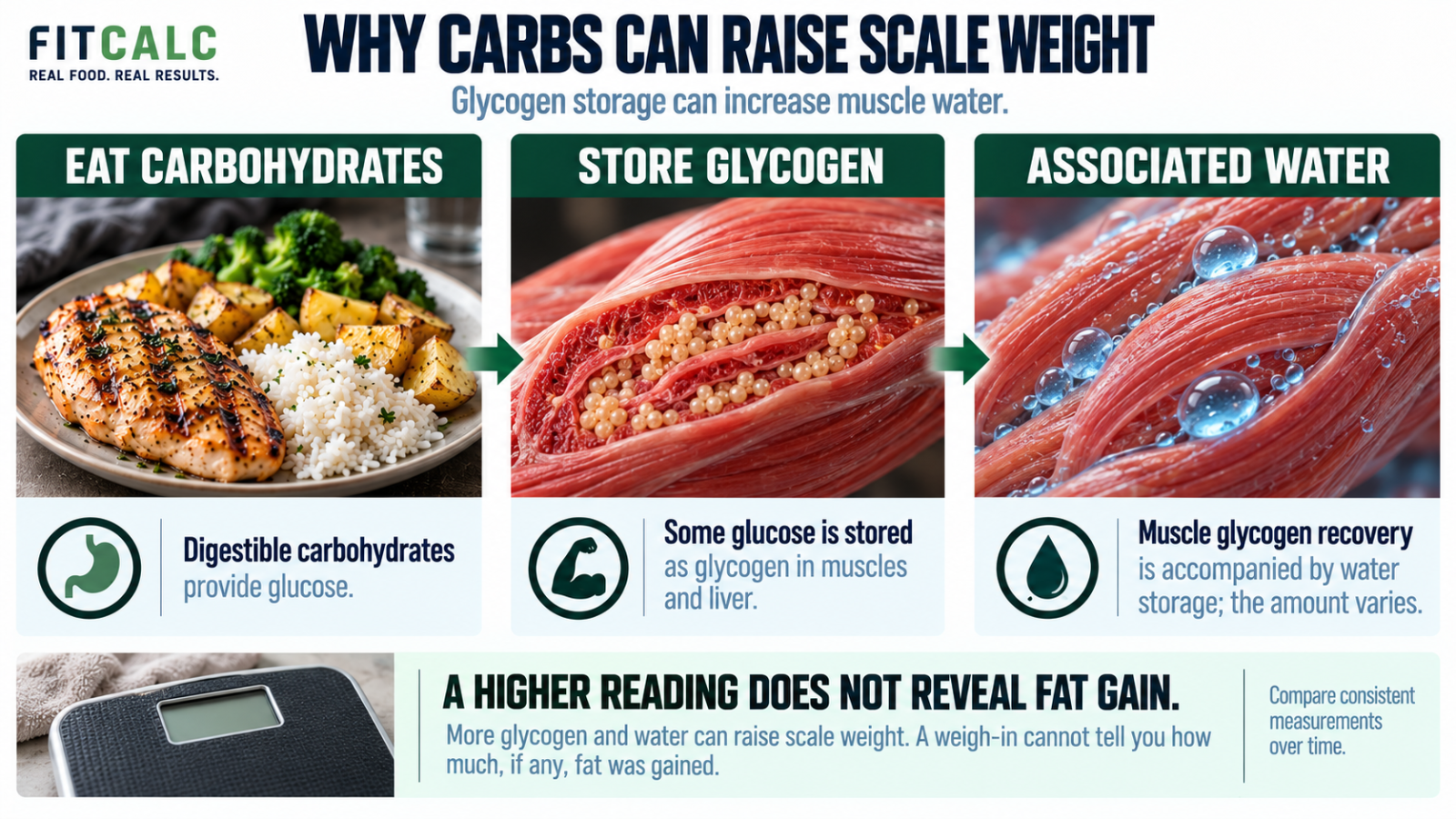
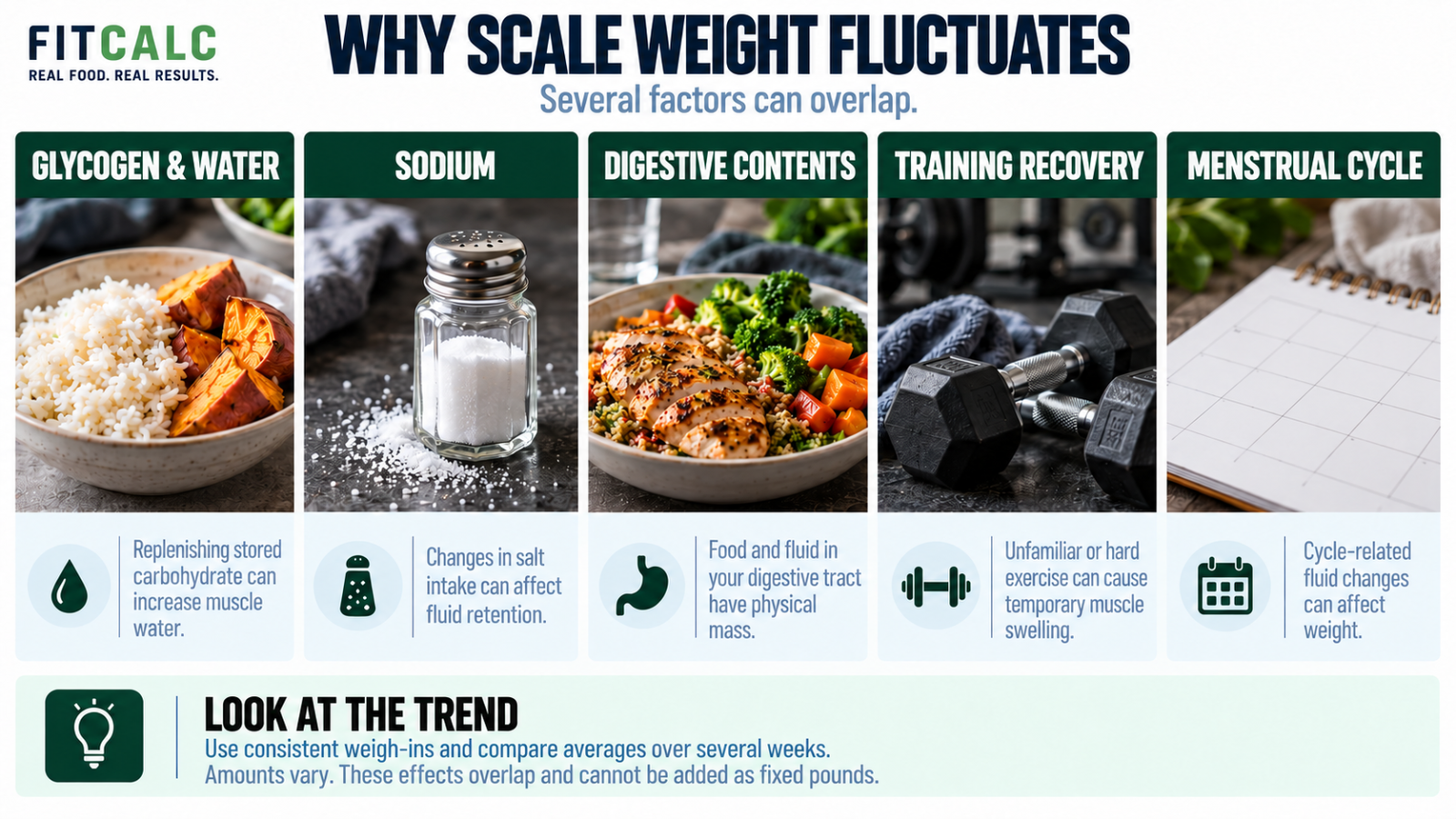
When you eat carbohydrates, some glucose is stored as glycogen, primarily in skeletal muscle and the liver. Glycogen is valuable stored fuel that can later support exercise and normal physiological function. Replenishing those stores can also increase muscle water.
In a small study of recovery after prolonged exercise in the heat, each gram of replenished muscle glycogen was accompanied by at least 3 grams of water. The measured ratio changed with rehydration, so this is a useful explanation of the mechanism, not a precise formula for predicting your next weigh-in.
Imagine you've been dieting and eating relatively few carbohydrates all week. Friday night you have a larger meal containing steak, potatoes, bread, and dessert. Your carbohydrate intake increases, glycogen stores begin replenishing, and additional water can accompany that glycogen. The scale can rise without an equivalent increase in body fat.
This works in the opposite direction too. When someone begins a very-low-carbohydrate diet, weight can fall rapidly as glycogen stores and associated water decrease. That dramatic early scale loss shouldn't automatically be interpreted as several pounds of body fat disappearing in a few days.
Sodium Can Move the Scale Too
A large restaurant meal isn't usually just higher in carbohydrates. It can also contain considerably more sodium than someone's normal diet.
Sodium plays an essential role in fluid balance, nerve signaling, and muscle function. The body regulates sodium and water through the kidneys and several hormonal systems. Changes in sodium intake can influence how much water is temporarily retained and excreted.
This is one reason a salty meal can leave you feeling heavier or puffier the following morning. The American Heart Association identifies puffiness, bloating, and weight gain as possible effects of sodium-related water retention. The size and timing of the response vary; you cannot assign a fixed number of pounds to a salty meal.
For an otherwise healthy person, returning to usual eating and drinking patterns often lets the temporary change settle over the following days. There is no need to drastically cut calories, avoid all carbohydrates, or force extra water to make the scale fall. Follow any individual fluid or sodium advice from your clinician.
Menstrual-Cycle Changes Can Add Another Layer
Fluid retention around menstruation can also affect weight. In a study of 42 women, weight was about 0.45 kg higher during menstruation than in the comparison phase, alongside an increase in extracellular water. That is an average from one study, not a prediction of how much your weight should change.
If you notice a recurring cycle-related pattern, record it alongside your weigh-ins. Comparing similar points in successive cycles can help you interpret a trend that looks confusing from one week to the next.
The Food You Ate Has Physical Weight
Sometimes the explanation is even simpler: food weighs something.
If you eat a large dinner containing a pound or two of food and drink several glasses of fluid, that material doesn't become weightless the moment you swallow it. Some remains in your digestive tract, while absorbed nutrients and water become part of the body's stores and fluids. Digestion itself does not make that mass disappear.
This is also why weighing yourself at random times throughout the day creates so much noise. Someone could weigh 180 pounds first thing in the morning, eat three meals, drink several pounds of fluid, and weigh considerably more that evening. That difference cannot be read as several pounds of newly gained body fat.
Digestive contents also vary from day to day depending on meal size, fiber intake, bowel movements, hydration, and other factors. That's another reason morning bodyweight under consistent conditions provides a more useful comparison than stepping on the scale whenever you happen to walk past it.
Hard Training Can Temporarily Increase Weight
Even doing something healthy can temporarily make the scale go the wrong direction.
Resistance training, particularly a difficult or unfamiliar workout, creates stress within trained muscle tissue and initiates an inflammatory and repair response. Exercise-induced muscle damage can involve temporary swelling and fluid accumulation within the affected tissue. A study in previously untrained men found that early increases in measured muscle size included swelling, rather than being entirely new muscle tissue.
Someone can begin training harder, eat appropriately, and temporarily see scale weight increase or stall. That alone does not tell you whether fat loss has stopped. Muscle glycogen may be increasing, water distribution can change, and recovering tissue can temporarily retain additional fluid. The study does not establish a fixed whole-body weight increase after a workout.
This is especially relevant for beginners. Someone who starts lifting weights while simultaneously beginning a fat-loss diet may experience changes in glycogen and water alongside changes in muscle and fat tissue. The scale alone won't perfectly describe everything happening to their body.
You Didn't Gain Four Pounds of Fat From One Dinner
Let's put a sudden scale increase into perspective.
Body-fat changes depend on energy balance over time, but the familiar 3,500-calories-per-pound rule is not an exact conversion between calories eaten and pounds gained or lost. Human weight change is dynamic: energy expenditure adapts, and the mix of fat, lean tissue, glycogen, and water changes. Hall and colleagues’ mathematical model accounts for those adaptations rather than assuming perfectly linear weight change.
Gaining several pounds of actual fat overnight would require a very large energy surplus beyond your body's normal requirements. A restaurant dinner can certainly put you into a calorie surplus, and repeated overeating can lead to body-fat gain. But waking up four pounds heavier after one big meal does not mean every additional pound on the scale represents newly created fat.
Some fat may have been gained if you consumed a genuine energy surplus. The important point is that a scale increase cannot tell you how much. The same logic applies when your weight drops dramatically after a low-carbohydrate day or after sweating heavily: you didn't necessarily lose several pounds of fat either.
Stop Comparing Random Weigh-Ins
If you're going to use a scale, make the measurement useful. We recommend weighing under reasonably consistent conditions: use the same scale on a firm, level surface, with similar clothing. For most people, the easiest time is first thing in the morning, after using the bathroom and before eating or drinking.
Suppose your morning weights in pounds this week are:
180.4 → 179.8 → 181.1 → 180.2 → 179.6 → 180.8 → 179.9
Those readings total 1,261.8 pounds. Divide by seven and the weekly average is 180.26 pounds, or 180.3 rounded to one decimal place. That gives you one useful number to compare with next week's average.
If the following several weekly averages gradually move downward, you're probably making progress even though individual days continue bouncing around. If the averages steadily rise during a weight-gain phase, the same principle applies. An average reduces day-to-day noise; it still includes water and other non-fat changes.
Daily weighing is optional. If it makes you anxious or encourages restrictive eating, weigh less often under consistent conditions, use other progress measures, or discuss a different approach with a qualified professional.
The Same Rule Applies When You're Trying to Gain Weight
People trying to gain weight can make the opposite mistake. You increase calories, eat a large high-carbohydrate dinner, and wake up three pounds heavier. It can feel like the bulk is already working, but you didn't build three pounds of muscle overnight.
The increase may reflect additional food, glycogen, and water, including water retained after a change in sodium intake. Actual muscle growth is a much slower process that requires consistent resistance training, adequate nutrition, and time.
This is why our advice is essentially identical whether you're gaining or losing weight: watch the trend rather than chasing individual numbers. For weight gain, we want weekly averages gradually moving upward over time. For fat loss, we generally want them gradually moving downward. What happened between Tuesday and Wednesday isn't nearly as important as what happened between this month and last month.
The FitCalc Approach
The scale isn't lying to you. It's simply measuring everything, while you're probably interested in only one or two components of that total weight.
Water changes. Glycogen changes. Sodium intake changes. Food moves through your digestive system. Training and the menstrual cycle can alter fluid balance. All of those factors can move scale weight without representing an equivalent change in body fat.
Weigh consistently if you choose to weigh. Look at averages across several weeks, alongside your food intake, training, activity, measurements, and how your clothes fit. After a large meal, return to your usual balanced meals, including protein-rich foods, vegetables, fruit, and appropriate carbohydrate portions, rather than trying to compensate for a single reading.
If your average weight keeps increasing while you're trying to lose fat, review your intake and activity instead of dismissing the trend as water. If you need a starting calorie target, FitCalc Plan can help you set one; use your multiweek trend to judge whether it needs adjustment.
When a Sudden Increase Needs Medical Advice
Do not assume all rapid weight gain is harmless. Contact a clinician about a rapid, unexplained increase, especially with new or worsening swelling. Swelling with shortness of breath or chest pain needs urgent medical care. If you have a condition such as heart or kidney disease, follow your clinician's monitoring instructions rather than the general advice in this article. MedlinePlus: unintentional weight gain; swelling guidance.
The scale measures your bodyweight. It does not measure your progress by itself.
Sources
American Heart Association. Effects of Excess Sodium.