What Happens to Your Metabolism When You Stay in a Calorie Deficit for Months?
Spend enough time reading about weight loss and you'll eventually hear that dieting for too long can "destroy your metabolism." According to this idea, months of eating in a calorie deficit eventually push the body into starvation mode, where fat loss stops and the solution is to start eating substantially more food again.
That's not how we look at prolonged weight loss at FitCalc. Your metabolism can adapt during a calorie deficit, but that doesn't mean it's broken. Some of the reduction in calorie expenditure is simply the predictable result of becoming a smaller person. There can also be additional metabolic adaptation, along with decreases in everyday movement and increases in hunger that make the original deficit smaller over time.
If you still have body fat to lose and your diet is reasonable, we don't think you need to randomly abandon the deficit for a week to "reset" your metabolism. Instead, understand why your calorie needs are changing, continue eating quality food and adequate protein, stay active, and adjust your intake when your actual progress shows that an adjustment is necessary.
A Smaller Body Naturally Burns Fewer Calories
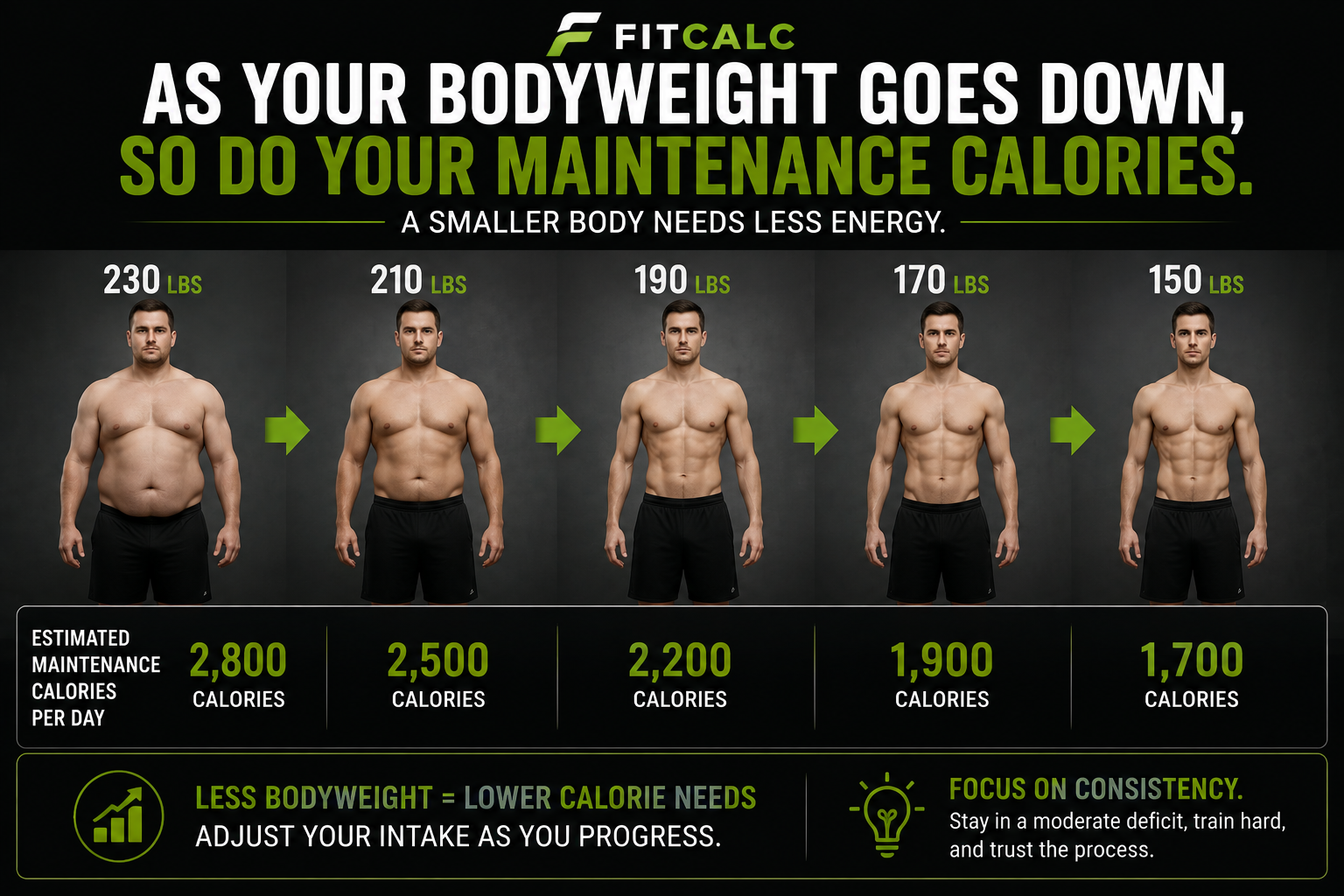
The first reason your metabolism changes during weight loss is also the simplest: there is less of you to maintain and move.
Imagine someone begins at 230 pounds and eventually reaches 180. That person's body no longer has to maintain or carry around the same amount of tissue. Walking up a flight of stairs at 180 pounds also requires less energy than moving the same body through the same staircase at 230.
Resting energy expenditure can therefore decrease as body mass decreases, while the energy cost of physical activity can also fall. This isn't evidence that the diet damaged anything. It's exactly what we should expect when the size and composition of the body change.
This is why the calorie intake that worked at the beginning of a diet may eventually stop producing the same rate of weight loss. If someone initially maintained their weight around 2,800 calories and ate 2,300 to create a deficit, their maintenance needs may be lower after losing a substantial amount of weight. Eating the same 2,300 calories could eventually create a much smaller deficit than it did at the beginning.
Your new maintenance intake isn't a punishment for losing weight. It's the amount of energy required to maintain your new body.
Metabolic Adaptation Is Real, but It Isn't "Starvation Mode"
There is another piece to the puzzle called adaptive thermogenesis. This refers to a reduction in energy expenditure beyond what researchers would predict from changes in bodyweight and body composition alone.
A systematic review examining 33 studies found evidence of adaptive thermogenesis in many of them, although the magnitude varied substantially. Importantly, better-designed studies tended to find smaller or statistically insignificant effects, and the adaptation appeared to become less pronounced in some studies after weight stabilization.
Earlier controlled research has estimated an average adaptive reduction around 120 calories per day, although individual responses vary considerably. Other studies have measured larger or smaller changes depending on the amount of weight lost, severity of the deficit, body composition, and methodology used.
So metabolic adaptation is real. But it doesn't mean the body reaches a point where a calorie deficit somehow stops being a calorie deficit.
If your total daily expenditure has fallen from 2,800 to 2,400 calories and you're eating 2,300, you're no longer in the 500-calorie deficit you started with. You're now only about 100 calories below your current needs. Fat loss will naturally slow.
That's not a broken metabolism. The numbers changed because your body changed.
You May Also Start Moving Less Without Realizing It
Not every reduction in calorie expenditure happens because resting metabolism changes.
When calories remain low for months, people can unconsciously reduce non-exercise activity thermogenesis, or NEAT. This includes the energy spent walking around, standing, fidgeting, doing chores, changing posture, and performing all the little movements that aren't deliberate exercise.
Someone who normally walks 10,000 steps may gradually start averaging 7,000. They may sit more often, take fewer trips around the house, or simply feel less energetic. None of those changes individually seem dramatic, but they can reduce total daily expenditure.
This is one reason we emphasize maintaining an active lifestyle during weight loss. Don't let dieting gradually turn you into a less active person. Continue walking, resistance training, playing sports, and participating in the physical activities you normally enjoy.
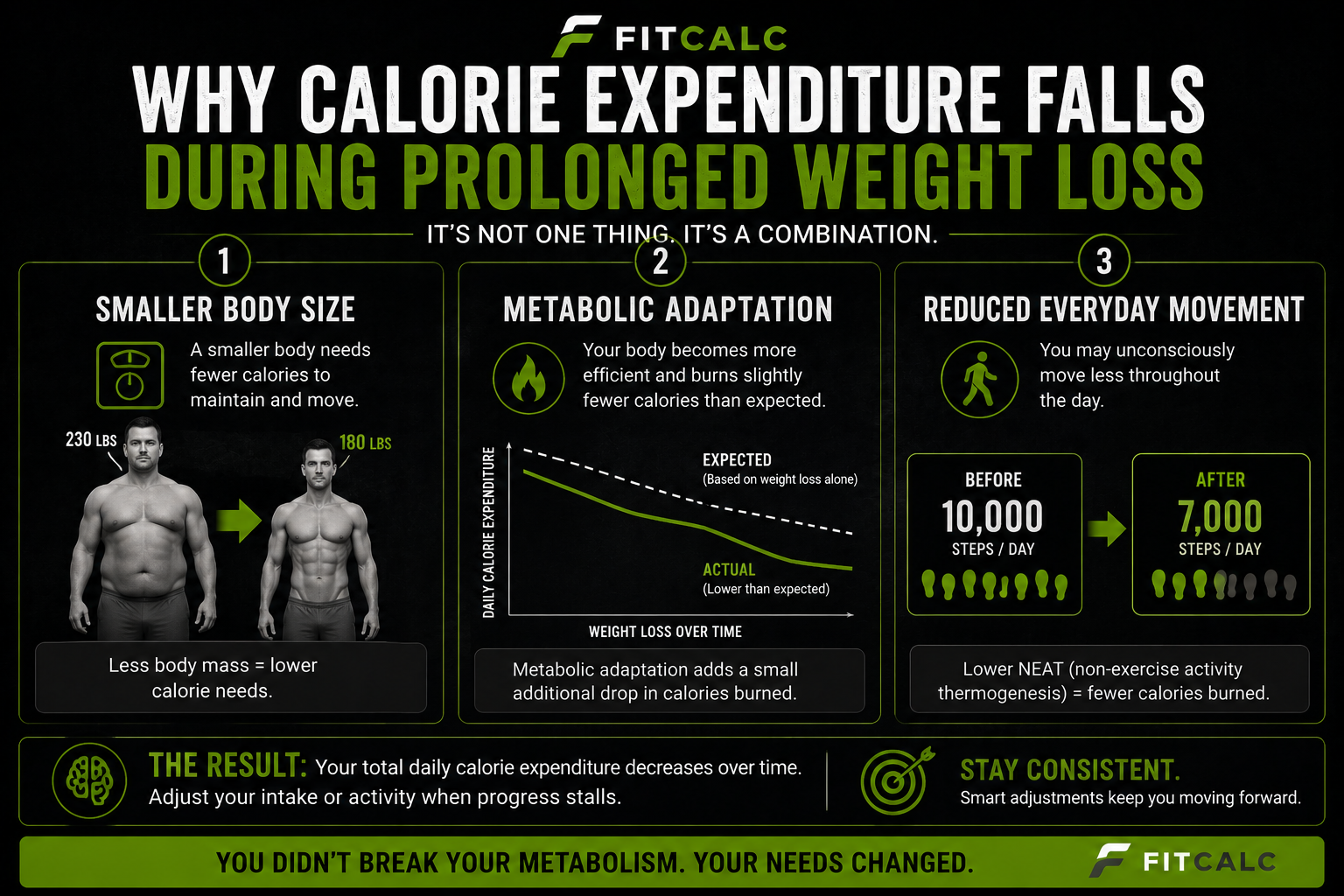
Why Weight Loss Eventually Slows Down
Put these factors together and the common weight-loss plateau becomes much easier to understand.
You weigh less, so your body requires fewer calories. Adaptive thermogenesis may reduce expenditure somewhat further. You may also move less without realizing it. Meanwhile, hunger can increase as the body responds to prolonged energy restriction. Reviews of long-term weight loss describe these combined metabolic and behavioral changes as important reasons weight loss becomes progressively harder to maintain.
That doesn't mean you should immediately slash another 1,000 calories whenever the scale pauses for three days. Bodyweight fluctuates because of water, sodium, carbohydrate intake, digestion, and numerous other factors. Look at trends across several weeks rather than individual weigh-ins.
If your average bodyweight genuinely stops decreasing for an extended period, your previous calorie intake may simply be close to your new maintenance level. At that point, a modest adjustment to food intake or activity can recreate the deficit.
Do You Need a Diet Break to "Reset" Your Metabolism?
We don't recommend automatically scheduling weeks where you abandon your deficit because you've been dieting for a certain number of months.
Diet breaks can be useful for some people psychologically, and research has investigated intermittent energy restriction as a potential dieting strategy. But the idea that everyone must periodically increase calories to maintenance or above in order to restart fat loss is not something we consider necessary.
If your deficit is sustainable, your nutrition remains adequate, and you're continuing to make progress toward a reasonable goal, stay consistent.
Weight loss should ultimately represent a lifestyle change rather than a temporary period of suffering followed by a return to the habits that produced the unwanted weight in the first place. Once the goal is reached, calories can increase to the maintenance intake appropriate for your new bodyweight. That maintenance level will often be lower than it was when you were heavier, and that's completely normal.

Protect Muscle While You're Losing Weight
One thing you don't want to unnecessarily lose is muscle.
Muscle contributes to strength, physical function, body composition, and resting energy expenditure. During a prolonged calorie deficit, adequate protein and resistance training help provide the nutritional material and training stimulus needed to preserve lean tissue.
Our general FitCalc approach remains the same: prioritize high-quality animal protein from meat, eggs, fish, poultry, and dairy when tolerated, resistance train consistently, and avoid making the calorie deficit more aggressive than necessary.
A diet shouldn't simply make you lighter. The goal should be to lose body fat while preserving as much muscle and physical performance as reasonably possible.
The FitCalc Approach
Your metabolism doesn't become permanently broken because you've spent several months losing weight. Your calorie requirements change because you change.
As bodyweight decreases, expect maintenance calories to decrease. Metabolic adaptation can lower energy expenditure somewhat further, and everyday movement may decline if you're not paying attention. Together, these changes explain why a calorie intake that produced rapid progress early in a diet may eventually produce much slower progress.
Don't respond by panicking about starvation mode or assuming you need to "reset" your metabolism with a week of extra calories. If your weight-loss trend has genuinely stalled, reassess your current intake and activity based on the body you have now, not the body you had when the diet began.
Continue eating mostly whole, nutrient-dense foods. Keep protein high. Resistance train. Stay active throughout the day. Maintain a reasonable calorie deficit until you reach your goal, then transition into the maintenance intake appropriate for your new weight.
Your metabolism didn't fail. Your maintenance needs changed.
Understanding that difference makes long-term weight loss considerably less mysterious.
Sources
Nunes CL, Casanova N, Francisco R, et al. Does adaptive thermogenesis occur after weight loss in adults? A systematic review. British Journal of Nutrition. 2022. The review included 33 studies and found evidence of adaptive thermogenesis in many studies, while noting substantial methodological variability and generally smaller effects in higher-quality designs. PubMed
Müller MJ, Bosy-Westphal A. Adaptive thermogenesis with weight loss in humans. Obesity. 2013. Reviews changes in resting and non-resting energy expenditure during calorie restriction and reports an average adaptive component of approximately 120 kcal/day with substantial individual variation. PubMed
Martínez-Gómez MG, Roberts BM. Metabolic Adaptations to Weight Loss: A Brief Review. Journal of Strength and Conditioning Research. 2022. Reviews metabolic and behavioral adaptations that can contribute to slowing weight loss and weight regain. PubMed
Camps SGJA, Verhoef SPM, Westerterp KR. Weight loss, weight maintenance, and adaptive thermogenesis. American Journal of Clinical Nutrition. 2013. Examined resting metabolic adaptation following weight loss and during subsequent weight maintenance. PubMed
Bosy-Westphal A, Müller MJ. Impact of calorie restriction on energy metabolism in humans. Experimental Gerontology. 2020. Reviews the physiological and behavioral mechanisms contributing to metabolic adaptation during calorie restriction. PubMed