Can Weekend Eating Cancel Your Calorie Deficit? How to Keep Flexibility Without Starting Over
You follow your usual meals during the working week, train consistently, and feel as though you are doing everything needed for fat loss. Then Friday dinner becomes a longer evening, Saturday has brunch and takeaway, and Sunday includes snacks while cooking. None of those occasions is a problem by itself. Together, they can change the picture.
Yes, weekend eating can cancel an estimated weekday calorie deficit. Whether it does depends on how much you eat and expend across the whole period. Eating above your usual diet target also does not automatically mean eating above maintenance.
The useful response is to understand your pattern and make it workable. You can enjoy a restaurant meal, keep a whole-food foundation, and continue your normal routine afterward.
Start with the distinction between a target and maintenance
Your calorie target is the intake you are aiming for. Maintenance is an estimate of the intake that would keep body weight broadly stable at your current activity level over time.
If you need an initial estimate, FitCalc’s maintenance calorie calculator can provide a starting point. The calorie deficit calculator can then help you plan a target below that estimate. Check either result against your real-world trend and how the plan feels.
Suppose your estimated maintenance is 2,500 calories a day and your usual fat-loss target is 2,100. Eating 2,500 on Saturday is 400 above your target, but it is still around estimated maintenance. That day would contribute no estimated deficit or surplus. It would reduce your weekly deficit compared with following the lower target every day.
The distinction matters because “I went over” can sound much more consequential than the numbers actually show. Equally, describing a weekend as “only a couple of meals out” tells you little about its total intake.
How two days can change the weekly arithmetic
For these illustrations, assume maintenance stays at 2,500 calories every day. Actual expenditure varies, and these numbers are examples rather than personal targets.
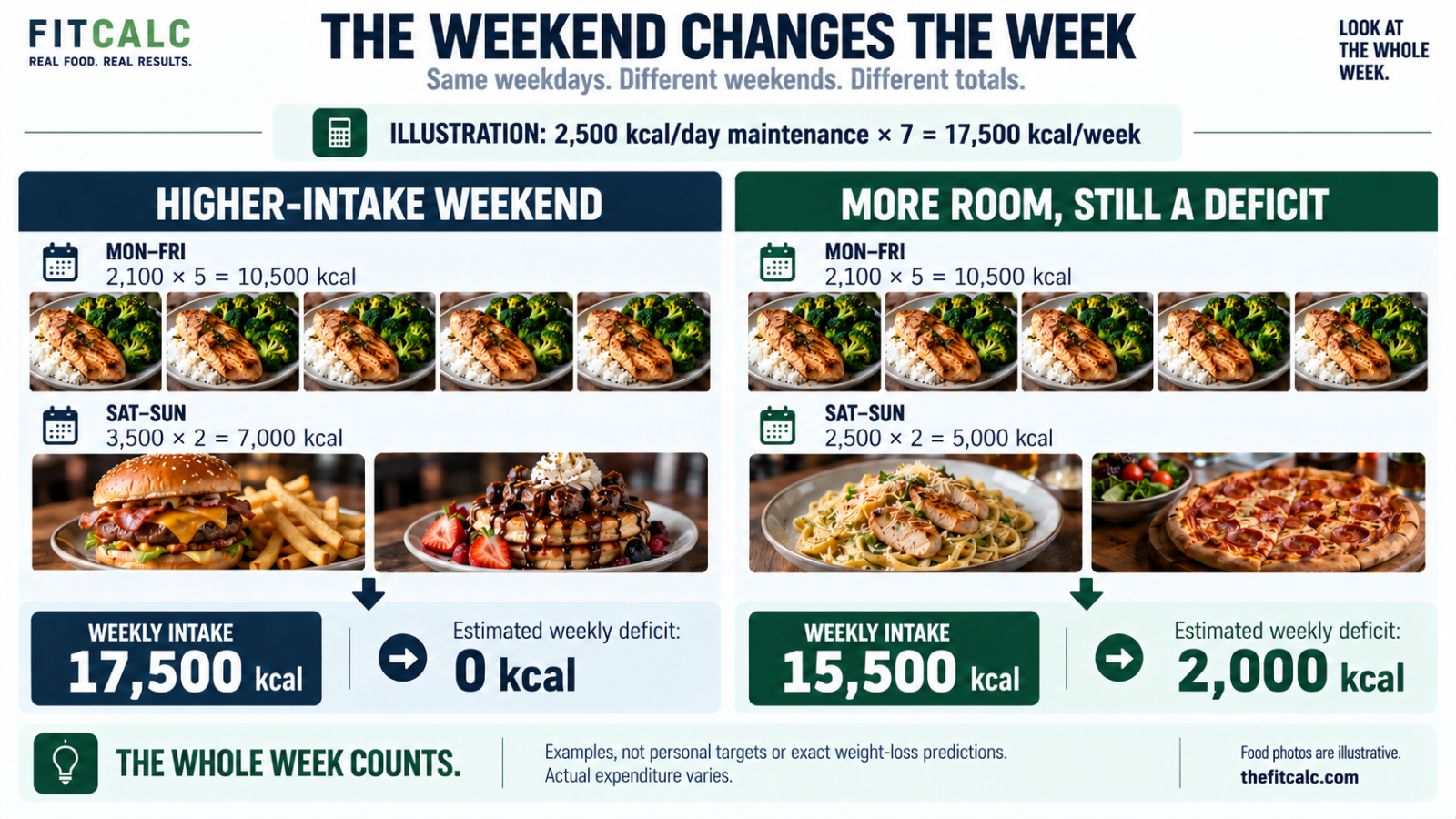
Example 1: The weekday deficit is fully offset
Estimated weekly maintenance: 2,500 × 7 = 17,500 calories.
Monday to Friday intake: 2,100 × 5 = 10,500 calories.
Saturday and Sunday intake: 3,500 × 2 = 7,000 calories.
Total weekly intake: 10,500 + 7,000 = 17,500 calories.
The five weekdays provide an estimated 2,000-calorie deficit: 400 a day for five days. The weekend provides an estimated 2,000-calorie surplus: 1,000 a day for two days. In this simplified example, the two balance out, leaving no estimated deficit for the week.
Notice that the weekend surplus is measured against maintenance, not against the 2,100-calorie diet target. Mixing those baselines produces misleading calculations.
Example 2: A more flexible weekend still leaves a deficit
Keep the weekdays identical, but change weekend intake to 2,500 calories a day:
Weekday intake: 2,100 × 5 = 10,500 calories.
Weekend intake: 2,500 × 2 = 5,000 calories.
Total weekly intake: 15,500 calories.
Estimated weekly deficit: 17,500 − 15,500 = 2,000 calories.
That works out to an average estimated deficit of about 286 calories a day. There is more room for food on both weekend days while the week still ends below estimated maintenance.
This is simply one illustration. You do not have to alternate calorie targets, and there is no need to force your intake into these particular numbers. A similar daily routine may feel easier.
A weekly average is a planning tool
Your body does not reset its energy balance on Monday. Seven days is a convenient bookkeeping window because work, training and social plans often repeat weekly. Energy balance continues across those calendar boundaries.
The calculation also cannot predict an exact amount of body fat lost. Food records and maintenance estimates have uncertainty, while energy expenditure and body composition can change over time. Hall and colleagues’ dynamic body-weight modelling explicitly accounts for adaptations in energy expenditure rather than treating weight change as a fixed, linear conversion from calories to pounds.
Use the arithmetic to understand direction and scale. Then assess your overall pattern across several weeks. One higher Monday weigh-in, by itself, cannot establish that the weekend erased fat loss. Our guide to overnight scale changes explains why body weight and body-fat changes can differ.
What research actually says about weekends
In a year-long trial reported by Racette and colleagues, researchers examined weekend patterns in 48 adults aged 50–60. During the interventions, higher weekend intake was associated with participants in the calorie-restriction group stopping their weekday weight-loss pattern on weekends, while the exercise group gained weight on weekends. The study supports paying attention to the full week, although its small, specific sample does not tell us exactly what will happen to every younger lifter.
A 2018 retrospective study of 7,007 weight-loss app users also found associations between weekly intake patterns and reported weight loss. However, users recorded their own information, and the study was observational. It cannot prove that keeping every day identical causes better results, or establish one ideal weekend allowance.
The practical interpretation is modest: a repeated weekend pattern is worth examining when progress differs from expectations. These studies do not mean every social meal needs an exact calorie calculation.
Find the part of your weekend that actually changes
Before cutting anything, look at one ordinary weekend. If calorie tracking feels useful and comfortable, record both days as realistically as you can. Include drinks, cooking ingredients, snacks and shared food. Restaurant estimates can stay estimates; do not invent precision by adding an arbitrary penalty to every meal.
You can also review the pattern without counting calories. Write down meal times, what you ate, and when you felt comfortably satisfied or unexpectedly hungry. Ask:
Did a delayed lunch turn into grazing until dinner?
Were drinks or snacks present more often than on weekdays?
Did the special meal replace a usual meal, or get added to it?
Was the weekday plan leaving me hungry and preoccupied with food?
Choose one recurring feature to change. For example, keep an easy lunch available before an afternoon out, or plate a snack rather than repeatedly eating from a shared bag. Treat this as a small experiment in making the weekend easier to manage.
Build flexibility around normal meals
Keep a whole-food foundation that is convenient
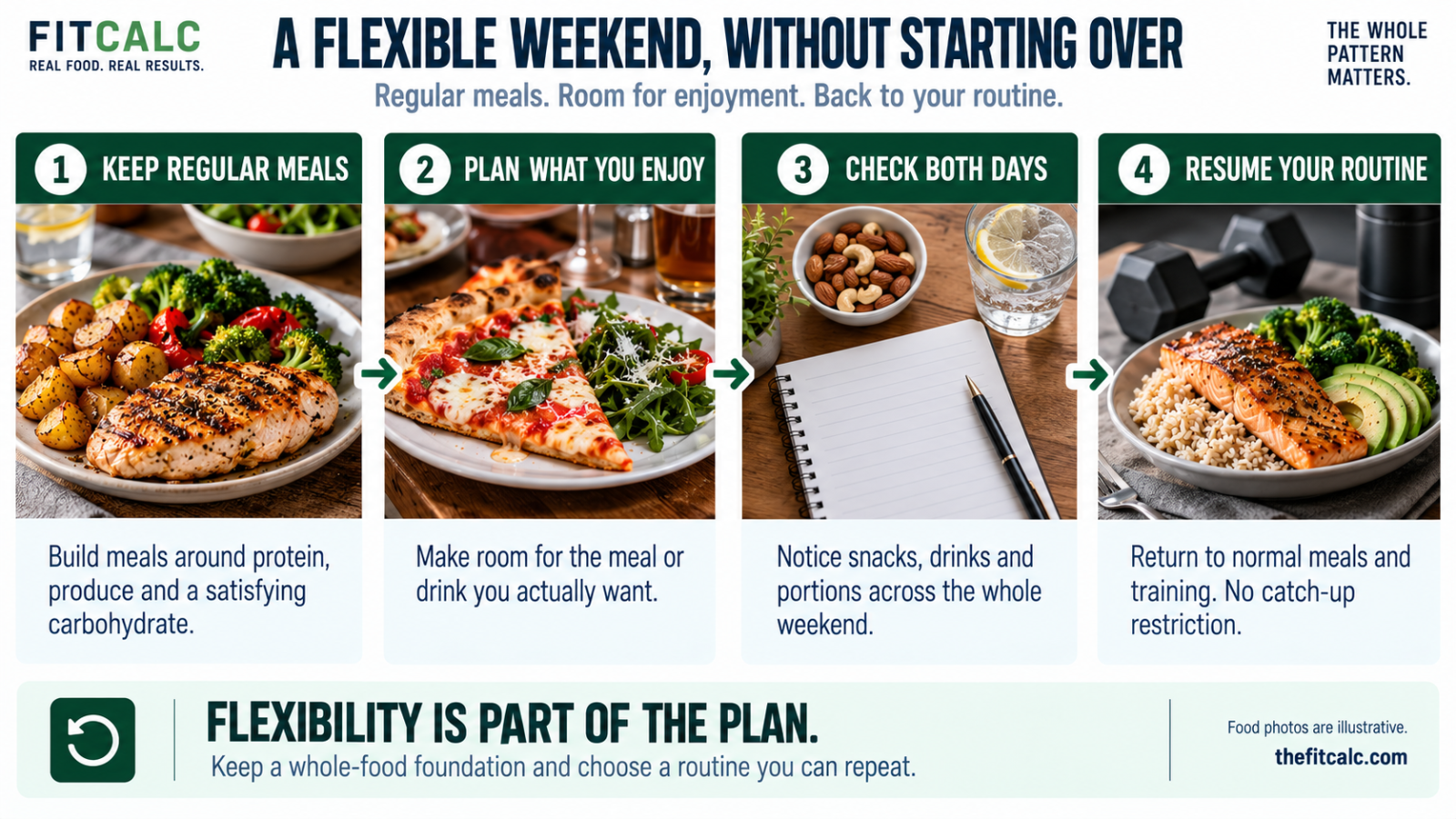
A useful starting point is a meal with a protein food, fruit or vegetables, and a satisfying carbohydrate. Options include chicken and rice with vegetables; eggs with toast and fruit; beans, rice and vegetables; or fish, potatoes and a salad. Frozen vegetables, canned beans and plain yogurt can make this practical without cooking everything from scratch.
There is experimental evidence that the food environment can affect intake. In a small inpatient crossover trial, 20 adults ate more energy when offered an ultra-processed diet than when offered an unprocessed diet, despite being allowed to eat as much as they wanted in both conditions. Each diet lasted two weeks. The study tested complete dietary patterns in a controlled setting; it does not show that every packaged food causes overeating.
For everyday planning, keep nourishing meals easy to assemble and include foods you enjoy. A takeaway or dessert can fit alongside that foundation.
Plan the meal you want to enjoy
If you have dinner out on Saturday, decide what sounds worthwhile before the day disappears into miscellaneous snacks. You might want a particular main course, dessert, or drink. You can choose those deliberately while eating regular meals earlier in the day.
For example, have your usual breakfast, a normal lunch, and dinner with friends. If the restaurant portion is more than you want, leaving some or taking leftovers home is an option. If you want dessert, enjoy it without turning the rest of the evening into an open-ended eating occasion.
These are practical planning options, not a tested formula or a promise of automatic weight loss. Choose the ones that suit your appetite, preferences and circumstances.
Keep movement part of your normal life
Continue your usual training schedule and enjoyable activity. A walk with a friend can be part of a pleasant weekend. Avoid calculating extra exercise as repayment for dinner or using a hard workout to justify eating. This article’s arithmetic assumes expenditure; it does not ask you to chase a calorie-burn number.
What to do after a bigger weekend
Return to your regular meals and training at the next opportunity. There is no requirement to wait for Monday, skip meals, or squeeze an extra deficit into the following days.
The NIDDK’s guidance on changing habits emphasizes planning ahead, making small changes and returning to your goals after setbacks. Applied here, that might mean putting an easy meal in the fridge or planning lunch before next Saturday’s errands.
If the same pattern happens repeatedly, review whether your weekday approach is realistic. A target that feels manageable on paper may be difficult to live with. Discuss persistent hunger, poor training recovery or concerns about your intake with a registered dietitian or qualified clinician rather than automatically cutting further.
If eating feels out of control, calorie tracking increases distress, or you repeatedly fast or exercise to compensate, step away from calorie-budget strategies and seek appropriate support. NIMH identifies loss-of-control eating and compensatory behaviors among eating-disorder warning signs. You deserve help with those experiences, regardless of body size.
The takeaways
Include all seven days when reviewing intake, and compare against estimated maintenance.
Going above a diet target can reduce the deficit without creating a surplus.
Use whole foods and regular meals as your base, with room for meals you enjoy.
Change one repeatable weekend habit before overhauling the entire plan.
After a higher-intake day, resume your routine without catch-up restriction.
A workable fat-loss approach has room for the life you actually lead. Understanding your weekly pattern can help you make that room deliberately, without treating every weekend as a test you pass or fail.
Sources
Racette SB et al. (2008). Influence of weekend lifestyle patterns on body weight. Obesity, 16(8), 1826–1830. DOI: 10.1038/oby.2008.320.
Hill C et al. (2018). Relationship Between Weekly Patterns of Caloric Intake and Reported Weight Loss Outcomes: Retrospective Cohort Study. JMIR mHealth and uHealth, 6(4), e83. DOI: 10.2196/mhealth.8320.
Hall KD et al. (2011). Quantification of the effect of energy imbalance on bodyweight. The Lancet, 378, 826–837. DOI: 10.1016/S0140-6736(11)60812-X.
Hall KD et al. (2019). Ultra-Processed Diets Cause Excess Calorie Intake and Weight Gain: An Inpatient Randomized Controlled Trial of Ad Libitum Food Intake. Cell Metabolism, 30(1), 67–77.e3. DOI: 10.1016/j.cmet.2019.05.008.
National Institute of Diabetes and Digestive and Kidney Diseases. Changing Your Habits for Better Health.
National Institute of Mental Health. Eating Disorders: What You Need to Know.