Does Intermittent Fasting Help You Lose Fat Without Losing Muscle?
You want to lose some body fat, keep lifting well, and avoid making food a second job. An eating window can sound appealing: start eating later, finish earlier, and spend less time deciding whether another snack fits. But if you also care about muscle, the clock cannot be the only part of the plan.
Time-restricted eating can be a workable way to organize meals. It does not guarantee greater fat loss than another sustainable eating pattern, and it does not protect muscle by itself. The useful question is whether a shorter window helps you meet your nutrition needs while training consistently. If it makes those tasks harder, there is no prize for keeping it.
What Kind of Fasting Are We Talking About?
Intermittent fasting describes several different approaches. This article focuses on daily time-restricted eating, such as eating within an eight-hour period and having no calorie-containing food or drink during the remaining sixteen hours. It is not advice to undertake prolonged fasts, alternate-day fasting or dehydration.
The eating window tells you when food is consumed. It does not tell you how much energy, protein, fiber or variety the food provides. A person can eat too little, enough or too much for their goal within the same window. Likewise, finishing dinner at a particular time does not establish whether the day's meals supported training.
Start with the routine you already have. Perhaps breakfast is comfortable, lunch is reliable and dinner follows an evening workout. Removing breakfast only makes sense if the resulting pattern works better overall. There is no requirement to replace regular meals with fasting simply because you want to lose fat.
Fewer Eating Hours Can Help, but Calories Still Matter
In a 12-month trial of 90 adults with obesity, an eight-hour eating window without calorie counting and daily calorie restriction both produced weight loss compared with a control group. The researchers did not find a statistically significant weight-loss difference between the two interventions. Reported energy intake fell in both groups. The study was relatively small and does not show that the approaches are interchangeable for every person.
A separate 12-month trial involving 139 adults with obesity tested an early eating window alongside calorie restriction. Adding the window did not produce a statistically significant advantage in weight loss over calorie restriction alone. That result is particularly relevant to someone who already has a manageable food plan and wonders whether fasting must be added on top.
Research is not uniformly negative or positive. A 14-week trial found greater weight loss with an early window plus weight-loss treatment, although the primary analysis did not find a statistically significant advantage for body-fat loss. Studies differ in meal timing, participants, support and what people actually eat. A promising result from one schedule is not proof of a universal fasting effect.
The practical interpretation is modest: limiting eating hours may help some people reduce intake or simplify choices. It is an option for organizing behavior, not a way to make energy intake irrelevant. You can also simplify eating by planning meals and reducing unplanned grazing while keeping breakfast.
Protecting Muscle Requires More Than Keeping a Window
Studies in lifters show that time-restricted eating can coexist with resistance training. In an eight-week trial of 34 resistance-trained men, an eight-hour eating pattern reduced fat mass relative to the comparison group while fat-free mass and maximal strength were maintained. Both groups followed structured training and planned nutrition. This was a small, short trial, not a guarantee that any fasting routine preserves muscle.
Keep the conditions around that finding in view. Following an eating window while lifting regularly and eating adequate protein is very different from skipping meals, missing training and hoping the fast will do the work. Muscle retention is the outcome you are trying to support, not an automatic feature of the schedule.
Fat-free mass also includes more than skeletal muscle. Changes in body-composition estimates should not be read as a precise count of muscle tissue gained or lost. Compare longer-term training performance, body-weight patterns and relevant measurements rather than drawing a conclusion from a single scale reading or scan.
Plan Your Protein Before You Shorten the Day
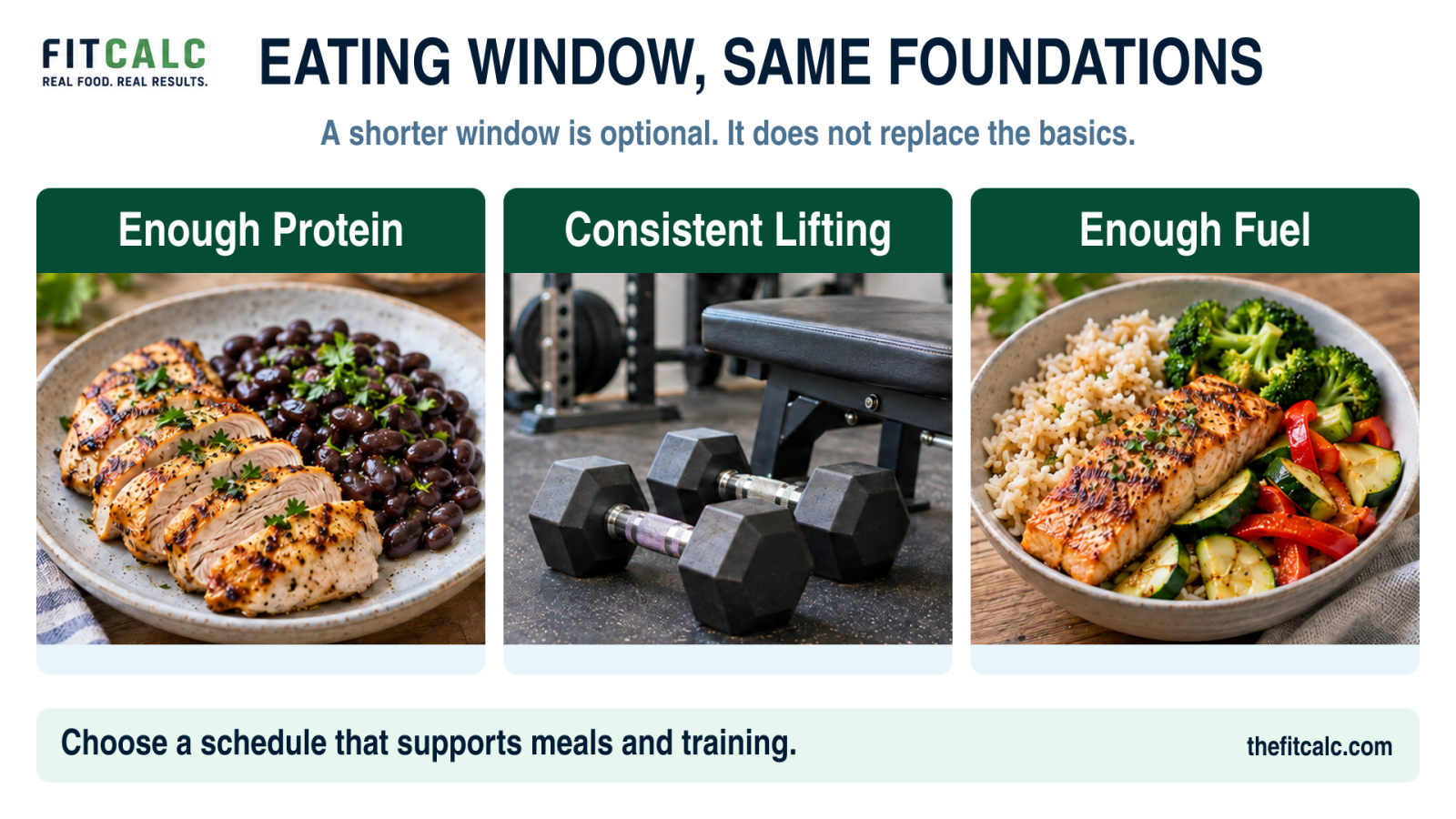
Before choosing meal times, establish a suitable daily protein target. Sports-nutrition guidance emphasizes adequate total protein and distributing useful portions across the day. It does not establish that squeezing the same food into the smallest possible window is better for building or retaining muscle.
The FitCalc Protein Calculator distinguishes an evidence-supported range from FitCalc's practical higher target. Use those as starting points for generally healthy adults, rather than treating a round number as a minimum everyone must reach. If a medical condition changes your protein needs, use individualized advice instead.
Now check whether the meals are realistic. As an arithmetic example, 120 grams distributed over three eating occasions averages 40 grams each. Splitting the same total over four occasions averages 30 grams. Neither total nor meal frequency is a prescription. The comparison simply shows why removing an eating occasion changes the portions you need elsewhere.
You could use eggs, fish, meat, dairy foods you tolerate, tofu or other suitable protein foods. Count the entire meal and use amounts you can comfortably eat. A window that repeatedly leaves most of the day's protein for an oversized dinner may be less practical than a longer day with an ordinary breakfast.
Keep Food Available Around Your Workouts
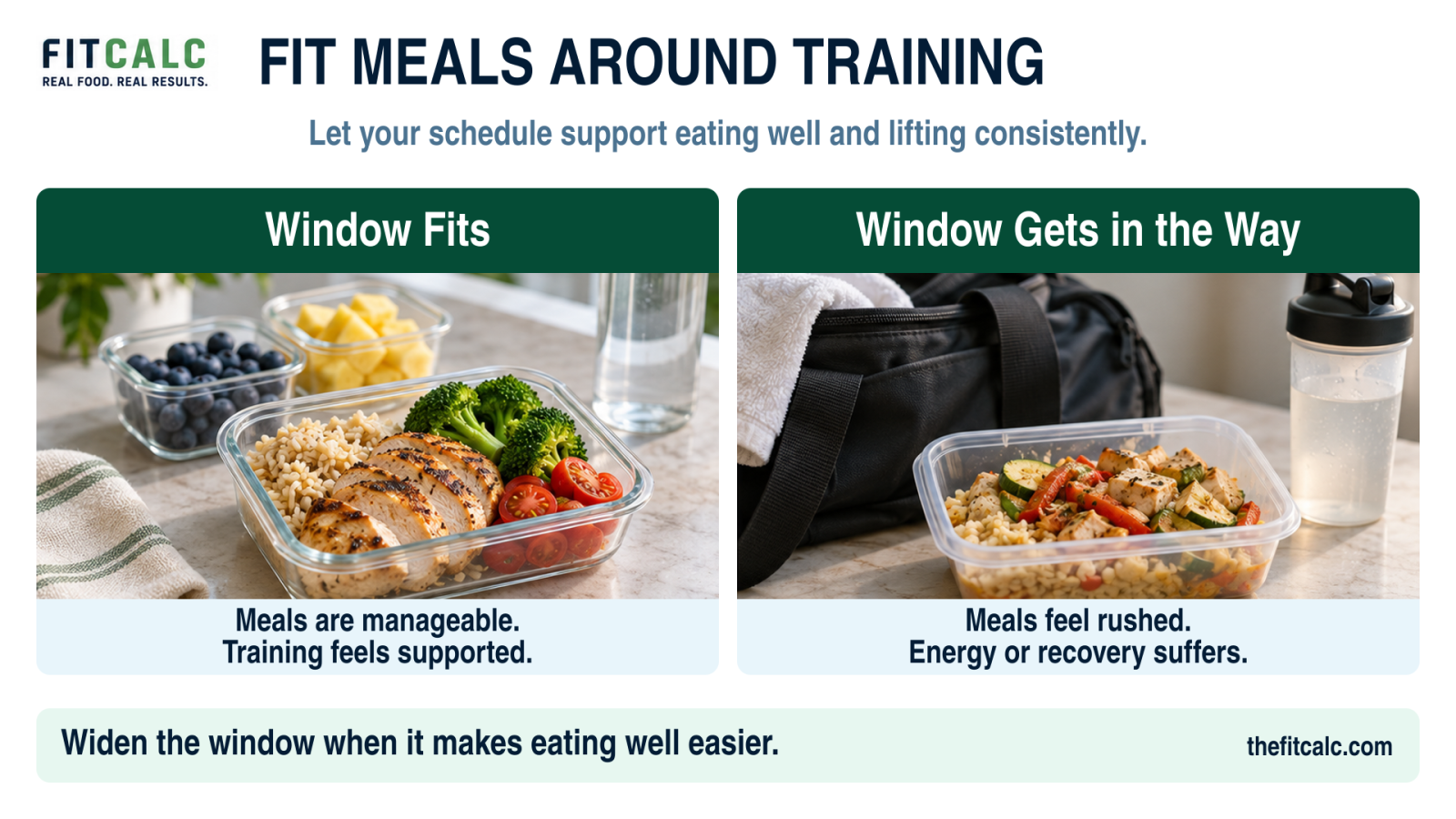
An afternoon or evening lifter may be able to fit meals around training without much difficulty. A person training early in the morning may find that waiting until noon creates an inconvenient stretch without food. Neither needs to copy the other's timetable.
For example, imagine someone who eats lunch, lifts later in the afternoon and then has dinner. Their usual meals already surround the session. Compare that with someone who lifts before work and cannot eat until the afternoon. The second person should consider whether an earlier first meal would make training and recovery easier rather than preserving a window at all costs.
This is practical planning, not a claim that eating at one exact minute determines muscle growth. Our article on eating after a workout explains why the last meal, the next available meal and the next demanding session matter more than a universal thirty-minute deadline.
Include enough carbohydrate-containing food and overall energy to support the work you are doing. A protein target cannot compensate for a routine that leaves you consistently underfed. The Macro Calculator can help organize the daily framework; the meal times should make that framework easier to follow.
A Shorter Window Can Be Awkward During Muscle Gain
Some people use time-restricted eating while trying to gain muscle. It is possible, but reduced eating opportunities can make an already difficult food target harder to meet. If you struggle with fullness or regularly miss meals, shortening the day may solve a problem you do not have.
In a 2025 eight-week trial of 17 well-trained adults, both groups ate a high-protein calorie-surplus diet and completed supervised resistance exercise. Fat-free mass increased in both groups. The time-restricted group nevertheless completed less total training volume and had smaller squat-strength gains. With so few participants, the study cannot settle the best schedule, but it illustrates why performance and practicality deserve attention alongside body composition.
If your priority changes from losing fat to gaining muscle, reassess the meal pattern. You are allowed to add breakfast, use a planned snack or shift dinner. A schedule is a tool for your current goal, not a rule you must maintain after it stops helping.
Check Whether the Routine Is Actually Helping
Write down what you hope a window will improve. Perhaps you want fewer unplanned evening snacks, a simpler workday or less decision-making. Then check that specific outcome. If the result is a rushed lunch, distracting hunger and an uncomfortable dinner, the plan needs adjustment even if you followed the clock perfectly.
Use a short review of ordinary days rather than judging one unusually busy day. Notice whether you can prepare and enjoy meals, whether workouts feel adequately fueled and whether social meals remain manageable. Do not treat a family breakfast or later dinner as a failure that requires compensation the next day.
If you use body-weight tracking, compare measurements taken under similar conditions over several weeks, not an isolated morning. The TDEE Calculator describes how to compare an initial estimate with your usual intake and weight trend. The estimate does not become more precise just because you eat within fixed hours.
Change the least useful part of the routine first. You might keep regular meals and stop buying a snack you rarely enjoy, or widen an existing window so a post-workout meal fits comfortably. You do not need to combine a narrower window, a large calorie cut and more exercise all at once.
Know When Fasting Is the Wrong Experiment
This article is general education for adults, not a fasting treatment plan. Do not use it to set a restrictive eating schedule for children or teenagers, during pregnancy or breastfeeding, or when you have a current or past eating disorder. People who are underweight, frail or struggling to eat enough also need a different conversation from a generic fat-loss article.
Diabetes and medicines that affect blood sugar require particular care. NIDDK's discussion of fasting emphasizes the limits of available evidence and the need to consider individual circumstances. Do not adjust medicine or skip needed food to maintain a window. Discuss the plan with your clinician first if your health or treatment could be affected.
Stop the experiment and seek appropriate advice if it produces dizziness, faintness, persistent weakness, worsening food anxiety or repeated difficulty eating enough. You do not need to push through those problems to make a nutrition plan legitimate.
Practical Takeaways
- Time-restricted eating is optional. It can help organize meals, but it has not consistently outperformed a workable calorie-controlled pattern.
- Keep resistance training, adequate protein and sufficient overall nutrition in place. A clock does not preserve muscle on its own.
- Choose meal times that let you eat comfortably and support training. Widen the window when it gets in the way.
- During muscle gain, fewer eating opportunities may make it harder to get enough food.
- Use professional guidance when a medical condition, medication, pregnancy, low intake or eating-disorder history changes the risks.
Sources
NIDDK. What Can You Tell Your Patients About Intermittent Fasting and Type 2 Diabetes? 2024.
NIH News in Health. To Fast or Not to Fast. December 2019, pages 1–2.