Do You Need to Eat Immediately After a Workout?
You finish your last set, check the time, and realize dinner is still an hour away. Do you need to buy a protein shake before leaving the gym, or can the meal you already planned do the job? For most everyday lifters, there is no need to treat the first few minutes after training as an emergency.
Eating after exercise matters, but the useful question is not simply how quickly you can swallow something. It is when you last ate, what that meal contained, whether another demanding session is coming soon, and how the next meal fits into your day. A practical recovery plan accounts for those details without turning every workout into a race against a stopwatch.
What the “Anabolic Window” Gets Wrong
Resistance exercise and dietary protein both stimulate muscle protein synthesis, the process of building new muscle proteins. That does not mean muscle stops responding to food half an hour after your workout. The International Society of Sports Nutrition describes the response to exercise as lasting at least a day, while also noting that it changes over time. This supports eating regularly during recovery, not postponing food indefinitely or panicking about a short delay.
A 2024 trial compared protein consumed immediately around workouts with protein consumed three hours before and three hours after them. The resistance-trained men ate a high-protein diet and trained for eight weeks. The researchers did not find a clear advantage to the immediate schedule for the principal muscle and performance outcomes. It was a small trial in a specific population, not proof that timing never matters, but it is difficult to reconcile with claims that a short post-workout window determines whether training “counts.”
There is also a difference between a short laboratory measurement and a long-term result. A study measuring protein synthesis for several hours can explain part of the recovery process; it cannot, by itself, establish that a particular snack produces more muscle over months. Be wary when an advertisement turns an acute response into a guaranteed body-composition outcome.
Start With Your Last Meal
Before deciding what to eat after lifting, look backward. The size and timing of a pre-exercise meal influence how urgent the next feeding is, which is why nutrient-timing guidance considers both sides of the workout. Eating beforehand does not disappear from the equation when you start your first set.
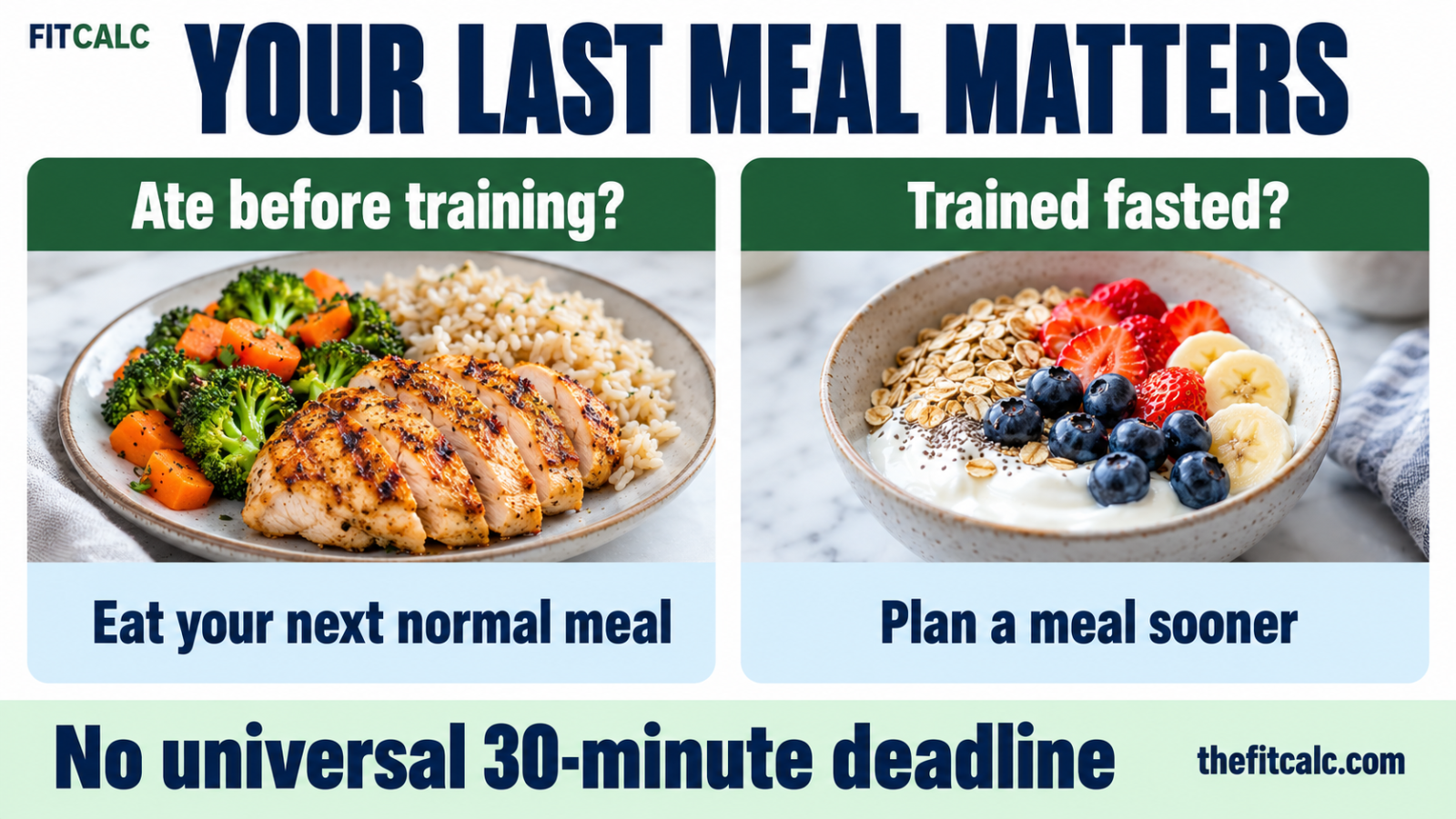
You Ate Before Training and a Meal Is Coming Soon
Suppose you eat a chicken-and-rice lunch at noon, lift from 2:00 to 3:00 p.m., and have a planned meal at 4:00 p.m. That is a different situation from exercising before breakfast. There is little practical reason to force down a separate recovery shake while driving home simply because the session has ended.
In that example, keep the planned meal and judge the whole routine: does lunch sit comfortably, is training productive, and are you meeting your daily nutrition needs? These times illustrate a workable schedule, not a universal rule that everyone must reproduce. If work or travel routinely turns the planned 4:00 meal into an 8:00 meal, pack a convenient backup instead.
You Trained Fasted or Have Not Eaten for Hours
If your last meal was dinner and you train the following morning, breakfast deserves more attention. The practical move is to plan a protein-containing meal after the session rather than continue the fast accidentally because the morning becomes busy. You still do not need to eat in the changing room, but there is usually no practical recovery reason to deliberately add several more food-free hours.
The same planning issue can arise after work. A rushed lunch, a long commute and an evening workout can leave a much larger gap than you intended. Put a simple meal or snack where you can actually use it: in a refrigerator at work, in an insulated lunch bag, or ready to reheat at home. The best schedule on paper is not helpful if it depends on cooking from scratch when you are already exhausted.
Build a Meal, Not a Supplement Ritual
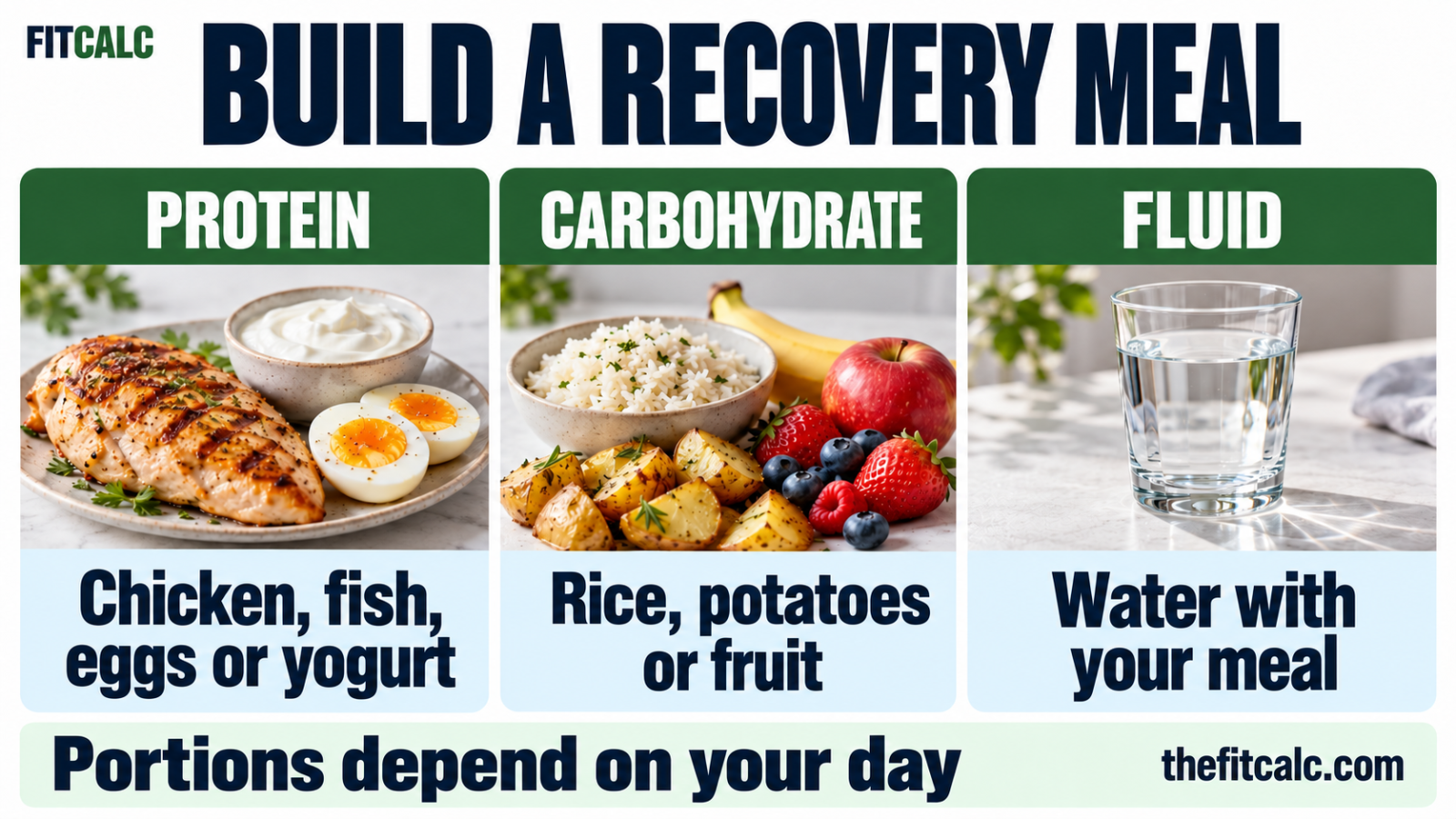
A protein-containing main meal can be your post-workout meal. Chicken, fish, lean meat, eggs, dairy foods and suitable plant-protein options can all have a place, depending on your preferences and the rest of your diet. Choose portions that contribute meaningfully to your daily target instead of assuming that any food with a protein claim supplies enough for your plan.
Whole-food research provides a useful reality check. A 2026 trial gave resistance-trained young adults protein from several foods after lower-body exercise, including eggs, salmon, pork, lentils and mycoprotein, with egg whites as the more isolated comparison. Muscle protein synthesis increased without a statistically significant difference between the groups over the measured period. This was an acute experiment, not a long-term ranking of meals, but it reinforces that recovery nutrition need not come from a powder tub.
Use a meal you already enjoy as the starting point. Chicken with rice and vegetables, fish with potatoes, an egg-based meal with toast, or tofu with rice can be practical templates. These are meal ideas, not nutritionally interchangeable servings; the protein and calories depend on quantities and preparation. Check labels or your usual food entries when portions matter to your target.
If a full meal is inconvenient, a smaller bridge can work better than an elaborate “recovery stack.” For example, take a sandwich to eat before the journey home, or keep a yogurt and fruit available if you tolerate dairy. A shake can be convenient when preferred, but convenience is its job. It is not a compulsory step that turns an otherwise adequate diet into an effective one.
How Much Protein Should That Meal Contain?
Sports-nutrition guidance commonly discusses roughly 20–40 grams of high-quality protein per feeding, with requirements influenced by body size, age and training context. Treat that as a useful planning range, not a strict absorption ceiling or a rule that makes a larger dinner wasteful. Your daily intake and the way you distribute it still need to fit together.
For an arithmetic example, someone planning 140 grams across four eating occasions could aim for an average of 35 grams each: 140 ÷ 4 = 35. Their post-workout dinner might supply one of those portions. The 140-gram target is illustrative, not a recommendation for every reader, and the four meals do not need identical amounts.
If you have not established a daily target, use the FitCalc Protein Calculator before obsessing over the timing of one meal. Its practical recommendation and evidence-supported range serve different purposes; neither can tell you whether a particular dinner is appropriate without considering the rest of the day. This article is general education for healthy adults, not a substitute for individual nutrition advice where a medical condition changes your needs.
When Carbohydrate Timing Becomes More Important
Protein timing and fuel replacement are related but different questions. Carbohydrate helps replenish muscle glycogen used during exercise. In a classic experiment involving prolonged cycling, consuming carbohydrate immediately afterward restored glycogen faster during early recovery than waiting two hours. That result concerns rapid fuel restoration after a demanding session, not a universal deadline for muscle growth after every lifting workout.
The distinction matters when you have two demanding sessions close together. A morning session followed by another hard session later that day creates a different recovery problem from lifting on Monday and returning on Wednesday. Sports-nutrition guidance gives specific rapid-refueling strategies for short recovery windows; an everyday lifter with a normal meal schedule does not automatically need to copy an endurance athlete’s aggressive carbohydrate protocol.
For a regular gym day, make room for carbohydrate foods you like in the meals around training. Rice, potatoes, bread and fruit are convenient options, and the portion should fit your appetite, total food intake and training demands. If you regularly combine heavy lifting with lengthy sport sessions or tournament play, consider a more individualized fueling plan rather than treating one snack as a complete solution.
A Recovery Meal Still Counts Toward Your Calories
Do not give food a separate accounting category just because it follows exercise. If you already budgeted for dinner, moving it closer to training changes its timing, not its calorie content. Adding a recovery snack as well may be useful when you need more food, but it should be a deliberate choice rather than an automatic reward for finishing your sets.
Consider a purely illustrative day planned at 2,300 calories. If those meals remain unchanged and you add a 300-calorie snack, the new total is 2,600 calories: 2,300 + 300 = 2,600. That is not inherently good or bad, and neither number is a recommendation. It simply shows why a snack can help someone who needs extra intake while making another person’s planned deficit smaller.
The FitCalc Macro Calculator can help organize the daily framework. Then place the meal where it works in your schedule. During a cut, you might reserve some of the day’s food for after training; during a gaining phase, you might make that meal more substantial. Neither approach requires inventing a special post-workout calorie allowance.
Make Your Next Workout Easier to Plan
Choose your next post-workout meal before you leave for the gym. Check when your last protein-containing meal will be, whether the next meal is genuinely available, and whether you have another demanding session coming soon. Those three questions are more useful than asking whether a banana or shake must be consumed at an exact minute.
Keep one backup option for the days when the plan changes. If dinner is delayed, use it; if dinner is ready, you do not have to eat the backup too. Aim for a routine you can repeat comfortably, then put your attention back on consistent training, adequate food across the day and recovery between sessions.
Key Takeaways
- A normal protein-containing meal after training is a sensible default. You do not need a mandatory shake or a rigid 30-minute deadline.
- If you trained after an overnight fast or a long gap without food, make eating afterward a higher priority.
- If you ate a substantial meal before lifting and dinner is coming soon, that dinner can usually be your recovery meal.
- Rapid carbohydrate replacement matters more when you have a short turnaround before another demanding session.
- Count recovery meals and snacks within your daily food plan rather than automatically adding them on top.
Sources
Jäger et al. (2017). International Society of Sports Nutrition Position Stand: protein and exercise.
Kerksick et al. (2017). International Society of Sports Nutrition position stand: nutrient timing.