How to Eat 150 Grams of Protein a Day Without Protein Powder
Eating 150 grams of protein can sound like a job that requires shakes, bars and a cupboard full of specialty products. In practice, the harder part is usually deciding what each meal will contain before the day gets away from you. Ordinary eggs, chicken, fish and other familiar foods can do the work, provided their portions add up.
This article turns that idea into a usable day of eating. You will see the actual food weights, a realistic total and a way to adjust the meals without treating 150 grams as a requirement for everyone. The example contains no protein powder or dairy, but it is a planning demonstration, not a claim that either must be avoided.
First, check whether 150 grams makes sense for you
A round number is convenient, but it is not a physiological threshold. Protein needs depend on body size, training, goals and health. The International Society of Sports Nutrition describes roughly 1.4–2.0 grams per kilogram per day as sufficient for most exercising adults, with circumstances such as dieting potentially changing the appropriate amount. FitCalc often uses about 1 gram per pound as a straightforward planning preference for healthy lifters, not as the minimum everyone needs.
For perspective, 150 grams is about 2.2 g/kg for a 150-pound person and about 1.7 g/kg for a 200-pound person. Neither calculation tells the whole story. Research on resistance training supports getting enough protein, but does not establish that continually increasing an already adequate intake produces proportionally more muscle. Our complete protein resource explains that evidence and FitCalc's recommendation in more depth.
Use the Protein Calculator to choose a starting point before copying someone else's menu. If you have kidney disease or another condition affecting your nutrition needs, get an individualized target rather than applying this example. The same menu should not automatically be assigned to children, pregnant people or anyone following a medically prescribed diet.
Build the day around a few dependable protein foods
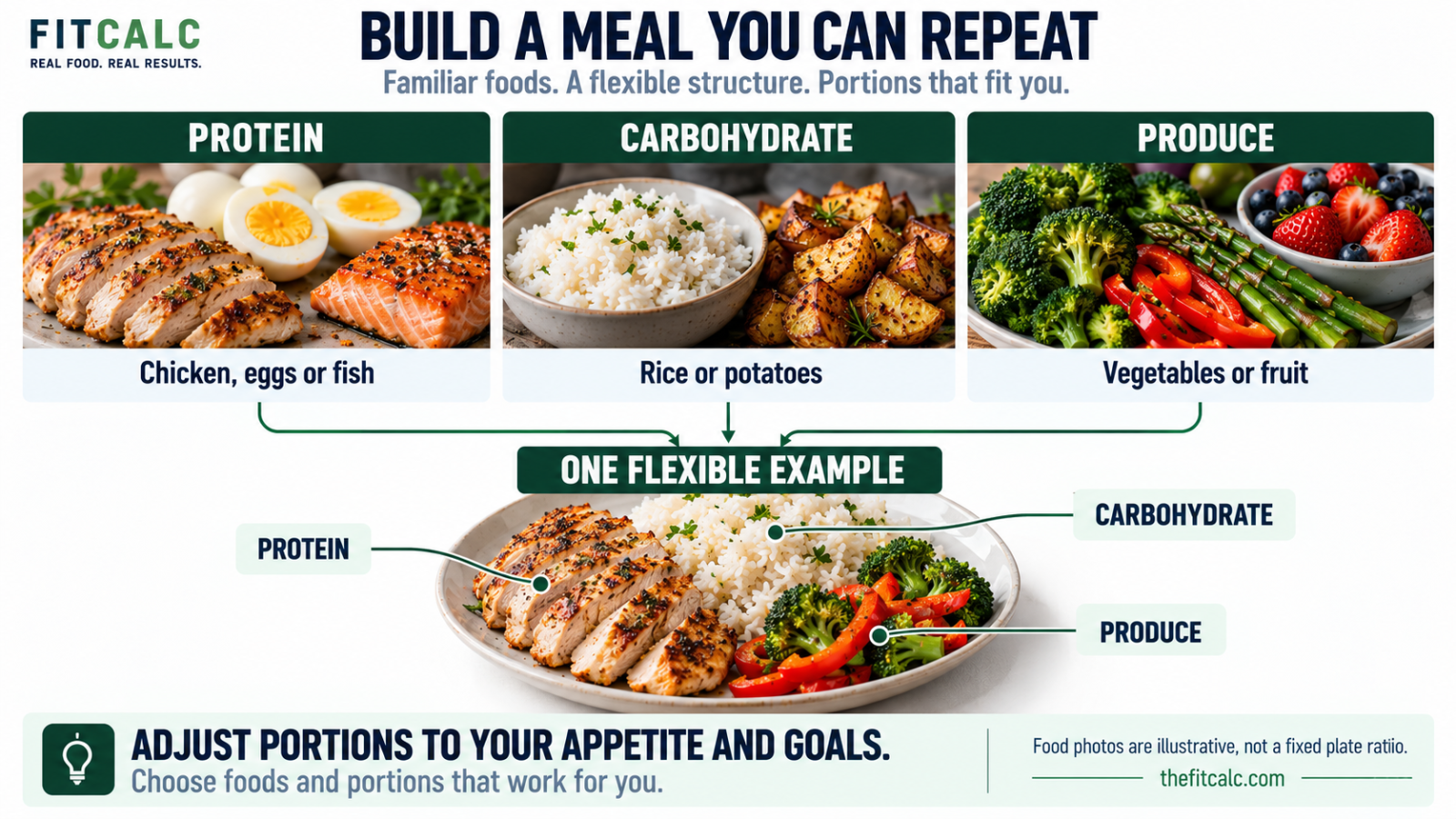
The easiest approach is to give your main meals a clear protein source, then count what the accompanying foods contribute. That might mean eggs at breakfast, chicken at lunch and fish at dinner, with a smaller meal filling the remaining gap. You do not need a special product at every eating occasion, and you do not need to make all four meals identical.
There is a useful distinction between planning the protein source and ignoring everything else. Rice, potatoes, vegetables and fruit contain some protein too. Those contributions belong in the total, although they are not interchangeable with a substantial serving of meat or fish. Counting the whole meal is more accurate than treating everything beside the chicken as nutritionally invisible.
You can distribute the food over three meals, four meals or another schedule you can sustain. This example uses four eating occasions because the portions are manageable and a spare container can fit a workday. It is not a mandatory meal frequency or a rule about how much protein your body can absorb at once.
A full example day: about 152 grams of protein
The following estimates use USDA FoodData Central's SR Legacy reference foods. Chicken, salmon, rice, potatoes and broccoli are weighed after cooking; eggs are weighed without shells, and fruit weights are edible portions. Oil is weighed separately. The database entries describe plain foods, so sauces, drinks and additional cooking fats are not silently included.
Real foods vary with size, variety, water loss and preparation. Use the label for a specific packaged product when available, and match the database entry to what you actually eat. The precise calculations below have been rounded for readability; they are not a laboratory analysis of your plate.
Breakfast: eggs, rice and a banana
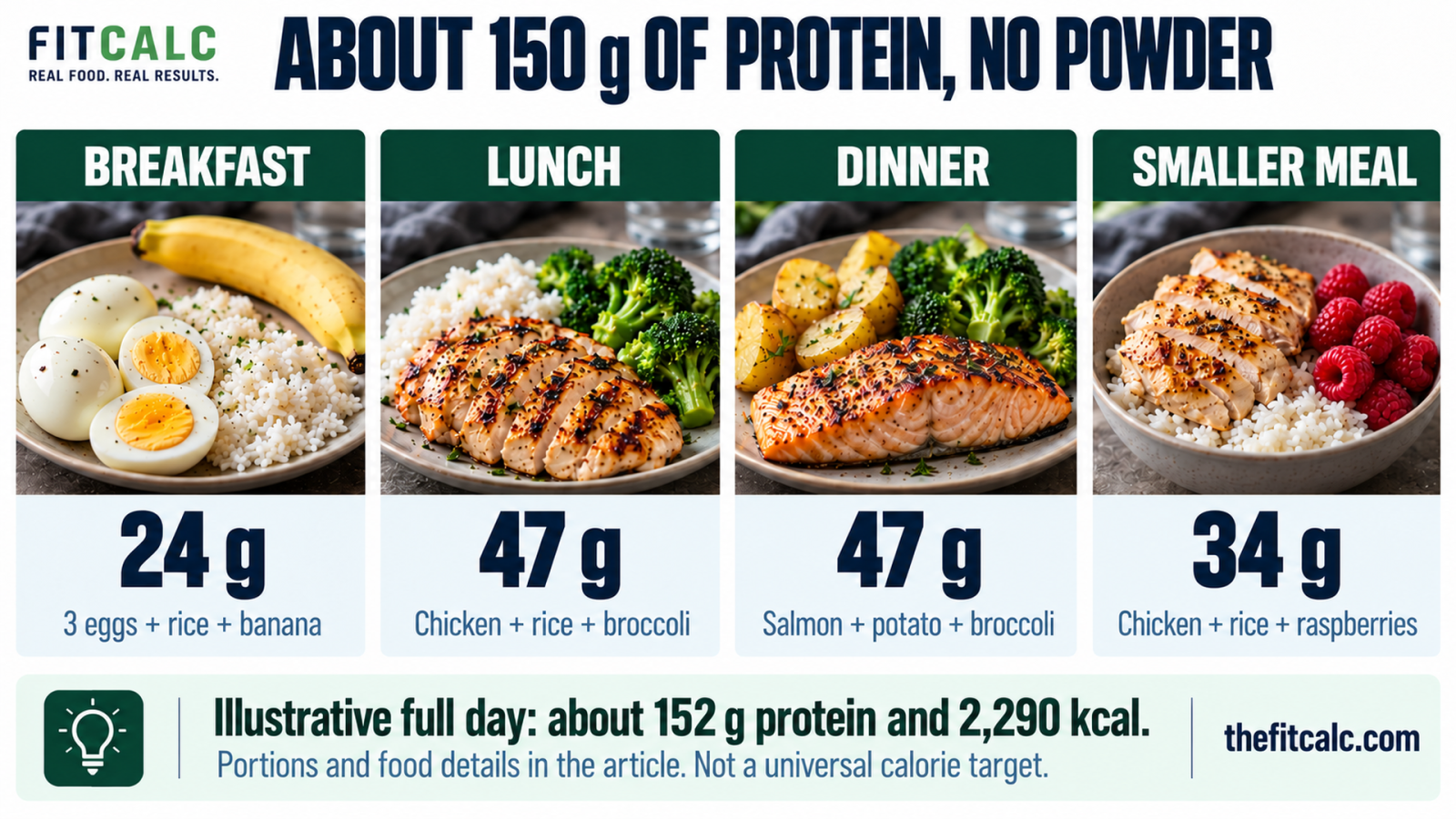
Start with three large hard-boiled eggs, approximately 150 grams without shells, plus 150 grams of cooked white long-grain rice and one medium banana, approximately 118 grams peeled. This combination provides about 24 grams of protein and 533 calories. The eggs supply roughly 19 grams of the protein; the rice and banana contribute the rest.
If rice at breakfast is not your preference, choose another carbohydrate food and recalculate the portion rather than assuming every side has the same nutrition. The important habit is keeping the eggs or another deliberate protein source in the meal. Scrambling the eggs can also work, but any added oil, butter or other ingredients need to be counted.
Lunch: chicken, rice and broccoli
Pack 130 grams of plain roasted, skinless chicken breast, 200 grams of cooked white rice and 75 grams of cooked broccoli. Add 10 grams of olive oil as a measured dressing or finishing oil that you actually eat. Using these reference entries, lunch provides approximately 47 grams of protein and 589 calories.
This is a practical batch-cooking meal because the protein and carbohydrate portions can be adjusted independently. Keep seasonings simple, then add flavor with a sauce whose label you can account for. If you cook the chicken in oil instead, do not count the same oil twice as both a cooking ingredient and a finishing ingredient.
Dinner: salmon, a baked potato and broccoli
Use 170 grams of cooked farmed Atlantic salmon, 300 grams of baked potato with its skin, another 75 grams of cooked broccoli and 10 grams of olive oil. Dinner supplies about 47 grams of protein and 744 calories. The estimate is specific to that salmon reference, not a universal value for every species, cut or preparation.
The potato contributes roughly 7.5 grams of protein, which is meaningful in the daily calculation even though salmon remains the meal's primary protein food. You could swap the vegetables or use a different fish, but the new foods deserve their own entries. A breaded fillet or a heavily sauced restaurant serving is not the same meal as plain cooked salmon.
A smaller meal: chicken, rice and berries
Use 90 grams of cooked chicken breast, 150 grams of cooked white rice and 150 grams of raspberries, eaten together or with the berries on the side. This provides around 34 grams of protein and 422 calories. It can be a smaller afternoon meal or an evening meal, depending on when you are hungry.
There is no requirement to call this a snack or to eat it after a workout. Its job is to make the day's total achievable without forcing an enormous dinner. If an extra container is inconvenient, divide its chicken and rice between lunch and dinner and eat the berries whenever they fit.
What the entire day adds up to
Using the unrounded ingredient values, the day totals approximately 152 grams of protein and 2,290 calories. The four rounded protein amounts are 24, 47, 47 and 34 grams. That is close enough to illustrate a 150-gram target without pretending that landing on exactly 150.0 is necessary; the rounded meal calories will differ slightly from the rounded full-day total.
The menu also includes carbohydrate foods, fruit, vegetables and dietary fat. Even so, this is one example day rather than a complete long-term nutrition prescription. Your calorie requirement, food preferences and need for variety still matter. Hitting a protein number does not, by itself, establish that every other part of your diet is appropriate.
Make swaps using protein and calories, not food weight alone
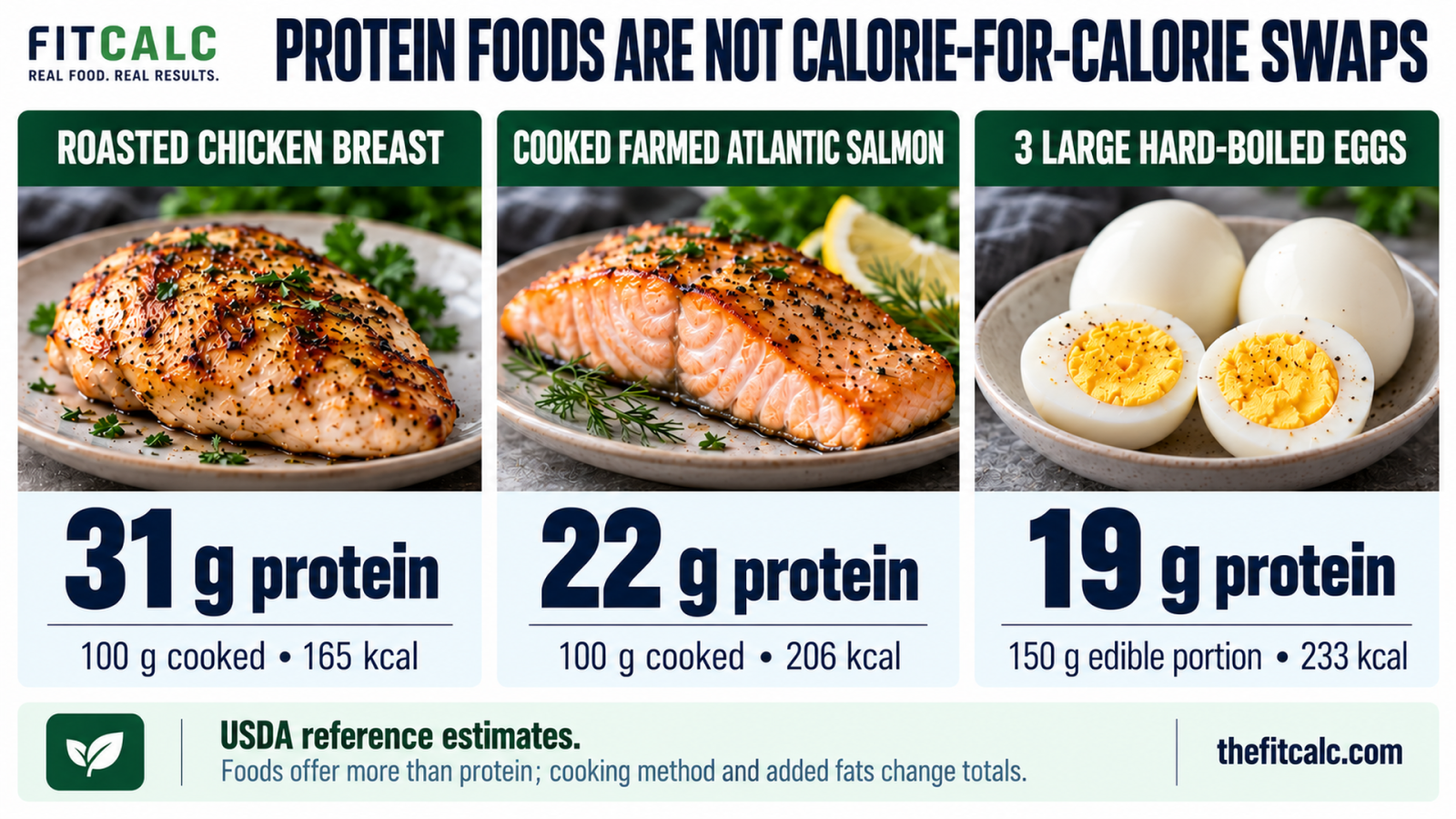
A 100-gram serving of food is not automatically a 100-gram serving of protein. In the USDA references used here, 100 grams of cooked chicken breast provides approximately 31 grams of protein and 165 calories. The same weight of cooked farmed Atlantic salmon provides about 22 grams and 206 calories. Three large hard-boiled eggs provide around 19 grams and 233 calories.
These are different foods, not a ranking of which one is good or bad. Salmon and eggs bring their own nutrients and flavor, while lean chicken makes it easier to add protein without adding as much energy. When changing the menu, check whether the replacement preserves the protein amount and whether its calories still fit the day.
For example, adding 50 grams of this cooked chicken contributes roughly 16 grams of protein and 83 calories. Adding 50 grams of the cooked rice contributes only about 1 gram of protein and 65 calories. Both may be useful additions, but they solve different problems. If protein is already adequate and you need more energy, more rice may be exactly what you want.
Beef, turkey and other fish can replace the repeated chicken in a real week. Use the actual cut, fat percentage and preparation when logging them. Dairy foods can also be convenient for people who tolerate and enjoy them; their absence here simply demonstrates that a high-protein day does not depend on dairy or powders.
Keep the food weights and labels consistent
One common source of confusion is weighing food cooked while logging a raw entry, or doing the reverse. Cooking changes water content, so the same number of grams can describe substantially different portions. A raw package weight cannot simply be substituted for one of the cooked weights in this example.
If you prefer to measure ingredients before cooking, build a recipe from those ingredients and divide the finished batch into portions. Our article on weighing food raw versus cooked walks through that method. Pick one consistent approach rather than switching between entries because one produces a more appealing total.
For packaged foods, check the serving weight and number of servings rather than relying on the large number on the front. The FDA notes that Nutrition Facts amounts apply to the stated serving, which is not a recommendation for how much you personally should eat. If you eat twice the serving, you need to account for twice its listed protein and calories.
Prep enough to make tomorrow easier
You do not have to prepare a full week of identical meals. Cooking a couple of portions of chicken and rice, boiling eggs and keeping fruit ready can remove several decisions from the next day. Portion the foods you find easy to underestimate, and leave some flexibility for dinner rather than designing a plan that only works when every meal is eaten at home.
Keep food safety separate from convenience. USDA guidance says to refrigerate perishable leftovers promptly, within two hours, or one hour if the temperature is above 90°F. Keep the refrigerator at 40°F or below, use refrigerated leftovers within three to four days and freeze portions intended for later. An insulated bag with suitable cold packs matters when your food will be away from refrigeration.
Adjust the calories without turning every addition into more protein
The sample's roughly 2,290 calories could be too much, too little or about right depending on the person. Once your protein target is established, use your energy needs to decide the rest of the menu. The Macro Calculator can help you see how protein, carbohydrate and fat fit together instead of treating protein as the only number worth planning.
If you need more calories, larger rice or potato portions, additional fruit or measured fats can expand the day. If you need fewer, adjust portions thoughtfully and recalculate rather than removing entire food groups by default. Some protein will change when you alter side dishes, so check the complete meal again. Keep space for fiber-rich foods too; our article on fiber on a high-protein diet covers that part of the balance.
A protein powder can be convenient, but convenience is different from necessity. If ordinary meals already meet an appropriate target, you do not need to add a shake just because you lift. The useful question is whether your eating pattern supports your goals and is realistic to repeat, not whether it looks like a supplement advertisement.
Practical takeaways
Choose a personal protein target before adopting 150 grams.
Give each main meal a deliberate protein source, then count the entire meal.
Use food weights and nutrition entries that describe the same cooked or raw state.
Check calories as well as protein when swapping eggs, meat or fish.
Prepare manageable portions safely and adjust the rest of the day to your energy needs.
You can reach about 150 grams without protein powder by assembling familiar foods in useful portions. The real advantage is not the absence of a shake. It is knowing what your meals provide, keeping the plan flexible and avoiding a last-minute scramble to make up the entire day's protein at dinner.
Sources
USDA FoodData Central: Downloadable Data, SR Legacy. Reference nutrient values for the nine foods used in the illustrative menu; calculations use edible gram weights and plain-food preparation descriptions.
Jäger R, et al. International Society of Sports Nutrition Position Stand: protein and exercise. 2017. Context for protein intake among exercising adults and the use of whole-food protein sources.
Morton RW, et al. Protein supplementation and resistance-training gains: systematic review, meta-analysis and meta-regression. 2018. Evidence for adequate total protein and diminishing additional benefit, not a requirement to use powder.
FDA: How to Understand and Use the Nutrition Facts Label. Serving-size interpretation and scaling nutrient amounts to the amount eaten.
USDA FSIS: Leftovers and Food Safety. Refrigeration timing, safe storage and leftover handling.
NIDDK: Healthy Eating for Adults with Chronic Kidney Disease. The need for individualized nutrition and protein advice in chronic kidney disease.