What Should You Eat Before a Workout? Practical Nutrition for Lifters
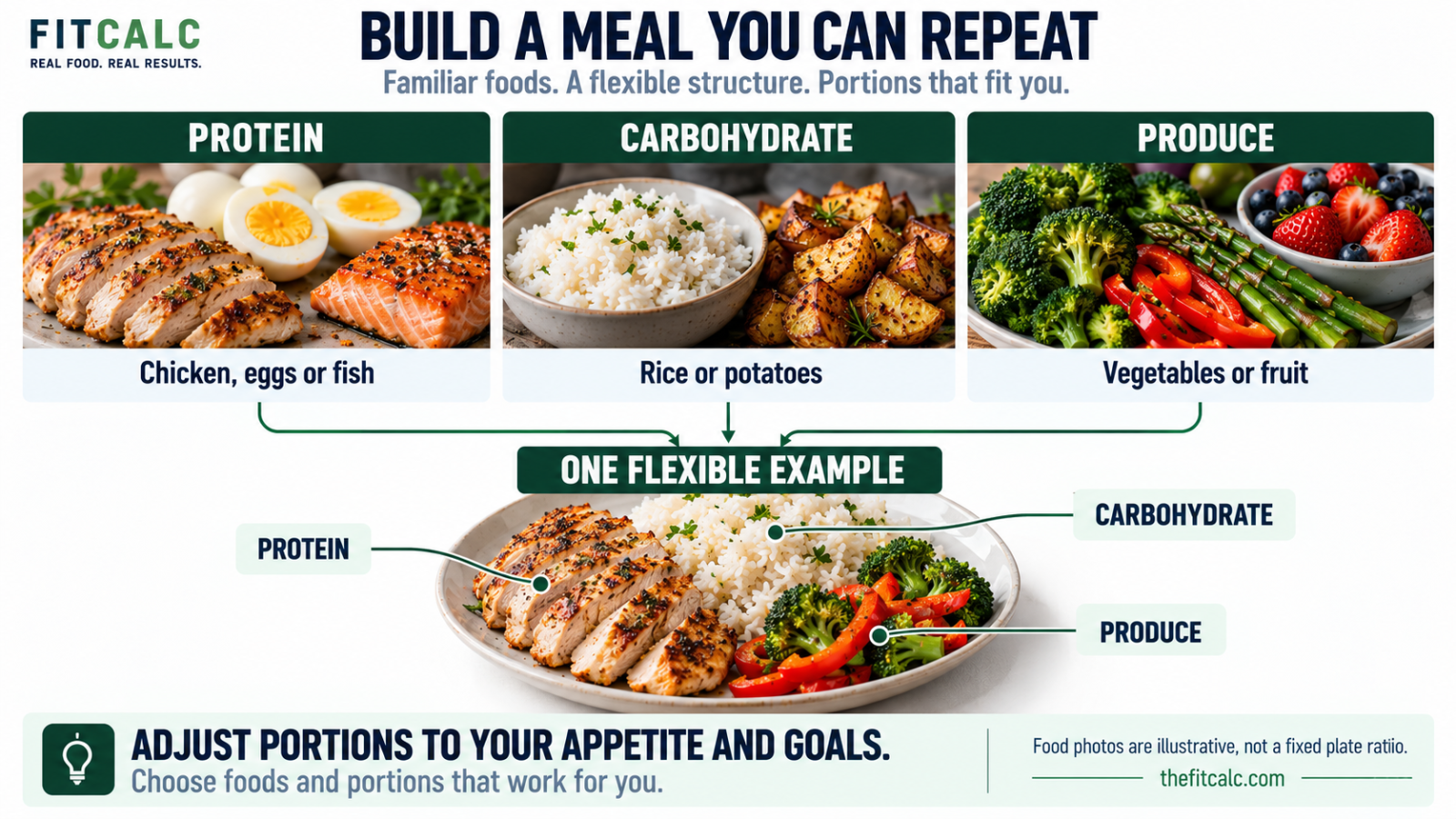
Chicken and rice, eggs with potatoes, or yogurt and fruit can all fit before a workout. The useful question is which meal fits the time you have. A full lunch eaten earlier in the afternoon and a banana grabbed on the way to the gym solve different problems.
For everyday lifters, a sensible starting point is to eat a normal meal when there is time, choose something smaller when training is close, and pay attention to comfort and performance. You do not need to force another meal into a day that already leaves you comfortably fed.
Start with your last meal and the session ahead
Before choosing food, consider when you last ate and whether that meal was substantial enough for you. If lunch was recent and you feel comfortable, the answer may be to bring water and train. If you have barely eaten since morning, planning some food before an evening session makes more practical sense.
Then consider the workout. A brief session of a few exercises and a demanding session with repeated hard sets are different experiences. Food decisions can also change when lifting follows another workout. Avoid treating every gym visit as if it needs the same elaborate preparation.
Finally, check your own pattern. Do you reliably become hungry halfway through? Does a large meal leave you uncomfortably full? The purpose of planning is to solve that specific problem. A convenient routine you can repeat is more useful than a complicated menu you abandon when work runs late.
What the research actually says about eating before lifting
Sports-nutrition recommendations often cover endurance events alongside other sports. The Academy, Dietitians of Canada, and ACSM position statement discusses substantial pre-event carbohydrate intakes for prolonged exercise. Those recommendations should not automatically become compulsory portions for an ordinary lifting session.
Direct resistance-training studies show why context matters. In a trial published in 2024, 39 trained adults completed afternoon workouts after eating breakfast and lunch or consuming the same food at lunch only. The researchers found no significant differences in the measured training outcomes between conditions. Both conditions included food before exercise, so this does not tell us that going all day without eating is equivalent.
A 2025 crossover trial compared higher-carbohydrate and lower-carbohydrate liquid breakfasts with a low-calorie placebo in 16 trained participants. Researchers detected no significant difference in total repetitions during the approximately 90-minute, upper-body-dominant session. This small study cannot settle every training situation, but it argues against promising that a larger carbohydrate dose always produces more reps.
Results are not uniformly negative. In a 2020 study in trained men, both a carbohydrate breakfast and a low-energy placebo breakfast increased back-squat repetitions compared with water alone; bench-press repetitions did not differ. The similar breakfast responses make it difficult to separate the effects of nutrients, appetite, and expectations. Your experience of eating can matter without proving that one precise nutrient dose is essential.
The practical conclusion is modest: use food to support your routine, and evaluate how you actually train. For the broader question of carbohydrate intake, read Are Carbs Actually Necessary for Building Muscle?
How long before your workout should you eat?
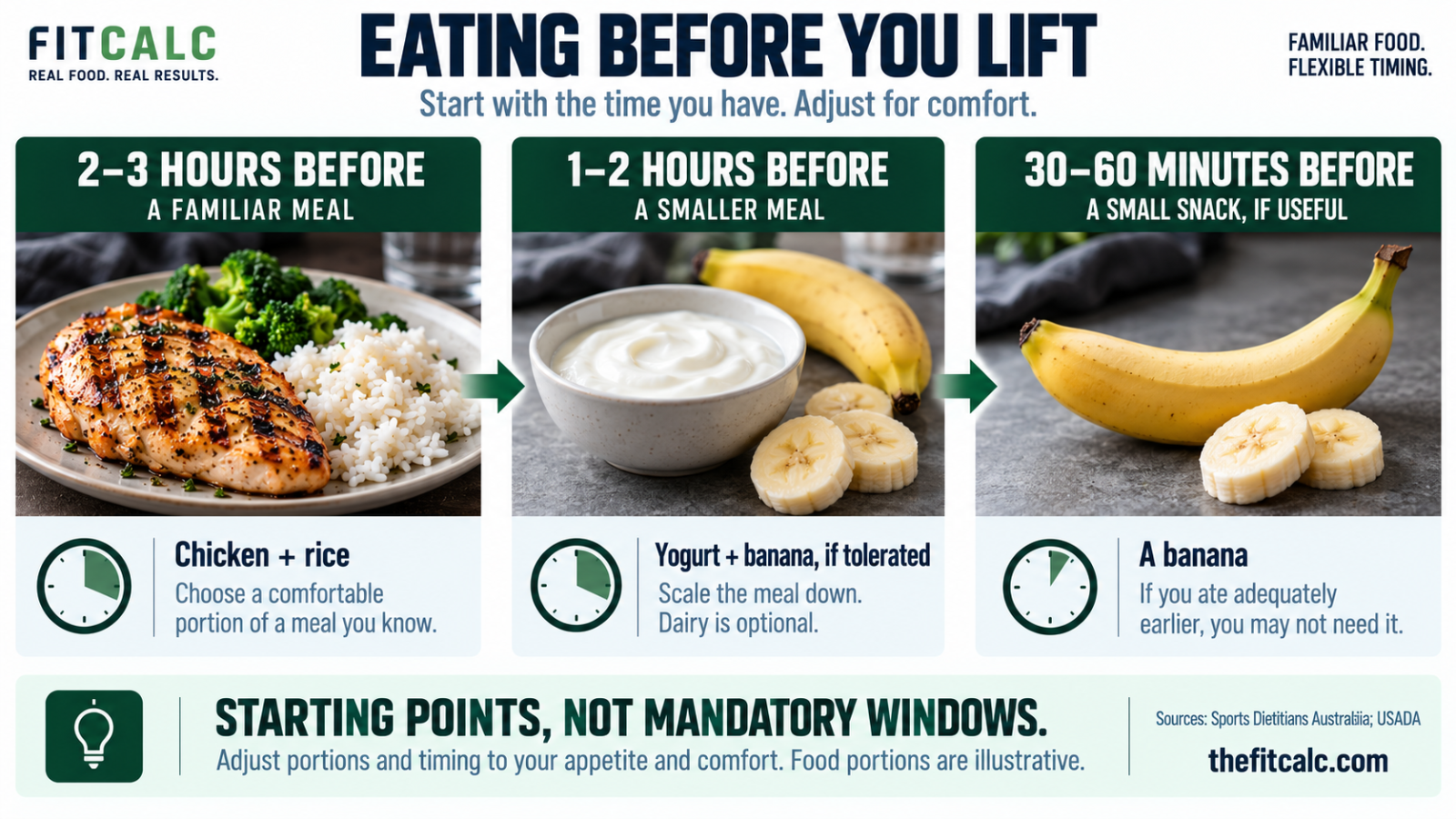
Sports Dietitians Australia offers a balanced meal around two to three hours before exercise as a starting point, with smaller snacks closer to the start. Treat that as a place to begin experimenting. The windows below overlap because meal size, food choice, and individual tolerance vary.
About two to three hours before: a familiar meal
This is a convenient place for an ordinary meal containing a protein food and a carbohydrate food. Think chicken with rice, white fish with potatoes, or eggs alongside rice and fruit. Add vegetables in an amount you already know sits well. You can prepare the same foods you eat on other days.
Keep the serving comfortable rather than trying to make one meal cover the entire day. If a rich sauce or generous amount of cooking oil makes your usual meal feel heavy, try a simpler preparation before training. Fish baked with potatoes may suit you better in this slot than the same foods deep-fried.
If you want help organizing your daily intake, the FitCalc Macro Calculator provides a planning estimate. Then arrange those meals around your schedule, adjusting portions and timing for comfort.
About one to two hours before: scale the meal down
With less time, try a smaller version of a meal you tolerate. Examples include a modest bowl of yogurt with banana, a small rice bowl with chicken, or a little leftover potato with egg. Dairy is optional; choose another familiar food if it does not agree with you.
Large amounts of fat, fiber, or protein close to exercise can cause discomfort for some people, as USADA's nutrient-timing guidance explains. That makes an oversized bowl loaded with nuts, seeds, cream, and protein powder a less useful first experiment than something simple. These ingredients can still fit elsewhere in the day.
About 30 to 60 minutes before: a small snack if useful
If you are hungry and training soon, consider a banana or a small portion of another familiar fruit. A little yogurt may work if you know you tolerate it. Keep the choice easy enough that you can judge whether it helps without feeling obliged to finish a full meal.
This window is an illustrative option, not a deadline for getting food into your system. If you ate adequately earlier and feel ready, another snack may add little. If you have missed several meals, a last-minute bite is also a reason to plan the next training day better.
Where do eggs, meat, fish, and dairy fit?
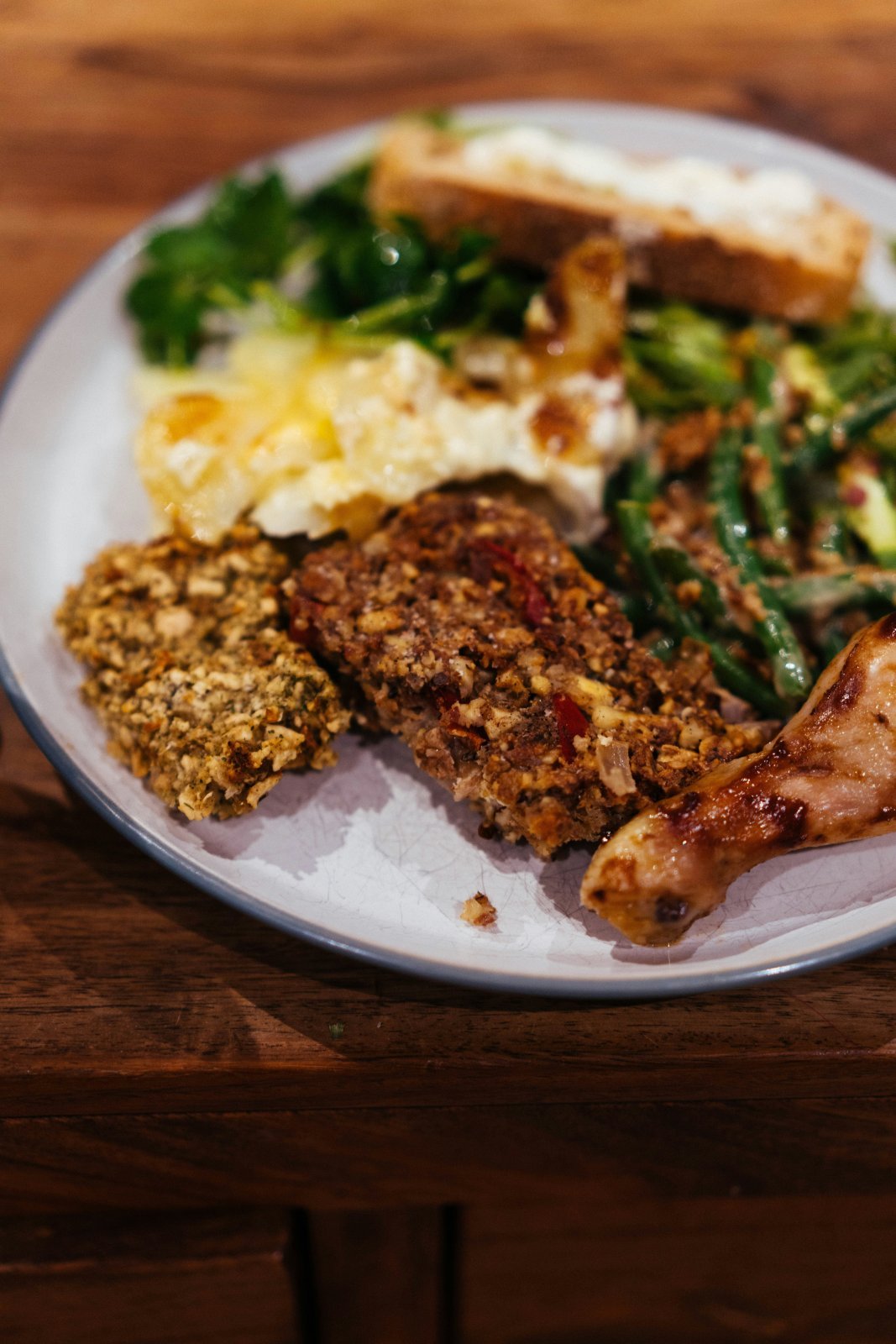
You can build your pre-workout routine around ordinary foods rather than a special product. Preparation changes the meal: eggs with a modest serving of potatoes are a different proposition from a large fried breakfast, and lean chicken with rice differs from chicken in a heavy cream sauce.
Choose foods you enjoy, then adjust their placement. If salmon or a larger beef meal sits comfortably when eaten earlier, keep it there. If you prefer a substantial egg breakfast but lift soon after waking, eating that breakfast afterward may make your morning easier. These are practical meal arrangements, not claims that one protein food outperforms another.
Keep the daily plan in view with the FitCalc Protein Calculator if you need a starting estimate. There is flexibility around the workout: a small training study comparing protein immediately before versus after lifting found similar muscular adaptations. It does not establish an exact rule for every mixed meal, but it gives little reason to force a large protein serving immediately before exercise when it makes you uncomfortable.
What if you train first thing in the morning?
An early start may leave little appetite or preparation time. One workable option is a small familiar snack, followed by breakfast after training. Another is training before breakfast if that suits you and you perform well. Prepare the food you want afterward so that a busy commute does not turn a convenient morning workout into an unintentionally prolonged gap without eating.
A 2025 randomized trial followed 28 young adults who trained twice weekly for 12 weeks, either after an overnight fast or after a meal, with isocaloric nutritional guidance. Both groups improved muscle thickness and performance, without significant differences between groups in those outcomes. The small sample and specific program limit how widely this can be applied.
Fasted training also carries no special fat-loss guarantee. In a small aerobic-training trial during a calorie-restricted diet, fat-loss outcomes did not differ between fasted and fed groups. That was cardio research, not a lifting study; it is a useful caution against turning the fuel used during one workout into a promise about long-term body composition.
Adjust a meal that feels uncomfortable
If your pre-workout meal regularly feels too heavy, change one thing first. Move it earlier, reduce the portion, or simplify the preparation. Changing the meal, timing, drink, and workout simultaneously makes it difficult to identify what helped.
For example, if a large yogurt bowl with fruit, oats, nuts, and seeds feels uncomfortable, try a smaller yogurt-and-banana portion before training and eat the remaining foods later. If a rice-and-meat meal works at lunch but feels heavy immediately before lifting, preserve the meal and give it more time.
These are experiments in convenience and tolerance, not elimination diets. You do not need to remove fiber or fat from your overall diet because a large amount close to training bothers you. Repeated or severe symptoms deserve advice from a qualified clinician or sports dietitian rather than increasingly restrictive food rules.
Remember fluids, and keep products optional
Plan to begin training hydrated, without forcing excessive fluid. Sports Dietitians Australia notes that fluid requirements vary between people and across conditions, including workload and sweat losses. Keep water available, and avoid treating a universal bottle-size target as a personalized hydration plan.
The Australian Institute of Sport describes sports foods as convenient ways to supply nutrients when everyday food is impractical. A shake or sports drink can serve a purpose, but the existence of a pre-workout slot does not create a requirement to buy one. Start with accessible food you enjoy.
Build a routine you can repeat
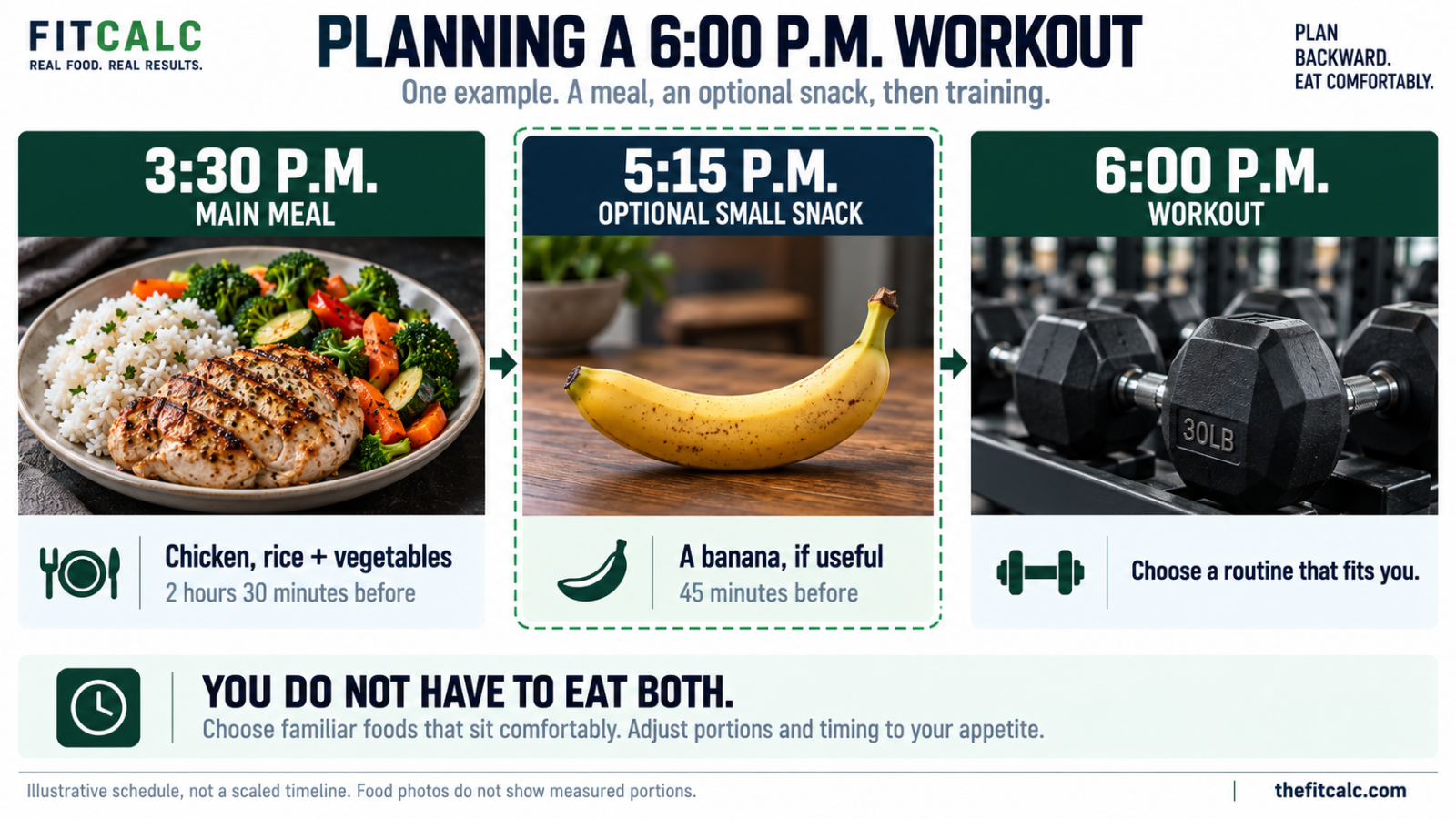
For an illustrative 6:00 p.m. workout, a meal at 3:30 p.m. leaves two hours and 30 minutes before training. If useful, a small snack at 5:15 p.m. leaves 45 minutes. Those times demonstrate how to plan backward; they are not a prescription to eat both.
Keep a brief note of the food, approximate portion, timing, stomach comfort, and how the session went. Compare similar workouts before deciding a meal is helping or hurting. A difficult session after poor sleep does not establish that lunch was wrong.
Once you find a couple of arrangements that work, make them easy to repeat: keep fruit available, save a portion of cooked rice or potatoes, and know which protein foods you want before or after training. The best routine is one that fits your appetite and schedule while letting you lift comfortably and eat well across the day.
Key takeaways
Build the plan around your last meal, workout start time, and appetite.
Allow more time for larger meals. A small, familiar snack may suit a shorter gap.
Meat, eggs, fish, and dairy if tolerated can fit; portion size and preparation matter.
Resistance-training research does not establish one compulsory pre-workout carbohydrate dose.
Fasted lifting is a preference to assess, with no special fat-loss guarantee.
Sources
Sports Dietitians Australia. What to eat before, during and post exercise.
USADA. Nutrient Timing: How do I Space Out Meals Around Training?