Should You Eat Fewer Calories on Rest Days? A Practical Guide for Lifters
You have a calorie target, a lifting routine, and a fairly reliable set of meals. Then a rest day arrives, and the same question comes up: should you still eat all of that food when you are not training?
For most recreational lifters, keeping the same daily calorie target is a sensible starting point. A modest difference between training and rest days can also work when it makes eating more comfortable or fits your schedule. The useful question is whether the pattern supports your overall goal, appetite, and recovery.
At FitCalc, we would keep protein consistent, retain useful carbohydrate foods, and make any calorie changes deliberately. You do not need to redesign your diet every time you take a day off. There is also no well-established training-day-to-rest-day calorie ratio that everyone needs to follow for better results.
A rest day is still a recovery day
The response to a workout continues after you leave the gym. Resistance exercise stimulates processes involved in repairing and remodeling muscle, and those processes extend into the hours that follow.
In a study of 15 young men, researchers found an enhanced myofibrillar protein-synthesis response to protein feeding 24 hours after exercise performed to failure. An earlier study in eight untrained adults measured elevated mixed-muscle protein synthesis in the fasted state at 24 and 48 hours after a resistance workout. These were laboratory studies, and their exact time courses should not be treated as a countdown that applies to every lifter. They do establish that the nutritional context of recovery extends beyond the workout itself. Burd et al., 2011; Phillips et al., 1997.
Meanwhile, you still need energy for everyday bodily functions, work, walking, and everything else that happens outside training. A day without lifting might involve considerably more movement than a training day spent at a desk. The absence of a workout tells you only part of the story about that day's energy needs.
That is why we would approach rest-day nutrition as part of the same ongoing plan. Recovery gives you a reason to keep eating adequately, even if your portions vary a little.
Start with a target for your normal week
Before changing rest-day calories, check what your existing target represents. The Maintenance Calorie Calculator asks for an activity level that reflects a typical week. FitCalc Plan likewise includes your usual activity and training when estimating maintenance and setting a goal-based intake.
If that typical week already includes four lifting sessions and three rest days, the resulting target is intended as a practical daily starting point for that routine. Reclassifying yourself as sedentary on every day off would be a different use of the estimate.
Actual expenditure varies from day to day, and a calculator cannot measure that variation precisely. You can still use a consistent intake while checking whether your average body weight and training are moving in the intended direction. For more background, our complete guide to calories explains how to turn an estimate into a useful starting target.
Keep your protein habit consistent
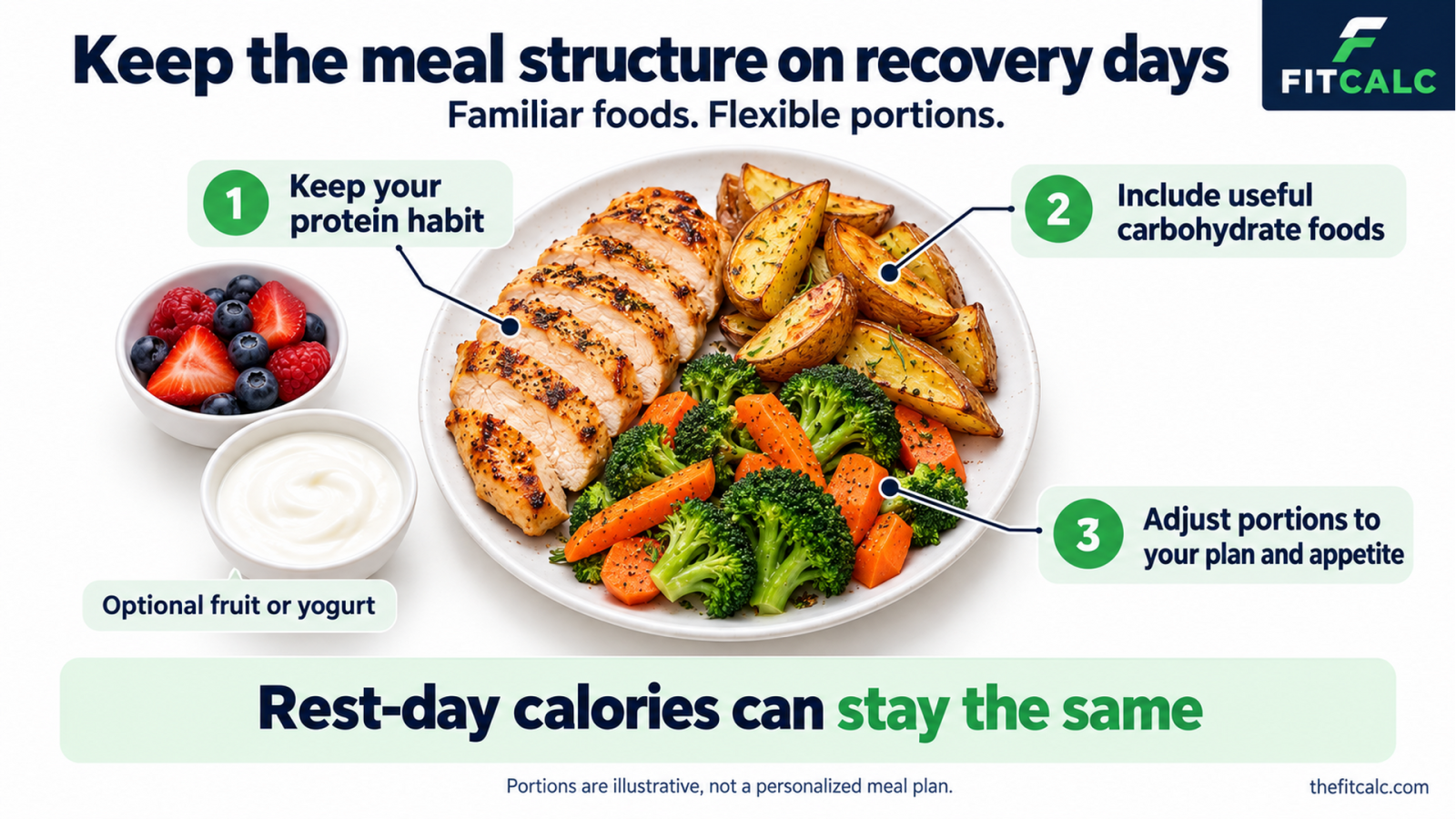
Rest days are a good time to keep the protein routine that already works for you. That might mean eggs or Greek yogurt at breakfast, chicken or beef at lunch, and fish or another protein-rich food at dinner. Tofu, tempeh, or beans and lentils can also contribute. The point is to maintain a reliable daily intake rather than thinking of protein as something needed only around a workout.
The Protein Calculator gives a contextual target and distinguishes the evidence-supported range from FitCalc's practical recommendation. For adults who resistance train, it displays a range of approximately 1.6–2.2 grams per kilogram per day. FitCalc often recommends around 1 gram per pound as a memorable planning target, while acknowledging that lower amounts within the range can work well.
A meta-analysis of 49 resistance-training studies in healthy adults estimated a plateau in additional fat-free-mass gains near 1.6 grams per kilogram per day. The estimate was uncertain, with a 95% confidence interval of approximately 1.0–2.2 grams per kilogram, so it should not be treated as an exact individual ceiling. The analysis supports adequate daily protein; it does not identify a special rest-day dose. Morton et al., 2018.
Keeping your usual target is our practical approach to making recovery and meal planning straightforward. There is no need to add another protein meal simply because you are sore, or to remove your normal protein foods because you did not lift today.
Carbohydrates can still fit the day
Carbohydrate foods remain useful between workouts. Your previous session may have used some stored muscle carbohydrate, and another session may be coming the next morning. Fruit, rice, potatoes, and other suitable foods can help provide the energy that fits your plan across that period.
In a study of 10 healthy young men, carbohydrate-containing drinks consumed after resistance exercise increased muscle glycogen replenishment over the first four hours compared with a placebo. That supports the role of carbohydrate in recovery. It does not establish a requirement to drink a particular supplement, eat at an exact minute, or hit one universal rest-day carbohydrate number. Roy and Tarnopolsky, 1998.
If you are less hungry on a quiet day, a smaller serving of rice or another carbohydrate food may fit well. If you are recovering from a demanding session and feel hungry, your usual portions may make more sense. You can retain these foods without making every rest-day meal identical to a training-day meal. Our article on carbohydrates and muscle building covers the broader training context.
Two workable ways to organize your calories
The simplest option is one calorie target every day. You can repeat meals, prepare similar portions, and evaluate progress without keeping track of two different plans. For someone whose normal week is fairly consistent, that simplicity is a substantial practical advantage.
A second option is a modest planned difference between days. You might prefer slightly more food around your longer workouts and slightly less on quieter days. This can be useful when the change matches your appetite or makes the routine easier to follow.
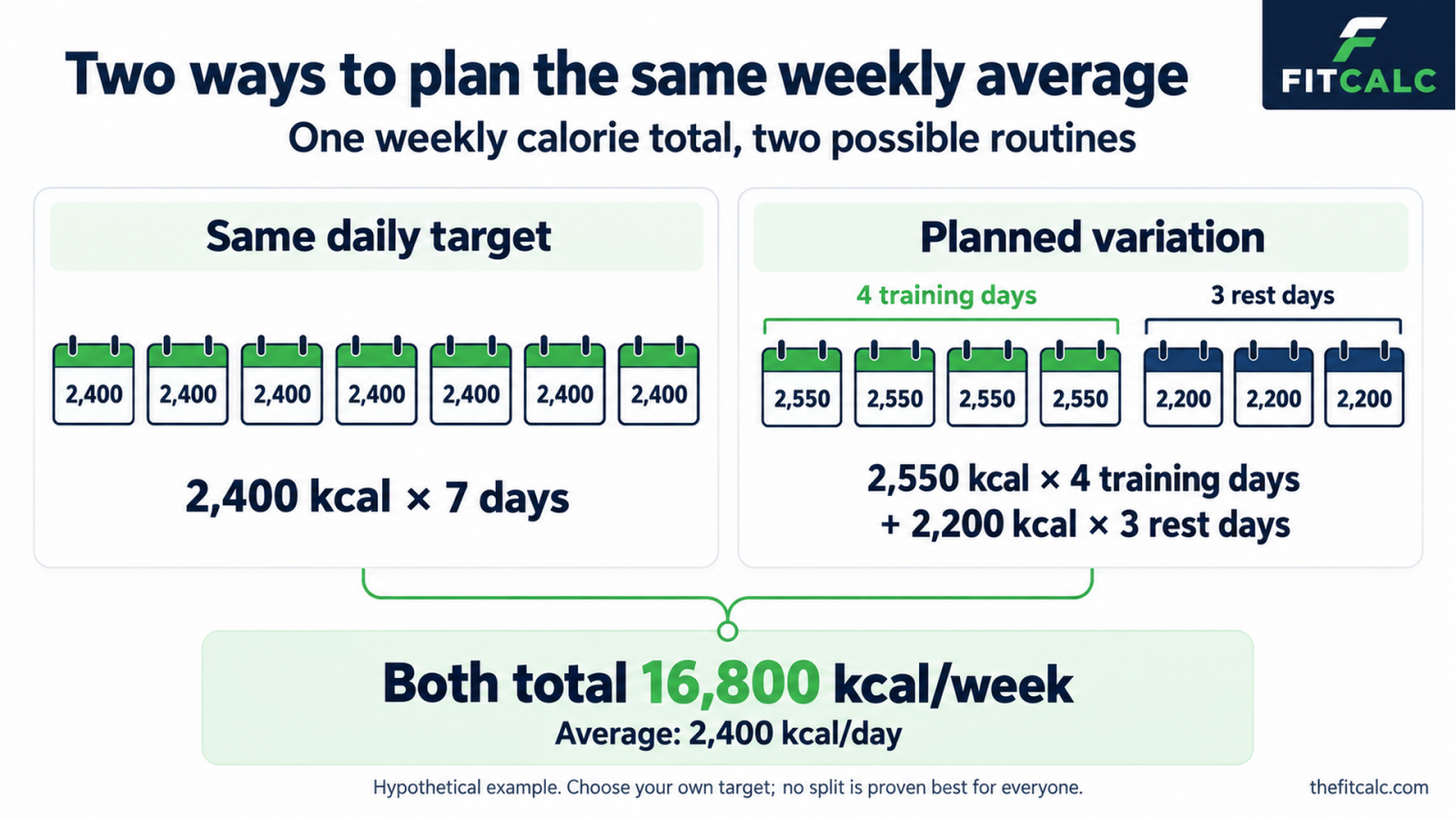
Here is a hypothetical example. Eating 2,400 calories on each of seven days gives a planned weekly total of 16,800 calories. Someone lifting four days per week could instead plan 2,550 calories on those four days and 2,200 on the other three. The total is still 16,800, averaging 2,400 per day.
Those numbers illustrate the arithmetic, not a recommended intake or a scientifically optimized split. They do not prove that the two patterns produce identical results, and your body does not reset its energy balance at the end of a calendar week. Looking at a week is simply a convenient way to check that a day-to-day adjustment still fits your overall plan.
If you try this approach, keep the changes modest enough that meals remain familiar and protein stays consistent. The Macro Calculator can help put a calorie target into the context of protein, carbohydrate, and fat. It cannot tell you that a particular rest-day reduction is ideal for your body.
Let your goal guide the overall pattern
During fat loss, the priority is a manageable overall deficit while continuing to train and eat adequately. Reducing food sharply on every rest day can make a plan harder to follow, particularly if it leaves you very hungry or leads to larger unplanned meals later. A predictable daily target may be easier than alternating between days that feel generous and days that feel restrictive.
During a muscle-building phase, watch for the opposite planning problem. You may think you are following a modest surplus because your training-day intake is high, while much lower rest-day intake brings the overall pattern back toward maintenance. Check the average before deciding that the calorie target itself is not working.
These are reasons to look at what you actually eat across your routine. Neither goal requires identical portions every day, and neither gets a guaranteed advantage from calorie cycling. Choose a pattern you can carry out consistently, then assess its results.
Our complete guide to building muscle connects food intake with training, recovery, and realistic expectations if gaining muscle is your main objective.
What does calorie-cycling research show?
Research on varying intake needs careful interpretation because the schedules differ. A two-day carbohydrate refeed, a week-long break from dieting, and a slightly smaller dinner on a rest day are different interventions.
A seven-week trial compared continuous dieting with five lower-calorie days and two consecutive carbohydrate-refeed days at maintenance. Only 27 of the 54 resistance-trained participants who completed baseline testing finished the trial as intended. Although the original paper described better fat-free-mass preservation, a published reanalysis found a between-group advantage only for dry fat-free mass, a calculated measure that excludes body water, rather than total fat-free mass or resting metabolic rate. That is a limited finding, not firm proof that refeeds preserve more muscle. Campbell et al., 2020; Peos et al., 2020 reanalysis.
The ICECAP trial randomized 61 resistance-trained adults to 12 weeks of continuous restriction or the same 12 dieting weeks interrupted by three one-week breaks at energy balance, taking 15 weeks overall. The breaks did not produce superior fat loss or fat-free-mass retention, although the intermittent group reported less hunger. Peos et al., 2021.
Another trial, with 38 resistance-trained women in the final analysis, compared six continuous dieting weeks with six dieting weeks interrupted by two one-week maintenance breaks. It found no between-group advantage for body composition or resting metabolic rate. In both trials, the breaks extended the calendar time needed to complete the prescribed dieting weeks. Siedler et al., 2023.
These studies do not establish the best daily training/rest split. For an everyday lifter, the more defensible reason to vary intake is that it suits appetite, schedule, or training demands. We would not promise that the variation itself resets metabolism or directs every extra training-day calorie into muscle.
Build rest-day meals from the same useful foods
Your food choices can stay familiar. Breakfast might be eggs with fruit, or Greek yogurt with berries. Lunch could be chicken or beef with rice and vegetables. Dinner might include fish, potatoes, and another vegetable you enjoy. Portions depend on your needs and the rest of your day; these combinations are examples rather than a fixed menu.
If you prefer the same calorie target daily, there is little to change. Keep the meals and portions that help you reach it. A reliable routine is especially useful when you already have limited time for shopping and meal preparation.
If you deliberately choose a lower-calorie rest day, make a specific adjustment instead of shrinking everything. You could keep the usual protein portion and vegetables while serving a little less rice, or reduce an extra calorie-dense topping. Retain enough food to make the day comfortable and to support the next workout.
You might also find that your appetite is higher the day after a hard session. That does not automatically mean your plan is wrong. Check the broader pattern before reacting to one unusually hungry afternoon. Consistent intake, hunger, training performance, and recovery together give you more useful context than any one of them alone.
Review the pattern before making another change
Try a routine long enough to observe a trend. FitCalc Plan suggests approximately two to three weeks as an initial review point. Treat this as guidance rather than a guarantee or a deadline for cutting calories. Short-term water changes can obscure the underlying trend. Consider average body weight, how consistently you followed the intake, and whether your workouts and recovery feel sustainable.
If results differ from what you expected, review the overall target and actual intake before blaming rest days. A missed workout, a larger restaurant meal, or one weigh-in does not by itself establish that you need a new calorie split.
Persistent fatigue, declining performance, poor recovery, or distress around eating deserve attention. They are reasons to review the plan and, when needed, seek individualized guidance from a qualified clinician or registered dietitian. Repeatedly cutting food without understanding the problem is unlikely to make the decision clearer.
The FitCalc approach
Start with a calorie target that reflects your usual week and goal. Keep protein consistent, include carbohydrate foods that work for you, and build meals primarily around useful whole or minimally processed foods.
A stable daily intake is a sensible default. Modest differences between training and rest days are an option when they make the plan easier to live with. The goal is a routine that supports progress across the week, with enough flexibility to accommodate real life and enough consistency to judge what is working.
Sources
Burd NA, West DWD, Moore DR, et al. Enhanced amino acid sensitivity of myofibrillar protein synthesis persists for up to 24 h after resistance exercise in young men. Journal of Nutrition. 2011;141(4):568–573. Study. doi:10.3945/jn.110.135038.
Phillips SM, Tipton KD, Aarsland A, Wolf SE, Wolfe RR. Mixed muscle protein synthesis and breakdown after resistance exercise in humans. American Journal of Physiology. 1997;273:E99–E107. Study. doi:10.1152/ajpendo.1997.273.1.E99.
Morton RW, Murphy KT, McKellar SR, et al. A systematic review, meta-analysis and meta-regression of the effect of protein supplementation on resistance training-induced gains in muscle mass and strength in healthy adults. British Journal of Sports Medicine. 2018;52:376–384. Meta-analysis. doi:10.1136/bjsports-2017-097608.
Roy BD, Tarnopolsky MA. Influence of differing macronutrient intakes on muscle glycogen resynthesis after resistance exercise. Journal of Applied Physiology. 1998;84:890–896. Study. doi:10.1152/jappl.1998.84.3.890.
Peos JJ, Helms ER, Fournier PA, et al. Continuous versus Intermittent Dieting for Fat Loss and Fat-Free Mass Retention in Resistance-trained Adults: The ICECAP Trial. Medicine & Science in Sports & Exercise. 2021;53(8):1685–1698. Study. doi:10.1249/MSS.0000000000002636.
Peos J, Brown AW, Vorland CJ, Allison DB, Sainsbury A. Contrary to the Conclusions Stated in the Paper, Only Dry Fat-Free Mass Was Different between Groups upon Reanalysis. Comment on: “Intermittent Energy Restriction Attenuates the Loss of Fat-Free Mass in Resistance Trained Individuals. A Randomized Controlled Trial”. Journal of Functional Morphology and Kinesiology. 2020;5(4):85. Reanalysis/commentary. doi:10.3390/jfmk5040085.