
Should You Eat Back Exercise Calories? How to Avoid Double-Counting Your Workouts
You finish a workout, glance at your watch, and see 450 calories burned. Your food app now says you can eat more. If you are trying to lose fat, should you use those extra calories? If you are trying to build muscle, would ignoring them leave you underfed?
The answer starts with how your calorie target was calculated. When your target already accounts for your normal exercise, automatically adding the workout calories again can count the same activity twice. When a plan deliberately excludes exercise, or today’s training is much more demanding than usual, additional food may make sense.
At FitCalc, our preferred starting point for a reasonably consistent routine is to estimate calorie needs from your typical week, choose a sensible goal, and adjust using your results. Your watch can help you understand your activity. Its calorie display does not need to dictate every meal.
Your calorie target may already include your workouts
Total daily energy expenditure, or TDEE, estimates the energy you use across the whole day. It includes resting needs, digestion, ordinary movement, and exercise. A TDEE-based calorie target is therefore different from a target that covers only your baseline day before a workout is added.
The FitCalc TDEE Calculator uses an estimate of resting energy needs and an activity multiplier. Choose the activity level that represents your ordinary week, including both training and movement outside the gym. If your selected level already reflects your lifting sessions and walks, those activities are already represented in the estimate. FitCalc’s calculator methodology explains these assumptions.
A simple example of double counting
Imagine your estimated maintenance is 2,800 calories per day, averaged across a normal week that includes four workouts. You choose a 15% deficit, giving you an illustrative target of 2,380 calories. The planned difference is 420 calories per day.
Now suppose you also add back 350 watch-reported calories after each of those four routine workouts. That adds 1,400 calories over the week, or 200 per day on average. Assuming the original maintenance estimate was appropriate, your planned average deficit has become smaller because the routine exercise was included twice.
These numbers illustrate the bookkeeping; they are not a claim about your actual expenditure or a guaranteed rate of fat loss. The mistake would still exist with a perfectly accurate watch. An activity cannot be both included in your starting estimate and treated as entirely new expenditure afterward.
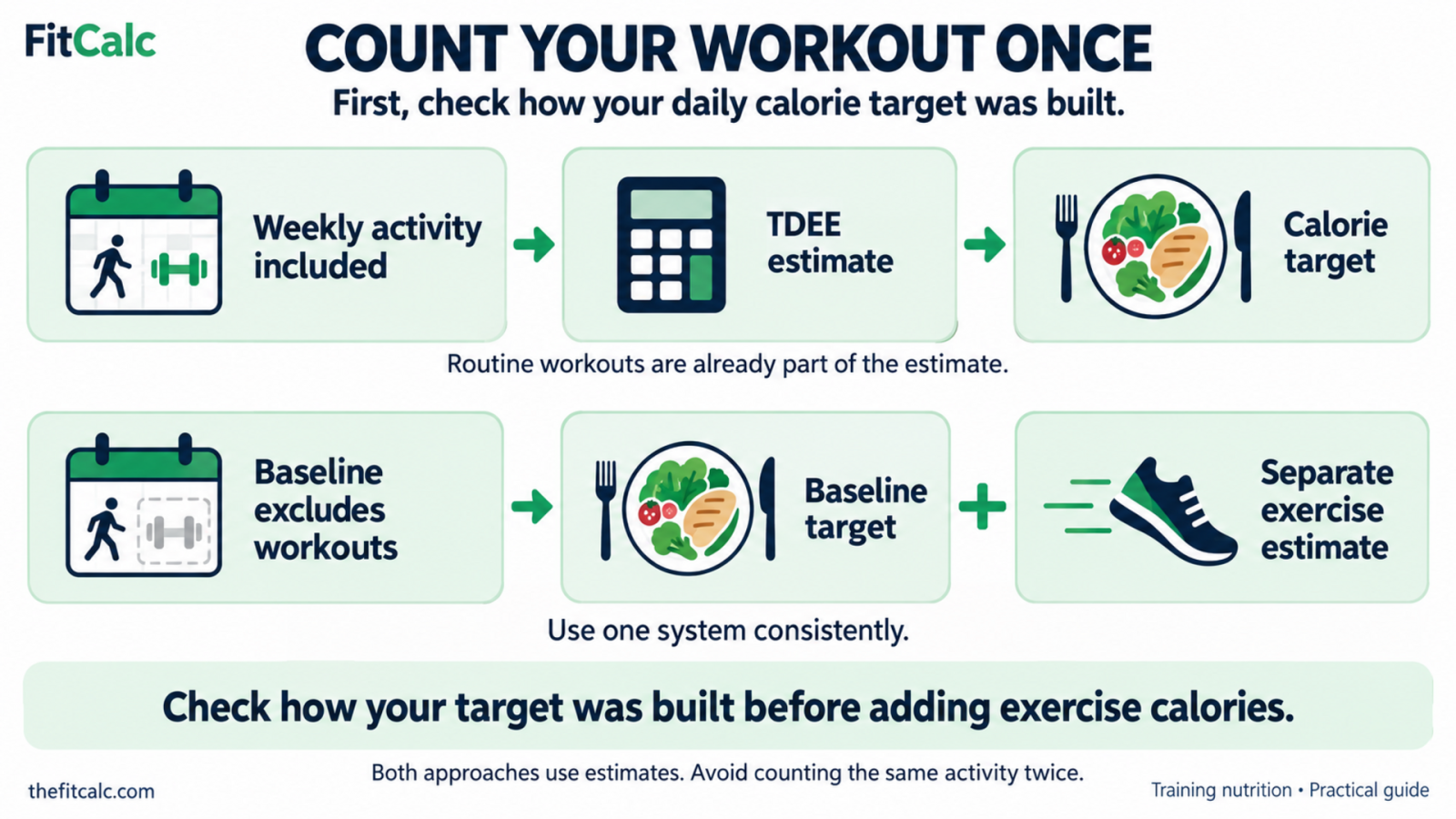
Two calorie systems can work, but they should not be mixed
A fixed TDEE-based target is convenient when your weeks look broadly similar. You might lift on Monday, Wednesday, and Friday, walk regularly, and eat close to the same target each day. The exercise is averaged into the week rather than reimbursed after every session.
A baseline-plus-exercise system starts with a target that deliberately excludes planned workouts, then accounts for them separately. This can be useful when activity varies considerably, but it depends on understanding what the baseline includes and how additional activity is estimated.
Neither system removes uncertainty. A weekly activity multiplier may fit poorly, and a separate workout estimate may be inaccurate. What matters is knowing which assumptions you are using and reviewing the outcome consistently.
Check what your app is actually adding
Before changing your food intake, check the app’s help page and settings. Does its activity level include deliberate exercise? Is an imported adjustment only for activity beyond what was already expected? Is the workout appearing twice because it came from both a connected watch and a manual entry?
Some apps reconcile activity automatically, while others use different rules. An adjustment on screen is not proof of double counting. Equally, copying a TDEE-based target into another app does not guarantee that the second app understands how that target was built.
For FitCalc users with a stable routine, a sensible default is to keep routine workouts inside the original weekly estimate. If you use another system, follow that system’s definitions rather than applying a blanket rule to every app.
Active calories and total calories are different numbers
Your body would use energy during a workout hour even if you spent that hour resting. Some displays show energy attributed to activity; others include both activity and the energy needed to keep your body functioning during the session.
For example, Garmin’s calorie terminology distinguishes active calories from total calories, and its recorded activity calories can include both active and resting calories. Labels differ across products, so check the definition rather than assuming that any number beside a workout means additional food.
As a hypothetical example, a session display might show 400 total calories, of which 80 are resting calories. Those 80 are not an extra cost created by the workout. If your baseline already covers resting needs, adding the full 400 would overlap with that baseline.
Even the remaining activity estimate is not automatically an amount to add back. You still have to ask whether your original target already accounted for that session. Understanding the label solves one possible overlap; understanding the plan solves the other.
Your watch estimates energy expenditure
Wearables infer calorie expenditure using information such as movement, heart rate, body measurements, and device-specific algorithms. A precise-looking number on the screen can still be an uncertain estimate.
In a validation study published in the European Journal of Sport Science, researchers compared the Apple Watch 6, Polar Vantage V, and Fitbit Sense with reference measurements during several activities, including resistance exercise. All three devices showed poor accuracy for energy expenditure in the tested conditions, even when heart-rate performance was better. Read the study.
Those findings concern specific devices and protocols. They do not establish the error of every current watch, or prove that your device always overestimates. The practical lesson is to avoid treating an exercise-calorie estimate as an exact food allowance.
A rule such as eating back half the displayed calories may sound cautious, but it is still a rule of thumb. It cannot correct an unknown measurement error and does not solve double counting when the workout was already included. Useful watch data can include how consistently you move, how long you train, and whether your routine has changed.
When extra food makes sense
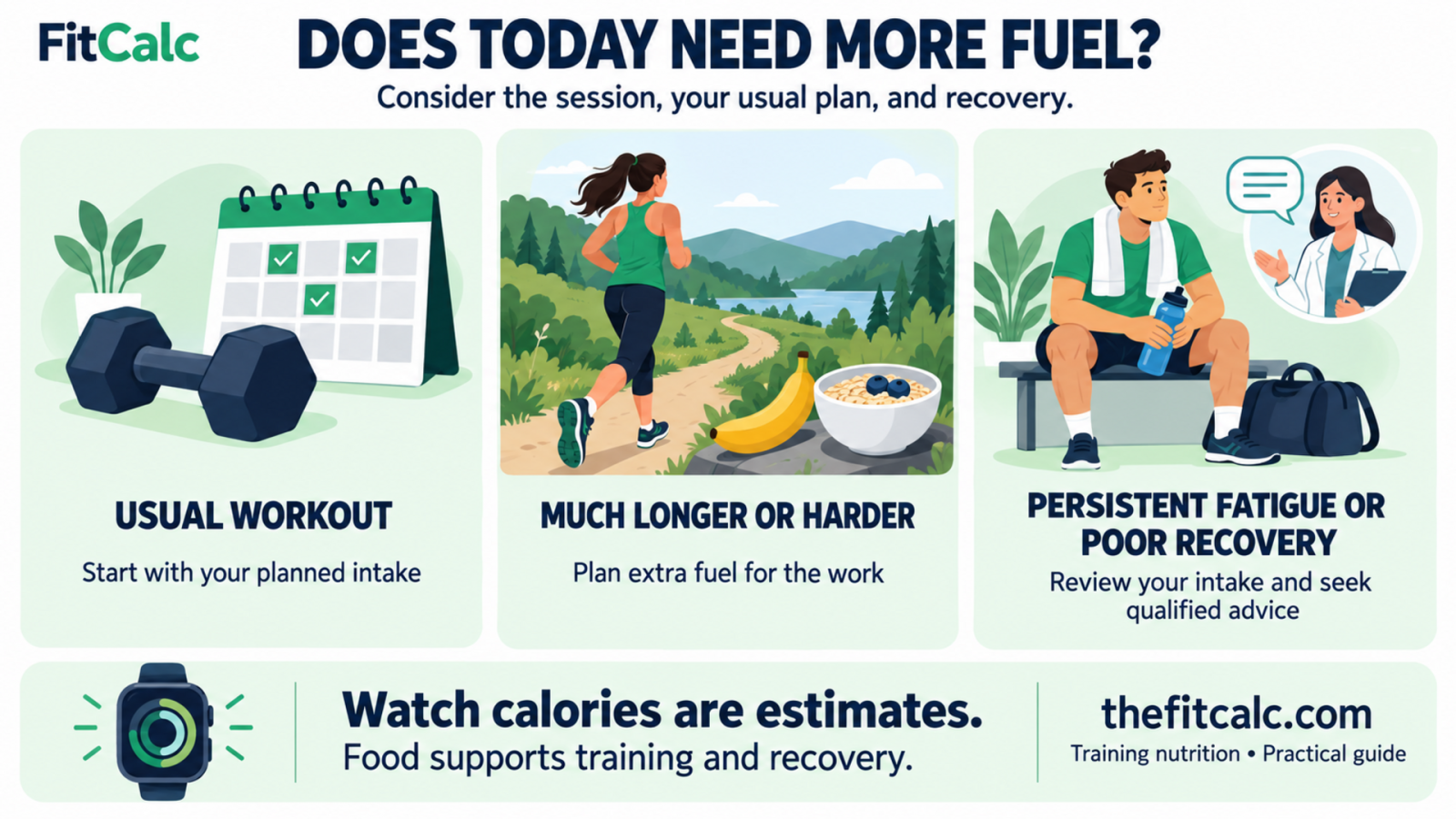
Avoiding double counting should never become an instruction to ignore genuine fueling needs. Your starting target is an estimate for a particular routine. If the routine changes, the estimate deserves another look.
A normal gym session already built into your plan is different from an unexpectedly long hike, a demanding tournament, or a new endurance-training block. Those situations may require additional food and a more deliberate fueling strategy. Sports-nutrition guidance recommends matching food and fluid intake to the demands of training and recovery, with individualized help when needed. See the joint nutrition and athletic performance position paper.
Plan food around the work
For an ordinary lifting day, that might mean placing one of your usual meals near training rather than adding a second meal because your watch lit up. Beef and potatoes, chicken and rice, eggs with toast and fruit, or yogurt with oats can fit into a practical day of eating.
For a much more demanding day, a larger carbohydrate portion or an additional meal or snack may be appropriate. The amount depends on the session, your overall intake, your goal, and your recovery. Long endurance sessions can require specific during-exercise fueling; a generic calorie target should not replace a suitable sports-nutrition plan.
Keep adequate protein in place and use the FitCalc Protein Calculator as an educational starting point. Extra training does not automatically mean every additional calorie should come from protein. A varied diet must also make room for carbohydrate, fats, and micronutrient-rich foods.
Judge the plan by more than a single weigh-in
For fat loss, start with an appropriate maintenance estimate and a manageable reduction. The FitCalc Calorie Deficit Calculator offers modest starting options and makes clear that its outputs are planning estimates.
Then follow a reasonably consistent approach long enough to learn from it. Review average food intake, multiweek weight trends, training performance, hunger, and recovery together. Two to three weeks can be an initial review point for an otherwise stable routine, but it is not a deadline for cutting calories. Water changes, menstrual-cycle effects, and a new training program can complicate short-term interpretation.
If your progress and recovery are where you want them, there is little reason to alter the plan because one workout displayed a surprisingly high burn. If results consistently differ from your goal, first check the activity assumptions, intake records, and duplicate exercise entries. Make a measured adjustment rather than changing both calories and activity aggressively at the same time.
Exercise can also influence appetite. In the E-MECHANIC randomized trial, adults with overweight or obesity lost less weight than predicted from supervised exercise, with increased energy intake contributing to compensation. That does not predict every person’s response, but it helps explain why exercise calories do not translate neatly into expected weight loss. Read the trial.
If your goal is maintenance or muscle gain, use the same review process with the appropriate goal in mind. A fixed target is useful only while it supports the outcome you are pursuing.
Do not turn calorie tracking into chronic underfueling
Persistent fatigue, declining performance, recurrent injuries, or menstrual changes deserve attention, especially when training has increased and food has not. These symptoms can have several causes and should not be diagnosed from an app.
The International Olympic Committee’s consensus on Relative Energy Deficiency in Sport describes health and performance problems associated with problematic low energy availability in female and male athletes. If you are struggling with these symptoms, speak with a qualified clinician or sports dietitian rather than waiting for a particular scale trend before seeking help.
This general approach is intended for healthy adults. Young athletes, people who are pregnant or breastfeeding, those with relevant medical conditions, and anyone with an eating-disorder history need individualized advice. If tracking creates anxiety or pressure to earn meals through exercise, stepping away from calorie arithmetic and getting support may be more useful than refining the numbers.
Practical takeaways
Check how your target was built. A TDEE estimate that reflects your normal training already includes that routine activity.
Use one accounting system. Do not automatically combine an exercise-inclusive target with a second allowance for the same workouts.
Read the device labels. Active, total, and recorded activity calories may describe different things.
Fuel meaningful changes in training. An unusually demanding day or a sustained increase in activity may call for more food and a revised plan.
Review progress and recovery together. A watch estimate should inform your thinking without overruling your needs or your longer-term results.
The useful question is whether your meals adequately support the routine and goal your plan was built for. Start there, count the activity once, and make adjustments when your training and real-world results give you a reason.
Sources
1. FitCalc. How FitCalc Calculators Work. Current public methodology, accessed October 4, 2026. Documents the resting-energy equation, activity multiplier, and goal-adjustment assumptions.
2. Garmin Support. Learn More About Tracking Calories on Garmin Devices. Accessed October 4, 2026. Defines active, resting, total, and recorded activity calories.
3. Hajj-Boutros G, Landry-Duval MA, Comtois AS, Gouspillou G, Karelis AD. Wrist-worn devices for the measurement of heart rate and energy expenditure: A validation study for the Apple Watch 6, Polar Vantage V and Fitbit Sense. European Journal of Sport Science. 2023;23(2):165–177. Published online 2022. doi:10.1080/17461391.2021.2023656.
4. Thomas DT, Erdman KA, Burke LM. Position of the Academy of Nutrition and Dietetics, Dietitians of Canada, and the American College of Sports Medicine: Nutrition and Athletic Performance. Journal of the Academy of Nutrition and Dietetics. 2016;116(3):501–528. doi:10.1016/j.jand.2015.12.006.
5. Martin CK, Johnson WD, Myers CA, et al. Effect of different doses of supervised exercise on food intake, metabolism, and non-exercise physical activity: The E-MECHANIC randomized controlled trial. American Journal of Clinical Nutrition. 2019;110(3):583–592. doi:10.1093/ajcn/nqz054.
6. Mountjoy M, Ackerman KE, Bailey DM, et al. 2023 International Olympic Committee’s consensus statement on Relative Energy Deficiency in Sport (REDs). British Journal of Sports Medicine. 2023;57:1073–1097. doi:10.1136/bjsports-2023-106994.