Is Grass-Fed Beef Actually Healthier Than Grain-Fed Beef?
Walk through the meat section of a grocery store and you can easily find two packages of ground beef that look nearly identical while one costs considerably more because it says grass-fed on the label. That naturally raises a question: are you actually buying healthier beef, or are you mostly paying for marketing?
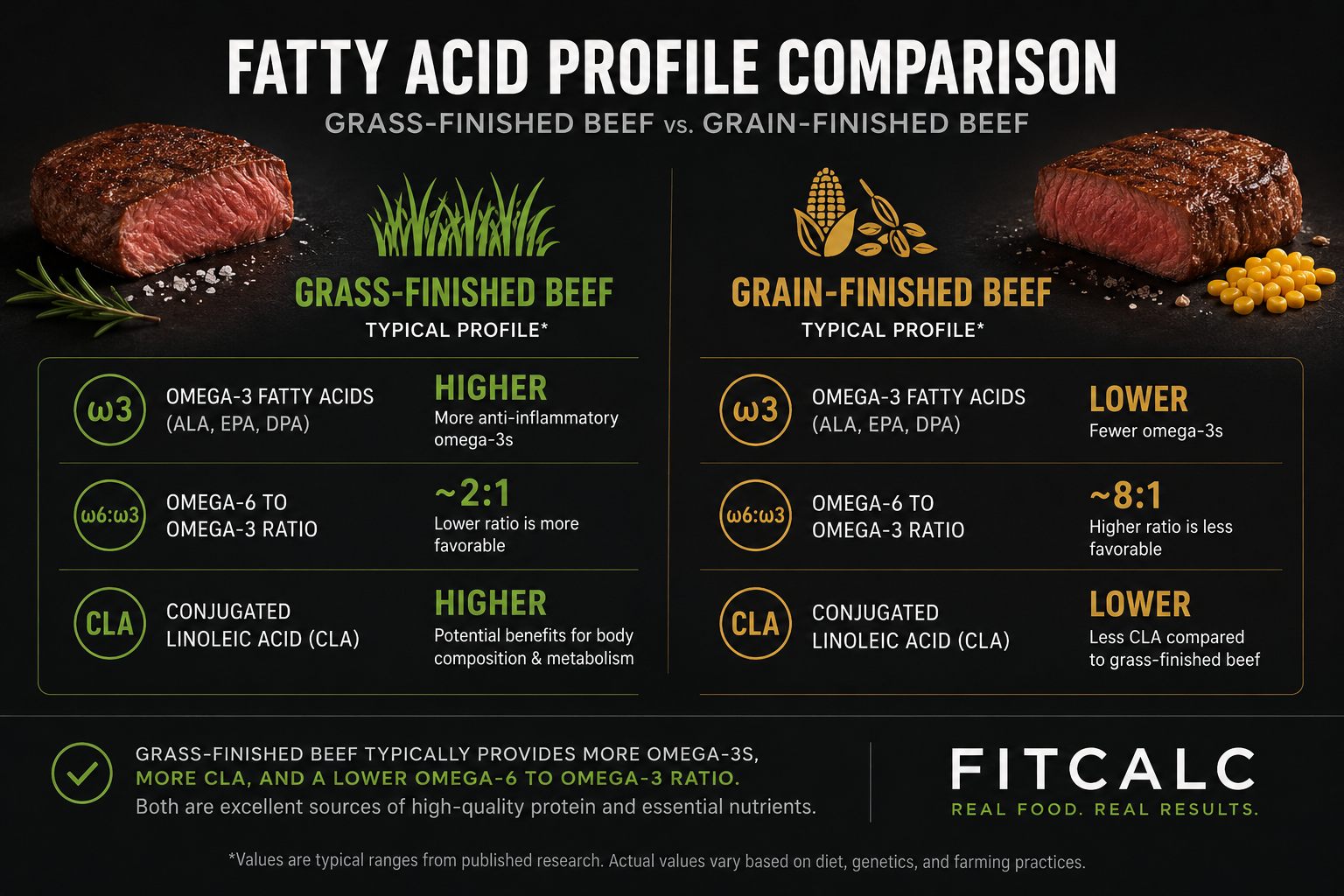
There are legitimate nutritional differences. Beef from cattle finished entirely on grass generally contains more omega-3 fatty acids, a lower omega-6-to-omega-3 ratio, more conjugated linoleic acid (CLA), and higher concentrations of certain antioxidants and other compounds. Newer research continues to find measurable differences in the nutritional composition of beef depending on what cattle eat.
At FitCalc, our preference is 100% grass-fed and grass-finished beef when it is reasonably available and affordable. If we're choosing between two otherwise comparable products and cost isn't an issue, we'll take the grass-finished beef.
But the second half of that recommendation is just as important: conventional grain-finished beef is still an excellent food. It still provides complete protein, vitamin B12, heme iron, zinc, selenium, creatine, carnosine, and many of the other nutrients that make beef so valuable in the first place.
If grass-finished beef strains your grocery budget, buy the regular beef and don't feel bad about it.
Grass-Fed and Grass-Finished Aren't Exactly the Same Thing
Before comparing the nutrition, it's useful to understand what we're actually talking about.
Cattle naturally consume forage during much of their lives. The USDA notes that cattle generally begin life eating grass, while a large portion of conventional cattle are later moved to feedlots and finished on formulated diets based largely on corn or other grains.
That finishing period matters because the animal's diet can change the composition of its meat.
This is why we prefer the more specific concept of grass-fed and grass-finished beef. Grass-finished cattle remain on grass, pasture, or other forage through the finishing period rather than transitioning to a conventional grain-heavy finishing ration. USDA materials have likewise distinguished animals merely described as grass-fed from animals actually finished entirely on forage.
Labeling can still be confusing. USDA considers claims such as grass-fed or grain-fed special production claims that producers must substantiate when used on federally inspected meat products. But grass-finishing systems themselves vary enormously depending on pasture quality, geography, season, supplemental forage, and management.
That's worth remembering because not every package of grass-fed beef has an identical nutritional profile.
Grass-Finished Beef Has a Better Omega-3 Profile
The most consistent nutritional difference involves fatty acids.
Grass contains considerably more alpha-linolenic acid, an omega-3 fatty acid, than cereal grains. When cattle remain on forage, some of that difference carries through into the fatty-acid composition of the beef.
A longstanding review of grass-fed and grain-fed beef found that grass-based finishing generally increases omega-3 fatty acids and produces a more favorable omega-6-to-omega-3 ratio. Grass-finished beef also tended to contain greater concentrations of CLA and trans-vaccenic acid.
A newer North American commercial-beef comparison published in 2025 found a particularly clear difference. Grass-fed samples had an average omega-6-to-omega-3 ratio of approximately 2.14, compared with 8.28 in grain-fed beef. Grass-fed beef also contained higher proportions of ALA, EPA, DPA, and CLA.
That is a genuine nutritional advantage.
It also needs some perspective. Beef isn't normally someone's largest source of omega-3 fatty acids. Fatty fish such as salmon can provide far more EPA and DHA in a serving. Choosing grass-finished beef therefore shouldn't be treated as a replacement for eating other omega-3-rich foods.
Still, if you're eating beef regularly, getting a somewhat better fatty-acid profile from the same food is a benefit, and it's one reason grass-finished remains our preferred option.
The Difference Goes Beyond Omega-3s
Fatty acids get most of the attention, but researchers are increasingly finding that cattle diet can affect other compounds in beef as well.
Earlier research found grass-based diets could increase precursors for vitamins A and E and certain antioxidant compounds compared with grain finishing. Grass-finished beef also tends to be leaner overall, although that depends heavily on the cut and individual animal.
More recent metabolomic research has made the comparison much more detailed. A 2024 study comparing pasture-finished cattle from Western U.S. rangelands with grain-finished cattle found higher concentrations of several compounds in pasture-finished beef, including phenolic antioxidants, alpha-tocopherol, choline, and omega-3 fatty acids. The researchers identified hundreds of metabolites that differed between the production systems.
Another controlled comparison found grass-finished beef contained higher omega-3 fatty acids, vitamin E, iron, zinc, and several phytochemicals than grain-finished beef.
This makes intuitive sense. An animal's diet influences its biology, and its tissues are ultimately built from nutrients derived from that diet. Cattle grazing diverse pasture consume a different collection of fatty acids and plant compounds than cattle eating a grain-heavy finishing ration.
However, this is where we need to avoid turning a real difference into an exaggerated claim. Finding more of a particular compound in grass-finished beef does not automatically prove that eating it produces a meaningful difference in long-term human health. The researchers behind the 2024 metabolomics study specifically cautioned that randomized human trials would be needed to determine whether the nutritional differences translate into appreciably different health outcomes.
We can recognize that grass-finished beef has the stronger nutritional profile without pretending the difference is enormous.
Grass-Finished Beef Can Vary Quite a Bit
One of the more interesting findings from newer research is just how much variation exists within the grass-fed category itself.
A survey of grass-finished beef from 12 U.S. producers found omega-6-to-omega-3 ratios ranging from 1.8 all the way to 28.3, despite all of the samples being considered grass-finished. Antioxidant and mineral concentrations also varied significantly between producers, with beef finished entirely on fresh forage generally tending toward higher concentrations of certain antioxidants.
The newer commercial comparison found substantial variation as well. Some retail grass-fed samples had relatively low omega-3 concentrations and fatty-acid profiles that looked surprisingly similar to grain-fed beef.
That doesn't make grass-fed labeling meaningless. Across studies, the overall pattern still favors properly grass-finished beef for several nutritional characteristics. It simply means the quality of the pasture and finishing system matters too.
If you have access to a reputable local farm that can tell you how its cattle are raised and finished, that information can be more useful than blindly assuming every expensive package with green pasture imagery is nutritionally identical.
Is Grain-Fed Beef Unhealthy?
No.
This is the part we don't want readers to lose sight of.
Whether a cow spends its finishing period eating forage or grain, the resulting beef remains an extremely nutrient-dense animal food. Conventional beef still provides high-quality complete protein, B12, highly bioavailable heme iron, zinc, selenium, creatine, carnosine, and numerous other nutrients.
Even researchers documenting advantages of pasture finishing have explicitly warned against interpreting those differences as evidence that grain-finished beef is unhealthy to consume.
This matters because food advice has to work in the real world.
Suppose grass-finished ground beef costs per pound while conventional 80/20 ground beef is .50. Someone feeding a family or eating large amounts of beef to meet a high protein target may be looking at a substantial difference in grocery spending every month.
We would much rather see that person buy conventional ground beef consistently than reduce their intake of high-quality animal protein because social media convinced them ordinary beef isn't good enough.
Grass-finished is an upgrade. Conventional beef isn't a failure.
What About Fat Content and Taste?
Grass-finished beef is often leaner than grain-finished beef, partly because grain finishing promotes greater fat deposition and marbling. Reviews comparing the two production systems consistently note lower overall fat content in grass-finished beef.
Whether that's an advantage depends partly on your goals.
Someone trying to reduce calorie intake may appreciate naturally leaner beef. Someone trying to gain weight may actually prefer fattier conventional beef because the additional fat makes it easier to consume enough calories. We don't believe naturally occurring beef fat is something healthy people need to fear.
Taste also differs. Grain finishing generally produces greater marbling and the familiar flavor many Americans associate with steak. Grass-finished beef can taste more mineral, earthy, or grassy depending on the animal and pasture, and its lower fat content can make it easier to overcook.
Neither flavor is objectively better. That's mostly personal preference.
If you buy grass-finished steak, particularly a lean cut, avoid cooking it into oblivion simply because you're accustomed to treating a heavily marbled grain-finished steak the same way. The nutritional upgrade isn't worth much if you don't enjoy eating it.
Is Grass-Fed Beef Worth the Extra Money?
This is ultimately the question most people care about.
If the price difference is modest and your grocery budget comfortably allows it, we think 100% grass-fed and grass-finished beef is worth choosing. The better omega-3 profile, lower omega-6-to-omega-3 ratio, higher CLA, and differences in certain antioxidants and micronutrients give it a legitimate nutritional edge.
If you're buying directly from a trusted local producer with high-quality pasture, the appeal becomes even stronger because you may know substantially more about how the animal was actually raised and finished.
But we would not rearrange an entire food budget just to make the switch.
If paying the grass-fed premium means buying less meat, cutting back on eggs or fruit, or struggling to afford other quality foods, regular beef is the better practical decision. The nutritional difference between grass- and grain-finished beef is much smaller than the nutritional difference between eating nutrient-dense beef and replacing it with highly processed food.
Prioritize the big decision first: eat quality whole foods.
Then optimize within those foods when your budget allows.
The FitCalc Approach
When all else is equal, we prefer 100% grass-fed and grass-finished beef.
Research consistently shows differences in fatty-acid composition, particularly higher omega-3s, more CLA, and a lower omega-6-to-omega-3 ratio. Several studies also report higher concentrations of certain antioxidants, vitamins, minerals, and other compounds in pasture-finished beef. Newer metabolomic research suggests the differences between production systems extend beyond the handful of nutrients traditionally measured.
Those are good reasons to choose grass-finished beef when you can.
But they are not good reasons to become afraid of conventional beef.
Regular grain-finished beef remains a nutrient-dense source of complete protein, B12, heme iron, zinc, selenium, creatine, carnosine, and quality animal nutrition. The available research has not established that the comparatively better nutrient profile of grass-finished beef makes conventional beef an unhealthy food.
So keep the decision simple.
If you can comfortably afford properly grass-fed and grass-finished beef, that's our preferred choice. If you find a quality local producer, even better. If conventional supermarket beef is what fits your budget, buy it, eat it, and don't spend the meal worrying that you made the wrong choice.
Grass-finished beef is better. Beef itself is still the priority.
Sources
Daley CA, Abbott A, Doyle PS, Nader GA, Larson S. A review of fatty acid profiles and antioxidant content in grass-fed and grain-fed beef. Nutrition Journal. 2010. The review found that grass-based finishing generally increased omega-3 fatty acids, CLA, trans-vaccenic acid, and several antioxidant compounds while producing a more favorable fatty-acid profile. PubMed
Jain R, Bronkema SM, Yakah W, et al. Nutritional Composition of Beef: A Comparison of Commercial North American Grass- and Grain-Finishing Systems. 2025. Commercial grass-fed beef had a lower omega-6-to-omega-3 ratio and higher concentrations of ALA, EPA, DPA, CLA, and several minerals, although substantial variation existed within grass-fed products. PubMed
van Vliet S, Provenza FD, Kronberg SL. Health-Promoting Phytonutrients Are Higher in Grass-Fed Meat and Milk. Reviews and related metabolomic work examining how pasture diversity and animal diets influence compounds ultimately present in animal foods. PubMed Central
Pasture-finishing of cattle in Western U.S. rangelands improves markers of animal metabolic health and nutritional compounds in beef. 2024. Pasture-finished beef contained higher concentrations of omega-3 fatty acids and several antioxidants and metabolites, while the authors cautioned that human trials are necessary to determine the clinical significance of these differences. PubMed Central
Bronkema SM, Rowntree JE, Jain R, et al. A nutritional survey of commercially available grass-finished beef. Journal of Animal Science. 2019. The study demonstrated substantial nutritional variation among grass-finished beef from different U.S. producers, including wide differences in omega-6-to-omega-3 ratios and antioxidant concentrations. PubMed Central