Building muscle is simple in principle, but that does not mean it happens easily. Your muscles need a reason to adapt, enough nutrition to support that adaptation, and enough recovery for the process to occur repeatedly over months and years.
Resistance training provides the stimulus. Protein supplies the amino acids needed to build and repair muscle tissue. Calories provide energy, while carbohydrates help support demanding training and replenish muscle glycogen. Sleep and recovery allow you to continue producing productive training sessions instead of accumulating fatigue faster than you can recover from it.
Problems usually arise when one of those pieces is missing or taken to an extreme. Eating enormous amounts of food will not compensate for poor training, just as a perfect workout program cannot overcome consistently inadequate nutrition. More sets are not automatically better, and gaining weight as quickly as possible does not mean you are building muscle as quickly as possible.
FitCalc favors a controlled approach: train progressively, eat enough quality food to support growth, use a practical protein target, include carbohydrate to support training, recover properly, and measure results over time. Our familiar 1 gram of protein per pound is a planning preference for healthy active adults, not a universal requirement.
This guide will explain how those pieces work together and how to adjust them as you become bigger, stronger, and more experienced.
This guide is general education for healthy adults, not an individualized rehabilitation or medical plan. If you have an injury, a condition affected by exercise or nutrition, or have been advised to restrict activity, get guidance appropriate to your situation before using a new program.
How Muscle Growth Actually Happens
Skeletal muscle is remarkably adaptable. When you repeatedly expose it to resistance training that exceeds what it is accustomed to, the body responds by making changes that better prepare the muscle for similar demands in the future.
That adaptation is known as muscular hypertrophy, or an increase in muscle size. At the level of the muscle fiber, hypertrophy involves an accumulation of proteins and other cellular components that increases the fiber's cross-sectional area. Resistance training stimulates the processes responsible for remodeling muscle tissue, but that stimulus must be repeated consistently for visible growth to accumulate.
This is why no individual workout builds a noticeable amount of muscle. A productive training session creates a stimulus. Nutrition and recovery support the response. Then you train again and repeat the process. Muscle growth is the accumulated result of hundreds of those cycles.
Resistance Training and Muscle Hypertrophy
Resistance training challenges skeletal muscle by forcing it to produce force against an external resistance. That resistance could come from barbells, dumbbells, machines, cables, or even bodyweight. The equipment matters far less than whether the exercise allows the target muscle to experience a sufficiently challenging and repeatable training stimulus.
Mechanical tension is considered a primary driver of resistance-training-induced hypertrophy. When muscle fibers produce high levels of force while lengthening and shortening under load, mechanical signals contribute to cellular processes involved in muscle remodeling and growth. Current hypertrophy models place mechanical tension at the center of the adaptation rather than treating muscle soreness or tissue damage as the goal. Wackerhage et al. (2019)
Following resistance exercise, muscle protein synthesis increases. Dietary protein provides the amino acids needed for the body to synthesize new muscle proteins, which is why training and adequate protein work so effectively together. Over time, when muscle protein accumulation consistently exceeds muscle protein breakdown sufficiently, muscle fibers can become larger. ISSN position stand on protein and exercise (2017)
This does not mean you need to destroy a muscle to make it grow. Hard or unfamiliar exercise can cause muscle damage and delayed-onset muscle soreness, but being extremely sore is not evidence that a workout was more anabolic. Excessive damage may actually interfere with subsequent training if it leaves you unable to perform normally for several days. Research examining the relationship between muscle damage and hypertrophy does not support treating damage itself as the primary mechanism responsible for muscle growth. Damas et al. (2016)
The goal is therefore not to leave the gym barely able to walk or move your arms. The goal is to expose the target muscles to enough productive tension and challenging work to stimulate adaptation, recover from that work, and then repeat it.
Nutrition supports the process but cannot replace the training stimulus. Someone can eat 200 grams of protein and remain in a calorie surplus every day, but without resistance training there is no strong reason for the body to direct that excess nutrition toward maximizing new skeletal muscle. Likewise, someone training extremely hard while consistently undereating may be limiting the resources available for growth.

Progressive Overload
If you performed the exact same easy workout with the exact same effort forever, eventually your body would have little reason to continue adapting. What was once challenging becomes normal.
This is where progressive overload becomes important. Progressive overload means increasing the demands placed on the body over time as your capacity improves. The concept is simple, but it is frequently reduced to one idea: adding more weight to the bar.
Increasing load is certainly one form of progression, but it is not the only one.
Suppose you perform an exercise with 100 pounds for 8 challenging repetitions. Weeks later, you can perform the same 100 pounds for 12 repetitions with equally good technique and a similar level of effort. Your performance has improved even though the weight on the bar has not changed. Increasing the load slightly and returning to a lower point in the repetition range may then give you room to progress again.
Execution can improve too. Performing an exercise through a greater useful range of motion, controlling the movement more effectively, reducing unnecessary momentum, or producing the same performance with better technique can make the target muscle work harder without immediately increasing load.
Over longer periods, training volume may also need to change. A beginner can often grow from relatively little work because almost every meaningful resistance-training stimulus is new. As someone becomes more experienced, additional productive volume may sometimes be needed to continue progressing.
The important distinction is between progressing because you have become stronger and forcing progression regardless of readiness. Adding 10 pounds every week while repetitions collapse and technique deteriorates is not useful progressive overload. You have simply made the exercise heavier.
Progress also will not occur perfectly every workout. Sleep, stress, nutrition, exercise order, and normal day-to-day variation affect performance. Advanced lifters may work for weeks to add a repetition or a small amount of weight to an established exercise.
Think of progressive overload as a long-term trend. If your training is effective and your body is adapting, you should gradually become capable of doing more high-quality work than you could previously.
For exercise programming and progression in more detail, see our strength-training guide.
Genetics, Training Age and Realistic Expectations
Muscle growth does not occur at the same rate for everyone, and it does not continue at the same rate throughout your training career.
A beginner has enormous room to adapt. The muscles have not yet been exposed to years of progressive resistance training, so relatively basic programming can produce noticeable improvements in strength and muscle size. This is why the first year or two of consistent training can be especially productive.
As you become more muscular and experienced, progress generally slows. An intermediate lifter may need considerably more time to produce changes that occurred quickly as a beginner, while an advanced lifter may consider relatively small improvements across an entire year meaningful.
People differ in their response to training. A large study of a standardized 12-week unilateral arm-training program found substantial variation in changes in muscle size and strength. Genetics may contribute, but an individual result also reflects training history, nutrition, recovery, adherence and measurement variability; it is not a direct test of someone's genetic potential. Hubal et al. (2005)
That does not make training pointless for someone without exceptional genetics. It means comparisons with other people are often misleading. Two beginners can follow the same program and diet yet gain muscle at noticeably different rates.
Social media makes this harder because dramatic transformations receive more attention than ordinary progress. Lighting, posing, body-fat changes, muscle memory, performance-enhancing drugs, and selective timelines can all distort expectations about how quickly natural muscle growth should occur.
A better comparison is your current self against your previous self. Are your lifts gradually improving? Are your measurements changing? Do progress photographs show more muscularity? Is bodyweight increasing at a controlled rate when you're intentionally gaining?
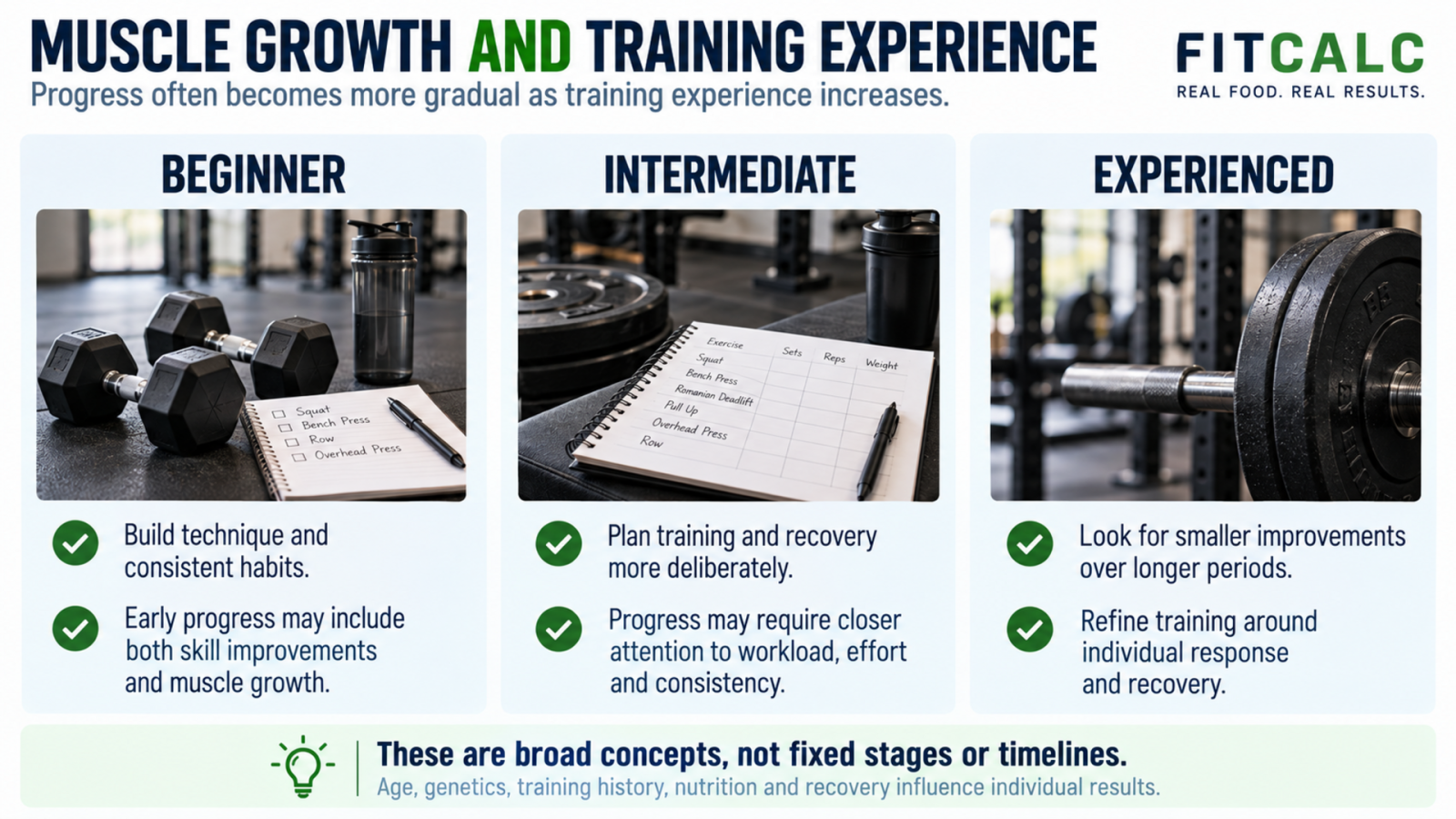
Muscle building rewards patience because the process becomes more difficult as you succeed. The goal is not to find a shortcut around that reality. It is to make your training, nutrition, and recovery good enough that you continue moving forward even after the easy beginner progress is gone.
Training for Muscle Growth
Effective hypertrophy training does not require a complicated program, but it does require enough challenging work to stimulate the muscles consistently. The exercises, repetitions, sets, and training days are tools for creating that stimulus. None of them should become rules followed without considering the larger goal.
FitCalc's approach is to focus on productive weekly volume, challenging sets, progressive performance, good exercise execution, and adequate recovery. You do not need to train six days per week simply because someone else does. A three-day full-body routine can build substantial muscle if it provides enough quality work, just as a five-day program can fail if most of its volume is poorly executed or difficult to recover from.
The number of days on the calendar matters less than what your muscles actually experience across those days.
Sets, Reps and Training Close Enough to Failure
There is no single repetition range where muscle growth suddenly begins.
Research comparing lower- and higher-load training has found similar average hypertrophy when sets were taken to failure, while heavier loads generally produced better one-repetition-maximum strength gains. That supports a broad range of usable loads; it does not mean an easy set with a very light weight is equivalent to a challenging one. Schoenfeld et al. (2017): Low- versus high-load training
That does not mean every repetition range is equally practical.
FitCalc recommends spending much of your hypertrophy training around 6–15 repetitions per set. This is not a biological hypertrophy zone where 5 or 16 repetitions stop working. It is simply an effective and practical range for many exercises. The load is heavy enough to create substantial tension without requiring extremely long sets, while still allowing enough repetitions to accumulate productive work and practice good execution.
Some exercises naturally fit outside that range. Heavy compound movements may sometimes be performed for fewer repetitions, while lateral raises, curls, leg extensions, calf raises, and similar movements can work extremely well at 15, 20, or more repetitions.
The more important variable is effort. A set of 12 repetitions performed with a weight you could have lifted 30 times is unlikely to provide the same hypertrophic stimulus as a genuinely challenging set.
You also do not need to reach absolute muscular failure on every set. In an eight-week trial in resistance-trained adults, stopping with one or two repetitions in reserve produced similar quadriceps growth to reaching failure, with less acute neuromuscular fatigue. That finding supports leaving a small margin on many sets, rather than proving that effort never matters. Refalo et al. (2024)
A practical FitCalc approach is to finish many working sets with approximately 1–3 repetitions in reserve, meaning you estimate that another one to three good repetitions were possible. This is a coaching starting point, and estimating it improves with practice. Occasional failure work can fit safer isolation exercises; demanding free-weight lifts need suitable safeties or a competent spotter.
The key word is good repetitions. If another repetition requires dramatically shortening the range of motion, throwing your body into the movement, or completely changing technique, the target muscle may already have reached its meaningful limit for that set.
FitCalc would rather see three hard, controlled sets that effectively load the intended muscle than five sloppy sets performed simply to increase a volume number.
Weekly Volume and Training Frequency
Training volume describes the amount of work performed, and when discussing hypertrophy it is often simplified to the number of challenging working sets performed for a muscle across the week.
Research supports greater average hypertrophy with higher weekly set volumes than with very low volumes, but it does not establish a single optimal number for everyone. More work is useful only when it remains productive and recoverable. Schoenfeld et al. (2017): Weekly training volume
For practical programming, FitCalc considers approximately 10–20 challenging sets per muscle group per week a useful broad range for many people. That is not a requirement to immediately perform 20 sets for every muscle. Beginners can make excellent progress with less, and the amount an experienced lifter benefits from depends on exercise selection, effort, recovery, training history, and the muscle being trained.
If you are new to resistance training, start with a manageable amount below this broad range if needed and build consistency first. More experienced lifters can start near the lower end of a range they tolerate and add sets only when progress and recovery justify it. Count challenging working sets, not warm-ups, and remember that compound lifts also train supporting muscles.
Frequency is where people often make this unnecessarily complicated. If your chest needs roughly 12 productive sets during the week, those sets could potentially be distributed across several different schedules. You might perform four sets during each of three full-body workouts, six sets during two upper-body sessions, or divide the work another way that fits your program.
When weekly volume is reasonably matched, research suggests that training frequency itself has a relatively small influence on hypertrophy. Frequency is valuable largely because it helps distribute volume, maintain training quality, and manage recovery. Schoenfeld et al. (2019)
This is why FitCalc does not believe someone automatically builds less muscle simply because they train three or four days instead of five or six.
For someone training only three days per week, a full-body routine is often one of the best options because each major muscle group can receive multiple training exposures while weekly volume is spread across the sessions. Someone training four days might prefer an upper/lower split. Five-day programs can work extremely well too, but the additional training day is useful only if it improves the overall program.
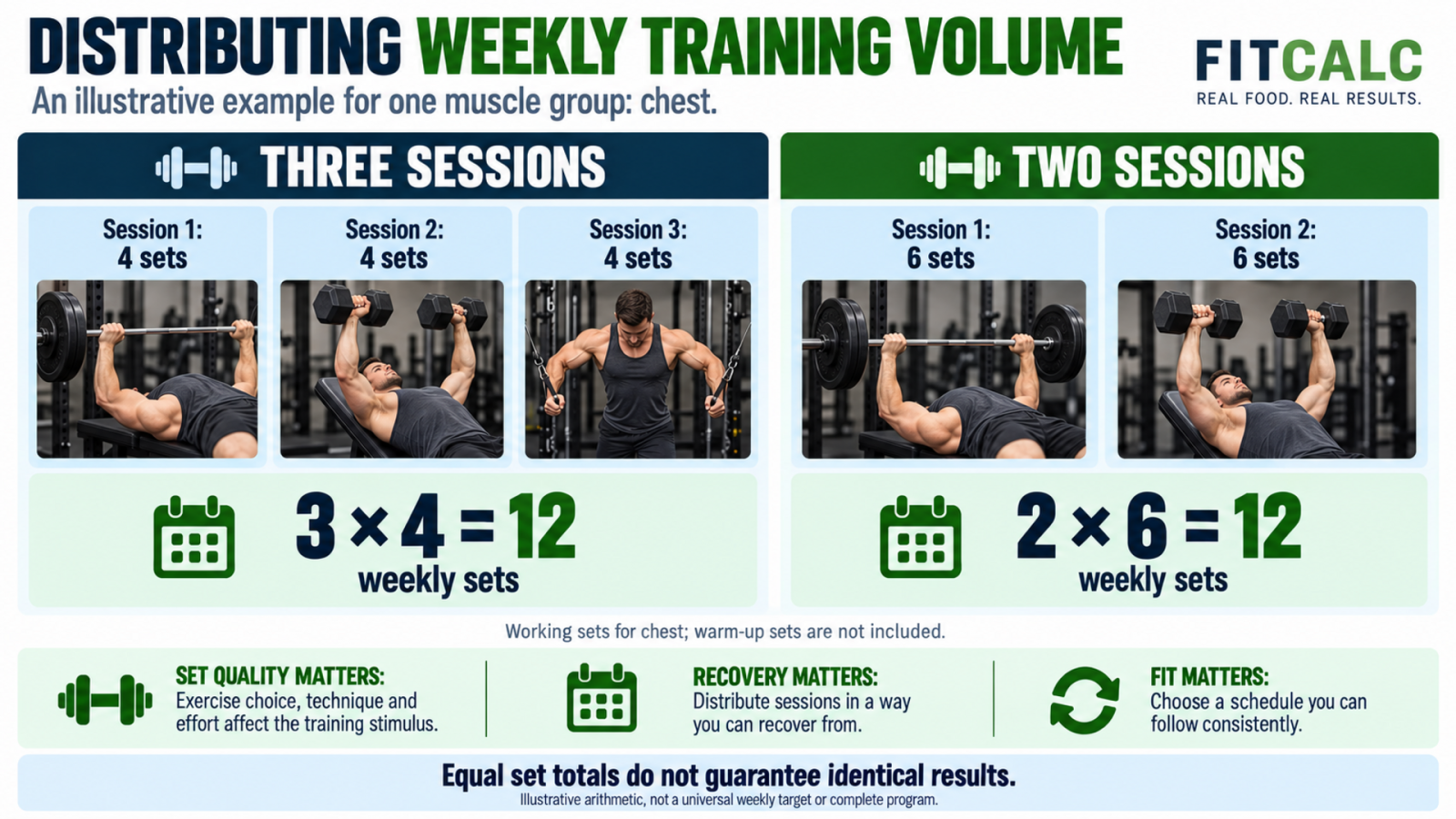
The best frequency is therefore the one that lets you perform enough quality volume, recover between sessions, progress over time, and actually follow the program consistently.
Exercise Selection and Execution
There is no universally perfect list of muscle-building exercises.
Barbells, dumbbells, cables, machines, and bodyweight movements can all build muscle. What matters is whether an exercise allows you to train the intended muscle effectively, progressively, and safely enough to repeat for months or years.
Compound exercises train multiple joints and muscle groups simultaneously. Squats, presses, rows, pull-ups, and similar movements can make a program efficient and allow substantial loads to be used. Isolation exercises focus more directly on a particular muscle or joint action and can add useful volume without always producing the systemic fatigue associated with large compound movements.
A good hypertrophy program can use both.
Stability also matters. An exercise does not receive bonus points for being difficult to balance. A stable machine press may allow someone to focus more effectively on the chest than an unnecessarily unstable pressing variation. Likewise, cables and machines can provide excellent resistance profiles and should not be considered inferior simply because they are not free weights.
Range of motion deserves attention as well. Use a controllable range that loads the intended muscle without forcing painful positions. Some research supports training at longer muscle lengths: for example, a study comparing seated and prone leg curls found greater growth in the biarticular hamstrings with the seated position. That is useful exercise-specific evidence, not proof that the deepest possible position is always best for every joint or exercise. Maeo et al. (2021)
Exercise execution should also remain consistent enough that progress means something. If you add 20 pounds to a row but gradually shorten the movement and use more momentum, you cannot confidently say the target muscles became capable of performing 20 pounds more work under the same conditions.
This is one reason constantly changing exercises can slow progress. Variety has a place, but you need enough consistency to learn movements, improve technique, and measure performance. Keep productive exercises long enough to actually progress them, and replace them when there is a reason, such as discomfort, poor target-muscle stimulus, stalled progress, or a change in training goals.
The goal is not to assemble the most impressive-looking workout. It is to create repeatable exercises, enough challenging volume, appropriate effort, and gradual progression, then continue doing that long enough for muscle growth to accumulate.
Eating to Build Muscle
Training creates the stimulus for muscle growth, but building new tissue still requires nutritional resources. If your workouts are productive but your diet consistently fails to provide enough calories, protein, and usable energy, you are making the muscle-building process harder than it needs to be.
FitCalc favors a controlled gaining phase, not the traditional idea of eating everything in sight because you are "bulking." More bodyweight gained does not automatically mean more muscle gained. The goal is to provide enough additional energy to support growth and training without accumulating unnecessary body fat at a much faster rate.
Food quality does not stop mattering because calories increase, either. A muscle-building diet should still be built primarily around nutrient-dense whole or minimally processed foods, with substantial animal protein and enough quality carbohydrates to support an active, demanding training program.
Calories and the Muscle-Building Surplus
Muscle or lean mass can increase without a calorie surplus in some circumstances, especially when a new training stimulus is combined with adequate nutrition. For example, a four-week trial in young men found greater lean-mass gain and fat loss with higher protein during an energy deficit and intensive exercise. Lean mass is not identical to muscle, and this demanding short-term protocol is not a template for every lifter. Longland et al. (2016)
That does not mean deliberately eating at maintenance or in a deficit is the best strategy for everyone whose primary goal is gaining as much muscle as reasonably possible. Building new tissue requires energy, and a calorie surplus creates an environment where energy availability is less likely to become a limiting factor.
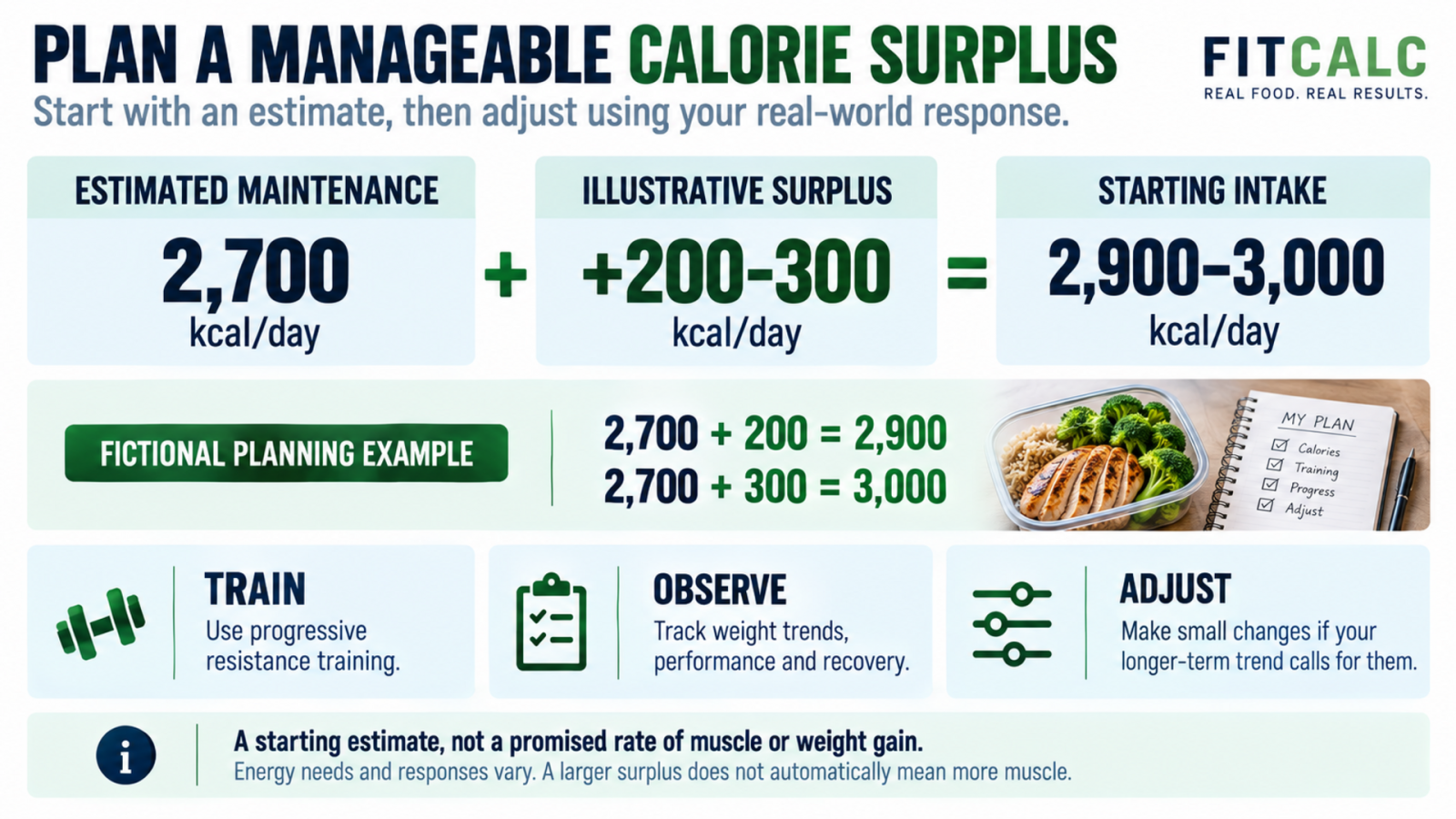
For a dedicated gaining phase, FitCalc uses a modest starting surplus of approximately 200–300 calories above estimated maintenance per day. Treat this as a practical trial, not a scientifically established optimum for every body size. Smaller or more experienced lifters may need a more conservative approach, and no calculator can precisely guarantee the true surplus.
If your maintenance intake is approximately 2,700 calories, that would put an initial muscle-gaining target around 2,900–3,000 calories per day.
The temptation is to assume that if 300 additional calories supports muscle growth, 1,000 additional calories must support even more. Human muscle does not grow that way. There is a limit to how quickly your body can construct new muscle tissue, and calories consumed beyond what can productively support growth can increasingly contribute to fat storage.
An eight-week study with 17 completers compared maintenance with intended surpluses of 5% and 15% in trained lifters. Faster weight gain was more clearly associated with increased skinfold thickness than with most muscle-thickness outcomes. There were some strength and muscle-specific signals, and the sample was small, so the study supports caution about aggressive bulking rather than proving that surplus size never affects muscle growth. Helms et al. (2023)
That is why FitCalc rejects the idea of a dirty bulk. Gaining 25 pounds quickly may make the scale impressive, but if a large portion of that gain is body fat, you have simply created more fat to lose later.
A controlled surplus also makes adjustments easier. If bodyweight, gym performance, and measurements are gradually moving in the right direction, continue. If weight remains completely unchanged for several weeks despite consistent intake, calories can be increased modestly. If bodyweight and waist circumference are climbing rapidly, the surplus may be larger than necessary.
If maintenance is still uncertain, first work through our calories and maintenance guide. A few weeks of consistent intake and weight trends can refine the initial estimate.
Protein, Carbohydrates and Fat for Muscle Growth
Once calories are established, protein is the first macronutrient FitCalc sets deliberately.
Our recommendation remains approximately 1 gram of protein per pound of bodyweight per day for healthy adults serious about building muscle and improving body composition. A 180-pound person would therefore aim for roughly 180 grams per day.
As explained in our protein guide, this is a practical FitCalc target, not a biological minimum. The ISSN describes about 1.4–2.0 g/kg/day as sufficient for most exercising adults, while a large resistance-training meta-analysis found diminishing average additional fat-free-mass benefit around 1.6 g/kg/day. Many people can do well below 1 g/lb; the target should also fit health, calorie intake and food preferences. ISSN position stand on protein and exercise (2017); Morton et al. (2018)
Carbohydrates are the next major consideration for an active lifter. Resistance training relies substantially on carbohydrate-derived energy, particularly as training volume rises, and muscle glycogen can decline during demanding sessions. Carbohydrate intake helps replenish those glycogen stores between workouts.
A 2026 meta-analysis found no clear independent hypertrophy advantage from higher carbohydrate intake when protein was matched, including its calorie-matched subgroup. Evidence certainty was low, so this is not proof that carbohydrate can never matter. A separate review of performance studies suggests extra carbohydrate may be more useful during high-volume sessions or when fuel availability is limited. Henselmans et al. (2026); Henselmans et al. (2022)
FitCalc often starts active lifters around 200 grams of carbohydrate per day and adjusts from there. This is a planning preference, not a minimum requirement for muscle growth or a suitable target for every active adult. Body size, total calories, session length, other sports, performance and digestion should guide the amount; some people do well with less, while others need considerably more.
Rice, potatoes and fruit are straightforward carbohydrate staples, alongside other foods that fit the person's preferences. Honey or 100% fruit juice can be convenient ways to add carbohydrate, but they are not nutritionally interchangeable with whole fruit. WHO counts their sugars as free sugars, so use them alongside whole fruit and other nutrient-rich foods, rather than as the main carbohydrate source. WHO: Healthy diet
Dietary fat then helps fill the remaining calorie requirement. Whole eggs, beef, salmon, olive oil, avocado, nuts, and other quality foods can provide dietary fat alongside useful nutrients. There is rarely a reason to push fat extremely low simply to fit more protein and carbohydrates into the diet.
The exact carbohydrate-to-fat ratio does not need to become another optimization problem. Set calories, establish protein, make sure an active person is eating enough quality carbohydrates, and use quality fats to complete the diet.
Food Quality During a Muscle-Gaining Phase
A calorie surplus gives you more room to eat. It should not become an excuse to stop caring about what you eat.
The old dirty-bulk mentality often treats all additional calories as equally desirable. If someone needs 3,200 calories to gain weight, the reasoning becomes that pizza, fast food, desserts, sugary drinks, and heavily processed snacks are simply efficient ways to reach the number.
They certainly make calories easy to consume. That does not make them the foundation FitCalc recommends.
A muscle-gaining diet should still be built primarily around whole and minimally processed foods. Beef, eggs, poultry, fish, rice, potatoes, fruit, vegetables, olive oil, avocado, nuts, honey, and other simple foods can provide plenty of calories while also supplying protein, carbohydrates, fats, vitamins, minerals, and other nutrients.
For someone who struggles to gain weight, increase portions gradually rather than abandoning food quality. More rice or potatoes, an extra serving of tolerated dairy, olive oil added to a meal, or avocado and nuts can make adequate intake easier. Fattier cuts of meat can fit too, but food choice still needs variety and attention to the overall balance of fats, fibre and produce.
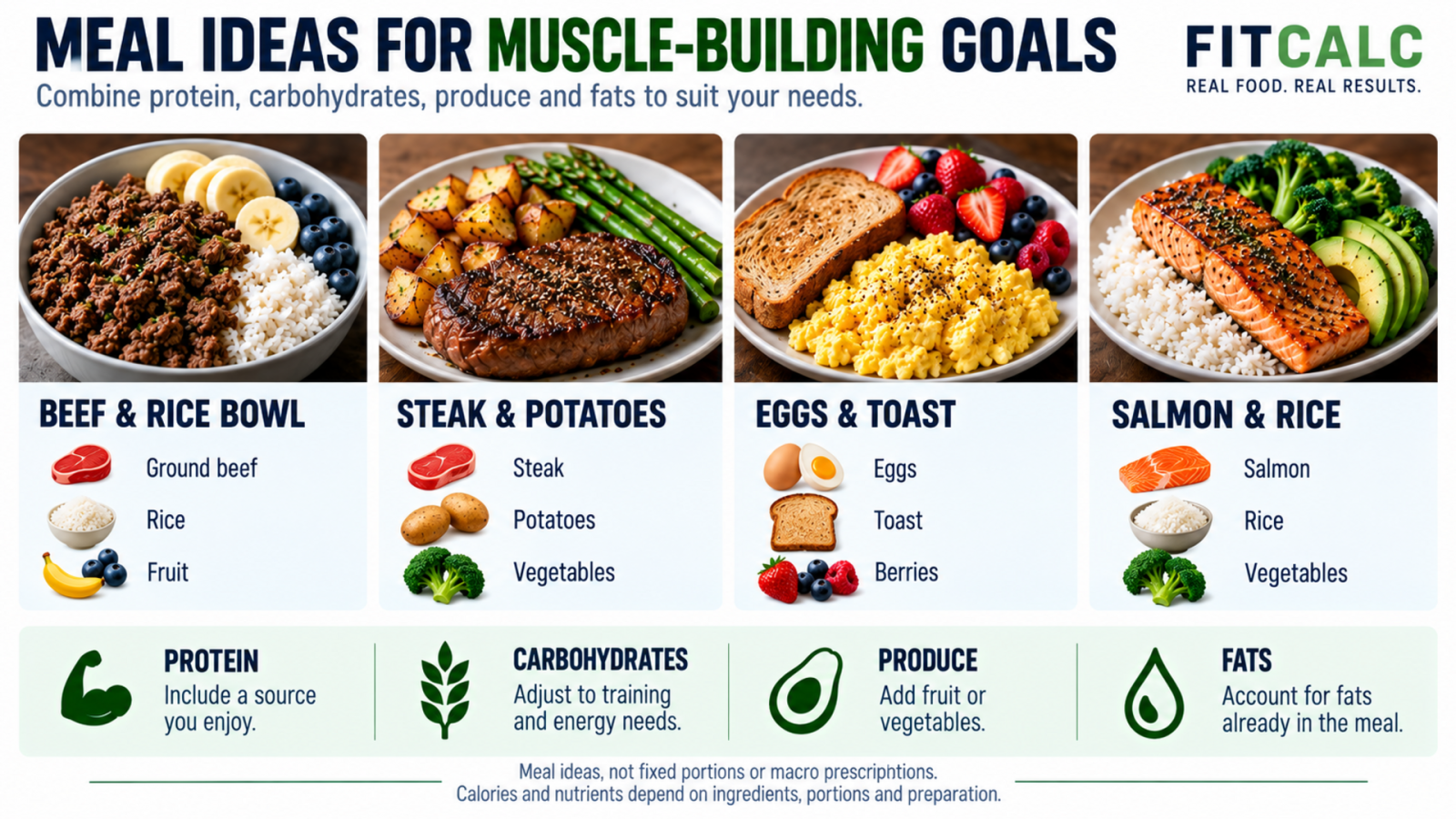
A simple muscle-building meal can start with a substantial serving of animal protein, followed by a generous carbohydrate source and additional fruit or vegetables. Dietary fat can come naturally from the protein source or be added according to calorie needs.
For example, steak with potatoes and vegetables, chicken with rice and fruit, or salmon with rice and greens can be useful templates. Home-prepared meals give you control over ingredients and portions, but a food's label as homemade or restaurant-made does not by itself determine its nutritional quality. Build a repeatable pattern you enjoy.
FitCalc does not require dietary perfection. Restaurant meals, desserts, or other less ideal foods can fit into an otherwise strong diet. The issue is what forms the foundation of your calorie intake.
If most of your food is nutrient-dense and minimally processed, hitting a calorie surplus does not require turning your diet into junk food. You are trying to give your body the resources to train, recover, and build tissue for months or years. Your food choices should reflect that goal.
A muscle-building phase should ultimately look like more of a good diet, not an entirely different and lower-quality diet simply because you are allowed to eat more calories.
Recovery, Progress and Adjustments
Muscle growth does not end when the workout ends. Training creates the stimulus, but your ability to adapt to that stimulus depends on what happens between sessions. Food, sleep, rest, and fatigue management all influence whether you return to the gym ready to produce another productive workout.
Recovery also gives context to training volume. Twenty hard sets are not better than twelve if the additional work leaves performance declining for the rest of the week. The goal is to perform as much productive training as you can actually recover from, not simply accumulate the highest number of sets possible.
This becomes increasingly important as you grow stronger. Heavier loads and greater training volumes can create more fatigue, while muscle growth itself becomes slower with experience. A sustainable program therefore needs to balance enough work to stimulate progress with enough recovery to allow that progress to occur.
Sleep, Rest and Recovery
Sleep is one of the most important recovery tools available, and unlike many expensive recovery products, it costs nothing.
During sleep, the body undergoes processes involved in tissue repair, nervous-system recovery, hormone regulation, immune function, and memory. Poor sleep can also affect training performance, motivation, appetite, and your ability to consistently execute a demanding program.
There is no honest equation saying exactly how much additional muscle eight hours of sleep produces compared with seven. Experimental sleep restriction in healthy young men has reduced myofibrillar protein synthesis, which is a reason to take sleep seriously. It does not establish a precise long-term hypertrophy penalty for every missed hour. Saner et al. (2020)
FitCalc recommends aiming for roughly 7–9 hours of quality sleep per night for most adults. Individual needs vary, but consistently sleeping five hours while trying to optimize training and muscle growth is working against yourself. CDC: About sleep
Rest days matter too. A rest day does not mean your muscle-building plan has stopped. It gives trained tissues and the broader body time to recover before the next training stimulus. Someone following a three- or four-day program can build substantial muscle without feeling obligated to perform a hard workout every day.
Recovery needs also differ between exercises and muscles. A few hard sets of lateral raises do not create the same whole-body fatigue as several demanding sets of squats or deadlifts. This is another reason simply counting sets cannot tell you everything about how difficult a program is to recover from.
Signs that recovery may be falling behind include persistently declining performance, unusual fatigue, worsening motivation to train, repeated soreness that never seems to resolve, and difficulty progressing despite adequate effort. One poor workout does not mean you're overtrained. A persistent pattern is more useful.
Before adding more training, ask whether you are recovering from the training you already perform. Stimulus without adequate recovery eventually becomes fatigue rather than additional productive work.
If persistent exhaustion or poor sleep continues despite allowing enough time for sleep, or symptoms interfere with daily life, seek medical advice rather than treating every problem as a need to train harder.
How to Know Whether You're Actually Building Muscle
Muscle growth happens slowly enough that you cannot reliably judge it from one mirror check or one morning on the scale. You need several forms of feedback viewed over enough time.
Bodyweight is useful during a gaining phase because a controlled upward trend tells you that enough energy is entering the system to increase total mass. Daily readings will still fluctuate because of water, glycogen, sodium, food, and hydration, so weekly averages are much more informative than individual weigh-ins.
If someone begins a gaining phase averaging 170 pounds and later averages 176, that is a 6-pound increase in total bodyweight. It is not proof of 6 pounds of muscle. Compare that trend with performance, waist measurements and consistently taken photographs, while remembering that water and glycogen also change.
Gym performance provides another important signal. If you can eventually perform more repetitions with the same load, use more weight with similar execution, or handle more productive work than before, your body is adapting to training. Strength gain and muscle gain are not perfectly interchangeable, because technique and neurological adaptations also increase strength, but sustained performance improvement is generally something we want to see.
Measurements can help fill in the picture. Increases in arm, thigh, chest, shoulder, or other circumferences can support the case that muscle is being added, particularly when waist circumference and overall body-fat appearance are not increasing rapidly. Progress photographs taken under similar lighting, distance, posing, and conditions can reveal changes that are difficult to notice when you see yourself every day.
Body-composition measurements can provide additional information, but none of the common consumer methods is perfectly precise. Small changes on a smart scale should not determine whether you think a three-month gaining phase succeeded.
The strongest evidence comes from several trends pointing in the same direction: gradual bodyweight gain, improving gym performance, increasing muscular measurements, and visible changes without disproportionately rapid increases in body fat.
This is why muscle building requires patience. You are looking for a pattern developing over months, not proof after ten days.
Our body-composition guide explains why scale weight, fat-free mass and skeletal muscle are different measurements.
When to Increase Calories or Change Your Training
A good muscle-building plan should be allowed enough time to work before you start changing it.
If your bodyweight has not meaningfully increased for several weeks, your training is consistent, and your calorie tracking is reasonably accurate, your current intake may no longer provide a surplus. Maintenance requirements can change as bodyweight and activity increase. Adding a modest amount of food, perhaps another 100–200 calories per day, may be enough to restore gradual weight gain.
The opposite problem is gaining too quickly. If bodyweight is climbing rapidly while waist circumference and visible body fat increase much faster than muscular measurements or performance, reducing the surplus makes sense. There is little benefit in continuing to push calories higher simply because the scale is moving.
Training adjustments require similar restraint. A stalled lift does not automatically mean you need another five sets for that muscle. Progress can slow because of poor recovery, inconsistent sleep, inadequate calories, exercise technique, unrealistic progression expectations, or simply because you are becoming more advanced.
Look at the broader pattern before changing the program. If several exercises for the same muscle have stopped progressing for an extended period despite adequate recovery and nutrition, then changing volume, exercise selection, or programming may be reasonable.
The goal is to change the variable that actually appears to be limiting progress.
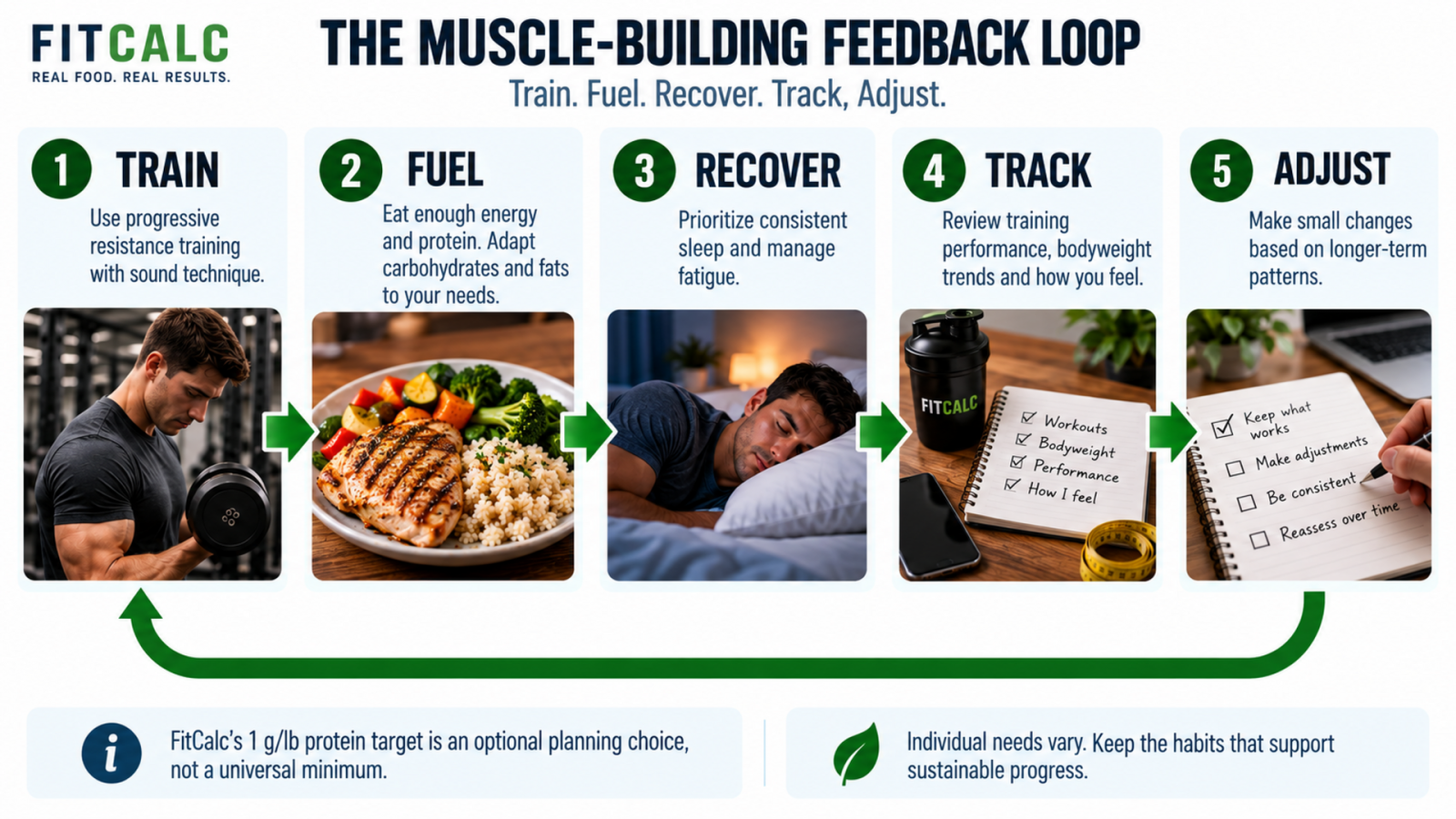
A successful muscle-building phase should become a feedback loop rather than a rigid plan you follow regardless of results. Train, eat, recover, measure what happens, and make small adjustments when enough evidence shows that something needs to change.
Practical Takeaways
Muscle growth requires a training stimulus strong enough to create adaptation and enough time for those adaptations to accumulate. Progressive overload keeps that stimulus challenging as you improve, while productive weekly volume matters more than simply training as many days as possible.
For much hypertrophy work, FitCalc favors challenging sets in the 6–15-repetition range, while recognizing that other ranges also work. Approximately 10–20 challenging weekly sets per muscle is a broad planning framework, not a beginner minimum or an instruction to maximize volume. Match the work to experience, performance and recovery.
Nutrition should support the training. FitCalc's planning starting points include a modest 200–300-calorie surplus for a dedicated gaining phase, protein near 1 gram per pound if appropriate, and carbohydrate tailored to the workload. These are adjustable choices, not universal requirements. Keep whole-food meals and a varied diet at the center.
Recovery completes the process. Consistent sleep, rest, and fatigue management allow you to keep producing productive training sessions instead of continually digging a deeper recovery hole.
Conclusion
Building muscle is a long-term process of giving your body a reason to adapt and then providing the resources necessary for that adaptation to occur.
You do not need the perfect workout split. You do not need to take every set to failure. You do not need an enormous calorie surplus, six meals per day, or a cabinet full of supplements. You need enough challenging training, progressive performance, adequate nutrition, and recovery repeated consistently.
FitCalc's approach is intentionally straightforward: train progressively, use enough calories and protein for your situation, include carbohydrate that supports your training, prioritize whole-food meals, sleep enough, and monitor the combined results. A controlled surplus can help a dedicated gaining phase, but neither scale gain nor a single macro number guarantees muscle growth.
As you become more experienced, progress will slow. That is normal. The answer is not automatically more food, more exercises, or more training days. It is increasingly precise execution of the fundamentals that already work.
Muscle is built slowly enough that consistency wins. A few great workouts or perfect meals will not transform your physique, but hundreds of productive workouts supported by months and years of good nutrition and recovery can.
Sources
Jäger et al. (2017). International Society of Sports Nutrition Position Stand: protein and exercise.