Weight loss has become surrounded by rules that make a relatively straightforward process seem far more complicated than it is. Carbohydrates get blamed. Meal timing gets blamed. Certain foods are labeled fat-burning while others are treated as if they automatically cause weight gain. Underneath all of that, the fundamental requirement remains the same: your body must consistently use more energy than you consume for weight loss to occur.
That doesn't mean calories are the only thing that matters. Two diets containing the same number of calories can differ substantially in protein, micronutrients, food quality, satiety, and how well they support training and muscle retention. A good weight-loss plan therefore does more than make the scale decrease. It creates an appropriate calorie deficit while providing enough protein and nutrients, supporting an active lifestyle, and preserving as much lean mass as reasonably possible.
This guide will walk through that process from beginning to end. We'll start with calorie balance and your daily energy needs, then establish an appropriate deficit. Later sections will cover protein and macros, food quality, resistance training and activity, progress tracking, plateaus, and eventually maintaining your new weight.
The goal is not to find the fastest way to make yourself lighter. It is to understand how to lose body fat in a way you can actually sustain.
Calories and the Foundation of Weight Loss
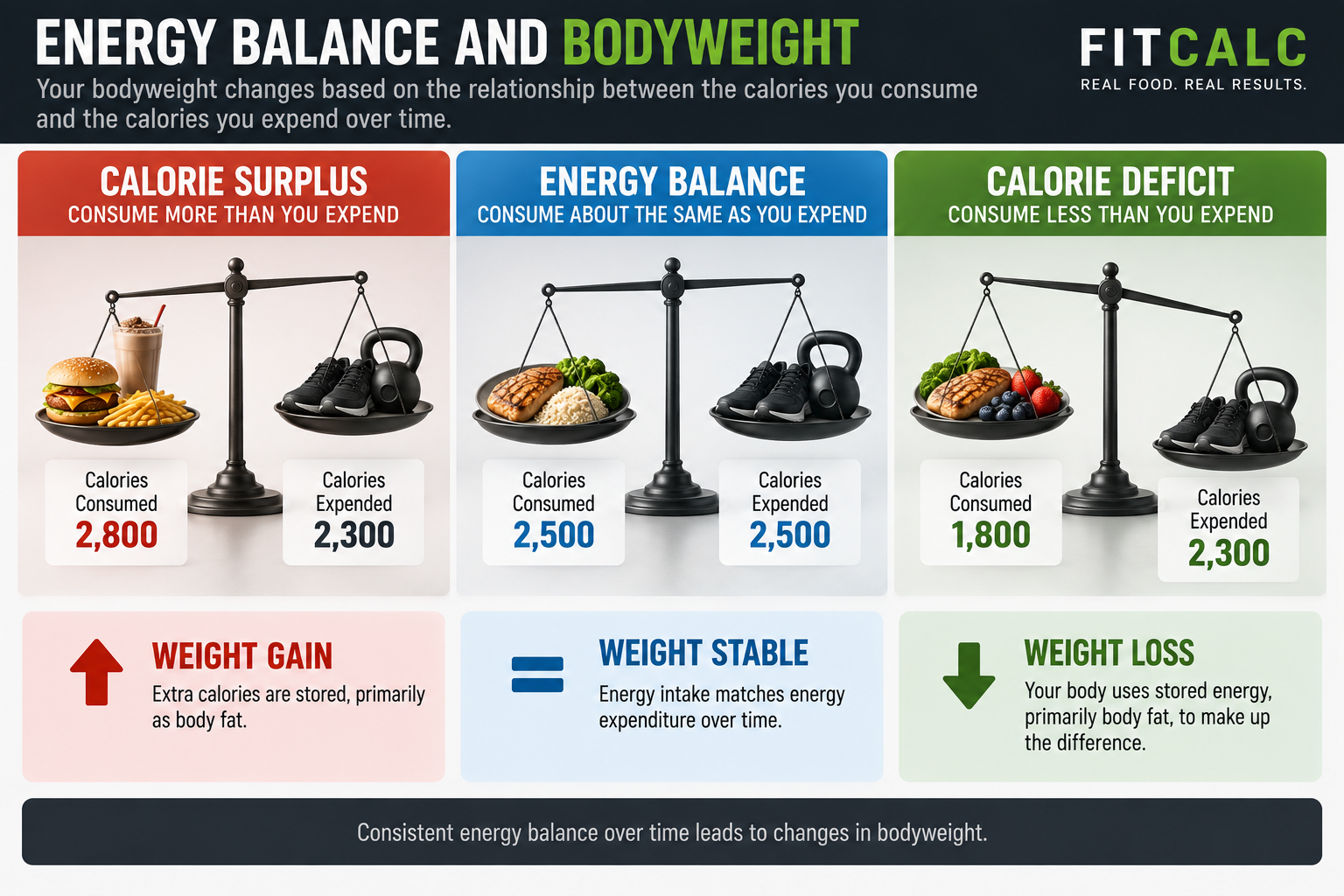
Weight loss starts with energy balance. Your body requires energy every day to keep your organs functioning, maintain body temperature, digest food, move around, exercise, and perform thousands of biological processes. Food and beverages provide that energy, which we measure in calories.
Over time, the relationship between the energy you consume and the energy your body uses influences whether your weight rises, falls, or remains relatively stable. When the two sides roughly match, you're around maintenance. Consistently consuming more energy than you expend creates a calorie surplus, while consistently consuming less creates a calorie deficit.
A calorie deficit is the fundamental requirement for losing bodyweight. When dietary energy does not completely cover your body's requirements, stored energy has to make up the difference. Body fat is one of the body's major energy reserves, which is why maintaining an energy deficit over time reduces fat mass. NIDDK similarly describes reducing calorie intake as central to weight loss, while physical activity increases energy expenditure and provides benefits beyond the calories it burns.
This does not mean food quality is irrelevant. A 2,000-calorie diet built around beef, eggs, fish, fruit, potatoes, rice, and other nutrient-dense foods is nutritionally very different from 2,000 calories dominated by ultra-processed food. Protein, micronutrients, food quality, hunger, training, and activity all influence the quality and sustainability of a weight-loss plan. Calories determine whether the necessary energy deficit exists, while the composition of your diet helps determine what living in that deficit actually looks like.
Weight Loss vs. Fat Loss
The scale measures your total bodyweight. It does not exclusively measure body fat.
Water, muscle, glycogen, bone, organs, digestive contents, and stored fat all contribute to the number you see. This is why losing five pounds on the scale does not necessarily mean exactly five pounds of body fat disappeared. Changes in carbohydrate intake can alter glycogen and associated water, sodium and hydration can shift body water, and simply eating less food can reduce the amount of material moving through your digestive system.
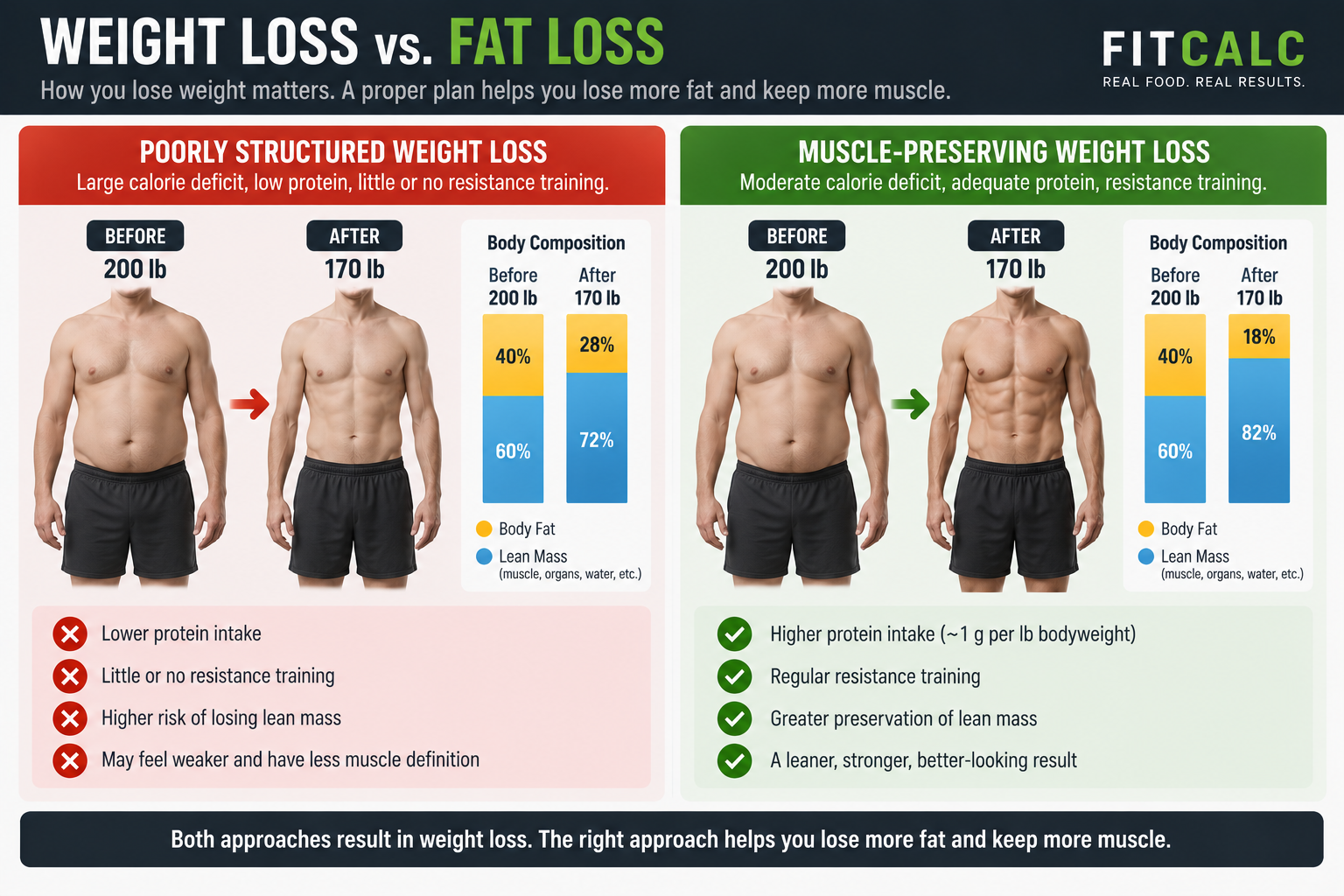
This distinction becomes even more important over longer dieting periods because some weight loss can come from lean tissue. Research examining resistance training during energy restriction has found that calorie deficits can impair gains in lean mass, particularly as the deficit becomes larger. That is one reason FitCalc does not recommend treating the fastest possible decline on the scale as the definition of successful weight loss.
Suppose two people each lose 30 pounds. One consumes adequate protein, resistance trains, stays active, and preserves most of their muscle. The other uses an unnecessarily aggressive diet, eats little protein, and loses substantially more lean tissue alongside the fat. Both people technically lost 30 pounds, but they did not achieve the same body-composition result.
For most people, the better objective is therefore to reduce excess body fat while preserving as much muscle and physical performance as reasonably possible. Later sections will show how protein, resistance training, and an appropriately sized calorie deficit help accomplish that.
BMR, TDEE and Maintenance Calories
Knowing that weight loss requires a calorie deficit immediately creates another question: a deficit compared with what?
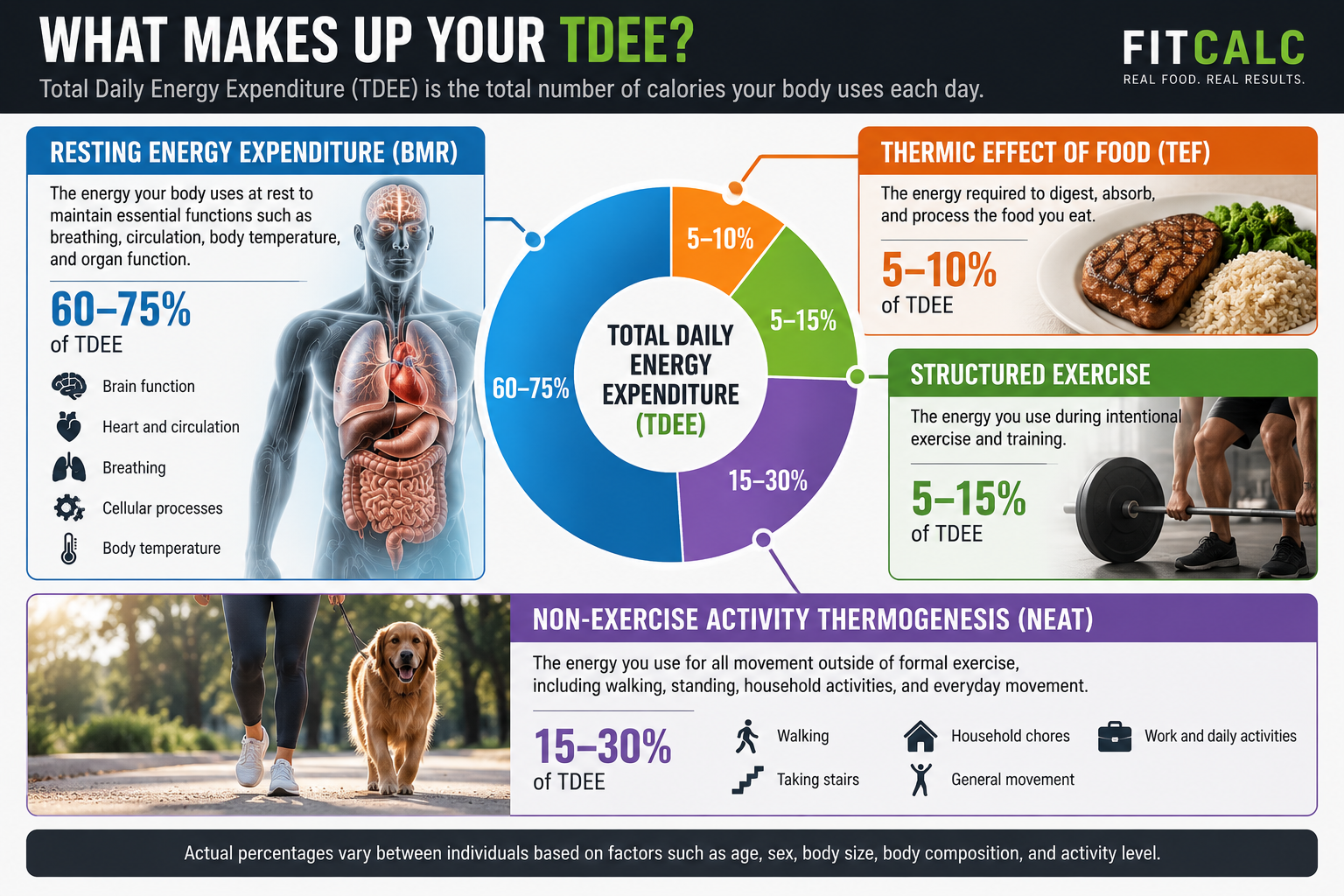
Your basal metabolic rate (BMR) represents the energy your body requires to maintain essential physiological functions under resting conditions. Even if you performed no deliberate exercise, your brain, heart, kidneys, liver, nervous system, and other tissues would still require substantial energy to function.
BMR is not the number of calories you should automatically eat each day. Real people walk, work, digest food, exercise, stand, clean, shop, fidget, and perform countless other activities. Your total daily energy expenditure (TDEE) attempts to account for the complete amount of energy you use across an average day.
TDEE includes resting energy requirements, the thermic effect of digesting and processing food, structured exercise, and non-exercise activity thermogenesis (NEAT). NEAT includes ordinary movement outside formal exercise, such as walking around at work, doing household chores, taking stairs, standing, and other spontaneous activity. Differences in these behaviors help explain why two people of similar size can have meaningfully different calorie requirements.
Your maintenance calories are the approximate intake at which your bodyweight would remain relatively stable at your current body size and activity level. If your average daily expenditure is around 2,600 calories, then an average intake near 2,600 would theoretically place you around maintenance.
No consumer calculator can determine this number perfectly. Predictive equations provide a useful starting estimate, while your actual bodyweight trend helps determine how close that estimate is. NIDDK's Body Weight Planner takes a similar approach by using personal characteristics and physical activity to model calorie requirements and expected changes in bodyweight over time.
If a calculator estimates maintenance at 2,700 calories and you accurately average around that intake for several weeks while bodyweight remains relatively stable, the estimate is probably reasonably close. If weight consistently increases or decreases, your actual energy balance may differ from the initial estimate. The calculator gives you a starting point; your bodyweight trend provides additional information.
Choosing the Right Calorie Deficit
Once you have a reasonable maintenance estimate, creating a calorie deficit becomes straightforward. If your estimated maintenance is 2,600 calories and you consume 2,200, your starting estimate is a 400-calorie daily deficit.
That doesn't mean the goal should be creating the largest deficit you can tolerate. An aggressive deficit can make the scale fall faster, but it also means less food and can make hunger, training performance, recovery, and muscle retention more difficult. At the opposite extreme, a very small deficit can produce progress so slowly that normal fluctuations in water and digestive contents make it difficult to determine whether the diet is working.
For many people, a moderate starting deficit around 300–500 calories per day is a reasonable place to begin, although it should not be treated as a universal prescription. Body size, body-fat level, activity, training demands, and the amount of weight someone needs to lose all affect what is appropriate. Someone carrying substantial excess body fat may tolerate a larger deficit differently from a relatively lean person trying to lose the final few pounds.
It's also important to understand that your maintenance requirements do not remain permanently fixed. As you become lighter, your body generally requires less energy to maintain and move. Adaptive thermogenesis can reduce expenditure somewhat further, although research suggests its magnitude varies considerably between individuals and studies.
This is why the familiar rule that a 3,500-calorie deficit always produces exactly one pound of weight loss is too simplistic for long-term planning. NIDDK's dynamic bodyweight models account for changes in metabolism and energy expenditure as bodyweight changes rather than assuming the same calorie reduction will produce identical weight loss indefinitely.
None of this means a calorie deficit eventually "stops working." It means the size of the deficit can change because your body and energy requirements have changed. A calorie intake that produced steady weight loss at 220 pounds may create a smaller deficit after you've reached 190.
That gives us a much more practical process than trying to calculate one perfect number at the beginning:
Estimate your maintenance calories, establish a reasonable deficit, follow it consistently, watch your weight trend over several weeks, and adjust when the evidence actually shows an adjustment is needed.
Building a Diet for Weight Loss
Once calories are set, the next step is deciding what those calories should actually contain. A calorie deficit determines whether weight loss can occur, but the composition of your diet influences hunger, nutrition, training performance, muscle retention, and how realistic the plan is to follow for months rather than days.
FitCalc favors a straightforward approach: prioritize high-quality protein, eat mostly whole or minimally processed foods, include quality carbohydrate and fat sources, and build meals you can consistently repeat. Weight loss does not require eliminating carbohydrates, eating extremely low fat, fasting for most of the day, or surviving on foods marketed specifically for dieting.
Your calorie target creates the boundaries of the diet. Protein and food quality help determine what you build inside those boundaries.
Protein, Carbohydrates, Fat and Your Macros
Protein deserves the most attention during weight loss because a calorie deficit creates conditions where preserving lean tissue becomes more difficult. Resistance training provides the physical signal to retain muscle, while adequate dietary protein supplies the amino acids needed to maintain and repair that tissue.
Research supports increasing attention to protein during energy restriction, particularly for active people. Higher protein intake combined with resistance training can improve body-composition outcomes during a calorie deficit, helping preserve or, under some circumstances, even increase lean mass while fat is lost.
For someone seriously pursuing fat loss while trying to preserve muscle, FitCalc generally recommends roughly 1 gram of protein per pound of bodyweight per day as a simple practical target. That is intentionally straightforward rather than the minimum amount someone might technically require. Individual needs vary, and people with a large amount of excess body fat may benefit from setting protein relative to goal weight or lean mass rather than forcing an unnecessarily large protein intake.
We prefer getting most of that protein from nutrient-dense animal foods such as beef, eggs, poultry, fish, and quality dairy when tolerated. These foods provide complete essential amino acid profiles alongside nutrients such as vitamin B12, iron, zinc, choline, creatine, and omega-3 fatty acids depending on the food.
Protein also tends to be particularly useful for satiety. A systematic review of higher-protein diets found evidence that increased protein can improve fullness or satiety in people with overweight or obesity, although the authors noted limitations in the available evidence. That doesn't make protein a substitute for a calorie deficit, but feeling more satisfied while eating fewer calories can make the deficit considerably easier to maintain.
After protein is established, carbohydrates and dietary fat fill out the remainder of the diet. Carbohydrates contain approximately 4 calories per gram, protein also contains approximately 4, and dietary fat contains approximately 9 calories per gram. Alcohol supplies approximately 7 calories per gram, although it is not an essential macronutrient.
There is no reason most healthy people need to eliminate carbohydrates to lose body fat. Potatoes, rice, fruit, honey, and other quality carbohydrate sources can fit comfortably inside a calorie deficit. For active people, carbohydrates are particularly useful for supplying energy and supporting glycogen stores used during demanding exercise. Someone lifting weights, playing sports, walking frequently, or otherwise living an active lifestyle will generally have more use for carbohydrate than someone who is largely sedentary.
Dietary fat remains important as well. Foods such as eggs, beef, salmon, avocado, olive oil, nuts, and other quality sources can provide dietary fat alongside useful nutrients. The main practical consideration during weight loss is that fat is more calorie-dense than protein or carbohydrate, so portions can add calories quickly. That does not make naturally occurring dietary fat unhealthy. It simply means calorie density matters when total intake is restricted.
Your final carbohydrate-to-fat ratio does not need to be mathematically perfect. Once calories and adequate protein are established, the remaining balance can reflect activity level, food preferences, appetite, and how you feel and perform. A macro target should help organize a good diet, not force you to eat foods you don't want simply to make three numbers line up perfectly.
Food Quality and Making the Deficit Easier
Calories matter for weight loss, but treating all foods as interchangeable because they contain the same amount of energy misses an important part of nutrition.
Whole and minimally processed foods generally provide a combination of protein, vitamins, minerals, water, fiber, and other nutrients while requiring you to eat actual meals. Ultra-processed foods are often engineered to be extremely easy to consume and can combine refined carbohydrates and fats in ways that make a large amount of energy relatively easy to eat quickly.
One of the strongest demonstrations comes from a controlled NIH inpatient trial. Participants were offered either ultra-processed or unprocessed diets that were matched for presented calories, energy density, macronutrients, sugar, sodium, and fiber. When allowed to eat freely, participants on the ultra-processed diet consumed approximately 500 additional calories per day and gained weight, while they lost weight during the unprocessed-food phase.
That does not mean processing automatically makes a food harmful, nor does it mean eating one packaged food ruins a diet. The practical lesson is that food quality can influence how easy it is to control calorie intake, even though energy balance still determines the resulting weight change.
At FitCalc, we recommend building most meals around recognizable foods with relatively simple ingredients. A weight-loss diet might include beef, eggs, chicken, salmon, potatoes, white rice, fruit, vegetables, avocado, olive oil, nuts, and other whole or minimally processed foods according to individual needs and tolerances.
A simple meal structure works well:
High-quality animal protein + quality carbohydrate or produce + an appropriate amount of dietary fat
That could mean steak with potatoes and fruit, eggs with potatoes and berries, salmon with rice and vegetables, or chicken with rice, avocado, and fruit. There is no requirement to eat stereotypical "diet food."
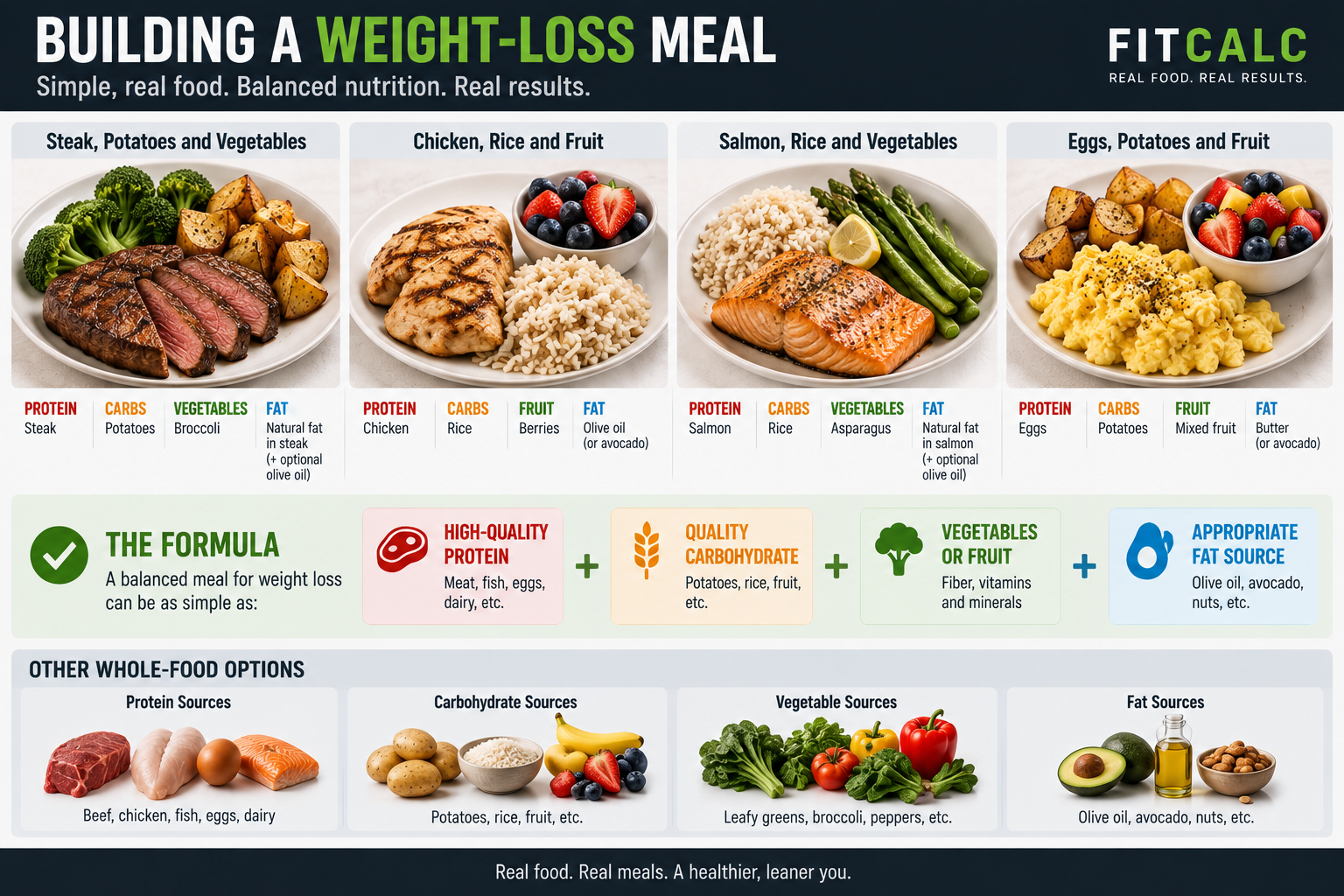
Portion size still matters. Olive oil is a quality food, but several unmeasured tablespoons can add hundreds of calories. Nuts are nutrient-dense, but they're also extremely energy-dense. A large fatty steak can contain substantially more calories than a leaner cut. Honey and fruit juice can be useful carbohydrate sources, particularly for active people, but they are easier to consume quickly than whole fruit.
This is where calorie awareness and food quality work together rather than competing with each other. You do not have to choose between counting calories and caring about nutrition. Calories tell you how much energy you're consuming, while food quality helps determine what nutrients, protein, satiety, and overall dietary value come with those calories.
FitCalc's general preference is to make roughly 80–85% or more of the diet whole or minimally processed foods, while leaving enough flexibility that the plan remains realistic. You don't need a diet so rigid that eating at a restaurant or having an occasional less-than-perfect meal feels like failure.
Consistency over months matters much more than dietary perfection for three days. Build most of your meals from quality foods, hit your protein target, keep average calorie intake aligned with your deficit, and make the diet simple enough that you can continue following it while living a normal life.
Training, Activity and Tracking Progress
A calorie deficit drives weight loss, but what you do physically during that deficit helps determine the kind of weight you lose and how well you function throughout the process. Exercise should not be treated simply as a way to burn enough calories to compensate for food. Resistance training, walking, recreational activity, and cardiovascular exercise each contribute something different.
Tracking matters for the same reason. Your calorie target is an estimate, and daily bodyweight is noisy. You need enough information to determine whether the plan is actually working without reacting to every small change on the scale.
Resistance Training and Preserving Muscle
When someone wants to lose weight, cardio is often the first form of exercise that comes to mind. Cardio can absolutely be useful, but resistance training should be a priority when preserving muscle is part of the goal.
A calorie deficit creates an environment in which the body has less incoming energy available. If muscle tissue is no longer being challenged and protein intake is inadequate, there is less reason for the body to retain all of that metabolically expensive tissue. Resistance training provides a repeated stimulus showing that the muscle is still needed.
The evidence supports this approach. A 2025 systematic review and meta-analysis examining resistance exercise during dietary weight loss found that adding resistance training helped protect against losses in fat-free mass, increased fat-mass loss, and improved muscular strength compared with dieting alone. Earlier research has similarly shown that the size of an energy deficit can influence lean-mass outcomes during resistance training, which is another reason not to make a diet unnecessarily aggressive.
You don't need to become a competitive bodybuilder. A well-designed resistance-training program performed several times per week can provide the necessary stimulus. The goal should be to continue challenging the major muscle groups with enough effort and volume to maintain strength and muscle as bodyweight falls.
Training performance also gives you useful feedback. Some decline can occur during a prolonged calorie deficit, particularly as someone becomes leaner or reduces calories substantially. But if strength suddenly collapses across the board, energy is constantly low, recovery is poor, and workouts become dramatically worse, it may be worth examining whether the deficit is too aggressive, carbohydrate intake is unnecessarily restricted, sleep is poor, or recovery is otherwise inadequate.
Protein and resistance training work together here. The high protein intake established earlier supplies amino acids, while training gives the body a reason to direct resources toward maintaining muscle tissue. Neither requires perfection, but combining them gives you a much better strategy for losing body fat rather than simply becoming a smaller version of your current body composition.
Steps, Cardio and Everyday Activity
Formal workouts represent only part of your daily movement. Walking around the house, standing at work, shopping, cleaning, taking stairs, doing yardwork, playing recreational sports, and other ordinary activities all contribute to daily energy expenditure.
This non-exercise activity can vary substantially between people and can also change during dieting. Someone eating fewer calories may unconsciously sit more, move less, or become less spontaneous throughout the day. That reduction in movement can partially offset the calorie deficit without the person realizing it.
This is one reason FitCalc strongly encourages an active lifestyle rather than relying exclusively on scheduled workouts. Walking is one of the easiest ways to accomplish that. A target of 10,000 or more steps per day can be an excellent practical goal for many healthy adults, but it is not a biological threshold where 9,500 steps suddenly becomes ineffective. Someone currently averaging 3,000–4,000 steps can benefit greatly from gradually moving toward 6,000, 8,000, and eventually higher levels.
Cardiovascular exercise can be added according to fitness level, goals, and preference. Running, cycling, swimming, hiking, sports, incline walking, and other activities can increase energy expenditure while improving cardiovascular fitness. NIDDK recommends that healthy adults work toward at least 150 minutes of moderate-intensity aerobic activity per week, along with muscle-strengthening activity on at least two days. More activity may be appropriate depending on the individual and their goals.
Cardio should not become punishment for eating. If you consume an unplanned meal, you don't need to spend two hours on a treadmill trying to erase it. The better strategy is maintaining a reasonable calorie intake and an active lifestyle consistently enough that occasional deviations don't determine the overall outcome.
Activities you genuinely enjoy can be especially valuable. Basketball, hiking, cycling, surfing, recreational sports, long walks, and active hobbies all count. Someone who resistance trains three or four times per week, walks frequently, and plays a sport regularly may already have a substantial activity level without needing to perform traditional cardio every day.
The best activity plan is therefore broader than simply asking how many calories did this workout burn? Resistance training helps preserve muscle, cardiovascular exercise develops fitness, and everyday movement keeps you active throughout the rest of the week.
How to Track Weight Loss Correctly
A good weight-loss plan needs enough time and data to determine whether it's working. The bathroom scale is useful, but only if you understand what it measures.
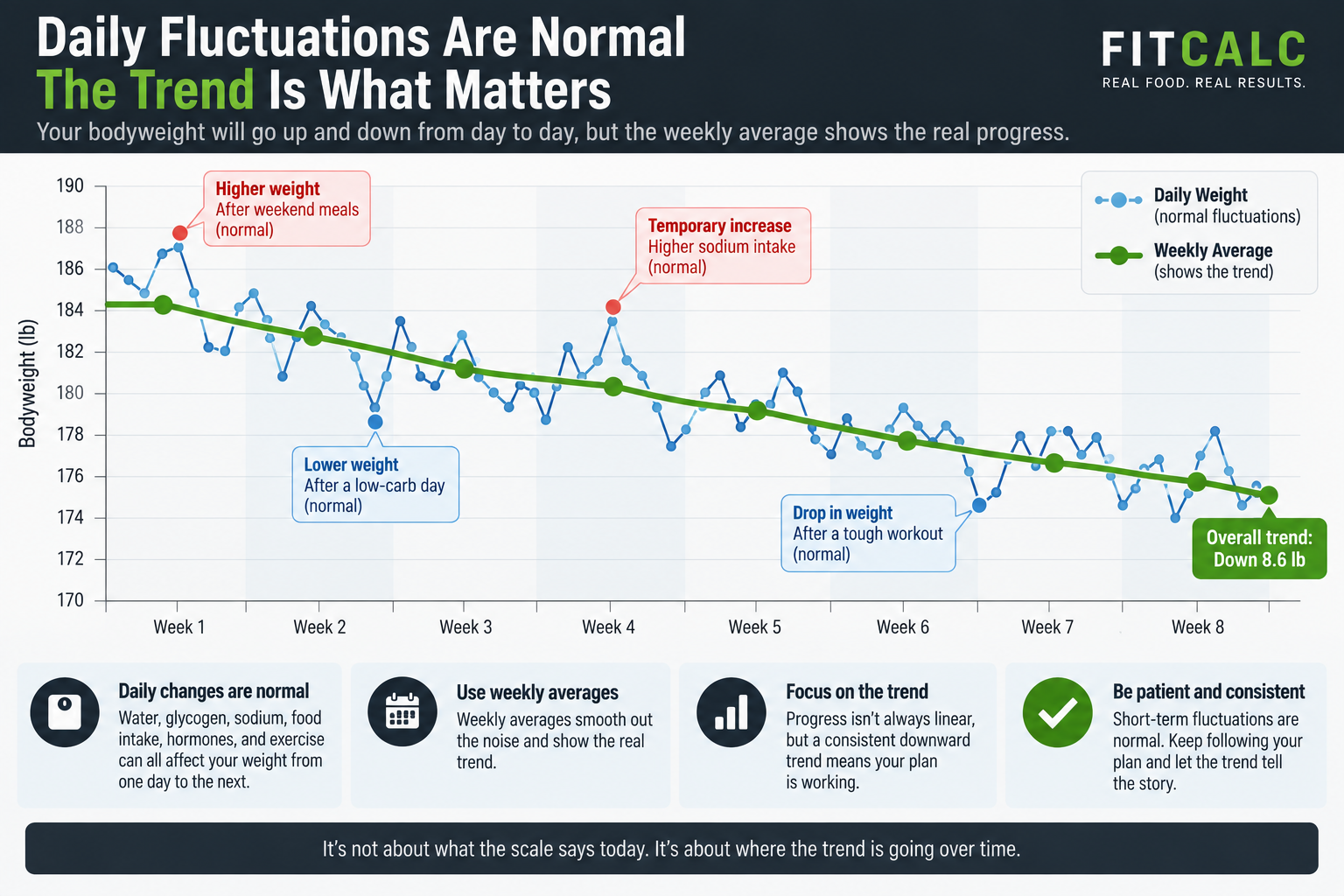
Your scale measures total bodyweight. Water, glycogen, sodium intake, digestive contents, hydration, and exercise-related fluid changes can all move the number from one day to the next. A person can wake up three pounds heavier after a large restaurant meal without having gained three pounds of body fat.
For most people comfortable with regular weighing, a useful approach is to weigh under similar morning conditions, ideally after using the bathroom and before eating or drinking. Instead of treating each reading as a verdict on yesterday's diet, use multiple measurements to establish a weekly average or broader trend.
Consider a fictional week:
Day Bodyweight
Monday - 181.2 lb
Tuesday - 180.4 lb
Wednesday - 181.0 lb
Thursday - 179.9 lb
Friday - 180.5 lb
Saturday - 179.7 lb
Sunday - 180.1 lb
Weekly average - 180.4 lb
The individual numbers bounce around, but the weekly average gives us something more useful to compare with the following weeks. If those averages gradually move from 182.0 to 181.2 to 180.4 to 179.8, the overall trend is clear even though some individual mornings moved upward.
Research on self-weighing suggests that frequent weighing can be useful as part of a broader behavioral weight-management program, although the scale itself obviously doesn't cause fat loss. Its value comes from providing feedback that can help you evaluate whether your current behavior is producing the expected result.
Bodyweight should not necessarily be your only measurement. Waist circumference can provide useful information about changes around the abdomen. Progress photographs taken under similar lighting, distance, clothing, and positioning can reveal visual changes that are difficult to notice day to day. The fit of your clothes and your performance in the gym can provide additional context.
This becomes particularly useful when resistance training is involved. Someone may lose fat while maintaining or even gaining some lean tissue, especially if they're relatively new to lifting. In that situation, body composition can improve faster than scale weight alone suggests.
The goal is not to collect every measurement imaginable. It is to have enough consistent information to identify the real trend. If average bodyweight and waist circumference are gradually decreasing while strength is reasonably maintained, the plan is probably doing exactly what it is supposed to do.
When the trend genuinely stops for long enough to matter, that's when an adjustment may become appropriate. Later in this guide, we'll distinguish a real plateau from normal scale noise and establish a simple troubleshooting process.
Plateaus, Goal Weight and Long-Term Maintenance
Weight loss rarely follows a perfectly straight line from starting weight to goal weight. Progress can slow, calorie requirements can change, and periods of apparent stagnation are normal. The important distinction is whether you're seeing temporary scale noise or whether your average weight has genuinely stopped declining.
Reaching your goal also doesn't mean returning to the exact lifestyle you had before losing weight. The calorie deficit eventually ends, but many of the habits that helped you succeed should remain. The objective is to transition from actively losing weight into maintaining a healthier bodyweight without treating the entire process as a temporary diet.
What to Do When Weight Loss Stops
A few days without a new low weigh-in is not a plateau. Neither is gaining two pounds after a restaurant meal or seeing the scale remain unchanged during a particularly difficult week of training. As discussed earlier, water, glycogen, sodium, food in the digestive system, and exercise-related fluid changes can temporarily hide changes in body fat.
Before adjusting anything, give the trend enough time to become meaningful. If calorie intake has been consistent and your average weight has genuinely stopped declining for multiple weeks, then it makes sense to investigate why.
A useful troubleshooting order is:
1. Confirm that progress has actually stopped. Compare weekly averages rather than isolated weigh-ins. Waist measurements can provide additional context.
2. Check calorie tracking. Portions can gradually become larger, cooking oils can go uncounted, drinks and snacks can be forgotten, and restaurant meals are difficult to estimate accurately.
3. Check activity. Steps and other everyday movement can decrease during dieting, sometimes without you noticing.
4. Reassess your current calorie needs. A person who has lost substantial weight generally burns fewer calories than they did at their starting weight.
5. Adjust modestly if necessary. If adherence is good and the plateau is real, a small calorie reduction or reasonable increase in activity may be enough to restore progress.
Metabolic adaptation is real, but it is often discussed as though dieting causes the metabolism to become permanently "damaged." A systematic review found evidence of adaptive thermogenesis following weight loss in many studies, although its magnitude varied and was often smaller in higher-quality studies. At the same time, simply becoming lighter reduces energy requirements because there is less body mass to maintain and move.
This is why FitCalc does not recommend automatically inserting high-calorie weeks or "metabolism resets" whenever progress slows. Diet breaks may be useful for some people for adherence or psychological reasons, but they are not required to make energy balance start functioning again. If you are healthy, recovering adequately, and still have body fat to lose, a well-structured calorie deficit can generally continue until you reach your goal.
The important part is making adjustments based on evidence rather than frustration. A genuine plateau calls for troubleshooting, not panic.
Reaching Your Goal and Finding Your New Maintenance
Eventually, the goal changes. Instead of trying to make average bodyweight continue falling, you want it to remain within a reasonably stable range.
Your maintenance calories at this point may be different from where they were when you started. If someone loses 40 pounds, their smaller body generally requires less energy to maintain and move. NIDDK notes that metabolism slows during weight loss and that fewer calories are required at the new, lower bodyweight.
That doesn't mean you need to remain in a calorie deficit forever. Once the desired weight has been reached, calorie intake can increase toward estimated maintenance and then be refined using the same real-world feedback that helped during weight loss.
Suppose someone finishes dieting at an average intake of 1,900 calories. Their new maintenance might ultimately be around 2,300 calories. They can increase intake toward that estimated maintenance level and monitor their weight trend over the following weeks. A small initial increase on the scale does not automatically indicate fat regain because eating more food and carbohydrate can increase digestive contents, glycogen, and associated water.
Maintenance also does not require keeping bodyweight fixed to a single decimal point. Establishing a reasonable range is more practical. Someone who finishes around 175 pounds might decide that remaining roughly within a few pounds of that weight represents successful maintenance. Normal fluctuations will continue even when body fat is stable.
The habits developed during weight loss should largely continue. Keep eating adequate protein. Continue resistance training. Stay active. Build most meals around quality foods. Monitor your weight occasionally or regularly enough to notice a genuine upward trend before 5 pounds becomes 20.
This is where the idea of a lifestyle change actually matters. If your old calorie intake and activity habits gradually produced an unhealthy bodyweight, returning completely to those same habits after reaching your goal makes eventual regain much more likely. Maintenance gives you more calories and flexibility than active dieting, but it still represents a new normal.
The FitCalc Weight-Loss Framework
A successful weight-loss plan does not need dozens of rules. Most of what we've covered can be reduced to a practical sequence that can be repeated and adjusted as your body changes.
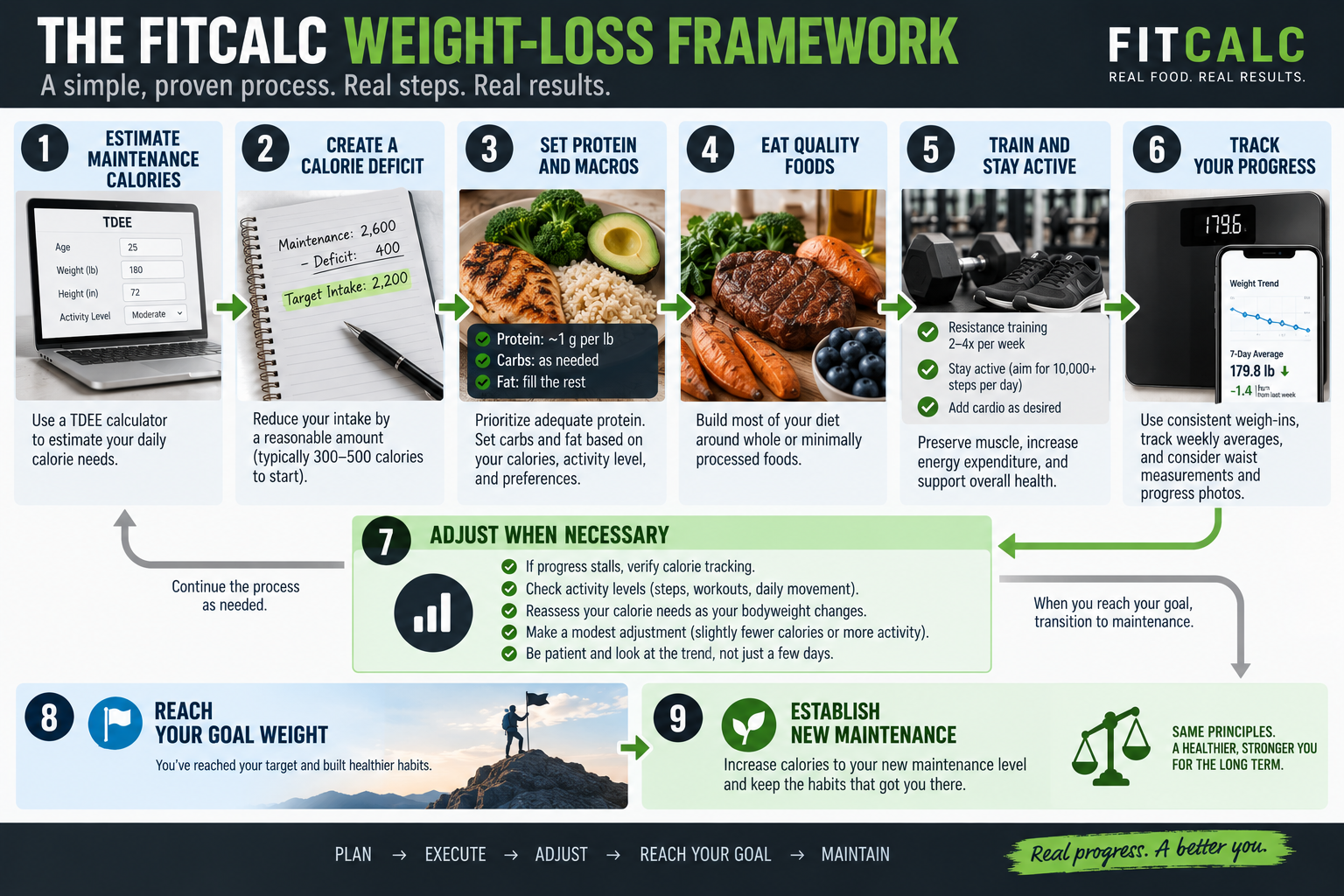
Start by estimating your maintenance calories. Create a reasonable calorie deficit rather than immediately choosing the lowest intake you can tolerate. Establish adequate protein and organize the remaining calories between carbohydrates and dietary fat according to your needs and activity.
Build most of your diet around nutrient-dense whole or minimally processed foods. Resistance train to help preserve muscle, stay active throughout the week, and use cardiovascular exercise where it improves fitness or fits your lifestyle.
Then measure what actually happens.
Use consistent weigh-ins and longer-term averages rather than reacting emotionally to individual readings. If the trend is moving in the right direction, continue. If progress genuinely stalls, verify adherence and activity before making a modest adjustment.
When you eventually reach your goal, transition out of the deficit and establish maintenance at your new bodyweight. Keep the habits that got you there rather than treating goal weight as permission to abandon them.
The complete process looks like this:
Estimate maintenance → create a reasonable deficit → set protein and macros → prioritize quality food → resistance train → stay active → track the trend → adjust when necessary → reach your goal → establish new maintenance
Practical Takeaways
1. Weight loss requires a sustained calorie deficit, but the quality of your diet still matters for nutrition, hunger, training, and overall health.
2. Estimate your maintenance calories first, then create a reasonable deficit rather than choosing an arbitrary low-calorie target.
3. Prioritize adequate protein, particularly when losing weight while resistance training. FitCalc generally uses roughly 1 gram per pound of bodyweight as a simple practical target when appropriate.
4. Carbohydrates and dietary fat can both fit into a healthy weight-loss diet. There is no requirement to eliminate either one.
5. Build most meals around whole or minimally processed foods, especially quality animal protein, fruit, vegetables, potatoes, rice, and appropriate fat sources.
6. Resistance training helps preserve lean mass while walking, cardio, sports, and everyday movement support activity and overall health.
7. Judge progress using trends, not individual weigh-ins. Water and other short-term changes can easily hide fat loss temporarily.
8. When weight loss genuinely stalls, check tracking and activity before making a modest adjustment to calories.
9. Reaching your goal ends the calorie deficit, not the healthy habits that produced the result.
Conclusion
Weight loss becomes much easier to understand once the major pieces are put in the right order. Calories establish the energy deficit, protein and resistance training help preserve muscle, food quality supports nutrition and makes the diet easier to manage, and consistent activity contributes to both energy expenditure and long-term health.
You don't need a perfect diet, a perfectly accurate calorie calculator, or a scale that moves downward every morning. You need a reasonable starting plan, enough consistency to generate useful feedback, and the willingness to make small adjustments when your actual results call for them.
Most importantly, think beyond reaching a particular number on the scale. The habits you develop while losing weight should form the foundation of how you maintain that healthier bodyweight afterward. The calorie deficit is temporary. The better diet, active lifestyle, resistance training, and awareness of your bodyweight can remain part of normal life.
That is what turns weight loss from a temporary project into a result you have a much better chance of keeping.