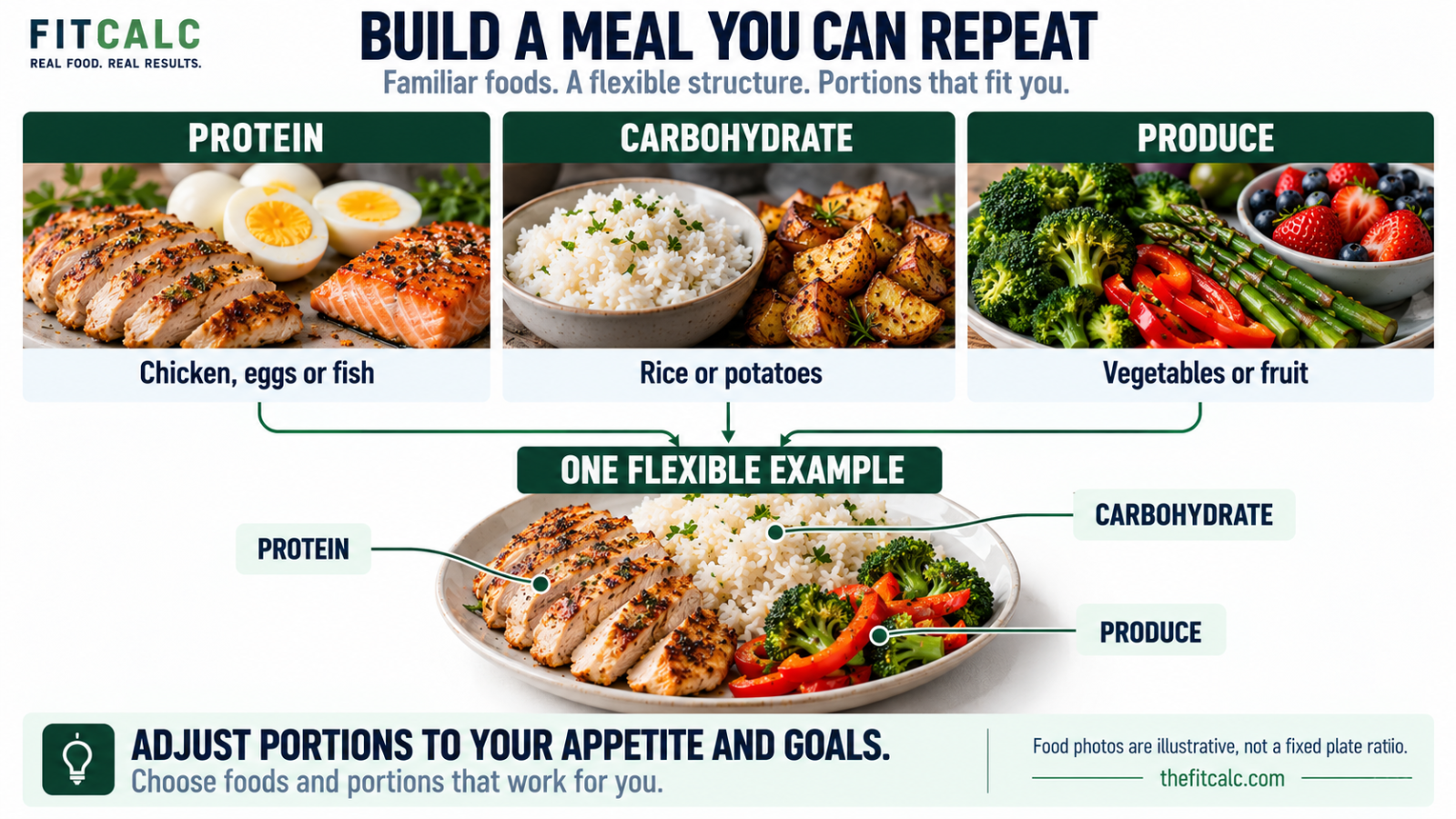
Almost every nutrition goal eventually leads to the same question: how many calories do I actually need each day?
The answer is more complicated than choosing a number from a chart. Your body continuously uses energy to keep you alive, digest food, move through daily life, exercise, and perform countless biological processes. Your total calorie needs are the result of all of those demands combined, and they can change as your body and lifestyle change.
Terms such as BMR, RMR, TDEE, and maintenance calories describe different parts of this system. Understanding them makes calorie calculators much more useful because you can interpret the number they provide instead of treating it as an exact metabolic measurement.
This guide will explain where your daily calorie expenditure comes from, why two people can have very different calorie requirements, how FitCalc and other calculators estimate those requirements, and how to refine an initial estimate using your own real-world results. Whether your eventual goal is maintaining, losing, or gaining weight, the first step is understanding approximately how much energy your body uses.
This guide explains calorie estimates for generally healthy adults. Children and teenagers, people who are pregnant or breastfeeding, and people with medical needs should get individualized guidance rather than applying an adult weight-management calculator on its own. The NIH Body Weight Planner likewise excludes people under 18 and those who are pregnant or breastfeeding. NIDDK Body Weight Planner
Understanding Calories and Energy Expenditure
Calories are often discussed only in the context of dieting, but they are simply a way of measuring energy. Your body needs that energy whether you're trying to lose weight, build muscle, maintain your current weight, or not thinking about nutrition at all.
Food supplies energy through protein, carbohydrate, fat and alcohol. Common general conversion factors are approximately 4 kcal per gram for protein and available carbohydrate, 9 for fat and 7 for alcohol. These are practical averages: fiber, sugar alcohols and differences between foods can make label calculations more complicated. Vitamins, minerals and water do not supply food energy. FAO food-energy conversion factors
On nutrition labels, the word Calorie with a capital C refers to a kilocalorie, or kcal. One dietary Calorie is technically equal to 1,000 small scientific calories. In everyday nutrition, however, when someone says a meal contains 700 calories, they mean 700 kilocalories. There is rarely any practical reason to worry about the terminology beyond understanding why scientific literature may use kcal.
Once food energy enters the body, it can be used immediately, stored for later use, or incorporated into tissues. At the same time, your body is continuously expending energy. When average energy intake and expenditure remain relatively similar over time, bodyweight tends to remain relatively stable. Consistently eating less energy than you expend encourages weight loss, while consistently consuming more creates the conditions for weight gain.
This is energy balance, and it provides the foundation for understanding everything else in this guide.
BMR vs. RMR
Even if you spent an entire day lying still, your calorie expenditure would not fall to zero. Your brain remains active, your heart continues pumping blood, your lungs continue exchanging gases, your kidneys and liver perform essential work, cells maintain themselves, and your body regulates temperature. Keeping a living human body functioning requires substantial energy before deliberate activity is considered.
Basal metabolic rate (BMR) describes the amount of energy required to maintain these essential functions under strict basal conditions. Measuring true BMR requires controlled conditions, typically including an overnight fast, physical and mental rest, a thermoneutral environment, and measurement after sleep before meaningful physical activity occurs. FAO human energy requirements
Resting metabolic rate (RMR), sometimes called resting energy expenditure, describes a very similar concept but can be measured under somewhat less restrictive conditions. Because RMR testing is more practical, it is commonly used in clinical and research settings. The two numbers are usually fairly close, which is why BMR and RMR are frequently used interchangeably in consumer fitness discussions even though they are technically different.
For most people, resting metabolism represents the largest component of total daily calorie expenditure. Body size and body composition are major reasons it differs between individuals. A larger body generally requires more energy to maintain than a smaller one, while metabolically active organs and lean tissues contribute substantially to resting expenditure. Age, sex, genetics, hormones, and other physiological factors can influence it as well.
This also explains why BMR should not be interpreted as your daily calorie allowance. If a calculator estimates your BMR at 1,700 calories, that does not mean eating 1,700 calories would maintain your weight. BMR represents only the resting foundation of your energy expenditure. Normal life adds additional energy demands on top of it.
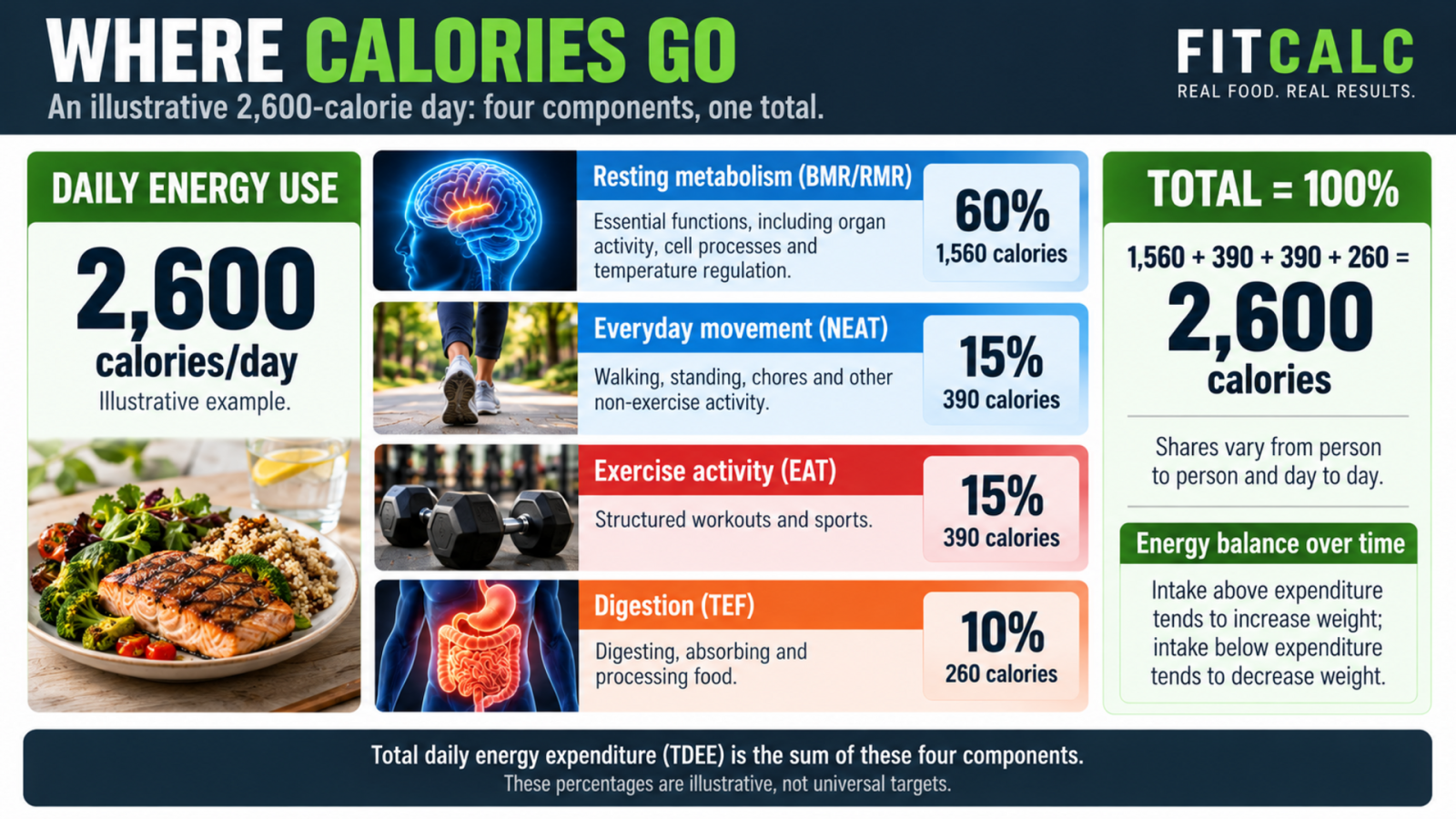
TDEE and the Four Parts of Daily Calorie Burn
Total daily energy expenditure (TDEE) expands the picture beyond resting metabolism. It represents the total amount of energy your body uses across an average day, including the calories required to stay alive and the additional energy associated with food and movement. FAO human energy requirements
Resting energy expenditure generally makes up the largest portion. The thermic effect of food (TEF) adds the energy required to digest, absorb, process, and store the nutrients you eat. Different macronutrients have different thermic effects, with protein generally requiring more energy to process than carbohydrate or fat.
Movement adds another major variable. Structured exercise includes deliberate activities such as lifting weights, running, cycling, swimming, sports, or dedicated cardio sessions. The calories used during those activities contribute to TDEE, but formal exercise is only one part of daily movement.
The rest is commonly described as non-exercise activity thermogenesis (NEAT). This includes walking around at work, standing, cleaning your house, taking stairs, shopping, doing yardwork, fidgeting, and virtually every other movement that isn't sleeping, eating, or deliberate exercise. NEAT can vary considerably between people and is one reason two individuals with similar BMR values can have very different total calorie requirements.
Consider two similarly sized people who each lift weights three times per week. One works from home at a computer, drives almost everywhere, and spends most evenings sitting. The other works on their feet, regularly walks 10,000 or more steps, does physical work around the house, and remains active on weekends. Their scheduled workouts may look nearly identical, but their total daily expenditure can be quite different because the rest of their days are not.
This is why TDEE is more useful for nutrition planning than BMR alone. BMR estimates the resting foundation. TDEE attempts to estimate the entire day.

Your maintenance calories are closely related to TDEE. If your average TDEE is approximately 2,600 calories and your average calorie intake is also around 2,600, your bodyweight should tend to remain relatively stable over time. That doesn't mean you burn exactly 2,600 calories every day. Activity and expenditure naturally fluctuate, so maintenance is better understood as an average range rather than a perfectly fixed daily number.
That distinction becomes important as we move deeper into calorie estimation. A calculator can give you a useful starting point for TDEE, but it cannot know exactly how much you walked around the office yesterday, how much you fidget compared with another person, or every individual characteristic influencing your metabolism.
What Determines How Many Calories You Need?
Your daily calorie needs are not determined by one factor. Two people can weigh the same amount and still have different maintenance calories because body composition, age, biological sex, occupation, exercise, and everyday movement all influence energy expenditure.
This is also why generic recommendations such as "eat 2,000 calories per day" have limited usefulness without context. For one person, 2,000 calories could create a substantial deficit. For another, it could be close to maintenance, while for someone smaller and less active it could even represent a surplus.
Understanding the major factors behind these differences makes TDEE estimates easier to interpret and helps explain why your calorie requirements can change throughout your life.
Body Size, Muscle, Age and Sex
Body size is one of the strongest influences on calorie expenditure. Larger bodies generally require more energy to maintain because there is simply more tissue performing metabolic work. Moving a larger body also requires more energy during walking, exercise, and other physical activity.
Body composition adds another layer. Fat-free mass is more metabolically active than fat mass.
Different lean tissues have very different resting energy costs. Organ-tissue models use much higher rates for the brain, liver, heart and kidneys than for skeletal muscle. One study evaluating these models used a skeletal-muscle estimate of about 13 kcal per kilogram per day, roughly 6 kcal per pound. These are model-based tissue averages, not a measurement of what each pound of your muscle burns. Wang and colleagues, 2010
Using that figure for illustration, five additional pounds of muscle would contribute roughly 30 resting calories per day directly. The calculation does not capture every change associated with training, recovery or moving a larger body, but it helps explain why gaining a few pounds of muscle does not automatically raise resting expenditure by several hundred calories.
Age matters, although the pattern is more nuanced than a sudden metabolic slowdown after 30. A large analysis found that energy expenditure adjusted for body size and composition was broadly stable between about ages 20 and 60, then declined in older adulthood. This describes a population-level pattern; it does not mean every person's calorie needs stay fixed for those decades. Changes in activity, muscle mass and health still matter. Pontzer and colleagues, 2021
Biological sex also contributes to differences in predicted energy needs. On average, men tend to have larger bodies and more fat-free mass than women, which contributes substantially to higher average resting and total energy expenditure. Predictive equations therefore commonly include sex alongside age, height, and weight.
The important point is that none of these variables exists independently. Your calorie requirements reflect your entire body and lifestyle rather than one characteristic such as age or muscle mass.

Exercise, NEAT and Your Lifestyle
Activity is one of the most variable parts of total daily energy expenditure, and structured exercise tells only part of the story.
Imagine two 180-pound adults who both lift weights for an hour on Monday, Wednesday, and Friday. The first works at a computer, averages around 3,000–4,000 steps per day, drives to work, and spends most evenings sitting. The second works on their feet, averages more than 10,000 steps, walks frequently outside work, and remains active on weekends.
Calling both people "moderately active" simply because they lift three days per week can hide a substantial difference in total daily movement.
This is one of the limitations of the activity multipliers used by many TDEE calculators. After estimating resting calorie expenditure, a calculator applies an activity factor intended to approximate the additional energy associated with someone's lifestyle. Categories commonly range from sedentary through very active, but real human activity exists on a continuum rather than fitting neatly into five boxes.
When choosing an activity level, consider your whole week, not just your workouts. Someone with a desk job who lifts three times per week may still have a relatively low overall activity level if they barely move outside those sessions. Conversely, someone who doesn't perform formal exercise may still expend considerable energy through a physically demanding occupation and high daily movement.
Everyday movement can also respond to changes in food intake. In a small experiment, 16 adults were overfed by 1,000 kcal per day for eight weeks. Their changes in non-exercise activity varied substantially and helped explain differences in fat gain. This does not mean everyone automatically burns off extra food, but it shows why expenditure is not always a fixed background number. Levine and colleagues, 1999
During weight loss, changes in energy expenditure can also involve the energy used outside rest. The response varies, so it is worth noticing whether your steps, work activity and general movement have changed alongside your food intake. Leibel and colleagues, 1995
This doesn't make calorie expenditure unknowable. It simply means activity should be treated as an estimate that can be refined rather than a permanent label.

Your lifestyle can also change quickly. Starting a warehouse job after years at a desk, beginning a daily walking routine, stopping a recreational sport, recovering from an injury, or dramatically changing weekly training volume can all alter your energy requirements without changing your age or height.
This is why a TDEE calculation from six months ago may no longer describe your current needs.
Food and the Thermic Effect of Eating
Eating food also requires energy.
Before nutrients can be used, food has to be digested, absorbed, transported, metabolized, and in some cases stored. The energy required for these processes is called the thermic effect of food (TEF), and it contributes a relatively small but meaningful portion of total daily expenditure.
The energy cost of processing a meal depends partly on its composition. In a small randomized crossover experiment in ten healthy young women, higher-protein meals produced a greater measured thermic response than higher-carbohydrate meals. The size of the response depends on the meal, person and measurement period, so it is not a fixed calorie discount to apply to everything you eat. Johnston and colleagues, 2002
Food structure and processing may matter too. A crossover study in 17 adults compared two cheese-sandwich meals and found a higher post-meal energy expenditure after multigrain bread with cheddar than after white bread with a processed cheese product. The experiment tested those particular meals over several hours. It did not establish a universal calorie advantage for every food described as whole or minimally processed, or measure long-term weight loss. Barr and Wright, 2010
For everyday planning, keep counting food calories normally. Digestion is already part of total expenditure, and subtracting a guessed thermic effect from each meal adds false precision. Build meals around foods you enjoy that help you meet your needs, such as beans, eggs, fish, yogurt, vegetables, fruit and whole grains. Choose them for the overall meal they help create rather than a promised calorie-burning bonus.
How Calorie Calculators Work and Why They’re Estimates
A calorie calculator does not directly measure how many calories your body burns. It takes information about you, applies mathematical equations developed from human research, and produces an estimate of your resting and total energy expenditure.
That distinction is important. A calculator result of 2,650 calories does not mean your body burns exactly 2,650 calories every 24 hours. Your actual expenditure changes with movement, exercise, food intake, and other factors, while individual biology creates variation that an equation cannot completely capture.
This does not make calorie calculators unreliable or useless. It simply means they should be used for what they are good at: giving you an informed starting point that can later be refined using real-world results.
How BMR and TDEE Calculators Estimate Your Needs
One widely used starting point is the Mifflin–St Jeor equation. It was developed using measured resting energy expenditure in 498 healthy adults aged 19–78, including people with and without obesity. It estimates resting energy expenditure, often abbreviated REE or RMR; consumer calculators commonly display this as BMR even though true basal testing uses stricter conditions. Mifflin and colleagues, 1990
The simplified equations, in kcal per day, are:
Men: estimated REE = (10 × weight in kg) + (6.25 × height in cm) − (5 × age in years) + 5.
Women: estimated REE = (10 × weight in kg) + (6.25 × height in cm) − (5 × age in years) − 161.
These are the sex-specific categories used in the original research. The result is an estimate derived from a study population, not a direct measurement of your metabolism.
For the equations and assumptions used in FitCalc's tools, see our calculation methodology.
Consider a 30-year-old man who is 6 feet tall and weighs 180 pounds. Converting those measurements gives approximately 81.6 kilograms and 183 centimeters. Using Mifflin-St Jeor produces an estimated resting requirement of roughly 1,815 calories per day.
That is not yet his maintenance intake.
To estimate TDEE, the resting estimate must be combined with an estimate of activity. A calculator generally does this by applying an activity multiplier. Someone who is sedentary receives a smaller adjustment, while someone whose life includes substantial exercise and daily movement receives a larger one.
This is where additional uncertainty enters the calculation. Weight, height, and age are straightforward inputs. "Moderately active" is much less precise. Two people can select the same activity category despite having very different step counts, occupations, workout intensity, and total weekly movement.
Validation research has found that Mifflin–St Jeor can be a useful starting estimate, while also documenting individual prediction errors. Its usefulness does not make it exact for everyone. Frankenfield and colleagues, 2003
Why Different Calculators Give Different Answers
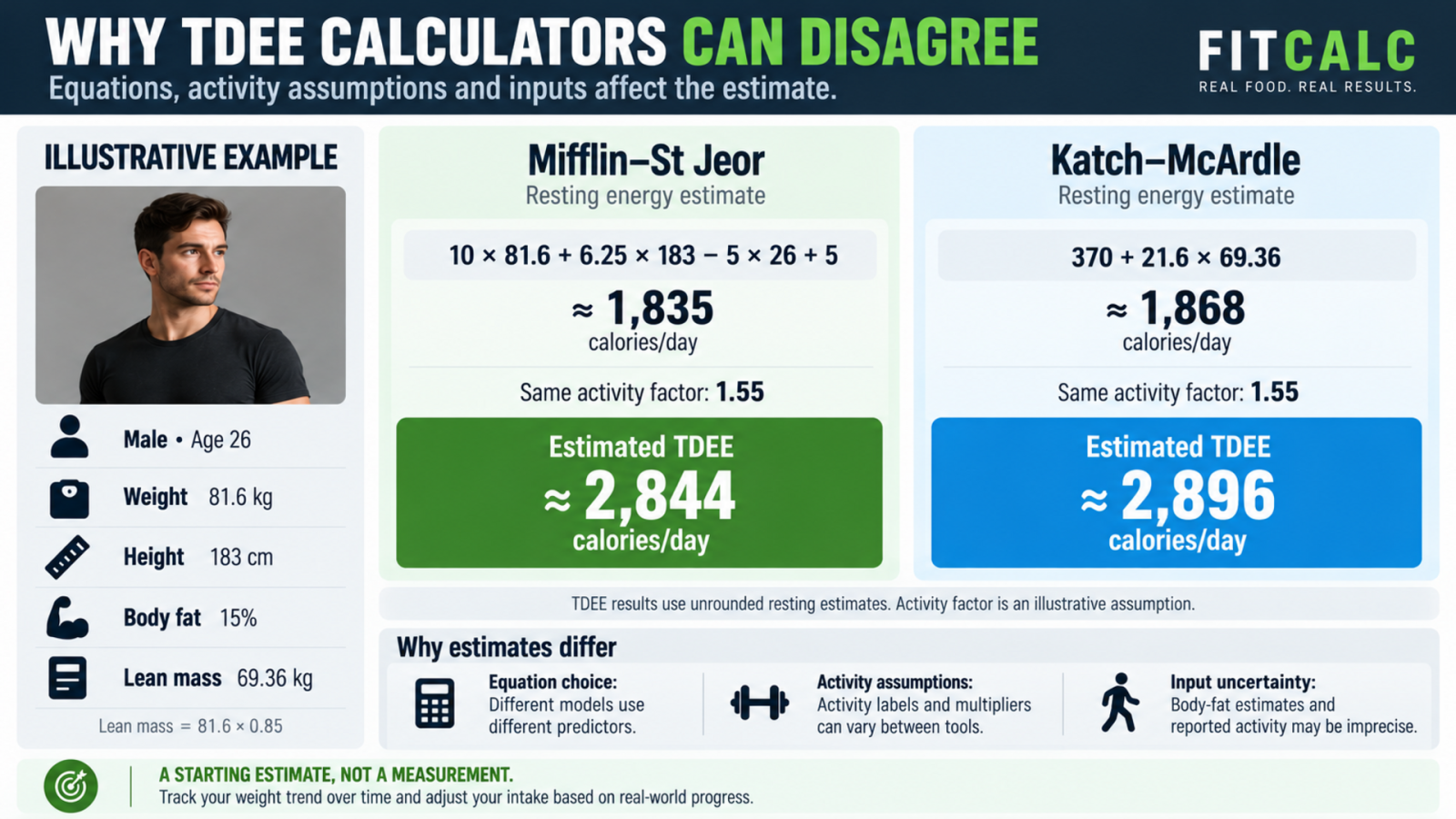
It is completely normal to enter the same information into two calorie calculators and receive different results.
One calculator might estimate maintenance at 2,450 calories while another gives you 2,650. That does not automatically mean one website has calculated your metabolism correctly and the other has failed.
Different calculators may use different resting metabolic equations. Mifflin-St Jeor, Harris-Benedict, revised Harris-Benedict, Cunningham, and other equations were developed using different populations and inputs. Some rely primarily on weight, height, age, and sex, while equations incorporating fat-free mass require body-composition information.
Activity assumptions can create an even larger difference. One calculator's definition of "moderately active" may not perfectly match another's, and neither calculator can directly observe what your typical day looks like. Small differences in activity multipliers applied to a BMR of 1,800 calories can quickly create differences of a few hundred calories in estimated TDEE.
There is also uncertainty in the information supplied by the user. Bodyweight can be measured easily, but body-fat percentage may itself be an estimate. Weekly activity can change. Someone might select a high activity category because they train intensely four times per week while overlooking the fact that they sit for nearly every other waking hour.
For practical nutrition planning, a difference of 100–200 calories between calculators usually isn't a reason to worry. Pick a reasonable evidence-based estimate, use it consistently, and observe what happens. Your weight trend can eventually provide more individualized information than comparing ten different calculator outputs and trying to decide which one looks most convincing.
Calculators, Fitness Trackers and Direct Measurement
Calorie expenditure can be estimated or measured in several ways, but the methods differ substantially in what they actually tell you.
An online calculator sits at the most accessible end. It predicts resting expenditure from your personal characteristics and then estimates total expenditure from activity assumptions. It requires no equipment and takes seconds to use, which makes it excellent for establishing an initial calorie target.
Wearable devices add information collected from your body and movement. Smartwatches and fitness trackers can monitor variables such as heart rate, steps, movement, and workout duration, then use proprietary algorithms to estimate calorie expenditure. These devices can be extremely useful for monitoring activity patterns, but their calorie-burn numbers should not be interpreted as precise measurements.
A laboratory study of seven wrist-worn devices found that estimates of energy expenditure had substantially greater error than heart-rate measurements. The study tested devices available at the time, so its exact error figures should not be applied to every current watch. It is a useful reason to treat a wearable's calorie display as an estimate. If your watch reports 700 workout calories, that is not a precise allowance for 700 extra calories of food. Shcherbina and colleagues, 2017
Before adding workout calories to your food target, check whether your starting estimate already includes that activity. Our guide to eating back exercise calories explains how to avoid counting the same activity twice.
More direct methods exist in laboratory and clinical settings. Indirect calorimetry estimates energy expenditure by measuring oxygen consumption and carbon dioxide production. It can provide a more individualized measurement of resting metabolic rate than a predictive equation, although the result can still be affected by testing conditions.
For measuring total energy expenditure during normal free-living conditions, doubly labeled water is widely considered a gold-standard research method. Participants consume water containing stable isotopes, and researchers track how those isotopes leave the body over a period of days to estimate carbon dioxide production and energy expenditure. It is extremely valuable for research, but it is expensive and unnecessary for ordinary calorie planning. IAEA technical guidance on doubly labelled water

The existence of sophisticated laboratory methods does not mean you need them to manage your diet. For most people, the combination of a reasonable calculator estimate, accurate enough food tracking, consistent bodyweight measurements, and several weeks of observation provides the information needed to make useful decisions.
If FitCalc estimates your maintenance at 2,600 calories, the correct response is not to assume 2,600 is unquestionably exact. It also isn't to dismiss the estimate because laboratory equipment would be more precise. Start around the estimate and allow your own results to help calibrate it.
That is where calorie calculators become most useful. They solve the difficult problem of choosing a sensible starting point, while your real-world data helps solve the remaining problem of determining how closely that estimate matches you.
Finding and Using Your Real Maintenance Calories
A TDEE calculator gives you a starting estimate, but the most useful maintenance number is the one that holds up in the real world. That means combining the estimate with actual calorie intake, bodyweight trends, and enough time to see what your body is doing.
You do not need laboratory equipment to make this useful. If your calorie tracking is reasonably accurate and your weigh-ins are consistent, a few weeks of data can tell you whether your estimated maintenance is close, too low, or too high.
How to Test Your Maintenance Estimate
Suppose FitCalc estimates your maintenance intake at 2,600 calories per day. Rather than treating 2,600 as an unquestionable fact, treat it as the first hypothesis.
Treat the next two to four weeks as an initial observation period rather than a definitive metabolic test. Keep your eating and activity reasonably consistent. If weighing is helpful for you, use similar conditions each time, such as in the morning after using the bathroom and before breakfast. Compare averages across weeks instead of responding to a single reading. Changes in water, glycogen and digestive contents can obscure changes in body tissue, especially after changing your diet or activity.
For example, suppose you record an average intake of about 2,600 calories per day and your weekly average weight moves from 180.0 to 179.6, 179.1 and then 178.6 pounds. That pattern is consistent with intake below maintenance if your records and activity are reasonably consistent. It does not identify an exact daily deficit or prove that your maintenance is a particular number.
The familiar 3,500-calories-per-pound rule does not capture the changing mix of tissue and water lost or how expenditure changes over time. Research-based dynamic models account for these changes rather than assuming that a fixed deficit produces the same weight loss indefinitely. Hall and colleagues, 2011
If your goal is weight maintenance and the downward trend continues, make a modest increase in intake and observe the next several weeks. If the trend is unclear, collect more consistent observations before adjusting. Review portions, cooking oils, drinks, activity changes and temporary fluctuations as well as the calculator result. Matching your food entry to raw or cooked weight is another useful accuracy check. A stable trend with consistent intake can give you a practical maintenance target without requiring an exact metabolic measurement.
Why Your Calorie Needs Change Over Time
Maintenance calories are not a permanent number attached to you for life.
Bodyweight changes can alter energy requirements. A person maintaining 220 pounds generally requires more energy than that same person would require at 180 pounds, all else being equal. A larger body contains more tissue to maintain and requires more energy to move through daily life.
Activity changes can shift maintenance even when bodyweight stays similar. Starting a physically demanding job, walking several thousand additional steps each day, increasing training volume, or beginning a new sport can raise expenditure. Becoming more sedentary can move it in the opposite direction.
Body composition matters as well. Lean tissue contributes more to resting expenditure than fat tissue, although the effect of gaining muscle is often exaggerated in fitness discussions. Building muscle can modestly increase resting energy requirements, but the larger impact may come from the training and activity associated with maintaining that muscle rather than the resting calorie cost of the tissue alone.
During weight loss, energy requirements usually fall partly because there is less body tissue to maintain and move. Some studies also find a reduction beyond what changes in body size and composition would predict, often called adaptive thermogenesis. Experimental work has documented this response, but its size and persistence vary. Leibel and colleagues, 1995
In another study of women who lost weight, the additional reduction in resting expenditure was relatively small after a period of weight stability and did not predict weight regain over follow-up. That result should not be assumed to describe every person or every weight-loss approach. Martins and colleagues, 2020
A lower maintenance requirement after weight loss does not by itself demonstrate permanent metabolic damage. It is a reason to reassess your current needs and avoid expecting the same calorie target to have the same effect indefinitely.
The same principle applies in the opposite direction. If someone gains bodyweight, increases training, and becomes more active, their maintenance needs may rise.

Using Maintenance Calories for Your Goal
Once you have a reasonable maintenance estimate, using it becomes much simpler.
If your goal is to maintain your current bodyweight, your average calorie intake should remain around maintenance over time. That does not require eating the exact same number every day. Someone maintaining around 2,700 calories might eat somewhat less on one day and more on another while their weekly average remains close to their needs.
For weight loss, average intake needs to remain below expenditure over time. For weight gain, average intake needs to be above expenditure. Gaining bodyweight and building muscle are related goals, but they are not identical; training, protein intake and your starting point also affect changes in body composition.
The important part is that maintenance comes first. A target of 2,000 calories has no meaning by itself. If your maintenance is 2,800, that intake represents a large deficit. If your maintenance is 2,100, it represents only a small one. If your maintenance is 1,900, 2,000 calories may put you slightly above maintenance.
This is why calorie targets copied from another person rarely make sense. Your goal determines whether intake should sit below, around, or above maintenance, but your own energy requirements determine what those numbers actually are.
Your target can also change as your body changes. Someone who starts losing weight at 2,300 calories may eventually require an adjustment after significant weight loss. Someone trying to gain muscle may need to raise intake gradually as bodyweight and activity increase.
The process should remain simple: use a calculator to establish a good starting estimate, follow it consistently, watch the real-world trend, and adjust only when your results show that the estimate no longer matches your current needs.
If weight loss is your goal, the complete weight-loss guide explains how calories, protein and progress checks fit together.
Practical Takeaways
Calories measure energy, while BMR, RMR, and TDEE describe different parts of how your body uses that energy. BMR and RMR focus on resting expenditure, while TDEE attempts to estimate the entire day's energy use, including digestion, exercise, and ordinary movement.
No online calculator can measure your metabolism directly. It uses equations and activity assumptions to provide a starting estimate, which is why different calculators can reasonably produce slightly different results. Fitness trackers add more real-world data but still have meaningful limitations when estimating calorie expenditure.
The most useful approach is to combine a sound estimate with consistent observation. Track your intake reasonably well, weigh under similar conditions, compare weekly averages, and allow enough time for the trend to become clear. If bodyweight is stable, your intake is probably close to maintenance. If it is consistently rising or falling, that information helps refine the estimate.
Your calorie needs can also change with bodyweight, activity, training, body composition, and age. Maintenance should therefore be viewed as a moving range rather than a permanent number.
Conclusion
You do not need to know your exact calorie expenditure down to the last calorie to make good nutrition decisions.
What you need is an estimate accurate enough to give you a sensible starting point. From there, your own data becomes increasingly valuable. A calculator can tell you that your maintenance is probably somewhere around 2,600 calories, but several weeks of consistent eating and weight tracking can tell you whether that number actually fits your body and lifestyle.
Understanding this removes much of the false precision surrounding calorie calculators. A result is not a metabolic diagnosis, and being 150 calories away from another website's estimate does not mean something is wrong.
Use BMR and TDEE for what they are designed to do: organize the problem and get you close. Then let your real-world results refine the answer.
Whether your goal is to lose weight, build muscle, or simply maintain where you are, understanding your maintenance calories gives you the foundation for deciding what comes next.
Sources
FAO. Food energy: methods of analysis and conversion factors. Chapter 4.
FAO. Human energy requirements. Chapter 2.
NIDDK. Body Weight Planner and adult-use disclaimer.
Wang et al. (2010). Specific metabolic rates of major organs and tissues across adulthood.
Pontzer et al. (2021). Daily energy expenditure through the human life course.
Leibel et al. (1995). Changes in energy expenditure resulting from altered body weight.
Barr and Wright (2010). Postprandial energy expenditure in whole-food and processed-food meals.
Hall et al. (2011). Quantification of the effect of energy imbalance on bodyweight.
Martins et al. (2020). Metabolic adaptation is not a major barrier to weight-loss maintenance.