Cardio becomes easier to plan when you separate three questions: how much activity fits your week, how hard a session should feel, and whether you are improving. A watch can help answer them, but its zone colors cannot make those decisions for you. Start with a manageable routine, use breathing and perceived effort alongside any heart-rate estimate, and judge progress across comparable sessions rather than chasing a perfect number every day.
This guide is for generally healthy adults who want better cardiovascular fitness without letting cardio take over their strength training or everyday life. It explains how to choose a starting routine, understand FitCalc’s heart-rate and pace tools, build up gradually, and troubleshoot conflicting feedback. The schedules and calculations are illustrative examples, not individualized exercise prescriptions or promises of a particular result.
There is a timely reason to learn these skills. In its October 20, 2026 announcement, the American College of Sports Medicine ranked wearable technology first in its 2027 fitness trends survey, with mobile exercise apps second. Those rankings describe what surveyed fitness professionals observe in the industry; they do not prove that a device or app produces better health outcomes. The useful question is what to do with the information on the screen. [1]
Start with the job you want cardio to do
Cardio is sustained or repeated activity that challenges your cardiovascular and respiratory systems. Walking, cycling, running, swimming, rowing and many other activities can serve that purpose. The best choice for you is not automatically the one with the biggest calorie number. It is one you can perform consistently at an appropriate effort, with a recovery cost that fits the rest of your training.
For general health, the U.S. Physical Activity Guidelines recommend 150–300 minutes of moderate-intensity aerobic activity per week, 75–150 minutes of vigorous activity, or an equivalent combination. Adults should also perform muscle-strengthening activity on at least two days per week. These are weekly targets to work toward, not a minimum entry requirement before movement becomes worthwhile. Some activity is better than none, and short bouts can contribute. [2]
Your immediate training goal can be more modest. Someone who currently does very little activity might first aim to make three short walks routine. A lifter might want to walk uphill without getting unusually winded while keeping lower-body sessions productive. A recreational runner might want to complete a comfortable continuous run. These goals lead to different starting workloads even though the longer-term public-health guidance is the same.
Write down one primary goal and one constraint before choosing a program. For example: “Improve comfortable running while keeping three lifting sessions” is more useful than “Burn as many calories as possible.” A constraint could be limited time, access to a stationary bike, recurring joint discomfort, or a demanding work schedule. It should influence the plan from the beginning rather than become a reason the plan repeatedly fails.
Choose a mode you can repeat
Walking is convenient and easy to fit around daily life. Cycling lets many people accumulate aerobic work without the impact of running. Running is useful when running performance is the goal, but adding a new running habit is also adding a new physical demand. Swimming and rowing can work well when you have access, confidence and adequate technique. No mode needs to win every category to be useful.
Use a short practical trial rather than a theoretical ranking. Try the same accessible activity several times at a comfortable effort. Notice whether you can fit it into the day, whether you enjoy it enough to return, and how your legs and joints feel afterward. If the activity repeatedly produces pain or disrupts other training, change the mode or workload instead of assuming that suffering means it is more effective.
You can also combine modes. A person might cycle twice during the workweek and take a longer brisk walk on Sunday. Record them separately so comparisons remain meaningful. Faster cycling does not establish faster running, and a demanding swim does not need to match a walking heart rate to have value.
Learn effort before you chase a zone
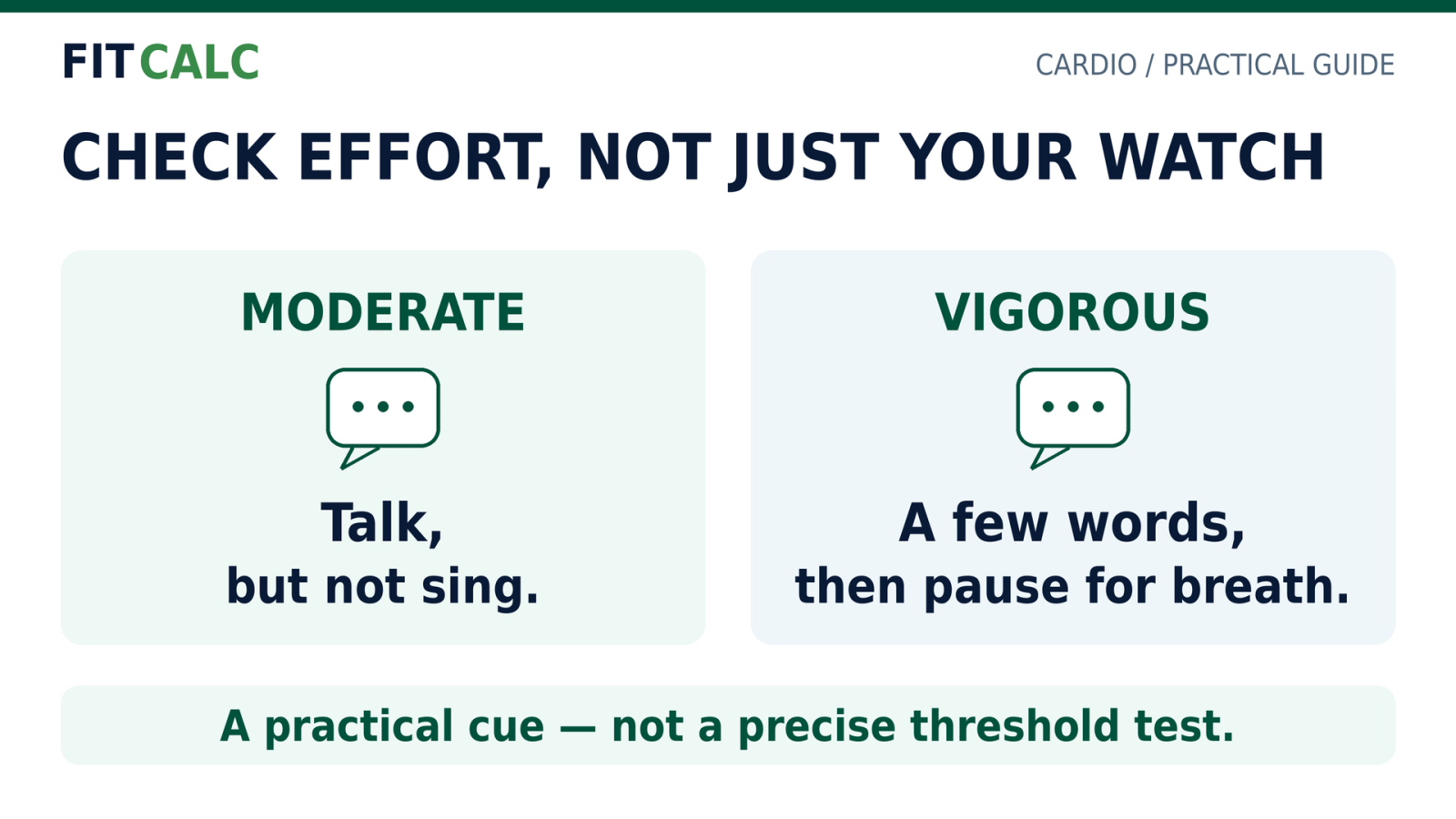
The simplest useful intensity check is whether you can speak comfortably. CDC guidance describes moderate activity as an effort at which you can talk but not sing; during vigorous activity, you generally cannot say more than a few words without pausing for breath. On its relative-effort scale from zero to ten, moderate activity is around five or six and vigorous activity begins around seven or eight. [3]
These are guides, not precise laboratory measurements. “Easy” in a running plan is also not a universal synonym for the CDC’s moderate-intensity category. For a conversational session, the practical intention is usually to maintain controlled breathing and an effort you can repeat, not to turn every outing into a test. A pace that meets that intention for one person may be too demanding for another.
During a steady session, check your effort after you have settled in. Say a normal sentence, notice your breathing, and ask whether the current effort matches the day’s purpose. If you planned a comfortable session but speech becomes strained, slow down, reduce the incline, or take a walking break. You do not need permission from the watch to make that adjustment.
Perceived effort is worth recording because it gives numbers context. A brief note such as “comfortable conversation throughout” or “last ten minutes felt much harder” is more informative than a heart-rate average alone. The same average can hide a steady session, repeated hard bursts, or a long warm-up followed by a short difficult finish.
Do not turn the talk test into a threshold test
Talk-test research supports its usefulness as a practical intensity cue, but the relationship with laboratory thresholds depends on the protocol and population. A small 2011 study, for example, did not find that its speaking-comfort stages simply matched the ventilatory threshold. That is a reason to avoid claiming that one comfortable sentence proves you are exactly below a particular physiological threshold. [4]
For most general-fitness sessions, the distinction is not a problem. You are choosing an appropriate effort, not diagnosing a precise metabolic boundary. If accurate threshold-based training matters for a specific sport or clinical situation, get an appropriate assessment and interpretation rather than trying to extract that certainty from an age formula or a generic watch setting.
Understand what a heart rate zone actually means
A heart-rate zone is a range defined by a chosen method. Before comparing two sets of zones, check how each was calculated. One device may use a percentage of estimated maximum heart rate; another may use heart-rate reserve; a coach may use measured threshold information. Identical zone names do not make those systems interchangeable.
FitCalc’s Heart Rate Zone Calculator offers percentage-of-maximum and heart-rate-reserve methods. Without an entered maximum, it uses the Tanaka equation: 208 minus 0.7 times age. The original research developed an age-based estimate in healthy adults. It is a population relationship, not a direct measurement of your personal maximum. [5]
For a hypothetical 40-year-old, the calculation is 208 − (0.7 × 40) = 180 beats per minute. Someone of that age can have a real maximum above or below 180. A higher maximum is not automatically evidence of better fitness, and an estimated maximum is not a target you need to reach during an ordinary workout.
If you enter a known maximum in FitCalc, that number takes priority over age. Do not treat the highest number ever flashed by a watch as a verified maximum, and do not undertake an unsupervised all-out test merely to fill in the field. Leave the value estimated when you do not have trustworthy measurement; keep that uncertainty visible when interpreting the result.
Percent of maximum and heart rate reserve
Percentage-of-maximum calculations multiply the maximum by the chosen fraction. In the example above, 60 percent of 180 is 108 bpm. Heart-rate reserve first subtracts resting heart rate from maximum heart rate, takes a fraction of that reserve, and adds resting heart rate back.
Suppose the same person has a resting heart rate of 60 bpm. The reserve is 180 − 60 = 120 bpm. At 60 percent of reserve, the calculation is 60 + (0.60 × 120) = 132 bpm. Both calculations are correct. The 24-bpm difference comes from the method, not from one calculator discovering that the person suddenly became fitter.
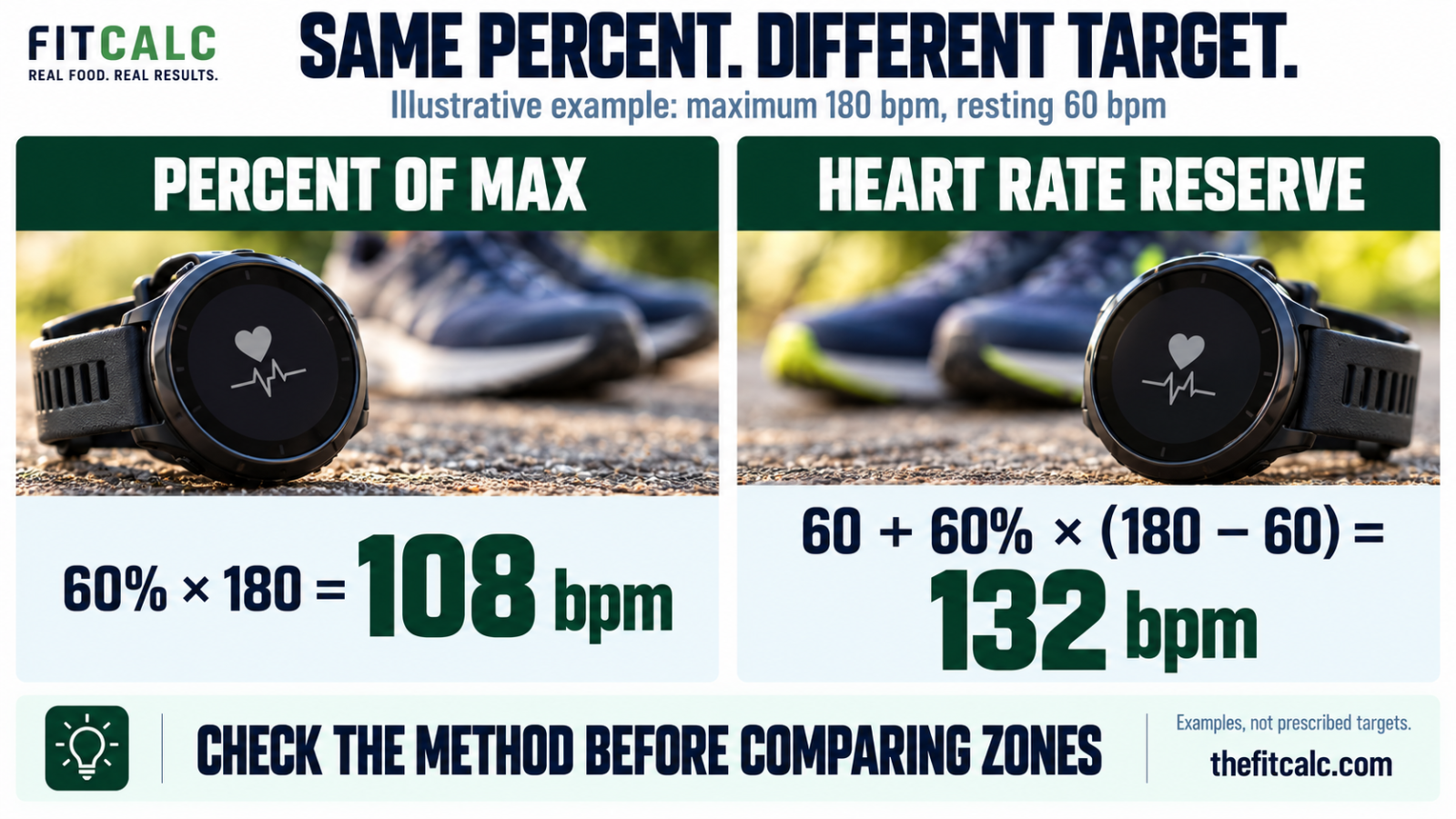
This is why you should not take a percentage recommended for one method and apply it to another. It also explains why switching a device setting can redraw your training history without changing the effort of a single workout. When saving a target, record the method and inputs along with the bpm range.
FitCalc uses five percentage bands: 50–60, 60–70, 70–80, 80–90 and 90–100 percent. Its whole-number display avoids overlapping boundaries. With a 180-bpm maximum, the second percentage-of-maximum band displays 108–125 bpm; 126 begins the next band. With the same maximum and a resting rate of 60, the second reserve-based band displays 132–143 bpm; 144 begins the next band. These display boundaries are conventions, not biological switches. [6]
Why Zone 2 labels can disagree
FitCalc’s second percentage band is not a measurement of your first lactate or ventilatory threshold. A watch’s “Zone 2” may also follow different settings from the zones described in a training article. Comparing the underlying method is more useful than trying to make every product show the same color.
If a calculator says your comfortable walk is outside its second band, do not immediately conclude the walk is useless. Equally, a green zone label does not guarantee that a session is appropriately easy for you. Treat the estimate as context, then compare it with breathing, effort and your ability to recover. FitCalc’s Zone 2 article discusses that narrower topic in more detail.
To use the calculator well, choose one method, enter sensible inputs, and save the result as a starting reference. Revisit the inputs when you have a good reason, such as better measurement, rather than adjusting them until the display confirms the pace you wanted to run. A consistent imperfect reference is easier to interpret than one you keep changing after every disappointing session.
Use a wearable without letting it overrule the session
Heart rate and calorie expenditure are different measurement problems. A device can perform reasonably well for one and poorly for the other. In an April 2026 validation study, 62 healthy adult men wore four smartwatches during endurance and resistance protocols. Heart-rate measurements performed substantially better than energy-expenditure estimates, whose agreement with indirect calorimetry was limited. The finding applies to the tested devices, participants and protocols; it is not a guarantee for every watch or every workout. [7]
That distinction matters when you interpret a neat-looking dashboard. A believable heart-rate trace does not validate the calorie total beside it. Nor does a newer device automatically make every estimate individualized. Use the workout record to describe what you did, and keep nutrition decisions anchored to your broader goal, intake and real-world progress.
When the screen and your experience disagree, first check the basics. Was the device worn as its manufacturer recommends? Did the reading change suddenly without a matching change in effort? Are you comparing the same activity and settings? If a number looks wrong, do not accelerate merely to force a target. A missing or questionable reading is a reason to use other cues, not a reason to abandon judgment.
Compare like with like
Heat is one reason the same pace can demand more from you on a different day. ACSM explains that exercising in hot conditions increases the work of distributing blood for cooling, which can raise heart rate. A hot, humid outdoor session therefore should not be judged as though it were an identical cool indoor session. Adjust the workload and environment rather than treating every higher reading as lost fitness. [8]
Record obvious context: the route, incline, weather, activity mode and whether you felt unusually tired. You do not need a complex spreadsheet. A few words are often enough to explain why a comparison is weak. Avoid trying to “correct” every result with a home-made formula; the goal is to recognize uncertainty, not cover it with more decimal places.
Keep device scores in proportion. A recovery score or estimated fitness number may be useful as a personal trend, but it should not be your only reason to add a hard workout or ignore symptoms. First ask whether you feel well, whether recent training was manageable, and whether the planned session fits the week. If the device disagrees, investigate the disagreement rather than automatically obeying it.
Use pace to describe a task rather than predict your fitness
Pace is time per unit of distance. Speed is distance per unit of time. For a completed run, you can calculate average pace by dividing total time by distance. For a planned effort, multiplying distance by a chosen pace gives the time that would be required if you maintained that pace throughout.
The FitCalc Running Pace Calculator performs those conversions and shows even splits. It does not establish whether a target is realistic, predict how fast you can race a longer distance, or account for terrain and fatigue. A calculated finish time is a mathematical scenario, not a performance forecast.
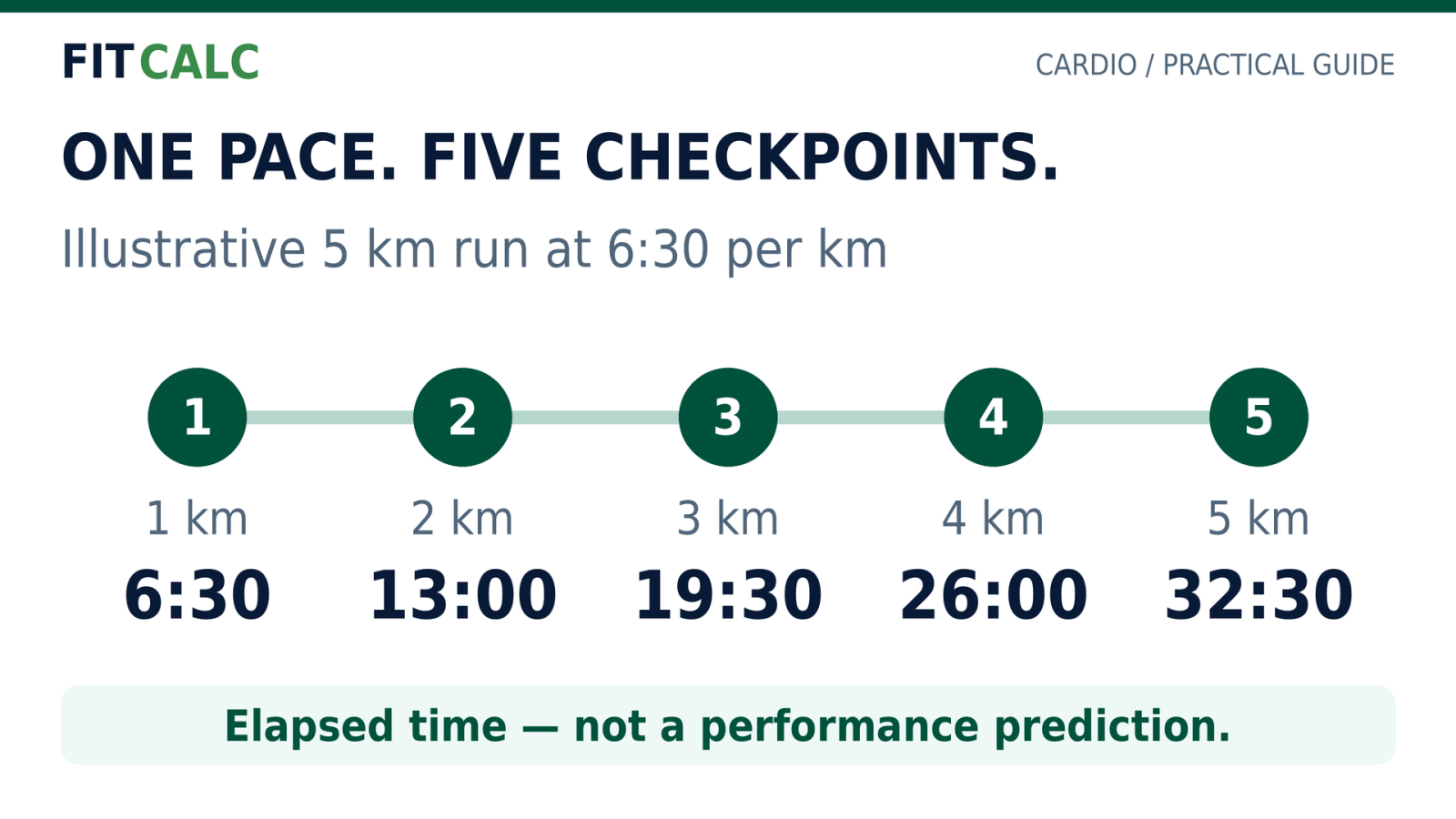
Consider an illustrative five-kilometer outing completed in 32 minutes 30 seconds. That is 1,950 seconds divided by five, or 390 seconds per kilometer: 6 minutes 30 seconds per kilometer. Average speed is about 9.23 kilometers per hour. The same pace is approximately 10 minutes 28 seconds per mile; using the correct distance unit is essential.
At exactly 6:30 per kilometer, even cumulative splits would be 6:30 after one kilometer, 13:00 after two, 19:30 after three, 26:00 after four and 32:30 after five. These are elapsed checkpoints, not five separate finish times. They can help you understand pacing, but they do not mean every hill or turn should be forced into an identical split.
A longer distance is a new task
If you enter ten kilometers at 6:30 per kilometer, the calculator returns 65 minutes, or 1 hour 5 minutes. It has doubled the distance while keeping pace constant. It has not established that a person who can run five kilometers at that pace can sustain it for ten. Endurance, conditions and the effort of the original five kilometers still matter.
Use that output to understand a scenario: “What would this distance require at this pace?” Then decide whether the scenario fits your present ability. For a comfortable session, slowing down or alternating running and walking is preferable to forcing a pace simply because you entered it in a calculator.
For treadmill work, record the displayed speed and incline as well as duration. For outdoor work, use the same route or a reasonably comparable route when assessing change. Even then, avoid treating a few seconds of difference as a clear improvement. What matters is a repeated pattern that agrees with effort and recovery, not a single favorable GPS reading.
Build a week from the activity you already tolerate
Begin with your recent routine, not the routine you hope to earn. Write down what you actually completed over the last couple of weeks. Include purposeful brisk walking and other aerobic activity outside the gym. Separate actual activity time from time spent changing clothes, waiting for equipment or standing between efforts.
If your starting point is low, choose short sessions that fit into ordinary days. The first progression can be making those sessions regular. It does not have to be adding an interval workout. The examples below are planning illustrations for generally healthy adults, not tested programs that everyone should follow or deadlines for reaching the weekly guidelines.
An example of starting with short sessions
Imagine someone whose current routine is two comfortable 15-minute walks per week. That is 30 minutes of walking. A reasonable planning experiment could be adding a third 15-minute outing, producing 45 minutes in total, while keeping the effort similar. Whether those minutes count as moderate activity depends on the actual intensity; the calendar alone cannot tell you.
If that routine feels manageable and does not cause concerning symptoms, the person could next extend one outing by five minutes. Three sessions of 15, 15 and 20 minutes total 50 minutes. Repeating that week is a valid choice. There is no requirement to increase every week, and no special benefit to obeying an arbitrary percentage increase when the starting volume is small.
At this stage, the useful outcome is consistency and tolerance. The person is building toward a larger routine, not pretending that 50 minutes already satisfies a 150-minute target. A difficult week might call for shorter outings or maintaining the same amount. Progression should respond to what is sustainable rather than convert a guideline into a rushed catch-up assignment.
An example of combining moderate and vigorous activity
For the public-health equivalence calculation, one minute of vigorous activity counts approximately like two minutes of moderate activity. CDC presents this as a practical way to combine the two, not a claim that every minute creates identical adaptations or burns exactly twice the calories. [9]
Suppose an established exerciser completes three genuinely moderate 30-minute sessions and two sessions containing 15 minutes of vigorous work each. The week contains 90 moderate minutes plus 30 vigorous minutes. Its moderate-equivalent total is 90 + (2 × 30) = 150 minutes. Actual moderate-or-vigorous activity time is 120 minutes, not 150.
Count only the work that meets the relevant intensity in this calculation. If the two harder sessions also include easy warm-ups, rests and cool-downs, those are useful parts of the session but do not automatically become vigorous minutes. A “30-minute interval workout” may contain far less than 30 minutes of vigorous work. Record the parts honestly rather than using the class name as the intensity measure.
Make the routine easier to keep
Attach sessions to dependable parts of the week. A short walk after lunch or a bike session after an upper-body workout may be easier to maintain than a vague promise to exercise when there is spare time. Keep an alternative ready for bad weather or a busy day. The alternative should preserve the purpose of the session, not punish you for missing the original plan.
If you miss a workout, resume with a manageable session instead of compressing all the missed work into the next day. The weekly total is useful for review, but it should not encourage a sudden overload at the weekend. Look for patterns in why sessions are missed and change the schedule before concluding that you need more willpower.
Progress without making every session harder
Duration, frequency and intensity are separate ways to change a cardio routine. Increasing all three at once makes it difficult to identify why fatigue or discomfort has appeared. FitCalc’s practical approach is to change one main variable at a time, observe the response, and keep the rest of the routine reasonably stable.
For example, if you comfortably cycle for 20 minutes three times per week, you could lengthen one session to 25 minutes while keeping the others unchanged. That increases the weekly total from 60 to 65 minutes. It is a modest planning choice, not a scientific rule that five minutes is always the correct increase. Your previous activity, health, recovery and chosen mode determine what is reasonable.
Do not confuse a better workout with a harder workout. Completing the same session more comfortably can be progress. So can maintaining a routine through a busy month without repeatedly exhausting yourself. Once a workload becomes dependable, you have a clearer basis for deciding whether a longer session or a little more intensity would serve the goal.
Add harder work only when it has a purpose
Intervals alternate harder efforts with easier recovery. They are an option, not a requirement for a useful cardio routine. A person already tolerating regular steady activity might introduce a small amount of controlled harder work, while someone still struggling to maintain short sessions may be better served by repeating those sessions.
For arithmetic, an example bike session could include a 5-minute easy warm-up, four repeats of 1 minute harder and 2 minutes easy, then a 5-minute cool-down. Total session time is 5 + (4 × 3) + 5 = 22 minutes. Only 4 minutes are designated harder work. Calling the entire session “22 minutes of vigorous activity” would be incorrect unless the actual effort supported that classification throughout.
The harder portions need not be all-out sprints. Do not use this example as a prescription if you are new to exercise, have symptoms, or need clinical guidance. Its purpose is to show how to account for work and recovery, and why a workout label tells you less than the actual session structure.
Running deserves its own gradual build
If your goal is running, alternating running and walking can make the starting workload more manageable. The NHS Couch to 5K program uses that approach with rest days between runs and an emphasis on building time rather than immediately chasing speed. It is a structured option to consider, not evidence that everyone must reach five kilometers in nine weeks. [10]
Cardiovascular confidence can also get ahead of how well a new activity feels on your joints and muscles. Being able to breathe comfortably does not mean you should immediately add much more running. Keep track of discomfort and how you feel between sessions, and seek qualified help for persistent or worsening pain rather than trying to solve it by changing heart-rate zones.
Fit cardio around strength training
Cardio and resistance training can coexist. An updated meta-analysis published in 2022 found that concurrent training did not, on average, compromise muscle growth or maximal strength compared with the same strength program alone. Explosive-strength development was more vulnerable, particularly when both types of work occurred within the same session. That does not mean every combination, workload or athlete responds identically. [11]
For a lifter, the practical question is whether added cardio is reducing the quality of important lifting sessions or making recovery harder. Start with a dose you can absorb. If lower-body lifting is the priority, avoid placing an unfamiliar hard run immediately before it. Choose scheduling and modes that make the entire week workable, rather than treating cardio and lifting as rival teams.
A simple week for someone who already lifts
Consider a person who lifts on Monday, Wednesday and Friday and already tolerates moderate cycling and brisk walking. One possible arrangement is 25 minutes of moderate cycling on Tuesday and Thursday, plus a 40-minute brisk walk on Saturday. That provides 90 moderate minutes if those activities genuinely meet moderate intensity. It leaves a gap to the 150-minute weekly target rather than concealing it.
Four additional 15-minute brisk walks would add 60 minutes, bringing the weekly moderate total to 150. These could be placed on days where they fit, including lifting days. This is an example of combining structured sessions with ordinary movement, not a demand that someone starting from zero suddenly perform the whole week.
If the person later adds a harder cardio session, it can replace part of the existing workload rather than simply sit on top of everything else. Review leg fatigue, sleep, session enjoyment and lifting performance. If several important sessions deteriorate, reduce the new demand and reassess before making the routine more complicated.
When both types of training must happen in one visit, do the work that matters most to your current goal while you are freshest. For a strength-focused person that often means lifting first, with modest cardio afterward. If a high-quality run is the priority that day, reverse the emphasis or separate the sessions when practical. FitCalc’s cardio and muscle-gain article explores this trade-off in more depth.
Eat for the training you are doing
Adding cardio is not a reason to replace ordinary meals with supplements. FitCalc favors a practical foundation of whole foods: meat, eggs or fish for protein; rice, potatoes and fruit for carbohydrate; and other foods that fit your preferences and overall nutrition needs. Dairy can be useful when tolerated, but it is optional. A dairy-free reader can build the same general structure without it.
A short, comfortable session may fit easily between your normal meals. A longer or more demanding training day may need more deliberate food planning. Familiar options such as a chicken-and-rice meal, eggs with potatoes, or fruit alongside an ordinary meal can be easier to repeat than constantly searching for a special workout product. Adjust portions to your needs and comfort rather than treating a photograph or example menu as a prescription.
Avoid automatically adding the full calorie number from every workout to your food target. If your starting intake already accounts for your usual activity, doing so may count that activity twice. Conversely, do not dismiss persistent hunger, declining performance or poor recovery just because an app says you have reached your calorie allowance. FitCalc’s exercise-calorie article explains the accounting problem.
Use FitCalc Plan or the TDEE Calculator as a starting estimate, then compare it with your actual routine and trends. A calculator cannot diagnose underfueling or tell you the exact additional food required by every session. Persistent fatigue, repeated injuries, menstrual changes or a difficult relationship with exercise and food deserve professional attention rather than another automatic calorie adjustment. These concerns can have several causes and should not be self-diagnosed as low energy availability. [14]
Measure progress with a small repeatable record
For each session, record the activity, duration and a brief effort description. Add distance or speed when relevant, plus heart rate if the measurement seems useful. A one-line context note can capture heat, hills, a poor night’s sleep or an unusually demanding lifting week. This is enough to make most general-fitness comparisons more honest.
Choose one repeatable session as a reference. It could be the same 20-minute bike ride, the same flat walking route or the same comfortable run-walk sequence. Repeat it under reasonably similar conditions without turning it into a maximal test. You are looking for a pattern such as similar work feeling easier, or slightly more work at a similar effort, while recovery remains manageable.
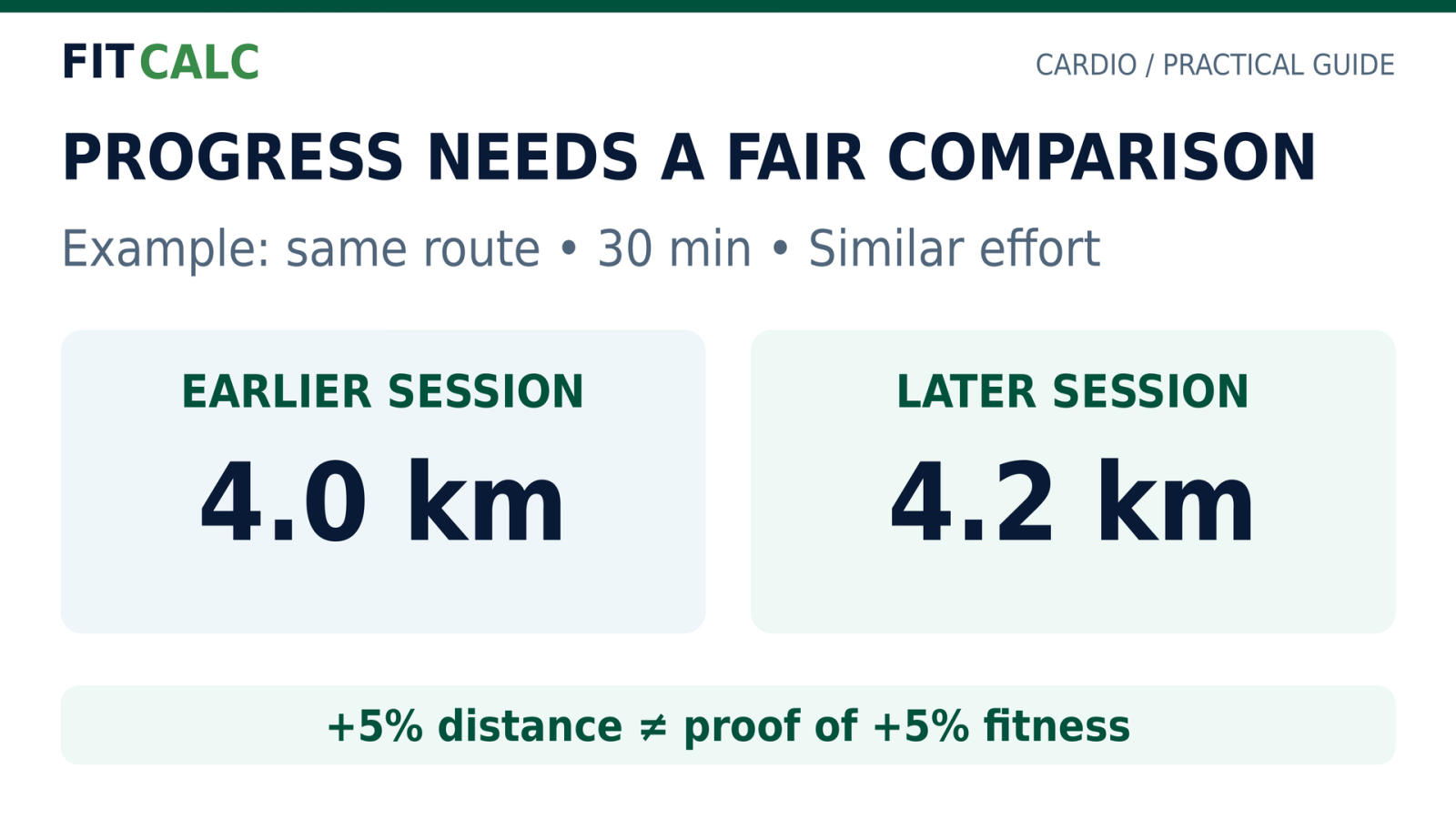
Imagine two illustrative 30-minute outings on the same route. In the first, a person covers 4.0 kilometers; in a later one, 4.2 kilometers at a comparable comfortable effort. Distance increased by 0.2 kilometers, or 5 percent. The average pace changed from 7:30 per kilometer to about 7:09. That is a useful observation, but one comparison cannot prove a precise 5-percent increase in cardiovascular fitness.
Check the other explanations before celebrating or worrying. Was the later day cooler? Were there fewer stops? Did the route or device change? If the improvement repeats across several comparable sessions and agrees with how you feel, it is more convincing. The aim is a decision you can use, such as continuing the current routine, rather than an exact physiological score you cannot verify.
When a week feels worse
A single difficult session rarely supplies enough information to redesign the plan. Review whether the workload recently increased, whether you are ill or unusually stressed, and whether the session was truly comparable. Choose an easier option or rest when appropriate. Do not compensate by trying to set a personal record at the next opportunity.
If performance repeatedly declines or discomfort persists, reduce the demanding part of the routine and seek qualified advice when needed. Do not keep raising the target just because the calendar says you should progress. A plan is useful only while it fits the person performing it.
Know when generic targets are not enough
Age-based zones need extra caution when medication or a health condition affects heart rate. Beta blockers, for example, slow heart rate; the American Heart Association advises discussing exercise targets with a healthcare professional rather than assuming an ordinary target chart still applies. Do not change medication to make a training zone easier to reach. [12]
This general guide is not a cardiac rehabilitation plan, a pregnancy exercise prescription, or individualized advice for someone with a diagnosed condition. If you are unsure about increasing exercise, especially vigorous work, discuss the plan with an appropriate clinician. A qualified exercise professional can help adapt the activity itself; medical symptoms should not be managed solely by a coach or fitness app.
Stop exercising if you develop concerning symptoms such as chest discomfort, fainting or severe unusual breathlessness. Seek urgent medical help for possible heart-attack symptoms; in the United States, call 911. Do not wait for the watch to confirm that something is wrong. Ordinary effort and a medical warning are not the same problem, and a reassuring device number cannot rule out an emergency. [13]
Practical takeaways
Start with a routine you can repeat, then build toward the weekly activity guidelines. A small sustainable beginning is better than an ambitious plan you cannot recover from.
Use breathing and perceived effort alongside heart rate. Check the method before comparing zone labels, and remember that an age formula does not measure your personal thresholds.
Treat pace calculations as arithmetic. A projected finish time does not establish that you can sustain that pace over a longer distance.
Keep the whole training week in view. Add cardio in a way that preserves the lifting, recovery and ordinary life you want it to support.
Look for repeated progress under comparable conditions. Do not let one watch reading, one difficult session or a calorie estimate dictate the next decision.
For your next session, choose an activity, a manageable duration and a clear effort intention. If you want a numerical reference, use the Heart Rate Zone Calculator, save its method and inputs, and compare the result with how the session feels. Use the Running Pace Calculator when you need to translate distance and time into an understandable pacing scenario. The numbers should make the next step clearer, not make a simple session harder to complete.
Sources
[1]
American College of Sports Medicine. Wearables Hold Top Spot in ACSM’s 2027 Fitness Trends
. October 20, 2026. Industry survey context; not evidence of product effectiveness.
[2] U.S. Department of Health and Human Services. Physical Activity Guidelines for Americans second edition. 2018, especially chapter 4. The current-guidelines page still identifies the second edition as current at the research check.
[3] Centers for Disease Control and Prevention. How to Measure Physical Activity Intensity. December 4, 2025. Relative effort and talk-test guidance.
[4] Quinn TJ and Coons BA. The Talk Test and its relationship with the ventilatory and lactate thresholds. Journal of Sports Sciences, 2011. Small primary study; protocol and population limit generalization.
[5] Tanaka H, Monahan KD and Seals DR. Age predicted maximal heart rate revisited. Journal of the American College of Cardiology, 2001. Basis for the 208 − 0.7 × age estimate.
[6] FitCalc. How FitCalc Calculators Work. Heart Rate Zones and Running Pace sections, checked October 25, 2026. Product-specific methods and limitations, not independent clinical evidence.
[7] Lee TH and colleagues. Comparative Validity of Smartwatch Derived Heart Rate and Energy Expenditure During Endurance and Resistance Exercise. Sensors, April 19, 2026. Primary validation study in 62 healthy adult men.
[8] American College of Sports Medicine. Exercising in Hot and Cold Environments. Consumer guidance on temperature and exercise strain; checked October 25, 2026.
[9] Centers for Disease Control and Prevention. What Counts as Physical Activity for Adults. Moderate and vigorous activity equivalence; checked October 25, 2026.
[10] NHS. Couch to 5K running plan. Run-walk progression and rest-day structure; checked October 25, 2026.
[11] Schumann M and colleagues. Compatibility of Concurrent Aerobic and Strength Training for Skeletal Muscle Size and Function. Sports Medicine, 2022. Systematic review and meta-analysis; primary studies vary in participants and programs.
[12] American Heart Association. How Do Beta Blocker Drugs Affect Exercise. Reviewed January 18, 2024. Medication and individualized heart-rate targets.
[13] American Heart Association. Warning Signs of a Heart Attack. Emergency warning signs; checked October 25, 2026.
[14] Mountjoy M and colleagues. 2023 International Olympic Committee consensus statement on Relative Energy Deficiency in Sport. British Journal of Sports Medicine, 2023, with subsequent correction. Clinical context for low energy availability and the need to exclude other causes of symptoms.