How Much Fat Should You Eat Per Day When Cutting?
When you start cutting calories, dietary fat can feel like the easiest place to make room. A smaller pour of oil, a leaner cut of meat and fewer handfuls of nuts can reduce your intake without removing entire meals. But taking that idea to its extreme creates a different problem: you still need a diet that is nutritious, satisfying and workable alongside training.
There is no single fat target that suits every lifter. A useful starting point is to understand the adult reference range, turn it into grams at your calorie intake, and then check what the resulting meals actually look like. The goal is not to eat the least fat possible. It is to allocate a limited calorie budget without neglecting protein, food quality or training fuel.
This article is for generally healthy adults pursuing a reasonable fat-loss goal. It is not a cutting plan for adolescents, pregnancy or breastfeeding, people who are underweight, or anyone whose medical condition or eating-disorder history calls for individualized nutrition care.
Start with a range, not a magic minimum
The National Academies' acceptable macronutrient distribution range for total fat in adults is 20–35% of energy. This is a population-level reference range, not a personalized prescription and not a research-proven sweet spot for preserving muscle during a cut. It also does not mean that falling slightly outside the range on an occasional day creates an immediate health problem.
For an everyday lifter, roughly one-quarter of calories from fat is a reasonable planning starting point to explore, not a rule you must defend at all costs. It leaves room to choose varied foods while allocating the rest of your energy to protein and carbohydrates. Your final intake may differ with food preferences, calorie needs, health considerations and the demands of training.
Do not confuse a percentage with a fixed amount. Twenty-five percent of 1,800 calories is 50 grams of fat, whereas 25% of 2,800 calories is about 78 grams. Both have the same percentage, but they represent different diets. That is why copying another person's fat grams without considering their total intake is usually unhelpful.
How to calculate your fat target in grams
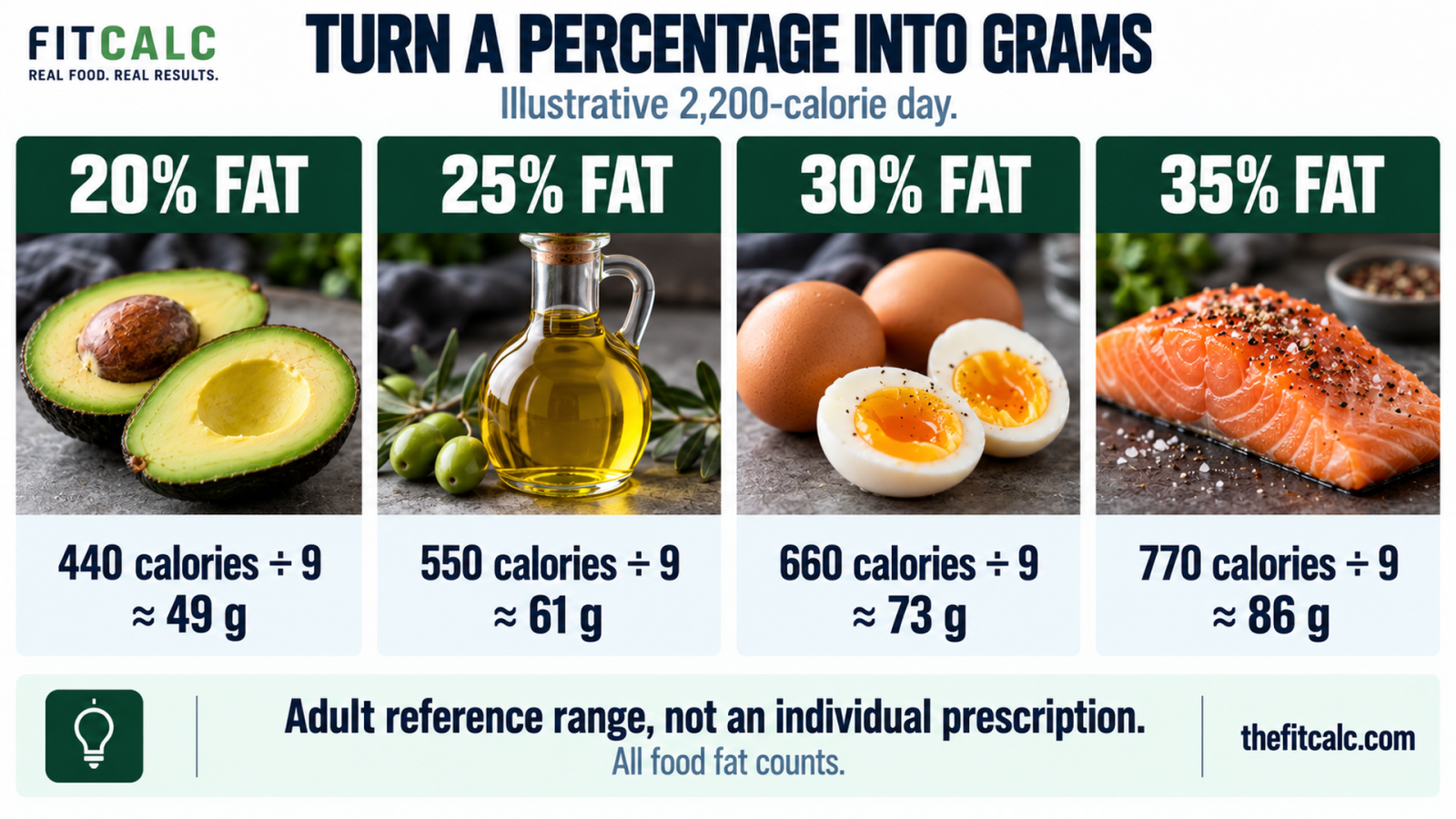
For ordinary macro planning, fat supplies about nine calories per gram, while protein and carbohydrate each supply about four. To convert a fat percentage into grams, multiply your daily calories by that percentage expressed as a decimal, then divide by nine. These standard factors are planning approximations; food-specific energy factors, fiber and label rounding can make a real food log differ slightly.
On an illustrative 2,200-calorie day, 20% from fat means 440 fat calories, or approximately 49 grams. At 25%, that becomes 550 calories and approximately 61 grams. Thirty percent provides about 73 grams, and 35% provides about 86 grams. The calculation translates a range into portions you can use; it does not tell you which endpoint your body requires.
It is perfectly sensible to round a result such as 61.1 grams into a practical target around 60 grams. Trying to hit a decimal exactly adds work without removing the uncertainty in food composition and portion measurement. Consistency across normal meals is more useful than repeatedly changing dinner to force a perfect number on an app.
Put calories and protein in place before adjusting fat
A cutting diet needs a suitable overall energy intake, not just a lower-fat label. The Calorie Deficit Calculator can help establish a starting estimate, while the Protein Calculator separates an evidence-supported range from FitCalc's practical recommendation. Neither replaces feedback from your actual progress or individualized clinical advice.
Once those decisions are made, fat and carbohydrate compete for the energy that remains. This does not make one of them bad. It simply means that adding more of one while holding calories and protein steady requires reducing the other. A macro target should make those trade-offs visible rather than hide them behind a ratio that supposedly works for everyone.
A complete 2,200-calorie example
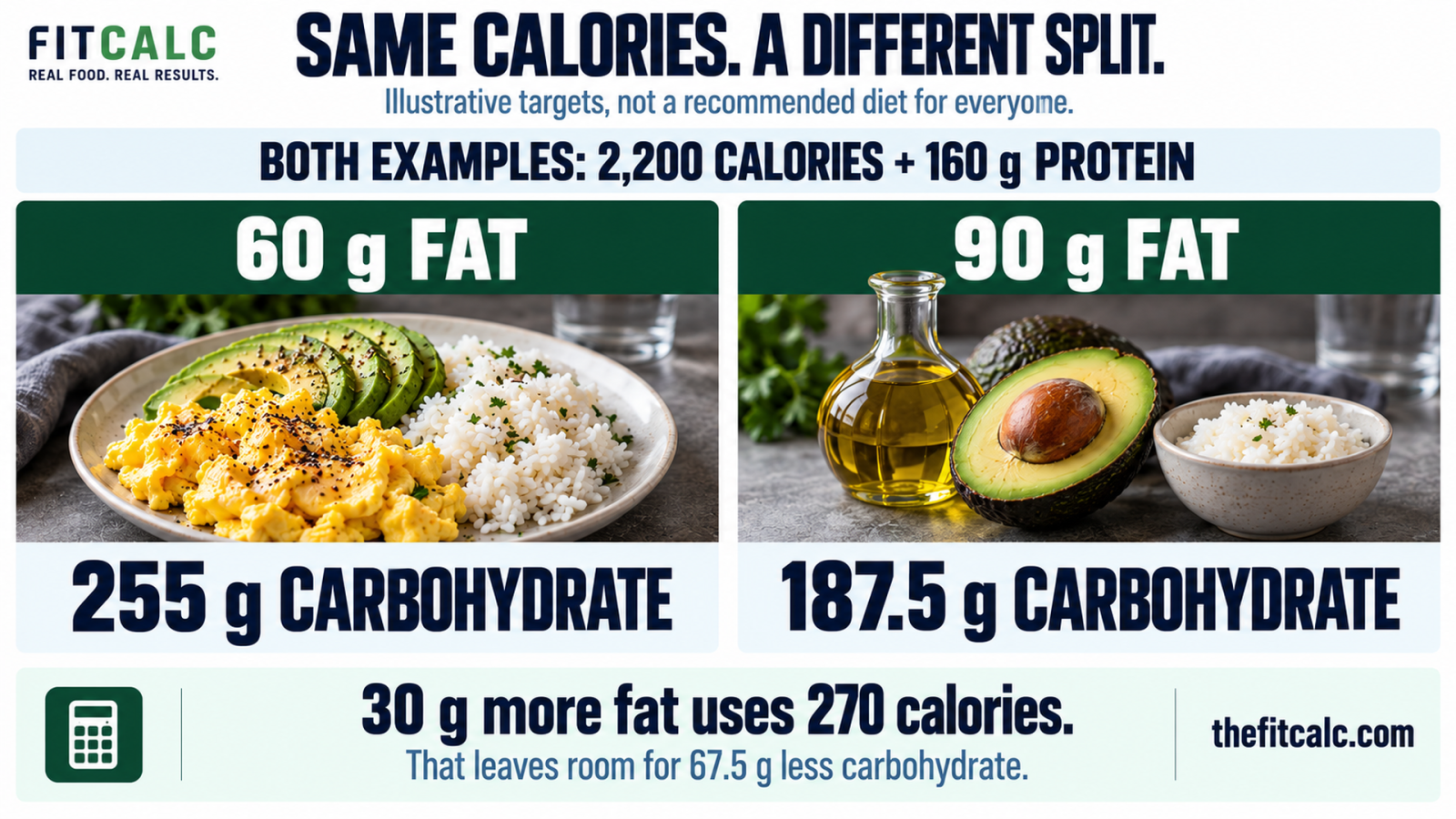
Imagine an adult who has already chosen an appropriate 2,200-calorie target and 160 grams of protein. Those are hypothetical inputs, not recommendations for every reader. Protein uses 640 calories. If the person chooses 60 grams of fat, that uses another 540 calories, leaving 1,020 calories for carbohydrate: 255 grams.
The full planning total is therefore 160 grams of protein, 60 grams of fat and 255 grams of carbohydrate. Using the standard factors, that is 640 plus 540 plus 1,020, which equals 2,200 calories. Fat contributes about 24.5% of the total, close to the illustrative quarter-of-calories starting point.
Now increase fat to 90 grams while keeping protein and calories unchanged. Fat uses 810 calories, leaving 750 for carbohydrate, or 187.5 grams. The extra 30 grams of fat has used the same 270 calories as 67.5 grams of carbohydrate. Ninety grams supplies about 36.8% of these calories, above the 20–35% adult reference range; this is a trade-off illustration, not an endorsement of that endpoint. The person should understand what was exchanged instead of assuming that extra “healthy fats” fit for free.
For a lifter who prefers carbohydrate-rich meals around training, the first split may be easier to organize. Someone else may prefer a different balance. The important question is whether the resulting food pattern supports the person's goals and routine, not which split sounds more impressive on paper.
What FitCalc's macro calculator is doing
The Macro Calculator allocates protein first, then sets fat using the greater of 0.6 grams per kilogram of body weight or roughly 25% of calories. Carbohydrate receives the remaining energy. This is FitCalc's planning method, not proof that 0.6 grams per kilogram is a universal biological minimum.
The distinction matters when a low calorie target cannot accommodate the preferred allocations. The tool displays a warning rather than creating negative macros or pretending the constrained result is ideal. Read that warning as a reason to reconsider the inputs. Reducing food further simply to make a calculator produce tidy numbers is not the purpose of the exercise.
Count the fat already in your food
Your fat target includes fat in eggs, meat, fish, nuts and other foods, not only the oil you add to a pan. If breakfast contains whole eggs and dinner includes salmon, those meals already contribute to the day's total. A bottle of olive oil is not a separate category that sits outside the macro budget.
A practical approach is to plan your main protein foods first, inspect their labels or matching database entries, and then decide how much additional fat fits. If the day's meat choices are relatively lean, you may have more room for avocado, nuts or a measured amount of olive oil. If several meals already contain fattier cuts, automatically adding substantial oil to each one may make the total harder to manage.
Do not assume every version of a food has the same numbers. Ground beef varies by lean percentage, salmon differs from white fish, and prepared sauces can contribute more fat than expected. Choose the entry that matches the actual product and preparation. Our article on weighing food raw or cooked explains why a cooked portion should not be paired with an unrelated raw-weight entry.
When meal prepping, account for the ingredients you actually use and the portions you actually serve. If substantial fat is drained and discarded, uncertainty increases; do not pretend a generic raw entry precisely measures what remains. The aim is a repeatable, honest estimate, not laboratory precision from a kitchen scale.
Choose useful foods, then adjust portions
Start with meals you genuinely want to keep eating. Eggs with fruit and potatoes, chicken with rice and vegetables, or fish with a substantial side can all be organized into different calorie budgets. You do not need an entirely new menu every time your fat target changes; often the adjustable pieces are the meat selection, cooking fat, dressing or extra snack.
For example, suppose a food label shows that one serving adds 10 grams of fat. That represents approximately 90 calories from fat, before counting any protein or carbohydrate in the food. Having two servings instead of one changes the plan meaningfully, even if the food is nutritious. Read the complete calorie figure rather than treating a fat-only calculation as the food's total energy.
Fat quality still matters. WHO recommends keeping saturated fat at no more than 10% of total energy and favoring unsaturated sources. At 2,200 calories, that corresponds to about 24 grams of saturated fat, which is part of the total fat allowance, not an extra allowance. Fish, avocado, nuts and olive oil can help diversify your choices alongside animal-protein foods. If a clinician has given you a different target because of your lipid profile or health history, follow that individualized guidance.
Lower fat is not automatically faster fat loss
In the DIETFITS trial, 609 adults with overweight or obesity were assigned to healthy low-fat or healthy low-carbohydrate approaches. Average weight change did not differ significantly between the groups after 12 months. This was not a trial of lean bodybuilders, and it does not prove that every macro split is equally suitable for training. It does challenge the claim that one broad label guarantees superior weight loss.
Likewise, raising fat while cutting carbohydrates does not make calorie intake irrelevant. Dietary fat and stored body fat are different things, but neither a low-fat menu nor a high-fat menu can be judged without considering the overall diet. Pick a pattern you can execute consistently instead of changing strategies whenever a single weigh-in disappoints you.
Adjust the plan without ignoring warning signs
Before changing macros, review a normal stretch of eating and training. Are portions being recorded consistently? Does the plan leave room for satisfying meals? Are you removing carbohydrate from every meal simply to accommodate oils and snacks you forgot to count? Those practical questions often identify a clearer adjustment than debating whether 25% or 28% fat is theoretically optimal.
If you decide to exchange fat for carbohydrate, make the trade explicit and preserve the intended calorie total. For example, 10 grams less fat makes approximately 90 calories available, equivalent to 22.5 grams of carbohydrate. This is arithmetic, not a promise of better performance. Keep the change modest enough that you can judge how the new meals fit your routine.
Persistent exhaustion, deteriorating performance, repeated injuries, menstrual disruption or other concerning symptoms should not be dismissed as proof that a cut is working. Problematic low energy availability can affect health and performance in athletes of either sex. Adding a particular fat food is not a diagnosis or a complete treatment. Pause the push toward further restriction and seek qualified medical or sports-dietitian guidance when these problems appear.
The practical takeaway
Use the adult fat range as context, convert it into grams at your actual calorie target, and then build meals that account for every source of fat. Set adequate protein, preserve useful carbohydrate where it fits your training, and pay attention to both total fat and food quality. A starting point around one-quarter of calories can be convenient, but it is not a hormonal insurance policy or a requirement to hit perfectly.
Use the Macro Calculator to see how the pieces fit together, then treat the result as a starting plan rather than a rigid verdict. The best fat target is not the smallest number you can tolerate. It is a sensible amount within an overall diet you can follow without sacrificing nutrition, health or the training you are trying to support.
Sources
National Academies. Dietary Reference Intakes: Acceptable Macronutrient Distribution Ranges.
FAO. Food energy: calculation of energy content and conversion factors.
NIDDK. Eating & Physical Activity to Lose or Maintain Weight.
World Health Organization. Healthy diet. Updated January 26, 2026.