Do Liquid Calories Count Differently When Losing or Gaining Weight?
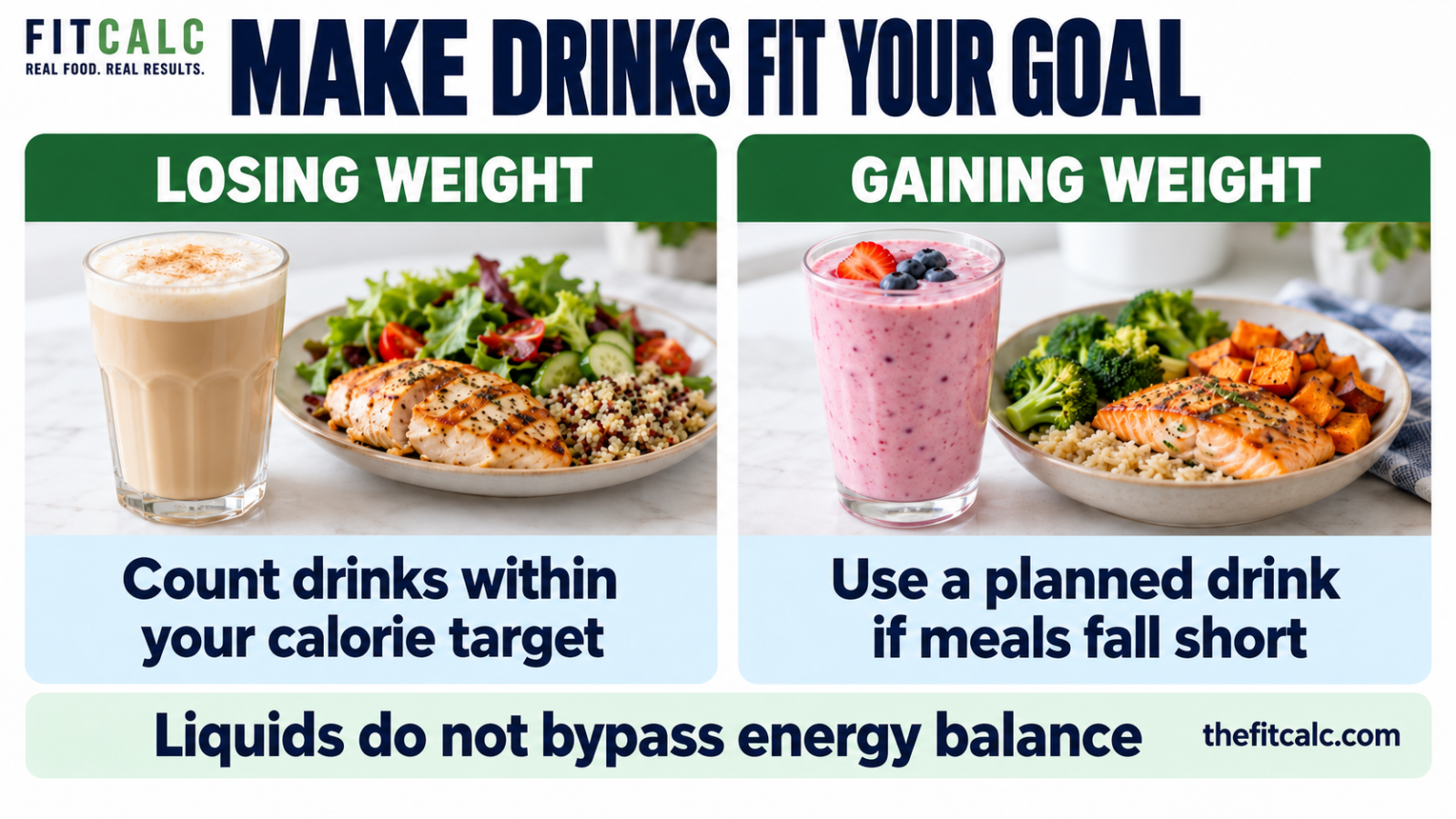
A drink can be easy to forget when you are adding up a day's food. Coffee gets a generous pour of milk, lunch comes with juice, and a smoothie feels more like something you drank than another meal. If you are trying to lose fat, those additions can make your intake higher than you intended. If you are trying to gain weight, a planned drink can sometimes make eating enough more manageable.
Liquid calories still count toward your energy intake. The useful question is not whether your body treats them as free, but whether a particular drink helps you eat the amount and mix of nutrients you need. Its ingredients, portion, timing and effect on your appetite matter more than a blanket rule that all drinks are good or bad.
Liquid Calories Are Still Part of Your Daily Intake
The Nutrition Facts calorie number describes energy from a serving of a food or beverage. Milk, juice, sweetened coffee and smoothies therefore belong in your calorie total, just as a sandwich or a bowl of rice does. “No added sugar” does not mean no calories, and a drink's protein content does not cancel out the energy it supplies. The FDA's explanation of calorie labels applies to both food and drinks.
You do not need a separate calculator setting for liquid calories. Use the FitCalc TDEE Calculator to establish an initial energy estimate, then include drinks when comparing your usual intake with that starting point. The estimate is not a guarantee of your exact needs. Your longer-term weight trend and the practicality of the plan help you judge whether the starting target needs adjustment.
For example, imagine that you intended to eat 2,200 calories, and your meals and snacks already total 2,200. Adding a drink containing 250 calories takes the day's total to 2,450. If you instead included that drink within the original plan, the total could still be 2,200. These are illustrative accounting examples, not personalized targets or predictions of how much body fat you will gain or lose.
Why a Drink May Not Keep You Full Like a Meal
Calories and fullness are related, but they are not interchangeable measurements. A drink may supply energy without giving you the same eating experience as a solid meal. Texture, chewing, the ingredients and the time before your next meal can all influence how satisfying it feels. This helps explain why drinking calories can change how easy it is to stay within a target, without changing the arithmetic of the target itself.
In a study of 58 adults, eating apple pieces before lunch produced greater fullness and lower total lunch intake than consuming matched portions of applesauce or apple juice. The trial tested a particular fruit and meal setting, not every smoothie or beverage. In a separate small randomized trial, whole apples emptied from the stomach more slowly than apple puree or juice, and produced greater fullness than juice. These experiments support choosing whole fruit when fullness is a priority, but they do not prove that blending any food automatically makes it fattening.
The evidence is not uniform. A trial comparing equal-calorie cola and cookies found no difference in later meal intake attributable to their liquid or solid form; timing mattered. An older, small four-week crossover study found weaker compensation for added soda calories than for jelly beans, but those foods cannot stand in for protein-rich milk, soup or a complete mixed smoothie. The practical conclusion is to observe how a drink affects your own meal pattern, rather than assume every liquid calorie bypasses appetite regulation.
When Losing Fat, Start With the Drinks You Barely Notice
You do not have to eliminate every calorie-containing drink to lose fat. A better starting question is which ones feel worth their place in the day. Perhaps a morning latte is something you genuinely enjoy, while the second sweetened drink at your desk is mostly habit. Keeping the first and changing the second may be easier to sustain than creating a list of forbidden beverages.
For several ordinary days, record what goes into your cup as carefully as what goes onto your plate. Include milk, cream, sugar, syrups, juice and the portion of a bottled drink you actually finish. Do this as a short observation exercise, not as a demand to measure every sip forever. The aim is to identify a repeatable pattern you can change, not to find fault with a single busy afternoon.
If a drink contributes little enjoyment or satisfaction, try a smaller portion, fewer additions, or water alongside your meal instead. If removing it leaves you noticeably hungry, you may prefer to allocate some of those calories to a solid snack or a more substantial meal. The useful result is a daily pattern you can repeat comfortably, not the lowest possible drink calorie total.
Keep the Benefit You Actually Want
Before changing a drink, name its job. Is it providing protein, convenience, flavor, caffeine, or simply something to sip? A sweet coffee and a protein-rich smoothie may both contain calories, but they are solving different problems. You can adjust one ingredient or portion without throwing away the whole routine. Compare the complete nutrition information and how the choice fits your meals, rather than judging it by sugar grams alone.
When Gaining Weight, Use Drinks to Fill a Real Gap
If large meals leave you uncomfortably full, a planned drink can be a practical way to distribute food through the day. That is a strategy to test, not a promise that everyone will eat more after adding a smoothie. Some people find a large shake so filling that they skip their next meal. Others tolerate a smaller serving between meals much better.
Begin with the gap you are actually trying to fill. If your usual eating pattern repeatedly falls short of your intended intake, try a consistent, measured addition and watch what happens to the rest of the day. Did you still eat dinner? Was the drink comfortable? Did it replace a snack you would otherwise have eaten? These questions are more useful than assuming the calories in the blender automatically become extra calories in your diet.
You can build around familiar foods, such as milk or an appropriate alternative, fruit, yogurt, and a measured amount of nut butter. Their nutrition varies considerably by product and portion, so use the labels rather than treating a recipe name as a fixed calorie value. Choose ingredients you tolerate and enjoy; a supplement or commercial mass gainer is not required to make a planned drink.
A simple hypothetical example shows why replacement matters. Adding a 300-calorie drink while everything else stays the same adds 300 calories to the day. Adding that drink but then skipping your usual 250-calorie snack changes the total by only 50 calories. Neither result tells you exactly how your body weight will respond, but it explains why “I added a shake” does not always mean you increased intake as much as you expected.
A Smoothie Is a Recipe, Not a Calorie Category
There is a big difference between a small fruit drink and a blender full of fruit, milk, yogurt, nut butter and other additions. Both can fit an eating plan, but calling them “a smoothie” hides the portion and ingredients. Treat a substantial smoothie as a planned meal or snack, rather than assuming that a healthy-looking ingredient list makes its size irrelevant.
Blending whole ingredients is also different from straining juice from them. Do not assume that all smoothies have the nutritional profile of clear juice, or that every juice has the same profile as soda. Check the actual recipe or label for protein, fiber, calories and serving size. A product can offer useful nutrients while still being less convenient for your current calorie goal than another option.
Count the Whole Batch Before Dividing It
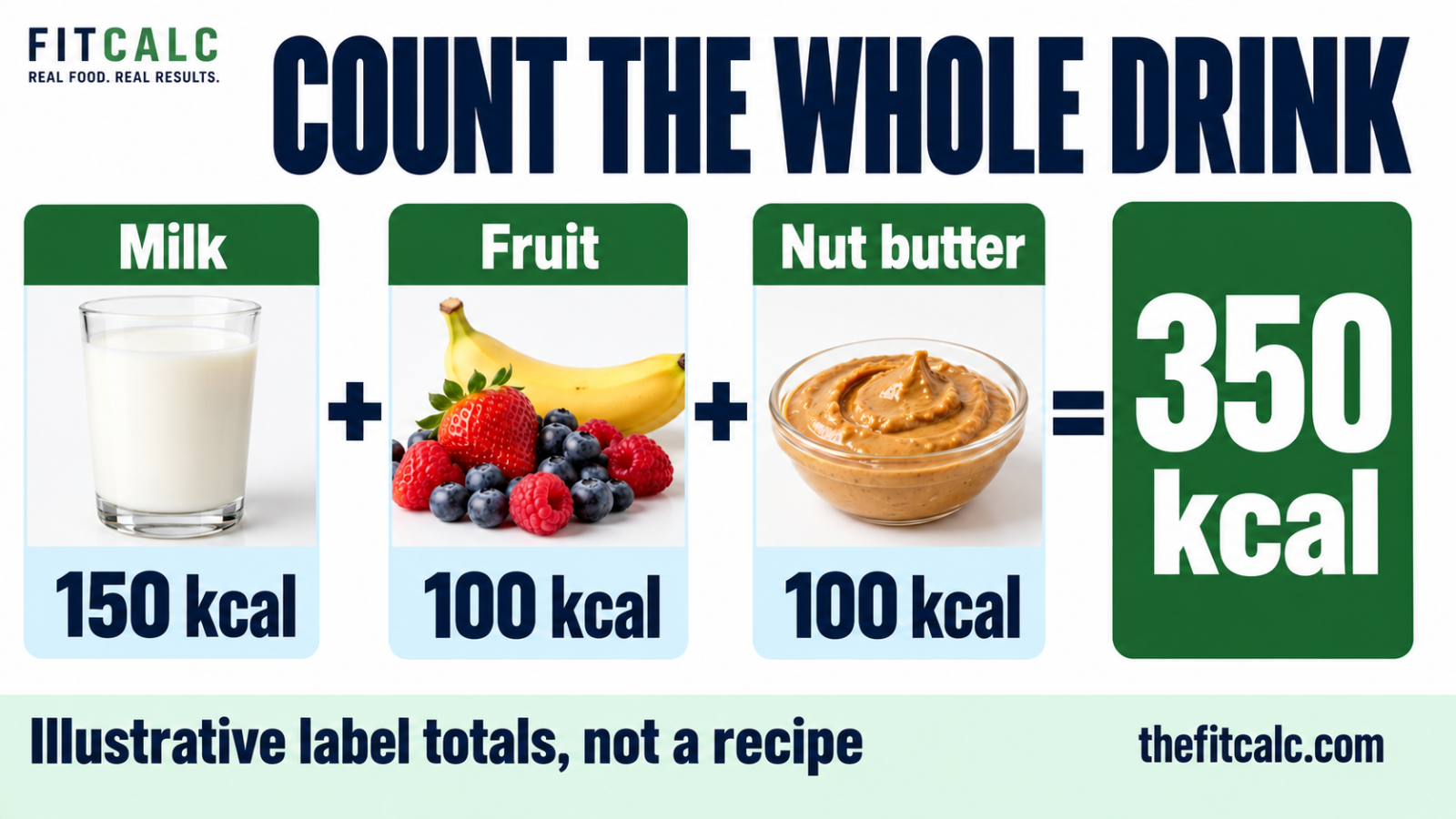
Here is an illustrative recipe calculation, using invented label totals rather than a recommended recipe: milk, 150 calories; fruit, 100; and nut butter, 100. The blender contains 350 calories in total. If you divide it into two equal portions, each contains 175 calories. Drinking both portions still supplies 350, even if you use two small glasses.
For a real recipe, substitute the amounts and nutrition values from your own ingredients. If you divide by weight, stir or blend the mixture evenly and weigh the full batch and your portion. A splash added after logging, a heaped spoonful instead of a measured amount, or a second pour can change the result. Precision only needs to be useful enough to make your routine consistent.
Fit Drinks Into the Plan, Then Check the Result
Start by deciding whether each regular drink is part of a meal, a snack, or an addition between meals. Log its full portion, then use the FitCalc Macro Calculator to see how your daily protein, carbohydrate and fat targets fit together. The calculator does not decide whether a particular drink will satisfy you. That part requires paying attention to the way you actually eat.
Change one recurring choice at a time and give yourself enough ordinary days to see whether it helps. For fat loss, the question is whether you can follow the overall plan without creating an uncomfortable hunger problem. For gaining weight, it is whether the drink genuinely adds to your intake while leaving room for meals. Keep resistance training, regular meals and a varied diet in the picture rather than making the entire goal about beverages.
Liquid calories are neither invisible nor automatically a mistake. Count them honestly, judge the whole drink, and use the portion that serves your goal. A measured drink you enjoy and plan for is easier to manage than an uncounted one you barely notice.
Key Takeaways
- Count calories from drinks in the same daily total as calories from food; do not add a special liquid-calorie multiplier.
- Some drinks are less filling than comparable solid foods, but that is not a universal rule for every beverage or person.
- For fat loss, look first at drinks you barely notice or enjoy. For weight gain, use a planned drink to fill a real gap rather than replace meals unintentionally.
- Measure the portion and count the ingredients. A smoothie made from nutritious foods can still be a substantial meal.
Sources
U.S. Food and Drug Administration. Calories on the Nutrition Facts Label.
U.S. Food and Drug Administration. Serving Size on the Nutrition Facts Label.