How Many Sets Per Muscle Per Week Do You Actually Need to Grow?
Walk into a gym and you'll see completely different approaches to building muscle. One person might train chest with four hard sets and leave. Someone else might spend 90 minutes doing every press, fly, and machine variation available. Both may believe their approach is optimal, but simply doing more work doesn't guarantee more muscle growth.
For hypertrophy, training volume matters. Research generally finds that performing multiple challenging sets produces more muscle growth than very low-volume training, and newer evidence continues to support a dose-response relationship between weekly training volume and hypertrophy. The important part is that the returns appear to diminish as volume increases. Eventually, adding more sets creates progressively smaller benefits while adding more fatigue.
At FitCalc, we think a useful starting target for someone serious about maximizing muscle growth is roughly 10–20 challenging working sets per muscle group per week. That isn't a magical range, and not every muscle or every lifter needs the same amount. Some people can grow extremely well near the lower end, while experienced lifters may benefit from additional volume for particular muscles. The goal isn't to reach the largest possible number of sets. It's to perform enough productive work to stimulate growth while still being able to recover and perform well.
That distinction between productive volume and junk volume is where hypertrophy training starts to make a lot more sense.
Hypertrophy and Strength Are Related, but They Aren't the Same Goal
Before discussing weekly sets, it's worth separating muscle hypertrophy from strength training. The two overlap considerably. A larger muscle generally has greater potential to produce force, and resistance training commonly makes someone both bigger and stronger. But training designed to maximize muscle size doesn't have to look exactly like training designed to maximize a one-repetition maximum.
Strength is highly specific to producing force and becoming skilled at particular movements. Heavy loads therefore become especially important. A large 2023 network meta-analysis covering 178 studies for strength and 119 for hypertrophy found that higher-load training, particularly loads above 80% of one-repetition maximum, ranked best for maximizing strength. Hypertrophy was much less dependent on using the heaviest loads, while multiple-set training was particularly important for muscle growth.
This is why a powerlifter and a bodybuilder can both train extremely hard while organizing their workouts differently. The powerlifter may spend more time practicing heavy squats, presses, and deadlifts with long rest periods and relatively low repetition counts. A bodybuilder can use a wider range of exercises and repetition ranges because the primary objective is placing enough mechanical tension on the target muscle and accumulating productive training volume.
For this article, we're interested in the second goal: maximizing muscle growth, not simply becoming as strong as possible on a particular lift.
Why Sets Are More Useful Than Counting Total Reps
You may have heard hypertrophy recommendations expressed as a certain number of repetitions per muscle each week. Older evidence-based bodybuilding recommendations sometimes used repetition ranges, and there is nothing inherently wrong with tracking reps. The problem is that raw repetition totals don't tell us how difficult those repetitions were.
Consider two lifters who each perform 75 repetitions for their chest during a week. The first completes several challenging sets of presses and flies, generally finishing with only a few repetitions left before muscular failure. The second uses very light weights and stops every set while still capable of performing another 10 or 15 repetitions. Both recorded 75 reps, but they did not necessarily provide their muscles with the same training stimulus.
This is why modern hypertrophy research and programming commonly discuss hard sets per muscle per week instead. A working set gives us a more useful unit as long as we're clear about what counts as one.
Warm-up sets aren't the same thing as working sets. Neither is an easy set performed nowhere near your actual capabilities. When we recommend 10–20 sets, we're talking about sets performed with enough effort and appropriate loading to meaningfully challenge the target muscle.
How Close to Failure Should a Working Set Be?
You don't have to reach absolute muscular failure on every set to make it productive. In fact, constantly grinding until another repetition is physically impossible can generate unnecessary fatigue and make the rest of a workout worse.
At the same time, stopping a set long before it becomes difficult isn't an efficient way to maximize hypertrophy. A 2024 meta-regression examining proximity to failure found that muscle growth tended to improve as sets were terminated closer to failure, although the researchers cautioned that the exact relationship remains difficult to quantify. Interestingly, strength gains appeared much less dependent on proximity to failure than hypertrophy.
Other systematic-review evidence has found no convincing hypertrophy advantage to reaching momentary muscular failure compared with stopping short of it, reinforcing the idea that you can train very hard without needing every set to end with a failed repetition.
For practical hypertrophy training, finishing most working sets somewhere around 1–3 repetitions in reserve is a useful approach. That means the set is genuinely challenging, but you're usually stopping before technique completely breaks down or you become unable to complete another repetition. Certain exercises and sets can reasonably be taken to failure, particularly safer isolation or machine movements, but failure doesn't need to become the definition of a productive workout.
A set of dumbbell curls that ends because your biceps are close to their limit is useful hypertrophy work. A set that ends because you got bored while still having eight good reps available isn't the same stimulus simply because you wrote it down as a set.

So, How Many Sets Per Muscle Per Week?
This is where the research becomes useful without giving us one perfect number.
The updated 2026 American College of Sports Medicine position stand identifies higher weekly training volume, around 10 sets per muscle group or more, as beneficial for hypertrophy. More recent dose-response research also supports the general relationship between increasing weekly set volume and increasing muscle growth, while showing that the additional benefit becomes progressively smaller as more volume is added.
That is why 10–20 challenging sets per muscle per week remains a useful practical range rather than a hard scientific law. Someone relatively new to serious hypertrophy training may grow extremely well from 10 good sets. Performing 18 simply because the internet says more is better could add fatigue without providing much additional benefit.
An experienced lifter may eventually discover that a particular muscle responds better to somewhat more volume. Another muscle might grow perfectly well with less. Genetics, training history, exercise selection, recovery, sleep, nutrition, and how close sets are taken to failure all influence how much volume someone can productively use.
The important point is that weekly volume has diminishing returns. If 10 sets work well, 20 sets won't automatically produce twice as much growth. Eventually you're investing substantially more training time and recovery capacity for increasingly small additional benefits.
This is where the idea of junk volume comes from.
More Sets Aren't Better If the Sets Become Worse
Imagine doing six challenging sets of chest presses and flies. Early in the workout you're strong, technically controlled, and capable of progressing the exercises. By set six, fatigue has accumulated, but the target muscle is still doing productive work.
Now imagine deciding that 20 sets must be better because 20 is a larger number. As the workout continues, loads fall, repetitions deteriorate, other muscles begin compensating, and each additional set contributes less quality work than the one before it.
At some point, you're accumulating fatigue faster than you're accumulating useful hypertrophy stimulus.
This doesn't mean high-volume training is inherently bad. A well-trained bodybuilder may tolerate and benefit from considerably more work than a beginner. It means volume has to earn its place in the program. If additional sets consistently reduce performance, interfere with later workouts, cause persistent soreness, or prevent progression, simply adding more is unlikely to be the answer.
Your recovery capacity matters too. Muscle doesn't grow while you're performing the set. Training provides the stimulus, while the adaptation occurs afterward. Adequate calories, protein, sleep, and time between demanding sessions all influence how much productive training you can sustain.
The best weekly volume is therefore not the maximum number of sets you can physically survive. It's the amount you can recover from while continuing to progress.
You Probably Shouldn't Do All Your Weekly Sets in One Workout
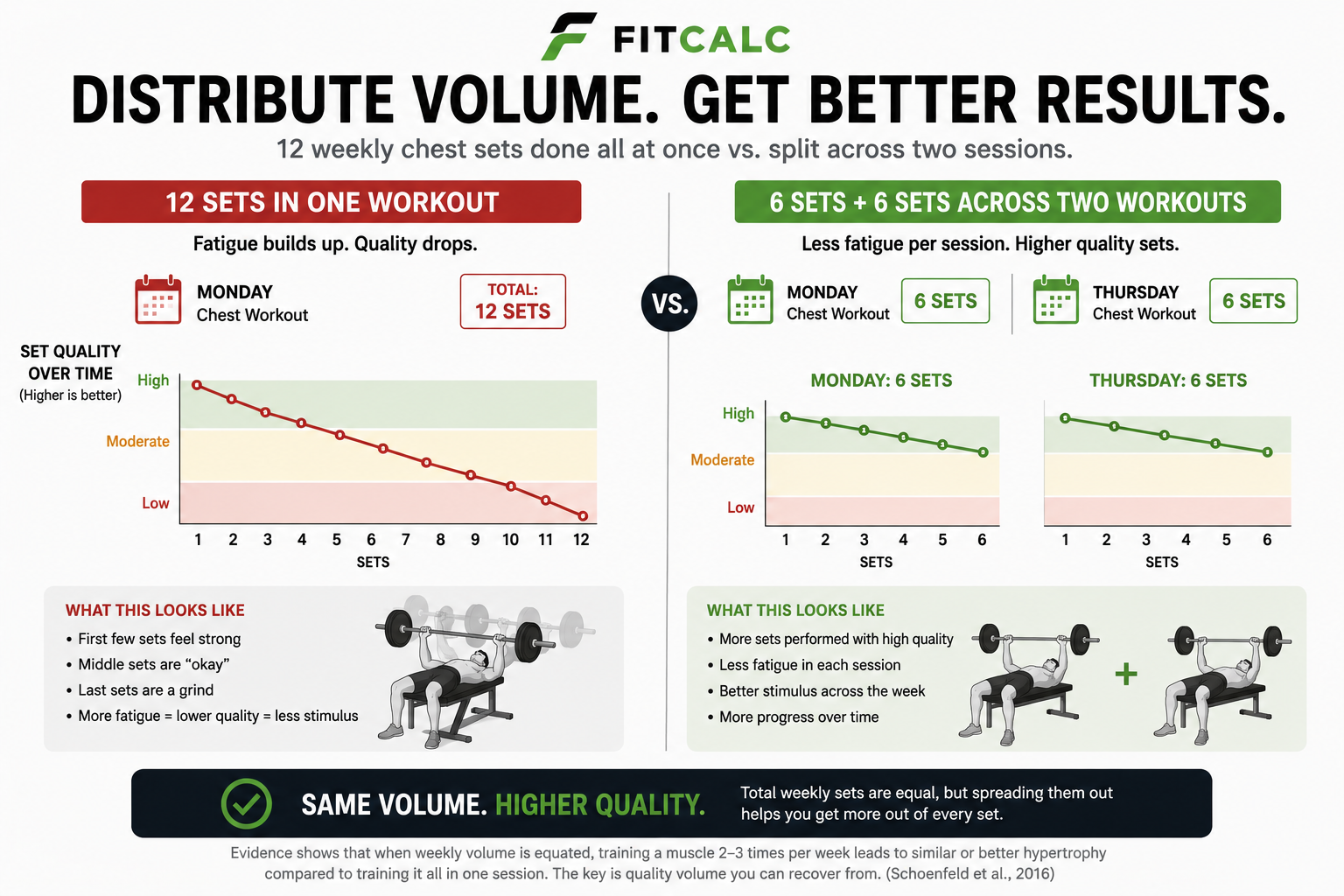
If your goal is 12 challenging sets for chest each week, you could theoretically perform all 12 on Monday. That doesn't mean it's the best way to organize them.
The first several sets of a workout are generally performed while you're fresher. As fatigue accumulates, maintaining load, repetitions, technique, and effort becomes more difficult. Splitting those 12 sets into six on Monday and six on Thursday can allow both sessions to contain higher-quality work.
Research on training frequency is somewhat mixed when weekly volume is equated. Earlier meta-analytic evidence suggested training a muscle twice per week may outperform once-weekly training for hypertrophy, while later reviews have found that frequency itself has a much smaller effect when total weekly volume is matched.
That makes frequency best understood as a tool for distributing productive volume rather than a muscle-growth switch by itself.
If you're performing 10 sets for a muscle each week, two sessions of five sets may work beautifully. If you're performing 16, dividing those sets across two or three sessions may make even more sense. There is no reason to force every set into one marathon workout simply because traditional bodybuilding splits often trained each muscle once per week.
How Do Compound Exercises Count?
This is one reason calculating weekly volume isn't perfectly straightforward.
A bench press clearly trains the chest, but it also trains the triceps and anterior deltoids. A row primarily targets the back while also involving the biceps. A squat trains several muscles simultaneously rather than contributing only to the quadriceps.
You therefore don't need to pretend every exercise affects only one muscle. The newest dose-response research has even explored different methods of counting direct and indirect sets because simply assigning every compound set equally to every involved muscle can distort actual training volume.
For normal programming, there's no need to turn this into advanced mathematics. If you perform substantial pressing volume, your triceps are already receiving meaningful work before you add extensions. If you perform rows and pulldowns, your biceps aren't starting their isolation work completely fresh from zero weekly stimulus.
This is another reason 10–20 sets should be treated as a framework rather than a quota. A lifter performing 12 sets of chest presses plus another 20 direct triceps sets may discover very quickly that counting each muscle in isolation ignores how resistance training actually works.
Pay attention to what exercises train, how well you're recovering, and whether the target muscles are progressing.
What Rep Range Should Those Sets Use?
Hypertrophy isn't restricted to the traditional 8–12 repetition range.
Research indicates that muscle growth can occur across a broad range of loads when sets provide sufficient effort. The 2023 network meta-analysis found that numerous resistance-training prescriptions promoted comparable hypertrophy, while heavier loading was considerably more important for maximizing strength.
That gives hypertrophy training flexibility. Sets of 5–8 can build muscle. So can 8–12, 10–15, and higher-repetition work. Different exercises naturally fit different ranges. Heavy squats for 20 repetitions may be technically possible, but fatigue and cardiovascular discomfort may become limiting before the quadriceps receive the best possible stimulus. Conversely, performing lateral raises for three extremely heavy repetitions probably isn't the most practical way to train the side delts.
For many exercises, roughly 6–15 repetitions provides a useful combination of loading, control, and effort, while isolation and machine exercises can comfortably extend higher. The exact rep count matters less than choosing an appropriate load, controlling the exercise, training the intended muscle, and bringing the set reasonably close to failure.
You don't need to perform the same number of repetitions on every exercise simply because a program template says "3 × 10".

How Do You Know If Your Volume Is Working?
The best hypertrophy program should eventually produce evidence that it's working.
Over time, you should be able to perform more repetitions with a given load, use more weight for similar repetitions, execute exercises with better control, or otherwise increase performance while maintaining the intended technique. Your bodyweight, measurements, photos, and eventually visible muscular development can provide additional information.
If you're consistently getting stronger within your hypertrophy rep ranges, eating enough protein and calories, recovering well, and gradually becoming more muscular, there is no reason to add five extra sets simply because someone online trains with more volume.
On the other hand, if a muscle hasn't progressed for an extended period despite good exercise selection, nutrition, sleep, and effort, increasing its weekly volume may be worth experimenting with. Add a small amount rather than doubling everything overnight, then watch what happens to performance and recovery.
Likewise, if your workouts leave you constantly exhausted, performance declines from session to session, joints hurt, soreness never resolves, and the target muscle isn't progressing, reducing volume may actually produce better results.
Science can give us useful ranges. Your training log tells you how you're responding inside those ranges.
A Practical Weekly Hypertrophy Example
Suppose someone wants to train chest with approximately 12 challenging weekly sets. Instead of performing all 12 on one day, the volume could be divided between two sessions.
On Monday, the lifter might perform three working sets of an incline press and three sets of a chest fly. On Thursday, another three sets of a flat press and three sets of a different fly or press variation would bring the weekly total to 12.
Those sets don't need to reach absolute failure. Most could finish with roughly one to three good repetitions remaining, while perhaps the final set of a safer isolation exercise is occasionally taken to failure. Over time, the lifter tries to add repetitions, load, or improve execution.
The same principle can be applied to the back, quadriceps, hamstrings, shoulders, arms, and other muscle groups while accounting for the overlap created by compound exercises.
That's much more useful than blindly trying to accumulate a predetermined number of repetitions.
The FitCalc Approach
If maximizing hypertrophy is your goal, start by aiming for roughly 10–20 challenging working sets per muscle group per week. You don't need to immediately begin at the top of that range. For many lifters, approximately 10–15 high-quality sets is a much better starting point than assuming more work automatically means more growth.
Perform those sets hard enough to matter. Most working sets should finish reasonably close to muscular failure, often around one to three repetitions in reserve, without requiring every set to end in an ugly failed repetition. Use exercises that allow you to train the intended muscle effectively, and distribute your weekly volume across enough sessions that fatigue doesn't turn the second half of your workout into junk volume.
Remember that hypertrophy and maximum strength are not identical goals. Heavy lifting can absolutely build muscle, but you don't need to organize your entire program around one-repetition-max performance to grow. Muscle can be built across a wide range of loads and repetitions when the sets are sufficiently challenging.
Most importantly, don't chase volume for its own sake. Ten excellent sets that you recover from and progressively improve are more valuable than 20 mediocre sets performed because a spreadsheet told you to hit a number.
Train hard enough. Do enough quality work. Recover from it. Then progressively ask your muscles to do more.
That's the volume that matters.
Sources
Pelland JC, Remmert JF, Robinson ZP, Hinson SR, Zourdos MC. The Resistance Training Dose Response: Meta-Regressions Exploring the Effects of Weekly Volume and Frequency on Muscle Hypertrophy and Strength Gains. Sports Medicine. 2026. The analysis included 67 studies and found a positive dose-response relationship between weekly set volume and hypertrophy with diminishing returns as volume increased.
American College of Sports Medicine. Resistance Training Prescription for Muscle Function, Hypertrophy, and Physical Performance in Healthy Adults. 2026 position stand. ACSM identifies higher weekly volume, approximately 10 sets per muscle group, as an important consideration when hypertrophy is the primary goal.
Currier BS, McLeod JC, Banfield L, et al. Resistance training prescription for muscle strength and hypertrophy in healthy adults: a systematic review and Bayesian network meta-analysis. British Journal of Sports Medicine. 2023. The hypertrophy analysis included 119 studies and found that numerous resistance-training prescriptions promoted hypertrophy, while multiple-set training ranked highly for muscle growth and heavier loading was more important for strength.
Robinson ZP, Pelland JC, Remmert JF, et al. Exploring the Dose-Response Relationship Between Estimated Resistance Training Proximity to Failure, Strength Gain, and Muscle Hypertrophy: A Series of Meta-Regressions. Sports Medicine. 2024. Muscle hypertrophy tended to increase as sets were terminated closer to failure