What Is a DEXA Scan, and Is It Actually the Best Way to Measure Body Fat?
Knowing your body-fat percentage sounds like it should be simple. Step on a smart scale, enter a few measurements into a calculator, get pinched with skinfold calipers, or book a DEXA scan and wait for the number.
The problem is that body-fat percentage cannot be measured perfectly in a living person with one simple test. Every practical method estimates body composition using different measurements and assumptions, which is why the same person can receive noticeably different results depending on the method used.
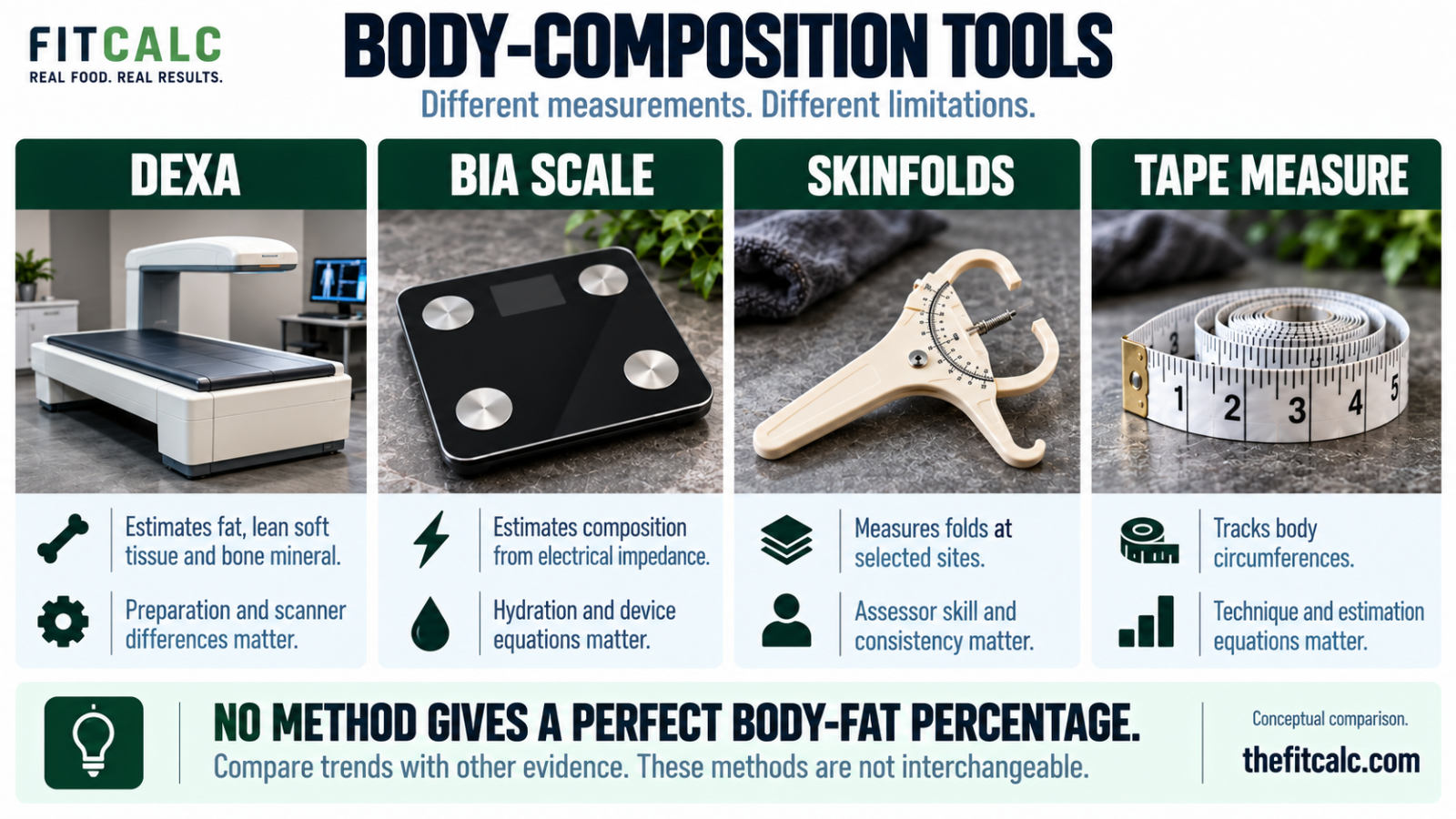
DEXA, technically called dual-energy X-ray absorptiometry or DXA, is one of the better tools available when someone wants a detailed look at body composition. It can estimate total and regional fat mass, lean soft tissue, and bone mineral content while using a relatively small amount of ionizing radiation. It is widely used in research and clinical settings, particularly for measuring bone mineral density.
At FitCalc, we consider DEXA an excellent option for someone who wants a more sophisticated body-composition assessment than a bathroom scale or circumference formula can provide. But we don't consider it a magical test that reveals your true body-fat percentage down to a decimal point.
DEXA is useful precisely when you understand what it can and cannot tell you.
What Does a DEXA Scan Actually Measure?
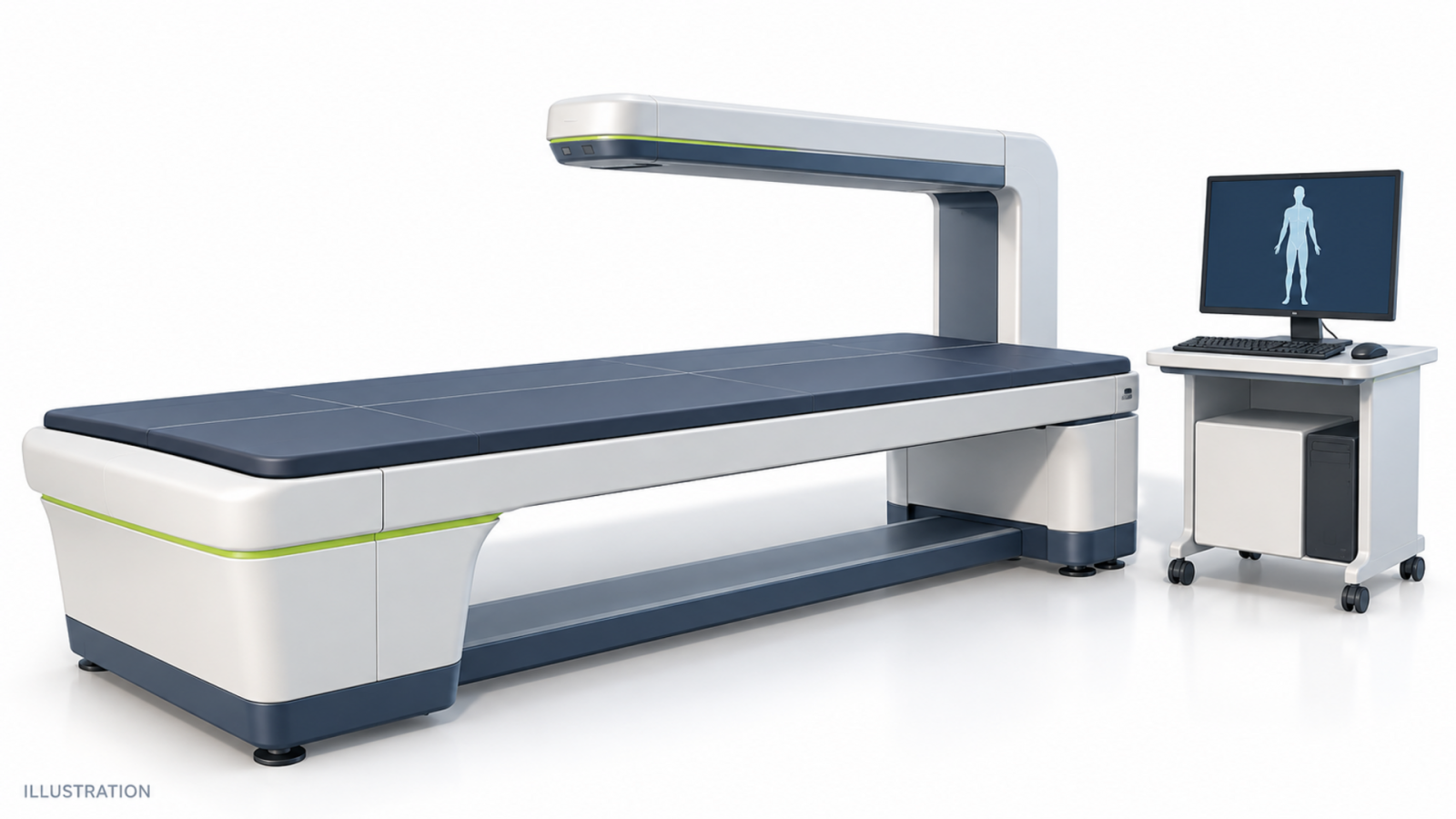
A DEXA scanner uses low-dose X-rays at two energy levels. Different tissues attenuate those X-rays differently, allowing the system to estimate bone mineral content, fat mass, and lean soft tissue using mathematical models.
The scan can provide an estimate of your total body-fat percentage, but it can also show how fat and lean tissue are distributed across the arms, legs, and trunk. Depending on the scanner and software, reports may include estimates of abdominal and hip-region fat distribution or visceral adipose tissue. Prado et al., 2026.
For someone interested in bodybuilding or changing body composition, regional information can be particularly interesting. You can compare lean-tissue estimates between your left and right limbs or see how your distribution changes between scans. But lean soft tissue is not the same as skeletal muscle: it includes water, organs, and other non-fat soft tissues. A rise in this number is not automatically new muscle protein.
DEXA also has an important clinical role in bone assessment. A dedicated hip and spine bone-density examination is used in evaluating osteoporosis; the bone mineral content on a whole-body fitness report is not a substitute for that examination or a clinical diagnosis. ISCD Official Positions, 2023.
The machine does not directly see individual muscle fibers or count every fat cell. DEXA results are measurements combined with assumptions, not a direct inventory of everything inside your body.
How Accurate Is DEXA for Body-Fat Percentage?
DEXA is useful, but the common description of it as the gold standard needs some context. No single in-vivo method perfectly measures every aspect of human body composition.
For estimating overall body fat, researchers often use four-compartment models combining body mass, body volume, total body water, and bone mineral measurements. These reduce some assumptions about fat-free tissue compared with simpler methods, although they still have measurement error.
A study of 27 elite male judo athletes compared changes measured by DEXA with a four-compartment model. Group-average changes did not differ significantly, but individual agreement was much less reassuring. This illustrates why agreement on average does not guarantee an accurate result for one person, particularly during weight manipulation. Santos et al., 2010.
Accuracy and precision are also different. Accuracy concerns how close a result is to the value being estimated; precision concerns how consistently repeated measurements agree. A scanner can be highly repeatable while still differing systematically from another method.
So if your report says 17.4% body fat, read that as the estimate produced by that scanner, software, and testing protocol. The decimal does not establish that your true body-fat percentage is known within a few tenths of a point. Rounding it to 17% does not remove the underlying uncertainty either.
That can still be useful information. It just is not perfect information.
Why DEXA Results Can Change
One reason body-composition measurements become confusing is that your body isn't physiologically identical every time you walk into a testing facility.
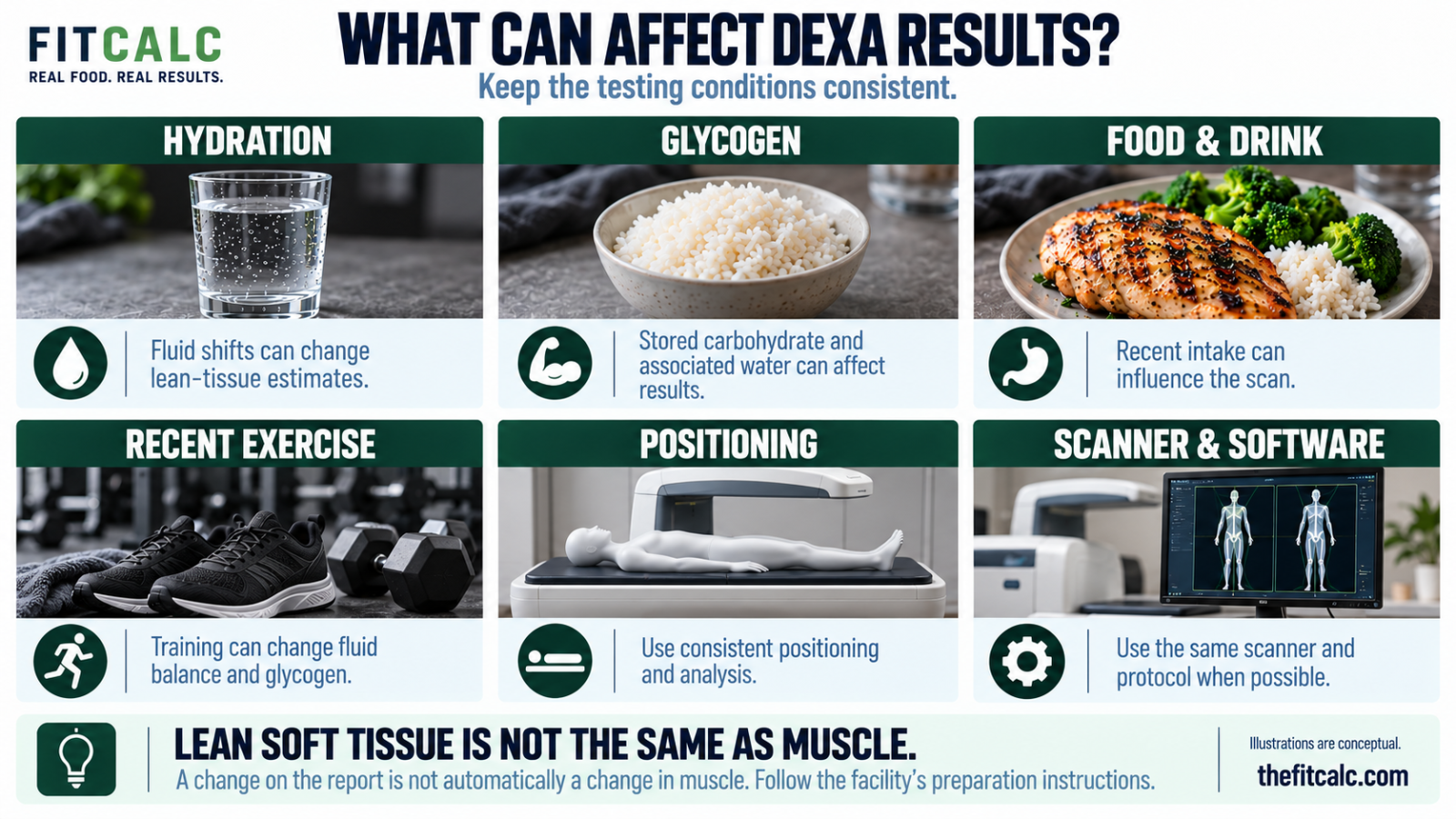
Hydration matters. Glycogen matters. Food in your digestive tract matters. Recent exercise can affect fluid distribution. Positioning on the scanner matters. The machine, software, calibration procedures, and technician can matter too.
In a study of active adults, normal daily activities and breakfast increased variability in DEXA estimates of total and regional lean mass. That is a reason to control the testing conditions, not evidence that breakfast causes rapid muscle gain. Nana et al., 2012.
A separate study in 18 trained male cyclists found that manipulating glycogen and creatine changed DEXA lean-mass estimates over a period when little change in muscle protein was expected. Glycogen storage and associated water can therefore look like a change in lean tissue on a report. Bone et al., 2017.
Large fluid shifts deserve particular caution. Research in dialysis patients found that fluid removal changed measured lean mass. Fluid retention or edema can similarly complicate interpretation; an unexpected lean-mass change in that setting belongs in a clinical discussion, not an automatic muscle-gain or muscle-loss conclusion. Horber et al., 1992.
This is why standardization matters. If your first scan happens in the morning before eating and training, under normal hydration conditions, don't compare it with a scan after three meals, a large drink, and a hard leg workout. Follow the facility's preparation instructions and keep the conditions as similar as reasonably possible.
DEXA vs. Smart Scales and BIA
Most consumer body-fat scales use bioelectrical impedance analysis, or BIA. The device measures opposition to a small electrical current and uses a prediction equation, often alongside height, weight, age, and sex, to estimate body composition.
The biggest advantage is convenience. You can keep a scale in your bathroom and collect measurements whenever you want. The downside is that the body-fat percentage on the screen should not be treated as an exact measurement.
A 2023 systematic review and meta-analysis in athletes found high correlations between BIA and DEXA but wide limits of agreement. BIA tended to estimate more fat-free mass than DEXA, and the researchers advised against using the methods interchangeably. This does not establish that DEXA was perfectly accurate, or that every BIA device makes the same error. Dzator et al., 2023.
That doesn't make your smart scale useless. Consistent bodyweight readings can help you follow a trend. Its body-fat trend needs more caution: using the same algorithm and testing conditions does not guarantee that it accurately tracks changes in fat. Compare it with waist measurements, photographs, and training performance rather than treating 14.7% as a definitive answer.
DEXA can provide more detailed regional information. Neither method should be treated as a direct muscle measurement.
DEXA vs. Skinfold Calipers
Skinfold testing takes a very different approach.
Instead of trying to estimate whole-body composition electronically, an assessor measures the thickness of subcutaneous fat at specific anatomical sites using calipers. Those measurements can be tracked directly or entered into equations that estimate body-fat percentage.
The major weakness is obvious: technique matters.
The assessor has to identify the correct locations, grasp the skinfold consistently, position the calipers correctly, and repeat the procedure reliably. Different equations can also produce different body-fat estimates.
But skinfolds have an advantage that gets overlooked. They're relatively inexpensive and, in experienced hands, can be useful for repeatedly tracking changes in subcutaneous fat.
In a study of 39 elite male rugby players, changes in the sum of seven skinfolds were associated with changes in DEXA fat mass across repeated assessments. Skinfolds helped identify the direction of change, but the size of the change needed more caution. That supports their practical use without making them interchangeable with DEXA. Zemski et al., 2019.
If you have access to an experienced practitioner who uses the same sites and technique every time, skinfold measurements can therefore be extremely useful even if you never convert them into a supposedly exact body-fat percentage.
What About Tape Measurements and Body-Fat Calculators?
Circumference-based methods are considerably simpler.
You measure specific parts of the body, combine those measurements with information such as height and sex, and use an equation to estimate body-fat percentage.
That's essentially what circumference-based body-fat calculators do.
They obviously cannot see inside your body. Two people with the same waist measurement can have different fat distributions and different amounts of muscle. Measurement technique also matters. Moving the tape slightly, pulling it tighter, measuring after a large meal, or using a different anatomical location can change the result.
Circumference methods are inexpensive and can be repeated consistently with careful technique.
You can take a waist measurement at home in a few minutes. You can repeat it every month. You can use the FitCalc Body Fat Calculator consistently as an approximate circumference-based estimate. It does not provide DEXA-level regional information or diagnose a health condition.
For most people trying to lose fat or build muscle, that may be enough.
If your waist circumference is steadily decreasing, your bodyweight trend is moving appropriately, your gym performance is being maintained, and your progress photos show a leaner physique, knowing whether you're exactly 18.2% or 19.6% body fat probably doesn't change what you should do tomorrow.
This is where a useful tracking routine matters more than chasing an exact percentage.
BMI Is Not a Body-Fat Test
BMI belongs in this discussion because people frequently confuse it with body composition.
Body mass index does not measure body fat.
BMI simply relates weight to height. It doesn't know whether your weight comes from muscle, fat, bone, or anything else.
That creates obvious limitations for muscular people. A heavily muscled athlete can have a BMI classified as overweight despite having relatively little body fat. Conversely, someone can have a BMI within the conventional normal range while carrying relatively little muscle and a higher body-fat percentage.
That doesn't make BMI completely worthless. It remains a useful screening and population-level metric, interpreted alongside other health information. CDC: About BMI.
But if the question is “What percentage of my body is fat?”, BMI cannot answer it.
DEXA, circumference formulas, BIA, skinfolds, and other body-composition methods are attempting to answer a fundamentally different question.
Is DEXA Worth Paying For?
For some people, yes. If you want regional information or are monitoring a substantial body-composition change, a properly performed DEXA scan can provide useful detail. Before paying, ask what the result would change about your plan.
We wouldn't tell the average person they need one. Someone trying to lose 30 pounds can make useful decisions using bodyweight trends, waist measurements, photographs, and training performance. Spending money on repeated scans doesn't automatically improve the diet or training program. Prices and what is included vary by provider, so check the current cost and whether interpretation is included.
DEXA uses a low dose of ionizing radiation, not zero radiation. Dose varies with the equipment and examination. RadiologyInfo: DXA. Pregnancy is a contraindication to DEXA body-composition scanning under ISCD guidance. Tell the facility before booking if you are pregnant or might be pregnant. ISCD Official Positions, 2023.
There is no universal schedule for fitness scans. Discuss the purpose and timing with the provider, including whether an expected change is large enough to detect and would affect your decisions. A clinician-directed bone-density follow-up follows its own medical plan. We view body-composition DEXA as an optional higher-detail assessment, not something every healthy person needs every few weeks.
If You Get a DEXA Scan, Standardize It
If you're going to have repeat scans, make the comparison as meaningful as possible. Use the same scanner and protocol where possible. Results from different systems may not be directly comparable without appropriate cross-calibration.
Follow the facility's preparation instructions. Keep food and fluid intake, recent exercise, time of day, clothing, bladder emptying, and positioning consistent. ISCD specifically emphasizes consistent preparation and positioning for precise body-composition measurements. ISCD Official Positions, 2023.
Avoid arriving for one scan depleted from a low-carbohydrate diet and another after carbohydrate loading. Don't deliberately dehydrate yourself or change prescribed medicines to improve a number. Tell the provider about unusual fluid retention and recent changes in your routine.
Most importantly, do not overreact to tiny differences. Ask the facility about its precision error and the minimum change it can distinguish from measurement variability for the specific outcome you are tracking. A few tenths of a percentage point may be noise; there is no single error margin that applies to every scanner, person, and body region. Prado et al., 2026.
Even a change larger than measurement variability is not automatically muscle growth or fat loss: changes in water and glycogen still need to be considered. Think in meaningful trends, not decimals.
What Is Actually the Best Way to Track Body Composition?
For most people, we don't think the answer is choosing one measurement and ignoring everything else.
Use several pieces of information together.
Track bodyweight under consistent conditions and watch weekly averages. Measure your waist periodically. Take progress photos under similar lighting and positioning if you're comfortable doing so. Pay attention to gym performance and strength. Use a consistent body-fat estimation method if you want an approximate percentage.
Then, if you want more detail, DEXA can provide another useful layer of information.
This approach also prevents one strange measurement from hijacking your perception of progress. If your DEXA estimate barely changes but your waist has dropped several inches, bodyweight has fallen appropriately, and photographs clearly show that you're leaner, you shouldn't conclude that months of progress somehow didn't happen.
Likewise, a smart scale claiming you dropped four percentage points of body fat in two weeks shouldn't outweigh everything else you know about the rate at which your body actually changed.
Body composition is something we estimate.
Progress is something we observe from multiple directions.
The FitCalc Approach
DEXA is a useful tool for obtaining a detailed body-composition assessment. It can estimate fat mass, lean soft tissue, bone mineral content, and regional tissue distribution in ways that a bathroom scale or tape measure simply cannot.
But DEXA is not an infallible measurement of your exact body-fat percentage.
Hydration, glycogen, food intake, recent exercise, positioning, scanner characteristics, software, and normal measurement variability can all influence the result. More sophisticated multi-compartment models remain important criterion methods in research, and no single in-vivo technique perfectly measures every component of human body composition.
For someone who wants a detailed baseline or is serious about monitoring a major physique change, we like DEXA when it's performed properly and interpreted realistically.
For everyone else, don't assume you need an expensive scan to know whether you're making progress.
Use the FitCalc Body Fat Calculator for a rough circumference-based estimate, not as an equivalent to a scan. Track waist circumference. Watch your average bodyweight. Monitor strength and training performance. Take progress photos if they're useful to you.
And if you eventually get a DEXA scan, treat the result as another valuable piece of information rather than the final word on your body.
The goal isn't to discover your body-fat percentage to the nearest tenth of a percent. It's to know whether your body composition is moving in the direction you want.
For a broader explanation of body fat, fat-free mass, BMI, and FFMI, read our complete body-composition guide.
Sources
Prado CM, Gonzalez MC, Norman K, et al. Methodological standards for body composition assessment—an expert-endorsed guide for research and clinical applications: bioimpedance, dual-energy X-ray absorptiometry, computerized tomography, and ultrasound methods. American Journal of Clinical Nutrition. 2026;123(5):101283.
International Society for Clinical Densitometry. Official Positions 2023: Adult. Sections on body composition and central DXA for diagnosis.
Santos DA, Silva AM, Matias CN, Fields DA, Heymsfield SB, Sardinha LB. Accuracy of DXA in estimating body composition changes in elite athletes using a four compartment model as the reference method. Nutrition & Metabolism. 2010;7:22.
Nana A, Slater GJ, Hopkins WG, Burke LM. Effects of daily activities on dual-energy X-ray absorptiometry measurements of body composition in active people. Medicine & Science in Sports & Exercise. 2012;44(1):180–189.
Bone JL, Ross ML, Tomcik KA, Jeacocke NA, Hopkins WG, Burke LM. Manipulation of Muscle Creatine and Glycogen Changes Dual X-ray Absorptiometry Estimates of Body Composition. Medicine & Science in Sports & Exercise. 2017;49(5):1029–1035.
Horber FF, Thomi F, Casez JP, Fonteille J, Jaeger P. Impact of hydration status on body composition as measured by dual energy X-ray absorptiometry in normal volunteers and patients on haemodialysis. British Journal of Radiology. 1992;65(778):895–900.
Dzator S, Weerasekara I, Shields M, Haslam R, James D. Agreement Between Dual-Energy X-ray Absorptiometry and Bioelectric Impedance Analysis for Assessing Body Composition in Athletes: A Systematic Review and Meta-Analysis. Clinical Journal of Sport Medicine. 2023;33(5):557–568.
Zemski AJ, Keating SE, Broad EM, Slater GJ. Longitudinal Changes in Body Composition Assessed Using DXA and Surface Anthropometry Show Good Agreement in Elite Rugby Union Athletes. International Journal of Sport Nutrition and Exercise Metabolism. 2019;29(1):24–31.
Centers for Disease Control and Prevention. About Body Mass Index (BMI).
Radiological Society of North America and American College of Radiology. Bone Density Scan (DEXA or DXA). RadiologyInfo.org.