
How Much Exercise Do You Need If You Sit at a Desk All Day?
For millions of people, sitting isn't really optional. You arrive at work, sit in front of a computer for several hours, drive home, and often end up sitting again for dinner or the evening. Even someone who exercises regularly can accumulate eight, nine, or more hours of sedentary time before the day is over.
The solution isn't to panic about every minute spent in a chair. Sitting is a normal part of life, and having a desk job doesn't automatically make someone unhealthy. The bigger problem is allowing prolonged sitting to become your entire lifestyle, especially when several hours can pass without getting up and meaningful physical activity rarely happens outside work.
At FitCalc, we think desk workers should approach activity from both directions. Break up long periods of sitting during the workday, then regularly exercise and pursue active hobbies outside of work. A 45-minute workout is valuable, but we'd rather not see that become the only meaningful movement in an otherwise completely sedentary day.
The good news is that you don't need to quit your office job or work at a treadmill desk for eight hours. Small movement breaks throughout the day, combined with regular exercise and an active life outside work, can dramatically change what a "desk job lifestyle" actually looks like.
Why Sitting All Day Is Different From Simply Resting
Sitting itself isn't inherently bad. You sit to eat, drive, work, relax, read, watch television, and recover between activities. The concern is prolonged sedentary behavior, particularly when large portions of the day involve very little muscular activity or energy expenditure.
Research consistently associates high amounts of sedentary time with poorer health outcomes, especially among people who also perform little moderate-to-vigorous physical activity. A harmonized meta-analysis involving more than 44,000 middle-aged and older adults measured activity using accelerometers rather than relying entirely on people's memories of how active they were. Higher sedentary time was associated with greater mortality risk most clearly among people with low activity levels.
That distinction is important because it prevents the message from becoming "chairs are killing us." The relationship between sitting and health is heavily influenced by what happens during the rest of the day. Someone sitting for eight hours because of work but regularly lifting weights, walking, playing sports, and remaining active outside the office is living a very different lifestyle from someone who sits for eight hours at work and then spends the rest of the evening on the couch.
Still, exercise outside work doesn't make movement during the day irrelevant. Prolonged uninterrupted sitting creates long periods where the large muscles of the legs are doing very little. Simply getting up and moving periodically changes that pattern, which is why researchers have become increasingly interested in breaking up sedentary time rather than only counting total exercise.
How Much Exercise Can Offset a Sedentary Day?
There isn't one exact amount of exercise that magically erases eight hours in a chair. However, research gives us a useful idea of how much activity can substantially reduce the risks associated with high sedentary time.
The same accelerometer-based meta-analysis found that roughly 30–40 minutes per day of moderate-to-vigorous physical activity appeared to attenuate the association between high sedentary time and mortality. Participants accumulating high amounts of sedentary time but also around this level of meaningful physical activity did not have significantly different mortality risk from the reference group with lower sedentary time and high activity.
That amount also fits reasonably well within established physical-activity recommendations. The World Health Organization recommends adults accumulate 150–300 minutes of moderate-intensity aerobic activity per week, or 75–150 minutes of vigorous activity, while also performing muscle-strengthening activities involving the major muscle groups on at least two days per week. WHO additionally recommends limiting sedentary time and replacing it with physical activity of any intensity when possible.
For someone working a desk job, we think those recommendations should be viewed as a foundation, not necessarily a ceiling. If you're capable of lifting several days per week, walking frequently, playing a sport, cycling, hiking, or otherwise being active, there is little reason to deliberately stop moving once you've technically satisfied the minimum guideline.
A good practical goal is to get meaningful physical activity most days of the week while also refusing to let the remaining hours become completely sedentary.
Your Workout Doesn't Have to Do All the Work
Imagine two people who both complete the same 45-minute workout after work. The first person sits for four uninterrupted hours in the morning, eats lunch at the desk, sits for another four hours, drives home, trains, and spends the rest of the evening sitting. The second person performs the same workout but regularly gets out of the chair, walks around the office, takes a short walk at lunch, uses the stairs, and generally finds reasons to move throughout the day.
Their formal exercise might look identical on paper. Their overall activity does not.
This is where non-exercise movement becomes important. Walking to another part of the building, standing up to talk with a coworker, doing household work, taking stairs, walking through a store, and moving around while completing everyday tasks may not feel like exercise, but they prevent the entire day from being divided into "sitting" and "working out."
This also connects directly with daily steps. As we discussed in our article on step counts, 10,000 steps isn't a magical threshold, but accumulating roughly 8,000–10,000 or more steps is a useful way to encourage everyday movement. A desk worker may need to be more deliberate about accumulating those steps because the job itself contributes very little activity.
The goal isn't to turn every movement into a workout. It's to stop treating exercise as the only time during the day when your body is supposed to move.
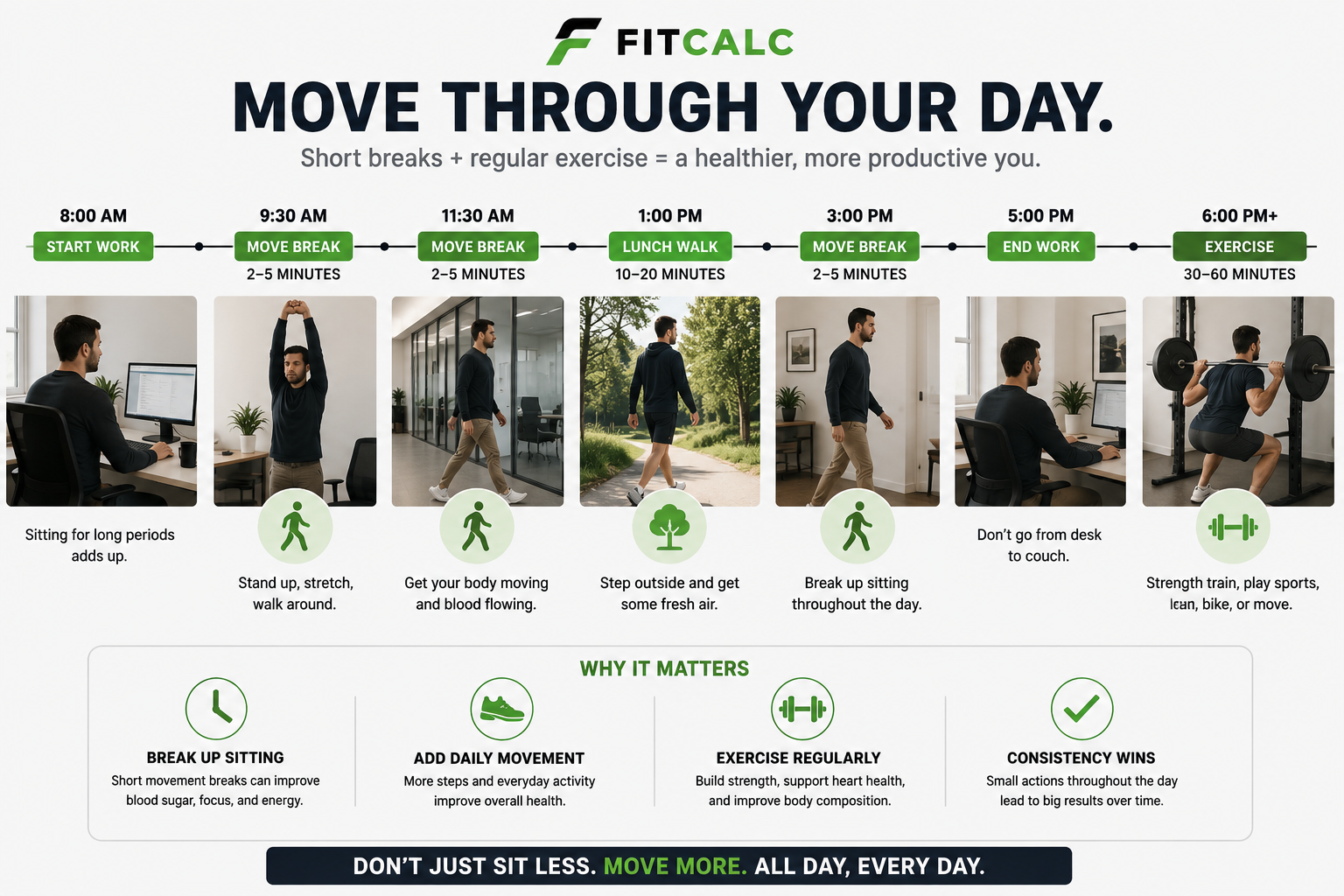
Breaking Up Sitting Actually Makes a Difference
Movement breaks aren't just a way to increase a step counter. Controlled experiments have found measurable differences when prolonged sitting is interrupted with short periods of activity.
In one randomized crossover trial, overweight and obese adults completed periods of uninterrupted sitting or interrupted their sitting with two minutes of light or moderate walking every 20 minutes. Both walking conditions reduced post-meal glucose and insulin responses compared with uninterrupted sitting.
Another trial conducted in office workers found that interrupting sitting with two minutes of light walking every 20 minutes substantially reduced the glucose response during a five-hour work period compared with remaining seated. Standing breaks appeared less effective than actually walking.
Researchers have also investigated how frequently these breaks need to occur. A 2023 randomized crossover study compared several combinations of one- or five-minute walking breaks every 30 or 60 minutes. The strongest glucose response occurred when participants walked for five minutes every 30 minutes, although even smaller doses produced reductions in blood pressure compared with uninterrupted sitting.
These studies are generally small and measure short-term physiological responses rather than proving that one exact break schedule prevents disease decades later. We therefore don't think everyone needs a timer that forces them out of the chair precisely every 30 minutes.
The useful takeaway is simpler: long, uninterrupted stretches of sitting are worth breaking up, and actually moving appears more useful than merely changing from sitting to standing.
How Often Should You Get Up From Your Desk?
There is no universally established perfect schedule, so this is one area where practical common sense is more useful than pretending science has discovered an exact formula.
If you've been sitting for an hour or two without moving, get up.
Walk to refill your water. Use the restroom. Walk around the office for a few minutes. Go outside briefly if your workplace allows it. Take a short walk after lunch. Stretch your hips, legs, shoulders, and back. If you work from home, walk around the house, take the dog outside, or do a simple household task before returning to your desk.
For people who like structure, a few minutes of movement roughly every 30–60 minutes is a reasonable target based on the intervention research. It doesn't need to become another obligation that creates stress if a meeting runs long or you're deeply focused on something. The objective is simply to avoid regularly realizing that you haven't left your chair in four hours.
We'd also prioritize movement over buying a standing desk and assuming the problem is solved. Standing can change posture and may feel better than sitting continuously, but several controlled studies have found light walking more effective than standing alone for improving post-meal glucose responses. A standing desk can be useful, but your body still benefits from actually going somewhere.
What Should You Do During a Movement Break?
You don't need an office workout.
A useful break can be as simple as walking for two to five minutes. If you've been sitting in the same position for a long time, adding a little mobility work can also feel good. Stand up, extend the hips, move the shoulders, rotate gently through a comfortable range of motion, or take a lap around the building.
The best movement break is usually one that fits naturally into your workday. Instead of emailing someone 30 feet away, occasionally walk over. Take a phone call standing or walking when appropriate. Use a farther restroom. Park somewhere that requires a little walking. If you have a normal lunch break, spending 10 minutes of it outside walking is an easy way to accumulate movement without requiring additional time after work.
These habits sound insignificant individually, but that is partly the point. Movement doesn't need to be difficult to count. When small habits are repeated across five workdays every week, they can turn hours of uninterrupted sitting into a day containing regular bouts of activity.

Your Life Outside Work Matters Even More
Movement breaks improve the workday, but we don't want this article to leave someone thinking that standing up every hour is a replacement for being physically active.
Outside work, regular exercise should be part of your life.
Strength training is an excellent place to start because it provides a stimulus that walking around an office simply cannot reproduce. Resistance training helps build and maintain muscle and strength, while aerobic activities challenge the cardiovascular system in different ways. A well-rounded routine can include both.
Exercise doesn't need to exist exclusively inside a gym, either. Sports and physical hobbies are some of the best ways to make an active lifestyle sustainable because the activity has a purpose beyond "burning calories." Basketball, soccer, cycling, swimming, hiking, tennis, surfing, martial arts, kayaking, running, and dozens of other activities can provide substantial movement while also being something you genuinely look forward to doing.
This is especially valuable for someone whose occupation requires very little physical effort. If your job gives you eight hours of sitting every weekday, your life outside work should ideally provide the opposite experience. Walk frequently, train, play something, work outside, and find hobbies that require your body to do more than move between chairs.
A desk job determines what you do for part of the day. It doesn't have to determine how active your life is.
Can One Workout Completely Cancel Out Sitting?
This question needs a little nuance.
Research suggests that sufficiently high levels of physical activity can substantially reduce, and potentially attenuate, the increased mortality risk associated with high sedentary time. That's encouraging for anyone whose job requires sitting. You are not doomed because your occupation happens on a computer.
But that doesn't mean we recommend deliberately sitting motionless all day because you're planning to exercise later.
Short activity-break experiments show that interrupting sitting can improve immediate glucose and insulin responses compared with remaining seated continuously. One study in healthy adults even found that regularly breaking up nine hours of sitting with brief walking bouts produced lower post-meal glucose and insulin responses than completing a single 30-minute walk before spending the remainder of the period sitting.
That doesn't mean short walks are "better than exercise." The interventions are measuring particular metabolic responses over a limited period, while structured exercise provides adaptations in cardiovascular fitness, strength, muscle, bone, and performance that walking around the office cannot replace.
The two strategies solve different parts of the same problem. Exercise regularly, and move throughout the day. There is no reason to choose between them.
A Practical Activity Routine for Someone With a Desk Job
You don't need to redesign your entire life around avoiding chairs. A good routine can be surprisingly normal.
During work, avoid letting several hours routinely pass without standing or moving. Take short walking breaks when your schedule permits, move during lunch, and use ordinary opportunities to get out of the chair. If your workplace allows a standing desk, alternating positions may be comfortable, but still make time to actually walk.
Outside work, aim for regular intentional exercise. For many people, that could mean strength training three or four times per week while also walking regularly and participating in a sport, cardio activity, or active hobby a few times per week. Another person might prefer cycling, swimming, running, recreational sports, or a different combination entirely.
The exact activity matters less than consistently challenging your body in ways your desk job doesn't.
If you want a simple starting framework, think about your day in three layers: break up prolonged sitting, accumulate ordinary movement, and perform real exercise regularly. When all three are present, a sedentary occupation no longer has to mean a sedentary lifestyle.
The FitCalc Approach
If you work at a desk all day, we don't think the answer is simply completing one workout and ignoring movement for the remaining waking hours. That workout is still extremely valuable, but your body benefits from activity outside the gym as well.
Get out of your chair several times throughout the workday. Walk for a few minutes, stretch, take a short lunch walk, use the stairs, and create reasons to move rather than allowing four-hour stretches of uninterrupted sitting to become normal. You don't need to follow a rigid timer, but a few minutes of movement every 30–60 minutes is a reasonable habit when your work allows it.
Then build actual physical activity into your life outside the office. Strength train. Walk. Play sports. Cycle. Swim. Hike. Run. Surf. Find something physical that you enjoy enough to do consistently.
Research suggests that roughly 30–40 minutes of moderate-to-vigorous activity per day can substantially attenuate the mortality risk associated with high sedentary time, but we don't view that number as permission to spend every remaining minute sitting. Being active should be something that happens throughout your life, not just during one scheduled workout.
You may have to sit to earn a living.
You don't have to build the rest of your life around sitting too.
Sources
World Health Organization. WHO Guidelines on Physical Activity and Sedentary Behaviour. WHO recommends adults perform 150–300 minutes of moderate-intensity aerobic activity or 75–150 minutes of vigorous activity per week, alongside muscle-strengthening activity, while limiting sedentary behavior.
Ekelund U, Tarp J, Fagerland MW, et al. Joint associations of accelerometer-measured physical activity and sedentary time with all-cause mortality: a harmonised meta-analysis in more than 44,000 middle-aged and older individuals. British Journal of Sports Medicine. Approximately 30–40 minutes of moderate-to-vigorous physical activity per day attenuated the association between high sedentary time and mortality.
Dunstan DW, Kingwell BA, Larsen R, et al. Breaking up prolonged sitting reduces postprandial glucose and insulin responses. Diabetes Care. 2012. Two-minute light- or moderate-intensity walking breaks every 20 minutes reduced post-meal glucose and insulin responses compared with uninterrupted sitting.
Brocklebank LA, Andrews RC, Page A, et al. The Acute Effects of Breaking Up Seated Office Work With Standing or Light-Intensity Walking on Interstitial Glucose Concentration: A Randomized Crossover Trial. Journal of Physical Activity and Health. 2017. Light walking breaks during seated office work reduced postprandial glucose compared with uninterrupted sitting.
Diaz KM, et al. Breaking Up Prolonged Sitting to Improve Cardiometabolic Risk: Dose-Response Analysis of a Randomized Crossover Trial. Medicine & Science in Sports & Exercise. 2023. The trial compared different frequencies and durations of walking breaks and found the strongest glucose effect with five minutes of walking every 30 minutes, while smaller doses also reduced blood pressure.
Peddie MC, Bone JL, Rehrer NJ, et al. Breaking prolonged sitting reduces postprandial glycemia in healthy, normal-weight adults: a randomized crossover trial. American Journal of Clinical Nutrition. Regular brief activity breaks produced lower post-meal glucose and insulin responses than prolonged sitting and, for those outcomes, a single continuous 30-minute activity bout followed by prolonged sitting.