Is 10,000 Steps Actually Necessary? How Many Steps Make a Difference?
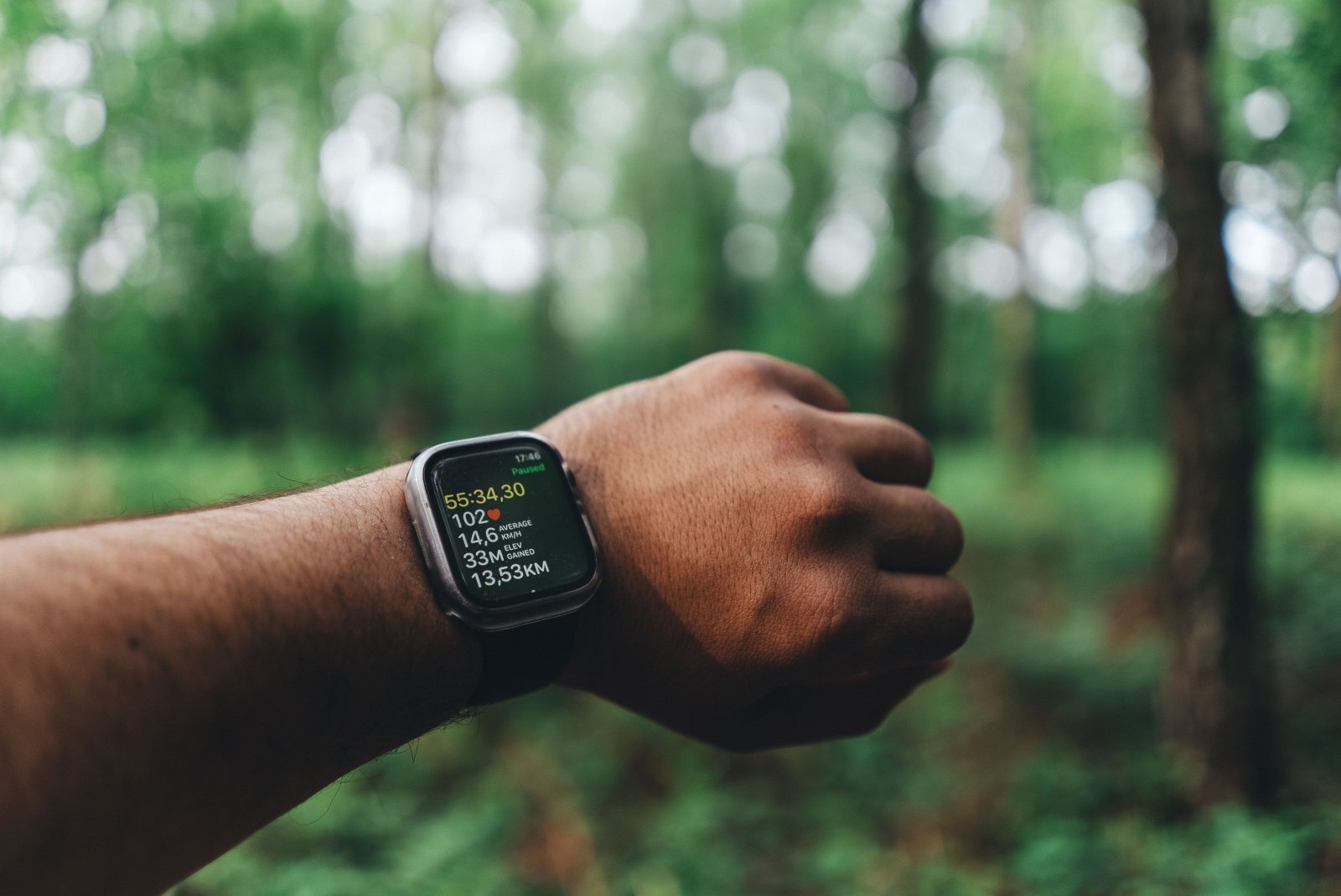
10,000 steps has become one of the most recognizable numbers in fitness. Smartwatches celebrate when you reach it, phones track your progress toward it, and plenty of people end the evening pacing around the house because they're still 800 steps short.
There is nothing magical about the number itself. You don't suddenly become healthy at step 10,000, and a day with 8,500 steps isn't a failure. Research increasingly shows that meaningful health benefits appear well below 10,000 steps and generally increase as people move more.
That doesn't mean we should throw the 10,000-step goal away.
At FitCalc, we think 10,000 or more steps per day is an excellent target for a healthy adult who is capable of reaching it. It encourages people to move throughout the day, provides a simple measurement to follow, and usually represents a substantially more active lifestyle than spending most waking hours sitting down.
But steps are only one way of measuring movement. Someone who gets 8,000 steps and spends an hour playing basketball may have been considerably more active than someone who gets exactly 10,000 steps and does nothing else.
The bigger goal is not to satisfy your smartwatch. The goal is to build a life where movement is normal.
Where Did the 10,000-Step Goal Come From?
Considering how deeply 10,000 steps has become embedded in health and fitness culture, you might assume the number originated from a large clinical trial.
It didn't.
The target appears to trace back to Japan in the 1960s. Around the time walking was gaining popularity following the 1964 Tokyo Olympics, the Yamasa company introduced a pedometer called the manpo-kei, which translates roughly to "10,000-step meter." The memorable round number became part of the device's marketing and eventually spread far beyond Japan.
So no, researchers didn't discover that the human body requires exactly 10,000 steps every 24 hours.
What happened afterward is more interesting. Scientists eventually began studying step counts directly, and while the research didn't uncover a magical threshold at 10,000, it did repeatedly find that people who walk more tend to experience better health outcomes than people who walk very little.
In other words, the original number may have come from marketing, but the behavior it encouraged turned out to be a pretty good idea.
You Don't Need 10,000 Steps to Start Seeing Benefits
One of the biggest mistakes people make with step goals is treating 10,000 as the minimum amount worth doing.
The evidence strongly argues against that.
A large 2023 meta-analysis included 17 studies and almost 227,000 participants. Researchers found that meaningful associations with lower mortality appeared at surprisingly modest step counts. Above roughly 3,867 steps per day, additional steps were associated with progressively lower all-cause mortality, while cardiovascular mortality benefits appeared at even lower levels. Every additional 1,000 daily steps was associated with about a 15% lower risk of all-cause mortality, although observational associations like these should not be interpreted as guarantees for an individual person.
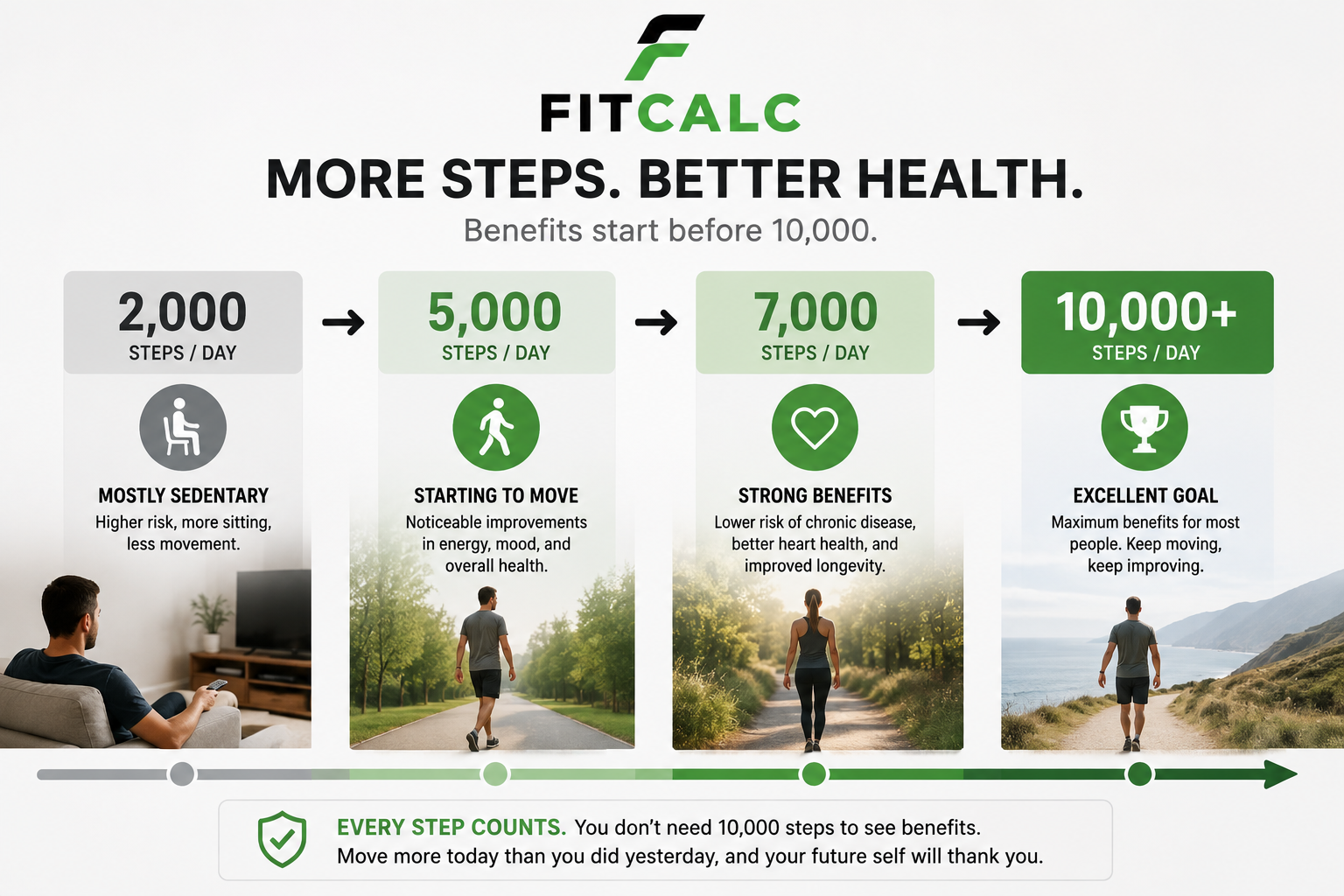
A much larger 2025 systematic review and dose-response meta-analysis expanded the question beyond mortality. Researchers evaluated 57 studies from 35 cohorts covering outcomes including cardiovascular disease, cancer, type 2 diabetes, dementia, depression, falls, and overall mortality. Compared with 2,000 steps per day, 7,000 daily steps was associated with a 47% lower risk of all-cause mortality, along with lower risks across several other measured outcomes.
That is extremely important for someone currently living a sedentary lifestyle.
If you average 3,000 steps per day, you don't need to believe that anything short of 10,000 is pointless. Moving toward 5,000, then 6,000, then 7,000 can represent a meaningful improvement.
Going from very little movement to substantially more movement is the first victory.
Why We Still Like 10,000 Steps as a Goal
If significant benefits occur at 7,000 steps, why bother aiming for 10,000?
Because "enough to produce a measurable benefit" and "a great daily activity goal" are not necessarily the same thing.
This is similar to how we approach other areas of fitness and nutrition. Research may identify a point where substantial benefits have already occurred, but that doesn't automatically mean everyone should deliberately stop there. For a healthy adult who has the time and physical ability to move more, 10,000 steps remains a useful and achievable target.
Research doesn't suggest that benefits disappear once you pass 7,000. The 2025 meta-analysis found that several health outcomes followed dose-response relationships in which greater step counts continued to be associated with lower risk, although some benefits began leveling off around 5,000–7,000 steps. The authors specifically noted that 10,000 steps remains a viable target for people who are more active, even though 7,000 may be a more realistic target for others.
Another large U.S. study followed 4,840 adults for an average of about 10 years. Compared with 4,000 daily steps, 8,000 steps was associated with substantially lower all-cause mortality, while 12,000 steps was associated with an even lower risk.
Again, these are observational data. People who move more can differ from sedentary people in many other ways, and a step counter cannot prove that every additional step directly caused the difference.
But taken together, the pattern is difficult to ignore: moving more is generally associated with better health, and there is no good reason for a capable, healthy person to be afraid of exceeding the minimum amount associated with benefits.
That's why we still like 10,000.
It's easy to remember. It's challenging enough to encourage movement. And reaching it generally requires more than walking from your bed to your car, sitting at work, and walking back inside at the end of the day.
What If You Only Get 8,000 Steps?
Then you had an 8,000-step day.
That's it.
One of the worst things we can do with useful health targets is turn them into arbitrary pass-or-fail tests. If your normal goal is 10,000 steps and you finish a busy Wednesday with 8,300, there is no reason to feel as though the day was wasted.
Eight thousand steps is still a substantial amount of movement compared with a highly sedentary day. Research involving U.S. adults has even found lower mortality risk among people who reached at least 8,000 steps on only a few days per week compared with those who never reached that level.
Consistency matters more than perfection.
A person averaging 9,000 steps over months is living very differently from someone averaging 2,500, even if the first person rarely sees the satisfying "10,000" notification on a smartwatch.
Our recommendation is therefore to treat 10,000+ as something to aim toward rather than a number to obsess over. Some days you'll exceed it easily. Other days you may land around 7,000 or 8,000. What matters is that movement has become part of your normal life.
The Biggest Improvement May Be Getting Off the Couch
The step-count research repeatedly highlights an encouraging pattern: people starting at very low activity levels have a lot to gain from moving more.
This makes intuitive sense. Someone already walking 12,000 steps every day is starting from a very different place than someone averaging 2,000. Adding another 1,000 steps to those two lifestyles doesn't necessarily represent the same change in activity.
This is why we don't think sedentary people should begin by worrying about whether 10,000 is "optimal." Start by determining what you actually do now.
If your phone or watch shows that you average 3,500 steps, try moving toward 5,000. Once that becomes normal, aim for 6,000 or 7,000. Eventually, 8,000–10,000 may stop feeling like a deliberate walking challenge and simply become the amount of movement built into your day.
Small changes add up surprisingly quickly. Walking while taking a phone call, going outside after dinner, parking farther from a store, taking the stairs, walking during lunch, or doing errands on foot can add hundreds or thousands of steps without requiring a formal workout.
The goal isn't to spend two hours marching around your neighborhood every night because you sat motionless all day. It's better to create reasons to move throughout the day in the first place.
Steps Are Not the Same Thing as Total Activity
This is the caveat that often gets lost when people become obsessed with step counts.
Your phone knows how many steps you took. It doesn't necessarily understand everything your body did.
Cycling is an obvious example. You can spend an hour riding hard and accumulate relatively few steps. The same problem applies to swimming. Strength training can be physically demanding while contributing very little to a step total. Depending on the activity and device, sports may also be measured poorly or not at all.
This is why we don't think anyone should judge an active lifestyle entirely by a step counter.
Walking is fantastic. It is accessible, inexpensive, easy to recover from, and can be performed almost anywhere. For someone who currently does very little physical activity, increasing daily walking may be one of the simplest improvements available.
But ideally, walking becomes the foundation of a broader active lifestyle rather than the only thing you do.
Play basketball or soccer. Ride a bike. Swim. Hike. Surf. Lift weights. Work in the yard. Go kayaking. Take your dog somewhere that requires an actual walk instead of opening the back door. Find physical hobbies you genuinely enjoy enough to keep doing.
A person who gets 8,000 steps, lifts weights for an hour, and plays basketball that evening doesn't need to walk around the kitchen before bed because a watch says the day was incomplete.

What About Steps for Weight Loss?
Walking can absolutely help with weight loss, but step count doesn't override energy balance.
Moving more increases energy expenditure. If you go from a very sedentary lifestyle to consistently walking thousands of additional steps each day while keeping everything else reasonably similar, you're increasing the amount of energy your body uses.
That can make maintaining a calorie deficit easier.
But 10,000 steps is not a guarantee of fat loss. Someone can walk 10,000 steps and still consume more energy than they expend. Likewise, someone losing weight doesn't necessarily need to hit 10,000 every day if their overall energy balance, nutrition, and activity support their goal.
Where walking becomes especially useful is that it provides additional activity without the recovery demands of adding another difficult workout. Someone already lifting weights several days per week may benefit more from increasing ordinary daily movement than from trying to turn every day into another intense cardio session.
For weight management, we therefore view steps as one useful piece of the activity side of the equation, not a loophole that makes calorie intake irrelevant.
Does Walking Speed Matter?
Step count measures volume, not necessarily intensity.
Ten thousand slow steps around a house and 10,000 brisk outdoor steps aren't identical physical challenges. Faster walking raises heart rate and energy expenditure more substantially, and deliberate brisk walking can contribute to moderate-intensity aerobic activity.
However, research suggests total step volume itself is highly useful. In a large JAMA study of U.S. adults, greater daily step counts were associated with lower mortality, while step intensity was not significantly associated with mortality after accounting for total step count.
That doesn't mean pace is meaningless. Walking faster can improve cardiovascular fitness and lets you cover more distance in less time. It simply means you don't need to turn every trip to the mailbox into a speed-walking competition for your steps to count.
A mixture makes sense. Move normally throughout the day, and when you're intentionally going for a walk, there's nothing wrong with picking up the pace.
The FitCalc Approach
If you're a healthy adult capable of walking comfortably, we think 10,000+ steps per day is an excellent goal.
Not because step 10,000 activates some hidden health switch. It doesn't. Research shows meaningful benefits well below that number, with particularly large differences between very sedentary people and those accumulating substantially more daily movement.
If you average 7,000 or 8,000 steps, you're still moving considerably more than someone barely reaching 2,000 or 3,000. If you're currently sedentary, gradually working toward those numbers is far more important than forcing yourself to reach 10,000 immediately.
But once 8,000 becomes easy, why stop moving simply because a study found benefits there?
Aim for 10,000. Exceed it when your day naturally allows it. Don't panic when you fall short.
Most importantly, don't let a step counter define your entire activity level. Walk frequently, but also find other ways to use your body. Lift weights, play sports, bike, swim, hike, surf, work outside, and choose hobbies that keep you moving.
The healthiest outcome isn't seeing 10,000 appear on a screen every night.
It's reaching the point where being active no longer feels like something you have to schedule. It is simply part of how you live.
Sources
Ding D, Nguyen B, Nau T, et al. Daily steps and health outcomes in adults: a systematic review and dose-response meta-analysis. The Lancet Public Health. 2025. The analysis included 57 studies from 35 cohorts and found meaningful associations between greater daily steps and numerous health outcomes, with 7,000 steps associated with substantial benefits compared with 2,000.
Banach M, et al. The association between daily step count and all-cause and cardiovascular mortality: a meta-analysis. European Journal of Preventive Cardiology. 2023. The analysis included nearly 227,000 participants and found progressively lower mortality associated with greater step counts.
Saint-Maurice PF, Troiano RP, Bassett DR Jr, et al. Association of Daily Step Count and Step Intensity With Mortality Among US Adults. JAMA. 2020. Greater daily step volume was associated with lower all-cause mortality in 4,840 U.S. adults followed for approximately a decade.
Inoue K, Tsugawa Y, Mayeda ER, et al. Association of Daily Step Patterns With Mortality in US Adults. JAMA Network Open. 2023. The study found substantial associations with lower mortality even among adults reaching 8,000 or more steps on only some days of the week.
Wise J. Sixty seconds on... 10,000 steps. BMJ. 2024. Reviews the history of the 10,000-step target and its origins in the Japanese manpo-kei pedometer rather than a specific biological threshold.
Tudor-Locke C, et al. Step Counting: A Review of Measurement Considerations and Health-Related Applications. Reviews the history and scientific use of pedometers, including the introduction of Yamasa's manpo-kei in 1965.