Will You Lose Muscle If You Take a Week Off Lifting?
If a holiday trip or a packed week knocks three workouts off your calendar, you probably won’t come home noticeably less muscular. That first squat may feel less familiar, and you may miss the way your shoulders look after a workout. Neither tells you much about how much muscle you’ve lost. Looking flatter, feeling rusty, and losing muscle tissue are three different things.
How you respond depends more on what interrupted your routine and how long it stays interrupted than on whether you hit every planned session. A week out of the gym while you’re still going about your day is different from a week on bed rest or in a brace. And if one busy week turns into a month, the useful question changes from “Do I have to get a workout in?” to “What can I do consistently until my schedule clears?”
What Happens When You Take a Week Off Lifting?
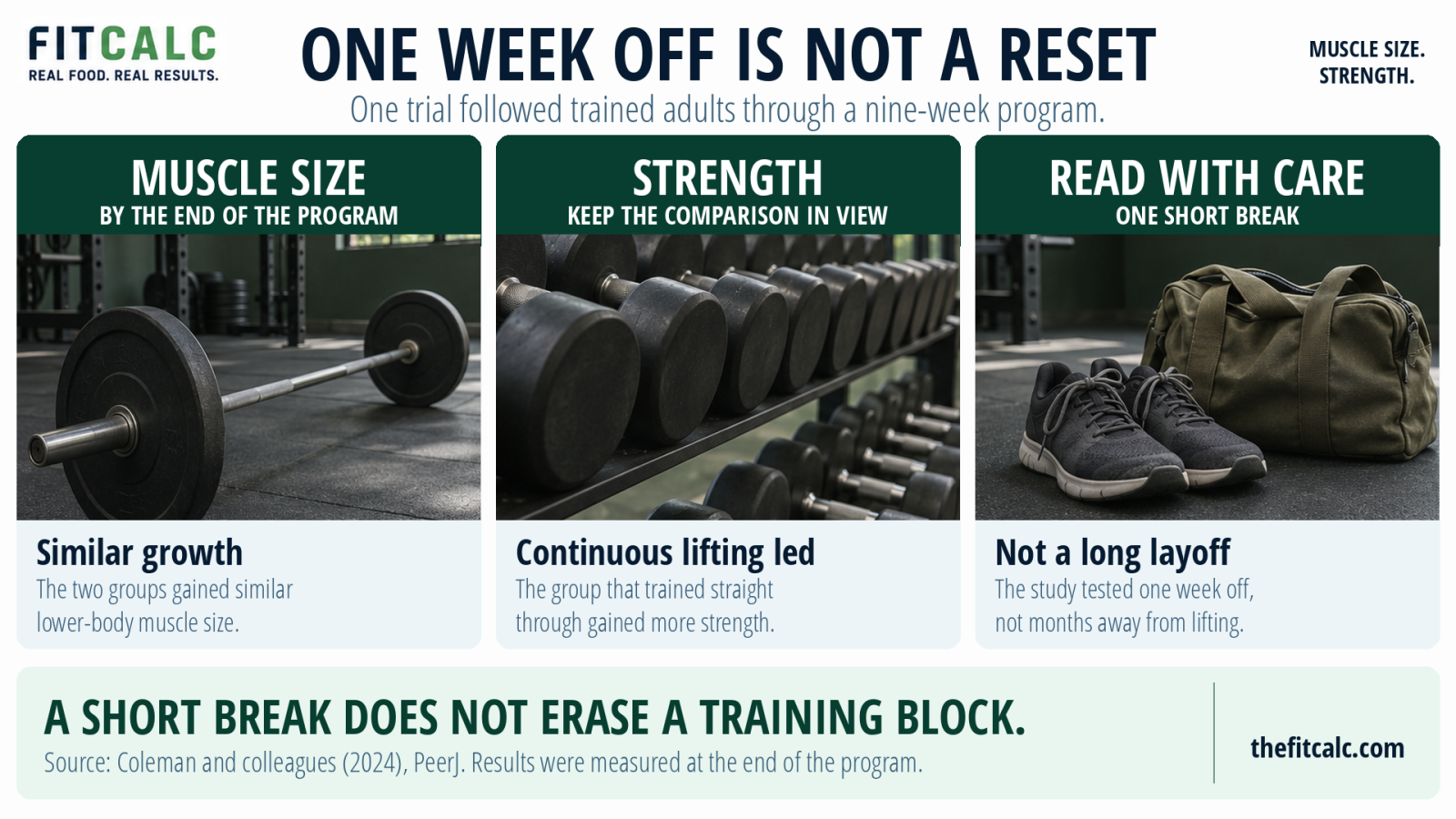
In a 2024 study, Coleman and colleagues randomly assigned 50 resistance-trained adults either to train continuously for nine weeks or to take a full week off halfway through the same program. Thirty-nine completed the study. Researchers supervised the lower-body sessions and measured muscle thickness at several sites. By the end of the program, the groups had made similar gains in measured lower-body muscle size, power, and local muscular endurance. The group that trained continuously improved more on the lower-body strength tests.
That’s reassuring if you have to miss a week, but it isn’t a promise that every muscle stays exactly the same on every day of a break. The study compared outcomes at the end of the program. It also didn’t test whether a lighter week of lifting would have worked better than a full week off. What you can take from it is that one missed week did not meaningfully derail muscle growth across the program, even though taking it off was not a shortcut to getting stronger.
Feeling Weaker Is Not the Same as Losing Muscle
Get back from a long drive on Sunday night, sleep poorly, then squat early Monday and your usual warm-up might feel like a work set. Before drawing conclusions from that session, consider how much besides training changed. You may have slept less, eaten at unfamiliar times, or arrived at the gym with stiff hips from sitting. Strength on a given day also reflects how practiced and comfortable you are with the movement, not just how much muscle you have.
The mirror has its own blind spots. You can look less full without the temporary fullness that follows a lifting session, and changes in food, fluid, and routine can move your scale weight without matching changes in body tissue. To judge your return, compare how a familiar lift feels across a few normal sessions rather than comparing your first day back with your best day before you left.
When the Break Lasts Longer Than You Planned
Ten weeks is a different proposition from seven days. In a 2024 trial by Halonen and colleagues, previously untrained adults in the periodic group lifted for ten weeks, stopped for ten weeks, then trained for ten more. They lost some of the strength and muscle size they had gained during the break and regained it quickly once they resumed. After the same amount of actual training, their final gains were broadly similar to those of the continuous-training group. For comparison, the continuous group waited ten weeks before starting its twenty-week program, so both groups finished at the same point in the study. That setup doesn’t mean a ten-week break gets you to your goal as quickly as training straight through from the same start date. It also wasn’t a study of a seasoned lifter after years of training.
If you’ve been out for several weeks, a more useful expectation is that you may need to work back up, not that you’re starting over. How much you have to rebuild depends on what you did during the break, what you were doing before it, and why you stopped. Missing the gym while you travel and walk around most days is not a template for returning from illness, an injury, or a period when you could barely move. If a clinician restricted your activity, follow their return guidance rather than a generic workout plan.
Keep a Smaller Workout When Time Is the Problem
When there’s no good way to fit in a workout during a single busy week, take the break and move on. If the situation is going to last, look for a version of your workout you can keep doing. In a controlled study by Bickel and colleagues, younger adults kept the muscle-size gains they’d made on much less resistance training; older participants didn’t preserve those gains in the same way on the reduced doses. A separate 2024 experiment in young women found that training every seven days after an initial program maintained the measured leg adaptations better than training every fourteen days. Those studies tested particular groups and routines, not one minimum dose that works for everyone.
If you have one short gym slot, use it for a few exercises that cover more than one muscle group. A leg press, dumbbell press, and row could make up one travel session. At home, you might use split squats, push-ups, and a securely set up resistance-band row instead. Start with one or two controlled sets of each, choose versions you can make reasonably challenging, and finish each set before your form breaks down. If you have time for a second session, add a familiar movement you missed rather than making the first one so hard you dread doing it again.
What to Eat While You Aren’t Lifting
There’s no need to try to make up for missed workouts by changing your entire diet. If you already have a protein target, keep it as your usual guide. If you don’t track, start with the food you actually have access to: eggs at breakfast, leftover turkey or chicken in a lunch wrap, or beans and beef in chili for dinner. The goal is to keep meals recognizable while your schedule changes, not to replace every snack with a shake. The Protein Calculator below can help you estimate a starting target if you want one.
Whether you eat more or less depends on how the rest of your day changes. Skipping a lift doesn’t necessarily make a sightseeing trip a lower-activity week. If you’re out for longer and moving substantially less than usual, look at your portions, your appetite, and your longer-term weight trend before changing your normal intake. If you normally eat extra to gain weight, there’s no need to force the same extra food through a sustained period off; give yourself enough to eat and revisit your plan when you have a regular training rhythm.
How to Lift Again Without Making Up Missed Workouts
After a week off, start with exercises you already know. Warm up normally and let those sets tell you whether your usual working weight makes sense. You don’t have to drop it automatically if it moves well, but it’s fine to take some weight off or do fewer work sets. Aim to finish with a few good reps still available. That gives you room to notice how the movement feels without turning your first session into a strength test. If you took a longer break, be more conservative with both the load and the number of sets, and build them back as you get more sessions in.
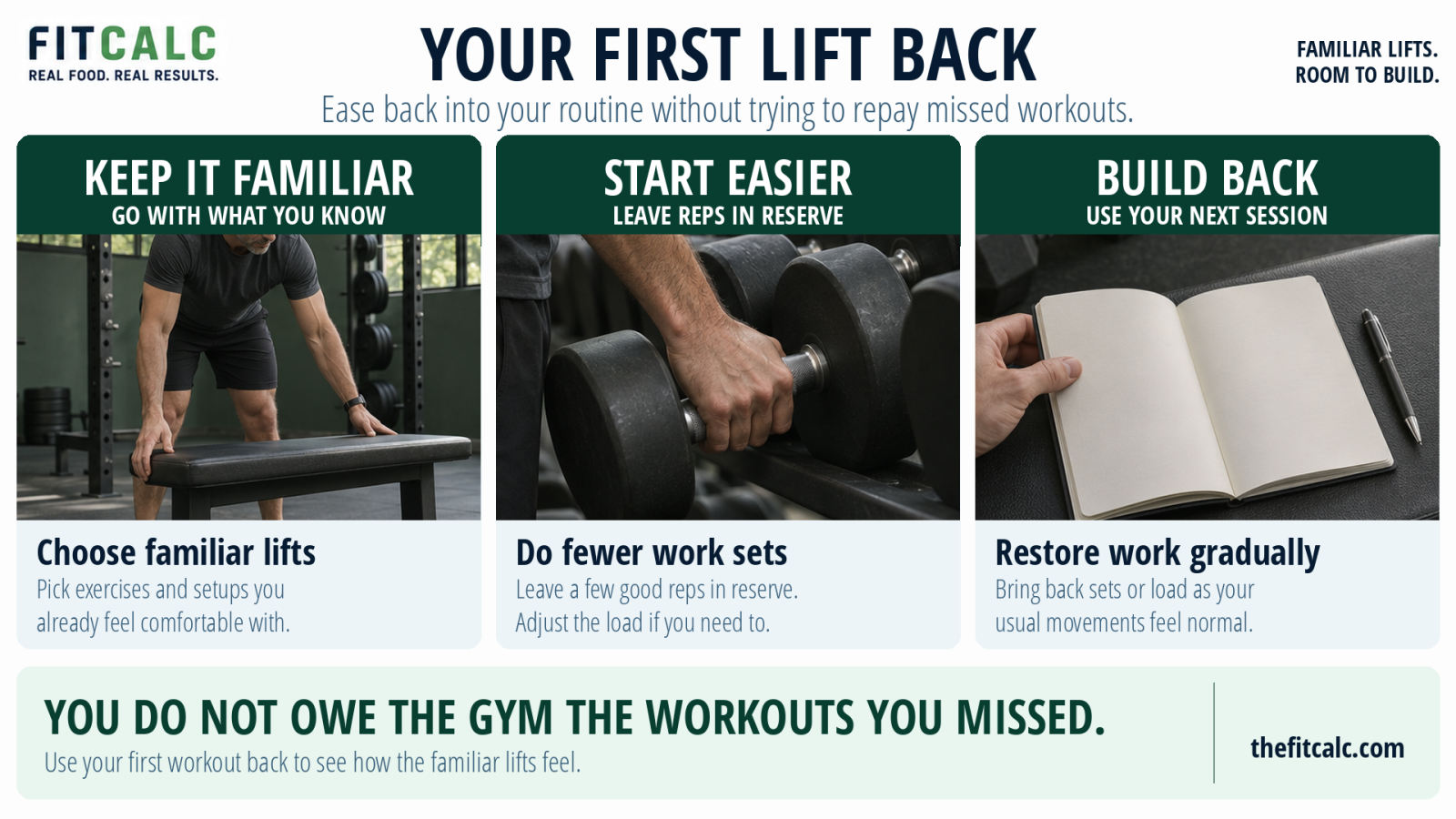
Suppose you normally bench for three sets of eight at 135 pounds. After the break, your warm-ups feel fine, but once you get to 135 it’s clear that eight clean reps would be a grind. Try two controlled sets at a lighter weight and stop while you could still do a few more reps. That’s an illustration, not a percentage everyone should follow. If you feel good at the next session, add back a set or return toward your normal load. You don’t owe the gym the three workouts you missed; look at what helps you do the next one well.
Use Your Next Session as a Check, Not a Deadline
Give yourself a better comparison than how heavy the bar felt once. Write down your first work-set load, reps, and how many more clean reps you think you could have done. On the next session, compare the same movement after a similar warm-up. If the bar moves smoothly and soreness didn’t interfere with normal activity, you can bring back some of your usual work. If you’re still unusually sore or your setup feels off, repeat the easier session. That note is more actionable than trying to estimate how much muscle you lost, and it gives you a way to judge your return without testing a max.
Related FitCalc Reading
Why Your Weight Can Change Overnight Without Gaining Fat
The Complete Guide to Strength Training
Should You Eat Fewer Calories on Rest Days?
Practical Takeaways
One week away from lifting is unlikely to undo your progress.
Pay more attention to the next few normal sessions than to the first warm-up back.
If the interruption stretches into several weeks, a shorter version of your routine can help you stay in practice when you’re able to train. Keep eating familiar protein-rich meals. Revisit your calorie target only if your activity level and routine have changed for longer.
Return with familiar lifts and reps to spare. Add back sets or load once you know how you respond.