How Big Should Your Calorie Surplus Be to Build Muscle?
If you want to get stronger and put on muscle, eating more can help. The tricky part is knowing how much more. An online calculator may suggest 2,600 calories for maintenance, a friend may swear you need 500 more every day, and your scale may jump the first week even though you only added a snack. None of those numbers tells you how much muscle you gained.
Start with a modest increase over your best estimate of maintenance, then adjust from several weeks of real-world feedback. You are trying to fuel productive lifting, not win a race to a higher number on the scale. The right initial target is one you can follow consistently enough to see what it does. This is a working plan, not a rule that every person needs to bulk or a guarantee that all the weight you gain will be muscle.
What a Calorie Surplus Does and What It Cannot Do
A calorie surplus means you are taking in more energy than you expend across the period you are looking at. It can give you room to eat enough, recover between sessions and show up ready to train. It does not replace progressive resistance training. If your workouts are scattered or your lifts never become more challenging, adding more food will not fix that by itself.
In an eight-week study, Helms and colleagues compared intended maintenance, a 5% surplus and a 15% surplus in resistance-trained lifters. Faster weight gain was more clearly associated with increased skinfold thickness than with improved muscle size or strength across the outcomes tested. It was a small, short study, and the prescribed intakes were targets rather than perfectly controlled amounts. It tells us more about the downside of pushing weight up quickly than it does about the ideal calorie target for a particular lifter.
Garthe and colleagues found a related pattern in elite athletes: a group receiving nutrition counseling ate more and gained more body weight and fat mass than a group eating freely, but the groups did not differ in lean body mass gained. Elite athletes are not interchangeable with recreational lifters, and lean body mass includes tissue other than muscle. Still, neither study makes a compelling case for forcing a large surplus by default.
You can sometimes gain lean mass without an intentional surplus. A small 2026 trial by Vargas-Molina and colleagues found that trained participants using high-protein protocols could improve measures of body composition at estimated maintenance or in a modest deficit over ten weeks. That study does not establish the best way to maximize muscle growth or show that everyone will recomp. If a beginner or returning lifter is already making progress at maintenance, there is no need to force calories up just because a bulk sounds like the next step.
Set a Starting Intake You Can Actually Test
Use the Maintenance Calorie Calculator if you do not have a starting point. If your recent intake is reasonably well logged and your weekly average weight has been fairly stable for several weeks at a typical activity level, that real-world intake is often the more relevant baseline. The calories and maintenance guide explains why the estimate can change when your work, steps or training change.
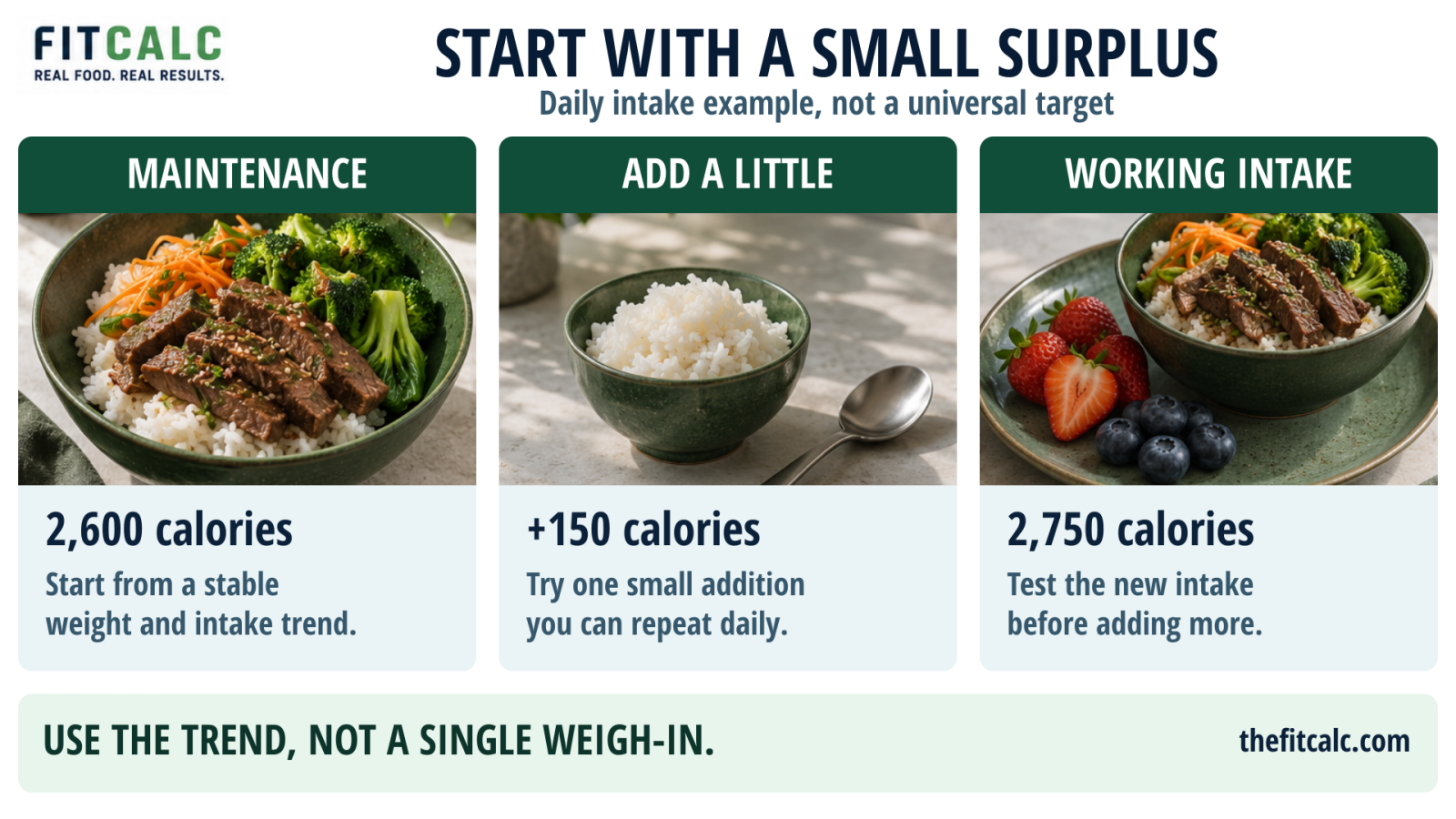
For an adult with estimated maintenance near 2,600 calories a day, a small first move might be 2,750 calories a day. That is 150 extra calories, or about 6% over the starting estimate. This is example math, not a researched cutoff. If true maintenance is 2,800, the same target would still fall short. If your current meals are erratic, first make them repeatable instead of treating an uncertain calculator result as an exact prescription.
Build the extra food into something you already eat. If dinner is ground beef, vegetables and rice, a little more cooked rice is easier to repeat than a separate shake you keep forgetting. If a sandwich leaves you rushed before training, pack fruit and a serving of yogurt you tolerate, or make your main meal a little larger. Foods and serving sizes vary, so use your own labels when you want the addition to be consistent. The goal is to make one repeatable change instead of building a different meal plan every day.
Check protein before spending all of the extra calories on snacks. A practical starting range for many healthy lifting adults is roughly 0.7 to 1 gram per pound daily (about 1.6 to 2.2 grams per kilogram, rounded). Research pooling resistance-training trials found little additional average fat-free-mass benefit from supplementation beyond about 1.6 g/kg/day; the estimate is not a hard ceiling for everyone. If you already have solid protein coverage, carbs that fit your meals can be a useful way to add energy without increasing protein further. Use the Protein Calculator for a starting point.
Track Three Signals Instead of One
Look at the weekly average, not the heaviest morning.
If weighing feels useful, weigh on several mornings under roughly the same conditions, such as after the bathroom and before breakfast. Compare like with like. A few bigger meals or more carbohydrates can change body water and the amount of food in your gut, so a jump in the first week is not a clean measure of fat or muscle gain. FitCalc’s guide to short-term scale swings shows why.
Compare lifts you actually repeat. Pick two or three familiar exercises and record the weight, reps and how many more clean repetitions you plausibly had left. A shaky ninth rep is not the same as a controlled ninth rep. Improved reps, load or technique over several sessions suggest the work is moving in the right direction, though skill gains can also increase strength without telling you exactly how much muscle you added. If every workout uses different exercises, fix the comparison before you blame the surplus.
Use waist measurements as optional context. Take them in roughly the same conditions and at the same spot if you want another signal. Do not react to a big reading right after dinner. A sustained rise in both waist and body weight, without better training, can be a reason to check whether the pace is faster than you want. It is not a home test that separates muscle from fat. If frequent weighing or measuring makes eating and training feel rigid or distressing, leave it out and focus on habits and training progress instead.
When to Hold, Add or Trim Calories
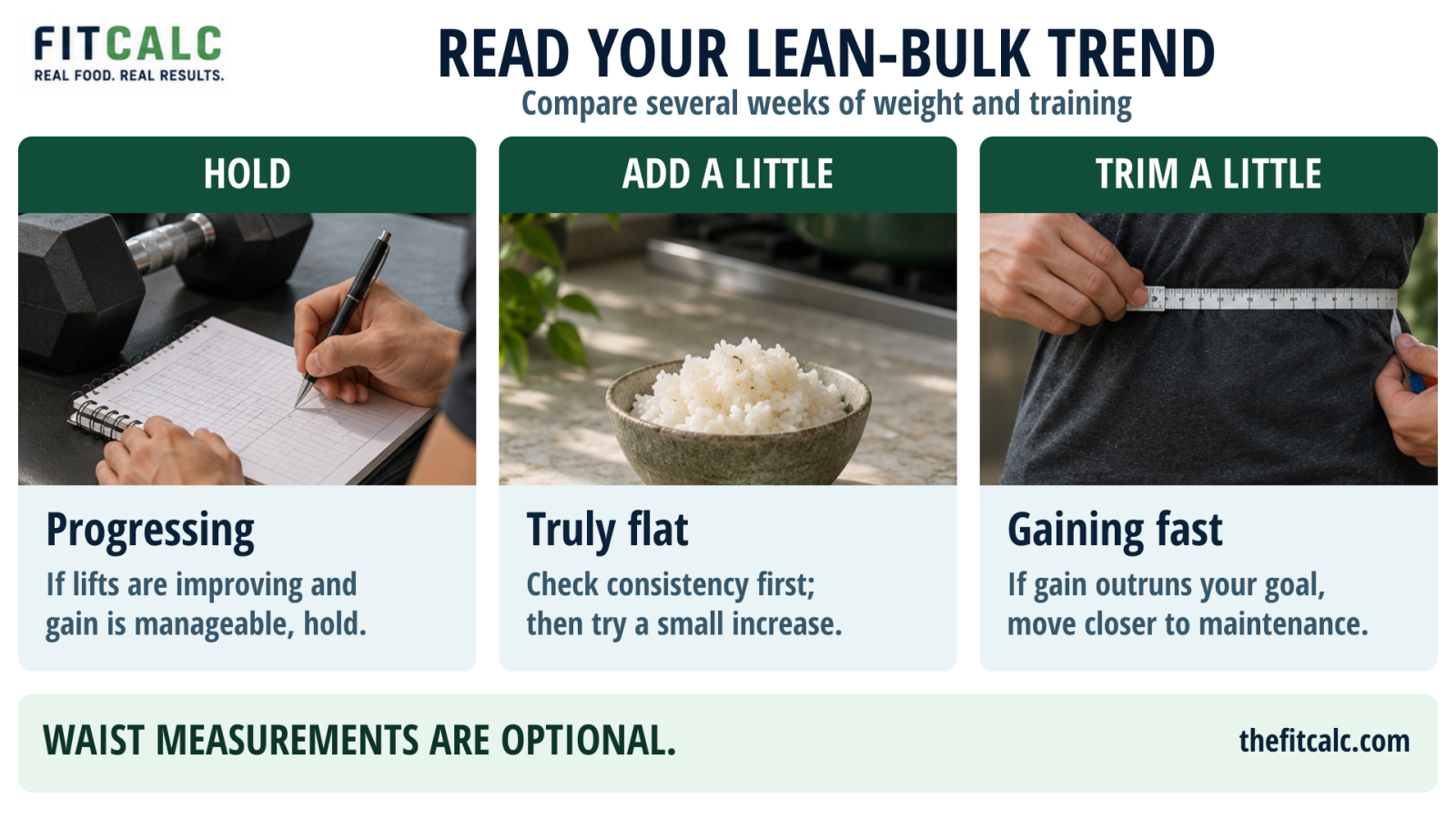
Hold when the plan is working.
Imagine your weekly averages are 170.0, 170.3 and 170.6 pounds and you have moved from eight to nine controlled reps on two familiar lifts. That is not proof that all 0.6 pounds were muscle. It is a reason to avoid changing several things at once when the direction fits your goal. Let the plan run for another couple of weeks rather than chasing a faster pace just because a chart says you could.
Add a little when you have a genuine flat trend. If weight and training have been flat for a few weeks and you can account for the meals you intended to add, try roughly another 100 to 150 calories a day as a small test. First check whether the training is consistent enough to progress and whether shifts, longer walks or a new sport increased activity. If the extra snack never made it into your week, solve that before raising the target. These steps help you diagnose the problem instead of turning every difficult workout into another calorie increase.
Trim the addition if your gain keeps outrunning your goal. One high weigh-in after a salty meal does not make a verdict. But if weight and waist are repeatedly moving faster than you want and training is no better, take a small step back toward maintenance. That could simply mean returning to your previous serving size instead of deleting an entire meal. Keep the protein and the strength program steady so you are not changing everything at once.
Keep the Plan Useful Outside the Gym
A vacation, late work shift or family dinner will not match the day you used to estimate maintenance. If eating the same surplus becomes difficult for a week, keep your familiar meals where you can and resume your normal experiment when you are home. Do not stack several missed snacks onto the first night back. If the schedule change lasts, let the next few weeks of data tell you whether the old baseline still works.
If you already feel under-recovered, review sleep and training demands along with food. More calories cannot make seven hard sessions fit into a schedule that only allows you to recover from three. Conversely, if you intentionally want more scale gain for a sport or because restoring weight is the main goal, the pace that suits you may look different. This article is for healthy adults lifting recreationally, not a recovery-weight prescription or a plan for pregnancy, adolescence or unexplained weight loss.
Key Takeaways
Use maintenance as an estimate and add the smallest repeatable amount worth testing.
Look for a few weeks of reasonably comparable weigh-ins and workouts, not one big day. A small surplus is not a magic number, and the trials do not identify the perfect pace. Keep protein and your lifting routine steady, make one adjustment when needed, and see what actually changes.
Related FitCalc Reading
Maintenance Calorie Calculator
The Complete Guide to Calories and Maintenance
Why Your Weight Can Change Overnight Without Gaining Fat
Sources
Morton et al. (2018). Protein supplementation and resistance-training gains in healthy adults.