Creatine Without the Bro Science: What It Actually Does to Your Muscles and Body
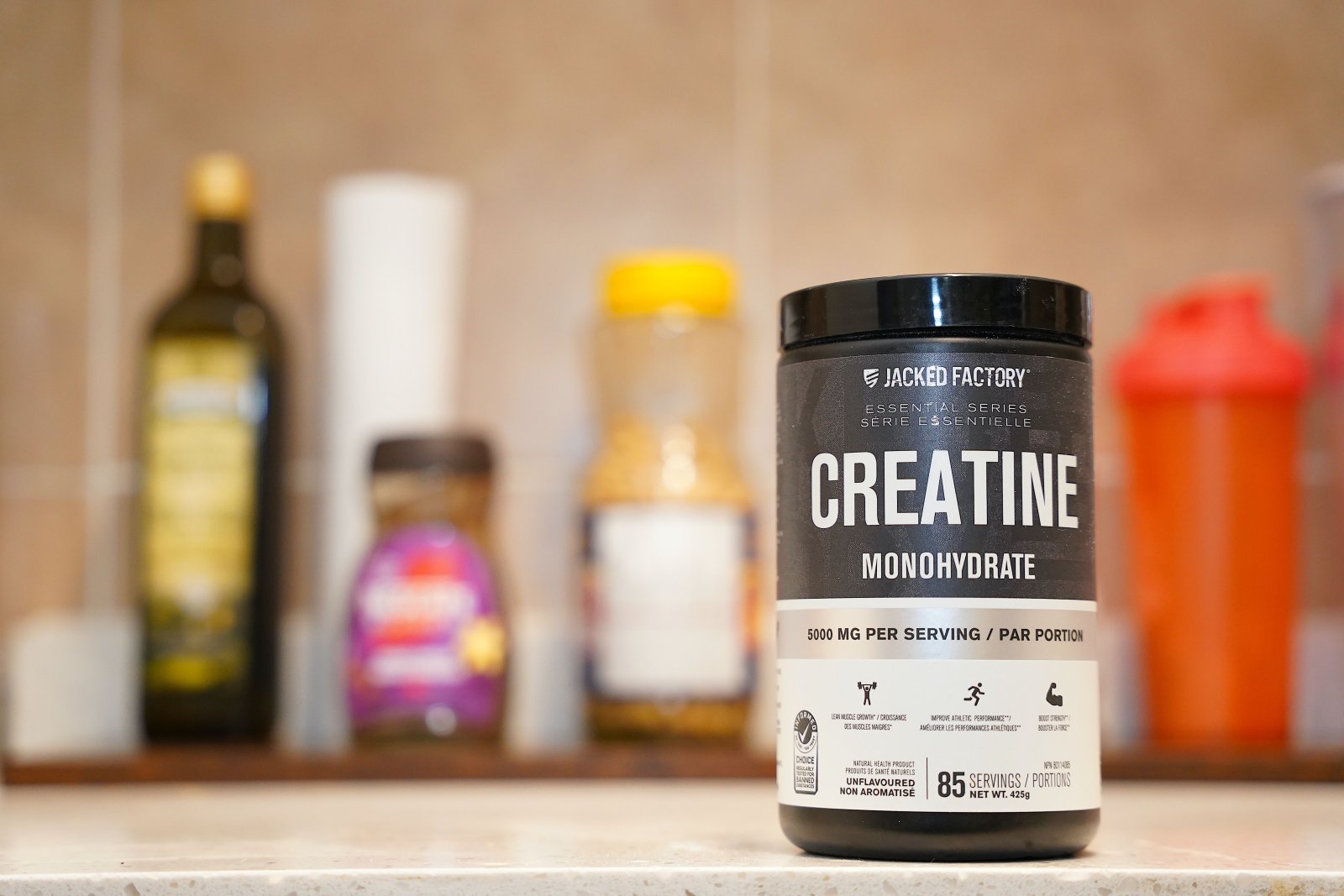
Creatine has been associated with bodybuilding for so long that plenty of people still assume it belongs exclusively in the gym. Mention creatine and the first image that comes to mind is usually a tub of powder next to a shaker bottle, followed closely by questions about water weight, kidneys, loading phases, and whether you need to cycle off.
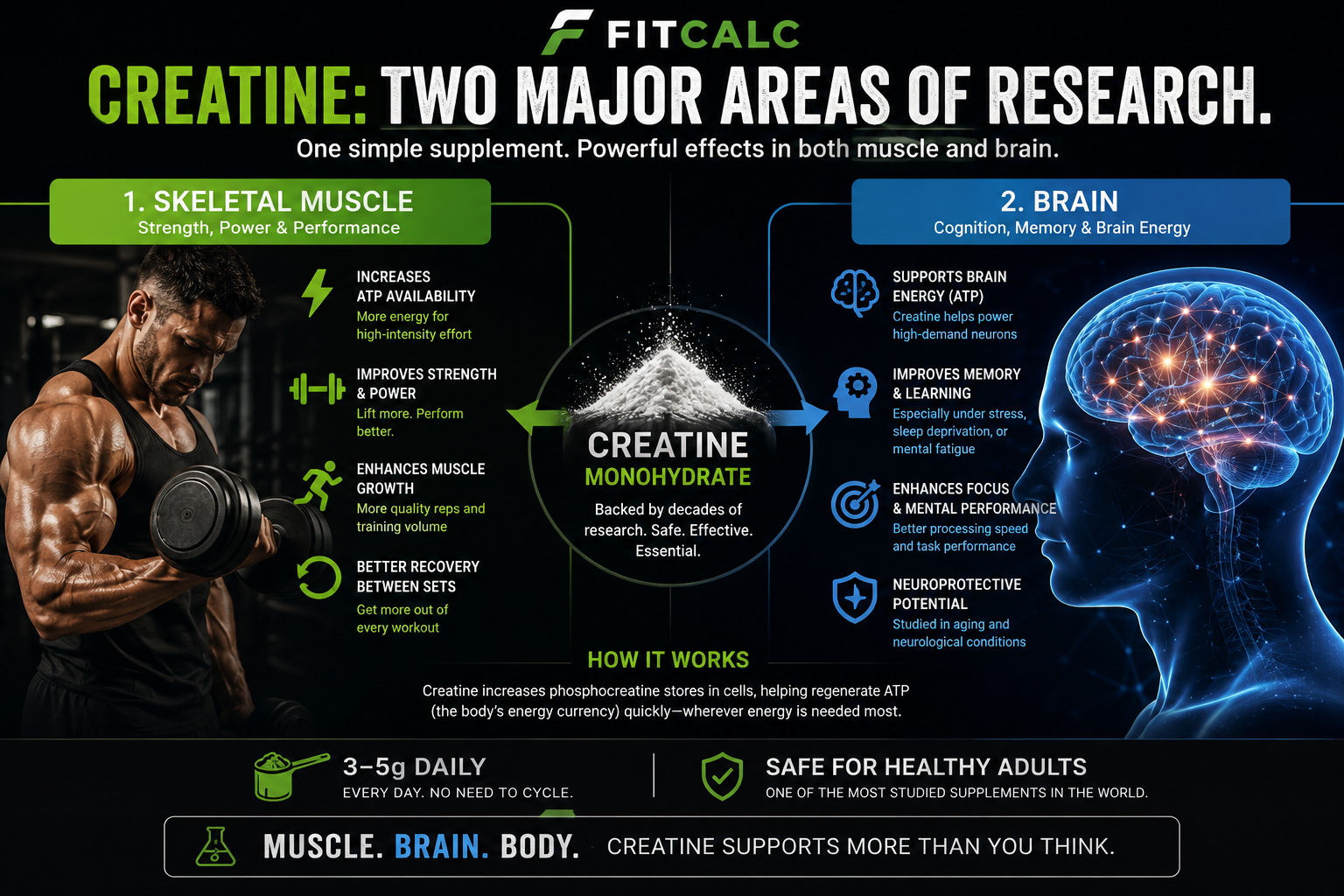
That reputation undersells what creatine actually is. Creatine is a naturally occurring compound involved in cellular energy production. Your body makes it, you obtain some from foods such as meat and fish, and skeletal muscle stores most of it. The brain also relies on the creatine-phosphocreatine system as part of its energy metabolism.
At FitCalc, we recommend plain creatine monohydrate for normal, healthy adults, not only bodybuilders. Its strongest evidence remains in resistance training, strength, and high-intensity exercise, but research has expanded into aging, muscle preservation, cognition, and brain energetics as well. Creatine isn't a miracle powder, and not every proposed benefit has the same level of evidence, but few supplements combine this much research, such a simple ingredient profile, and such a low cost.
For most adults, the approach can remain remarkably simple: take 3–5 grams of creatine monohydrate every day and keep taking it.
What Is Creatine?
Creatine is produced naturally from the amino acids glycine, arginine, and methionine. The body synthesizes it primarily through processes involving the liver and kidneys, while dietary creatine comes predominantly from animal foods, especially meat and fish.
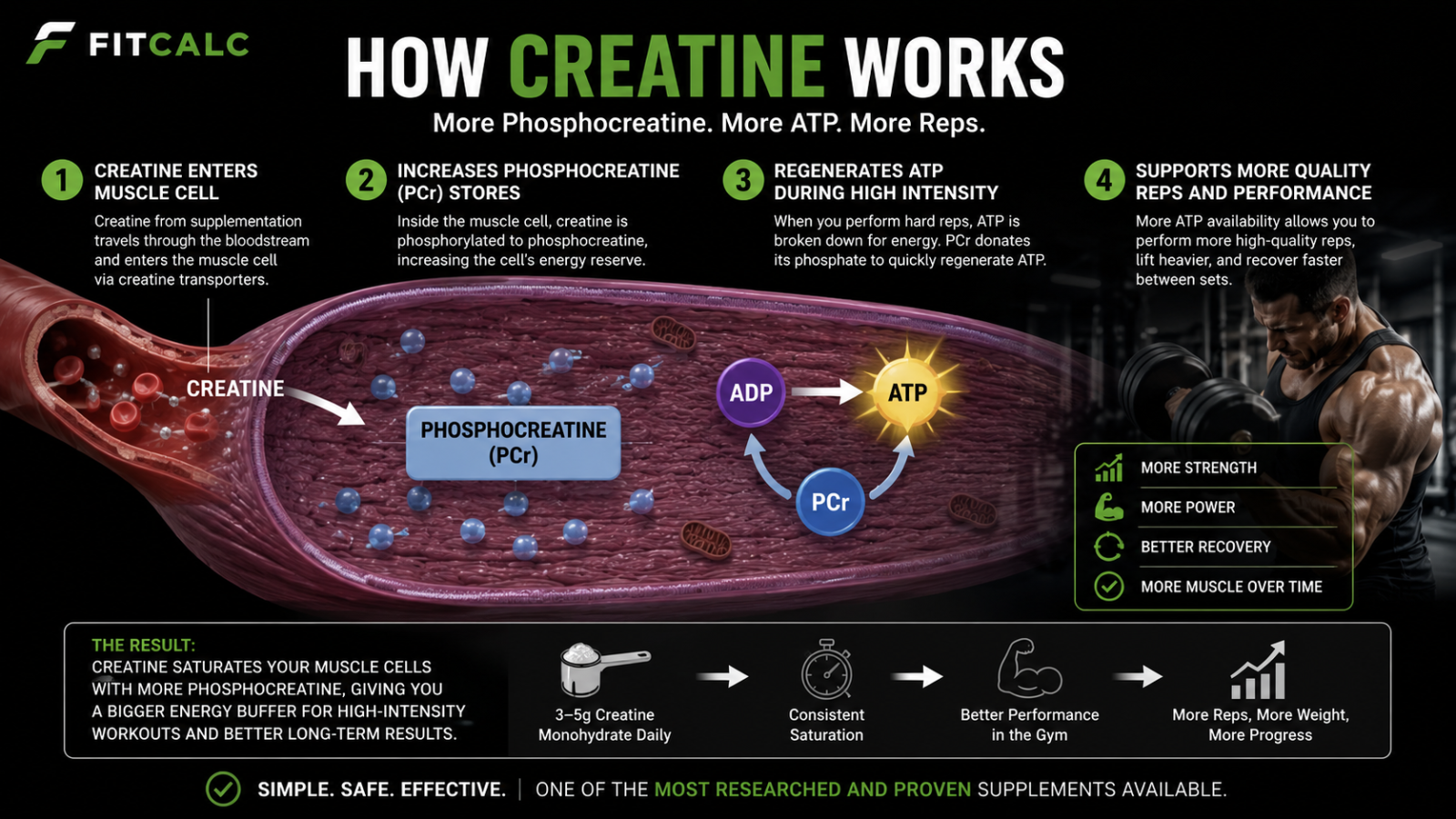
Once creatine reaches tissues such as skeletal muscle, some of it is converted into phosphocreatine. That stored phosphocreatine becomes particularly important when cells suddenly need large amounts of energy.
The immediate energy currency used by your cells is adenosine triphosphate, better known as ATP. During intense muscular work, ATP is broken down rapidly. Phosphocreatine can donate a phosphate group to help regenerate ATP, allowing the muscle to continue producing high levels of force for a little longer.
This is why creatine works particularly well for repeated high-intensity efforts. Think heavy sets of squats, sprinting, jumping, repeated sets in the gym, or other activities where your body repeatedly needs energy quickly. Supplementation increases muscle creatine and phosphocreatine stores beyond what many people maintain through ordinary diet alone, increasing the capacity of this energy system.
Creatine does not build muscle by acting like a steroid. It helps improve the energy environment in which hard training occurs, allowing you to perform more high-quality work and ultimately get more from your training.
What Creatine Actually Does for Muscle Growth
Creatine's reputation in bodybuilding exists for good reason.
A 2024 systematic review and meta-analysis examined creatine supplementation alongside resistance training in adults younger than 50. Compared with resistance training alone, adding creatine produced about 1.14 kilograms, or roughly 2.5 pounds, more lean body mass on average. Creatine supplementation was also associated with slightly greater reductions in body-fat percentage and fat mass.
That doesn't mean swallowing creatine while sitting on the couch automatically adds several pounds of new contractile muscle. Much of creatine's value comes from its interaction with training. If supplementation allows you to perform an additional repetition, maintain force better across repeated sets, or accumulate more quality training over months, those small performance improvements can contribute to greater adaptation.
Creatine also draws water into muscle cells as muscle creatine stores increase. This is responsible for some of the early increase in lean mass people experience after beginning supplementation. Importantly, this is intracellular water stored within muscle, not body fat. Many people actually notice that their muscles look slightly fuller rather than simply appearing "bloated."
Over longer periods, the combination of increased cellular hydration, improved training capacity, and resistance training can contribute to genuine increases in muscle tissue. The initial scale increase and long-term muscle-building effect are therefore related but not identical.
Creatine Helps You Train Harder
The muscle-building benefit makes more sense once you stop thinking about creatine as something that directly "creates" muscle.
Suppose you normally perform a hard set of an exercise for 10 repetitions. As the set continues, your ability to rapidly regenerate ATP becomes one of several factors contributing to fatigue. Greater phosphocreatine availability doesn't remove fatigue, but it can help support repeated high-intensity performance.
Multiply a small improvement across several exercises, multiple workouts per week, and years of training, and the potential value becomes obvious. Creatine helps make your training more productive, and productive training is what builds muscle.
This is also why creatine is relevant outside traditional bodybuilding. Sprinting, jumping, repeated bursts in sports, and other high-intensity activities rely substantially on rapid energy production. Creatine's usefulness isn't determined by whether you own a stringer tank top or compete in bodybuilding.
For older adults, this becomes even more interesting. Reviews consistently find that creatine combined with resistance training can improve lean mass, muscle thickness, strength, and functional ability beyond training alone in older populations. Maintaining muscle and strength becomes increasingly important with age, which is one reason we think creatine deserves to be viewed through a much broader lens than sports supplementation.
Creatine Isn't Just for Your Muscles
Your muscles aren't the only tissues that require rapid, reliable energy.
The brain is extremely energy-demanding and contains its own creatine-phosphocreatine system. This has led researchers to investigate whether increasing creatine availability can influence memory, attention, processing speed, and cognitive performance, particularly when the brain is under greater energetic stress.
A 2024 systematic review and meta-analysis included 16 randomized controlled trials involving adults between approximately 21 and 76 years old. Creatine supplementation produced statistically significant improvements in memory, attention time, and processing-speed measures, although the evidence was stronger for memory than for several other cognitive outcomes. The researchers did not find significant improvements in every measured domain, including overall cognition and executive function.
Another meta-analysis focused specifically on memory in healthy people and found a small but significant improvement with creatine supplementation. More recent research in older adults has also reported promising relationships between creatine and aspects of cognition, although the number of high-quality supplementation trials in that population remains much smaller than the exercise literature.
This doesn't mean five grams of creatine will suddenly turn someone into a genius. The cognitive evidence is promising, but it is not as established or consistent as the evidence for muscular performance. What it does show is that creatine's biological role extends well beyond making your biceps look fuller.
Higher Doses and Cognitive Performance
This is one area where doses above the typical 3–5 grams per day become interesting.
A 2024 randomized crossover experiment gave participants a single high dose of 0.35 grams of creatine per kilogram of bodyweight during 21 hours of sleep deprivation. Researchers observed changes in cerebral high-energy phosphates alongside improvements in cognitive performance and processing speed compared with placebo. A more recent experiment using 0.2 g/kg during sleep deprivation also reported less deterioration in several cognitive tasks.
These are unusually high acute doses studied under unusually stressful circumstances. They are not evidence that everyone should replace a normal 5-gram daily serving with 20 or 30 grams indefinitely. They do, however, demonstrate that researchers are actively investigating higher creatine availability for purposes extending beyond muscle performance.
For everyday use, we still think 3–5 grams daily is the sensible baseline. Higher-dose cognitive protocols are interesting research, not something the average healthy adult needs to copy without a reason.
Why Creatine Becomes More Interesting With Age
One reason we recommend creatine beyond the bodybuilding population is that maintaining muscle becomes increasingly important as people get older.
Age-related reductions in muscle mass, strength, and physical function can eventually affect everything from athletic ability to the ability to perform ordinary daily tasks. Creatine isn't a replacement for resistance training, adequate protein, or an active lifestyle, but evidence suggests it can make resistance training more productive in older adults.
A 2024 review concluded that creatine monohydrate combined with resistance training improves measures of lean mass, muscle thickness, upper- and lower-body strength, and functional ability in older adults. A newer review similarly describes accumulating evidence for benefits involving lean body mass, muscle size, strength, functional ability, and potentially aspects of cognition and memory.
This is one reason the idea that creatine is "for young gym guys" makes increasingly little sense. A 25-year-old lifter may take creatine to squeeze more performance from his training. A 65-year-old may have an even stronger long-term reason to care about preserving muscle, strength, and physical function.
We don't think someone should wait until muscle loss becomes a problem before taking muscle health seriously.
Does Creatine Damage Your Kidneys?
This is probably the most persistent creatine myth.
The confusion partly exists because creatine supplementation can increase serum creatinine, a blood marker commonly used when estimating kidney function. Creatinine is a breakdown product related to creatine metabolism, so increasing creatine intake can affect the marker without necessarily indicating kidney damage.
A 2026 systematic review and meta-analysis of randomized controlled trials found that creatine supplementation increased serum creatinine modestly but produced no significant differences in urea or estimated glomerular filtration rate (eGFR) between creatine and control groups. The authors concluded that the increase in serum creatinine did not correspond with significant alterations in the other evaluated measures of renal function.
Another recent systematic review reached a similar conclusion: creatine supplementation produced a small increase in serum creatinine while pooled evidence did not indicate a significant reduction in glomerular filtration rate.
For a healthy adult with normal kidney function, the available evidence does not support the idea that recommended creatine supplementation damages healthy kidneys. Someone with known kidney disease, abnormal renal function, or a medical condition requiring management is in a different situation and should discuss supplementation with the clinician managing that condition.
One practical point is worth remembering: if you take creatine and have bloodwork performed, tell your healthcare provider that you supplement with creatine. Serum creatinine can be interpreted differently when supplementation is part of the picture.
What About Creatine and Hair Loss?
The hair-loss concern became popular largely because of a small 2009 study in rugby players that reported an increase in dihydrotestosterone, or DHT, after a creatine-loading protocol. DHT is involved in androgenetic hair loss in genetically susceptible people, so the result quickly turned into the much broader internet claim that creatine causes baldness.
That conclusion was never actually demonstrated by the study. It measured hormones, not hair loss.
Subsequent reviews have repeatedly pointed out that the original finding has not established that creatine causes hair loss, and the available evidence has not demonstrated a direct causal relationship between normal creatine supplementation and balding. Until good human research shows otherwise, we don't consider fear of hair loss a compelling reason for a healthy adult to avoid creatine.

Do You Need a Loading Phase?
No.
A traditional creatine-loading protocol uses approximately 20 grams per day, often divided into four 5-gram servings, for around five to seven days. Afterward, intake drops to a maintenance dose of roughly 3–5 grams daily.
Loading works because it saturates muscle creatine stores faster.
It is also completely optional.
Taking 3–5 grams every day will gradually increase muscle creatine stores without a loading phase. It simply takes longer to reach a similar level of saturation. For most people who aren't in a hurry, this is the approach we prefer because it is simple and tends to reduce the chance of gastrointestinal discomfort associated with taking large amounts at once.
Creatine is a long-term habit, not a seven-day transformation. Whether saturation takes a week or several weeks isn't particularly important when you're planning to take it consistently for years.
You Don't Need to Cycle Creatine
There is also no compelling reason for healthy people to routinely cycle on and off creatine.
Creatine isn't an anabolic steroid, and supplementation doesn't require the kind of "off cycle" commonly associated with hormonal drugs. Once muscle creatine stores are elevated, consistent intake helps maintain them. If you stop supplementing, those stores gradually return toward baseline.
Taking creatine for eight weeks and then intentionally stopping for four doesn't provide an established advantage. It mostly means spending part of the year without the elevated creatine stores you were supplementing to achieve.
Take it every day.
Consistency matters far more than complicated cycling schedules.
When Should You Take Creatine?
Whenever you're most likely to remember it.
Research has investigated pre-workout versus post-workout timing, consuming creatine with carbohydrates or protein, and numerous other strategies. None of that changes the basic reality that creatine works by gradually increasing tissue creatine stores.
This isn't caffeine. You don't swallow five grams and suddenly feel stronger 20 minutes later.
Take it with breakfast. Put it in water after training. Mix it into a shake. Take it with dinner. The best time is the one that makes daily supplementation automatic.
If you consistently take creatine, timing is a detail. Consistency is the strategy.

What Kind of Creatine Should You Buy?
This part is even simpler.
Creatine monohydrate.
Supplement companies have developed creatine hydrochloride, buffered creatine, creatine ethyl ester, liquid creatine, creatine nitrate, and plenty of other variations. They are often marketed as being absorbed better, requiring smaller doses, causing less water retention, or producing superior results.
Creatine monohydrate remains the form with the enormous research base behind it. There is little reason for the average person to pay more for an exotic version simply because the label sounds more advanced.
We also prefer the ingredient list to be as boring as possible.
Ideally, turn the container around and see:
Creatine monohydrate.
That's it.
You don't need artificial colors, proprietary blends, stimulants, sweeteners, gums, fillers, or a fruit-punch flavor system for creatine to work. Buy plain creatine monohydrate from a reputable manufacturer and mix it into whatever you normally drink.
How Much Creatine Should You Take?
For the average healthy adult, our recommendation is straightforward:
3–5 grams of creatine monohydrate every day.
Larger individuals with considerably more muscle mass may reasonably gravitate toward the higher end, while five grams is an easy universal amount for most adults. You don't need to calculate the dose to the decimal point.
Creatine is also naturally present in meat and fish, which is one reason people eating diets rich in animal foods already consume some creatine. Supplementation is still useful because consistently obtaining enough dietary creatine to maximize tissue stores would require eating impractically large amounts of those foods every day.
We prefer getting nutrients from whole foods whenever practical, but creatine is a good example of where supplementation has a clear purpose. A few grams of a naturally occurring compound can raise tissue creatine stores beyond what most diets reliably provide.
That makes creatine fundamentally different from many supplement products containing dozens of ingredients with questionable doses and little meaningful evidence.
The FitCalc Approach
Creatine is one of the easiest supplements for us to recommend.
If you're a normal, healthy adult, we believe plain creatine monohydrate deserves a place in your daily routine whether or not you consider yourself a bodybuilder. Its strongest benefits are established in strength, high-intensity performance, lean mass, and resistance-training adaptations, while research into aging and brain function makes the supplement increasingly interesting outside the gym.
Our approach is intentionally boring: buy plain creatine monohydrate with no unnecessary additives, take 3–5 grams every day, and don't overthink the timing. You don't need a loading phase. You don't need to cycle off. You don't need the expensive new form with a complicated name.
Creatine won't replace protein, resistance training, sleep, or a nutrient-dense diet. It won't transform your physique without putting in the work, and the emerging cognitive research shouldn't be exaggerated into claims that creatine makes everyone dramatically smarter.
But that doesn't diminish what makes it unusual.
Creatine is inexpensive, extensively researched, naturally present in the human body and animal foods, useful for muscular performance, increasingly relevant to healthy aging, and potentially beneficial to aspects of brain function. Very few supplements can make that kind of case.
For most healthy adults, we don't see much reason to leave those potential benefits on the table.
Sources
Kreider RB, Kalman DS, Antonio J, et al. International Society of Sports Nutrition position stand: safety and efficacy of creatine supplementation in exercise, sport, and medicine. Journal of the International Society of Sports Nutrition. 2017. Comprehensive review of creatine's effects on exercise performance, muscle, dosing, and long-term safety. PubMed
Kreider RB, Stout JR. Creatine in Health and Disease. Nutrients. 2021. Reviews creatine's biological roles and research extending beyond sports performance, including aging, neurological function, metabolism, and health applications. PubMed Central
Forbes SC, Candow DG, Ferreira LHB, Souza-Junior TP. Effects of Creatine Supplementation on Properties of Muscle, Bone, and Brain Function in Older Adults: A Narrative Review. Journal of Dietary Supplements. Reviews evidence surrounding creatine, resistance training, aging, muscle function, bone, and brain health. PubMed
Avgerinos KI, Spyrou N, Bougioukas KI, Kapogiannis D. Effects of creatine supplementation on cognitive function of healthy individuals: A systematic review of randomized controlled trials. Experimental Gerontology. 2018. Found evidence of potential cognitive benefits, particularly for memory and in populations with lower baseline creatine availability or greater physiological demand. PubMed
Prokopidis K, Giannos P, Triantafyllidis KK, et al. Effects of creatine supplementation on memory in healthy individuals: a systematic review and meta-analysis of randomized controlled trials. Nutrition Reviews. 2023. Meta-analysis examining creatine supplementation and memory performance in healthy people. PubMed
Roschel H, Gualano B, Ostojic SM, Rawson ES. Creatine Supplementation and Brain Health. Nutrients. 2021. Reviews brain creatine metabolism and evidence concerning cognition, sleep deprivation, neurological function, and circumstances that may increase brain creatine requirements. PubMed Central
Antonio J, Candow DG, Forbes SC, et al. Common questions and misconceptions about creatine supplementation: what does the scientific evidence really show? Journal of the International Society of Sports Nutrition. 2021. Addresses kidney function, water retention, hair loss, loading, sex differences, children/adolescents, fat mass, and whether alternative forms outperform creatine monohydrate. PubMed Central