How Much Sleep Do You Actually Need for Muscle Growth and Recovery?
People will carefully track calories, protein, carbohydrates, sets, repetitions, and supplements while routinely sleeping five or six hours per night.
That is a strange place to cut corners.
Sleep is not a magic muscle-building hack, and getting nine hours instead of eight will not suddenly transform your results. But sleep is one of the basic conditions that supports recovery, normal physiological function, and your ability to continue performing productive training sessions.
The American Academy of Sleep Medicine and Sleep Research Society recommend that healthy adults regularly get at least seven hours of sleep per night. Their expert panel also considered 7–9 hours appropriate for supporting optimal adult health, while recognizing that individual needs vary.
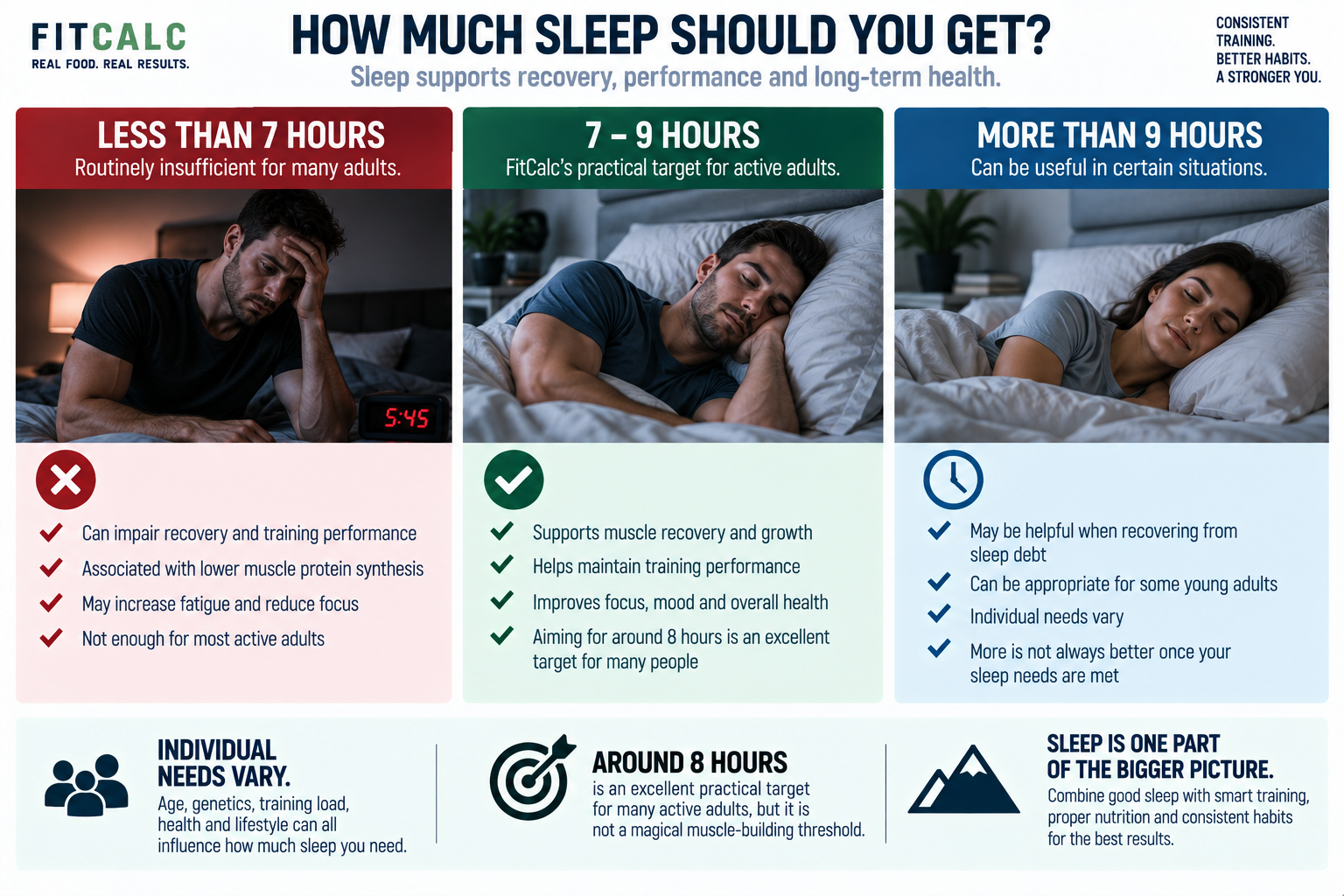
For active adults concerned with muscle growth, strength, recovery, and body composition, FitCalc recommends aiming for roughly 7–9 hours of quality sleep per night, with around eight hours being an excellent practical target for many people.
That does not mean one six-hour night destroys your gains. It means consistently treating sleep as optional while trying to optimize everything else is probably working against you.
How Much Sleep Do You Actually Need?
There is no scientifically established number of hours that suddenly maximizes muscle growth.
You will sometimes hear that everyone needs exactly eight hours, but individual sleep needs vary. Genetics, age, activity, health, previous sleep, and other factors can influence how much sleep someone needs to feel and perform their best. The major adult sleep recommendation is therefore framed as seven or more hours on a regular basis, rather than declaring exactly eight hours universally optimal.
FitCalc uses 7–9 hours as a practical target for most active adults.
Someone who consistently feels well recovered and performs well after seven and a half hours does not need to force themselves to lie in bed for nine simply because more sounds better. Likewise, someone who routinely sleeps five hours should not assume their sleep is adequate just because they can still make it through a workout.
Young adults and people recovering from accumulated sleep debt may sometimes benefit from more than nine hours. The AASM/SRS consensus specifically recognizes longer sleep as potentially appropriate in those circumstances.
Sleep quality matters too. Spending eight hours in bed while repeatedly waking throughout the night is not necessarily equivalent to eight hours of uninterrupted sleep. Duration is the easiest number to discuss, but sleep timing, regularity, and quality also matter. The AASM/SRS methodology itself notes that healthy sleep involves more than duration alone.
For practical purposes, start by giving yourself enough opportunity to sleep. If you want eight hours but only allow yourself six and a half hours between getting into bed and your alarm going off, no supplement or recovery technique can make up the missing time.
What Happens to Muscle When You Don't Sleep Enough?
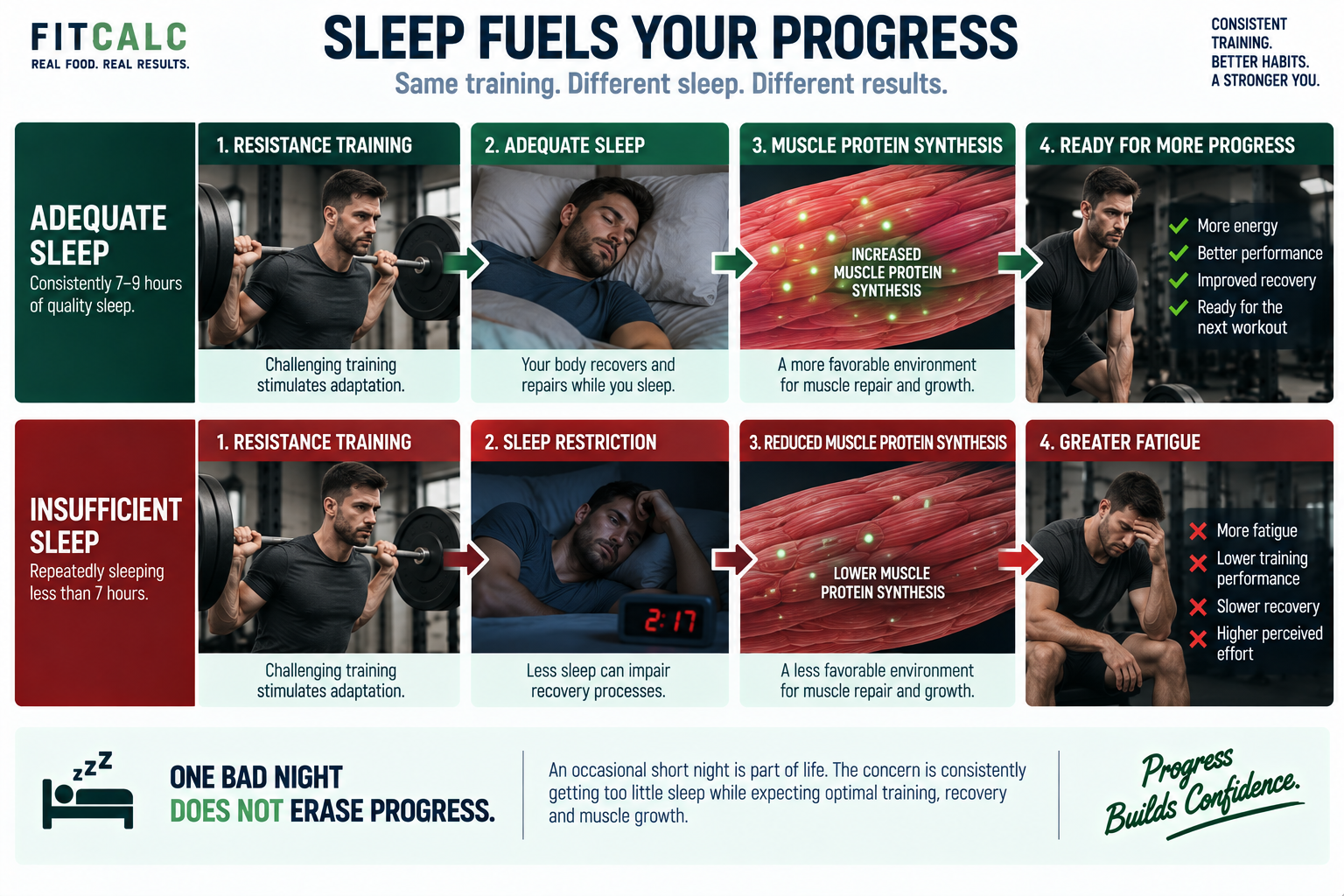
One of the most direct connections between sleep and muscle comes from research examining muscle protein synthesis.
Muscle protein synthesis is part of the continuous process through which muscle proteins are built and remodeled. Resistance training and adequate dietary protein stimulate this process, which is one reason FitCalc places such a strong emphasis on progressive training and sufficient protein intake.
Sleep restriction appears capable of interfering with that environment.
In one controlled study, 24 healthy young men completed five nights under different sleep conditions. One group had eight hours in bed each night, while another was restricted to only four hours. Researchers found that myofibrillar protein synthesis was lower in the sleep-restricted group.
Another experiment involving one night of complete sleep deprivation found an 18% reduction in post-meal muscle protein synthesis compared with the normal-sleep condition.
Those findings are meaningful, but they need context.
Neither experiment proves that sleeping six hours instead of eight will cause you to build a specific percentage less muscle over the next year. Four hours of sleep for five consecutive nights and an entire night without sleep are much more severe than the occasional short night most people experience.
The correct takeaway is more restrained: significant sleep restriction can create a less favorable physiological environment for muscle protein synthesis and recovery.
That matters if your goal is muscle growth. You can train hard, eat enough calories, and consume roughly 1 gram of protein per pound of bodyweight as FitCalc recommends, but recovery is still part of the process.
Does Poor Sleep Make You Weaker in the Gym?
This is where the evidence becomes more interesting. You might expect a bad night of sleep to immediately destroy your strength the following day. That does not always happen.
A systematic review examining inadequate sleep and resistance-exercise performance found that sleep deprivation often had little effect on measures of muscular strength, although the studies were limited and results varied depending on the type and duration of sleep loss.
That helps explain something many lifters have experienced: you can sleep badly and occasionally still have a surprisingly good workout. But strength is not the only component of performance.
A 2024 systematic review and meta-analysis found that acute sleep deprivation negatively affected overall athletic performance, including high-intensity intermittent exercise, skill control, speed, aerobic endurance, and explosive power. The effects varied depending on the type and timing of sleep loss. Other meta-analytic evidence has also found a moderate negative effect of sleep deprivation on endurance performance.
Poor sleep can also increase sleepiness and impair attention, which matters when you're trying to execute technically demanding movements safely and consistently. This is why judging sleep entirely by whether you can still bench press your normal weight is too simplistic. Being capable of completing a workout after poor sleep does not mean you are fully recovered.
One bad night is not a reason to panic or automatically skip the gym. If you feel capable of training safely, you may still have a productive session. The larger concern is repeatedly sleeping too little while expecting your body to perform and recover optimally week after week.
Sleep, Testosterone, and Hormones
Sleep discussions in fitness often become testosterone discussions almost immediately. There is some evidence supporting a relationship, but it is easy to exaggerate.
A frequently cited small experiment studied 10 healthy young men after a rested condition and then after one week in which they were limited to five hours in bed per night. Daytime testosterone concentrations were approximately 10–15% lower following the sleep-restricted period.
That is interesting evidence that substantial sleep restriction can influence the hormonal environment. It is not evidence that going to bed two hours late tonight will crash your testosterone and destroy tomorrow's muscle growth.
The study was very small, the restriction was substantial, and testosterone is only one part of an enormously complicated recovery system. Sleep influences cognitive performance, metabolism, nervous-system function, immune function, appetite, muscle protein metabolism, and many other processes.
FitCalc therefore does not recommend thinking about sleep solely as a way to "boost testosterone." Get enough sleep because sleep itself is a fundamental biological requirement, not because you're trying to manipulate one hormone.
Can Naps or Catch-Up Sleep Help?
If you occasionally sleep poorly, getting additional sleep later can be useful.
Research on athletes suggests that sleep extension—deliberately increasing sleep opportunity—may improve some aspects of athletic performance, particularly in people who were not getting enough sleep beforehand. However, the evidence base is still relatively small, and the magnitude of benefit varies between outcomes.
Naps can help too.
A systematic review examining napping in athletes found potential benefits across physical and cognitive performance, fatigue, sleepiness, and other outcomes. The authors noted that naps provide an opportunity to supplement nighttime sleep without necessarily compromising sleep quality. A broader review of sleep interventions similarly found sleep extension and napping among the more effective strategies studied for improving sleep and subsequent performance, while acknowledging limitations in the evidence.
FitCalc's position is simple: nighttime sleep should remain the foundation.
A nap is useful when you had a short night, have an unusually demanding schedule, or simply benefit from one. It should not become a strategy for intentionally sleeping four or five hours every night and attempting to patch the problem during the afternoon. The same applies to weekends.
Sleeping longer after a period of insufficient sleep can help recover some sleep debt, and longer sleep is specifically recognized as potentially appropriate during sleep-debt recovery. But deliberately sleeping too little Monday through Friday and relying on marathon weekend sleep is not the same strategy as consistently giving yourself enough sleep. Consistency remains the better foundation.
How to Get Better Sleep Without Overcomplicating It
Improving sleep does not require turning bedtime into another complicated optimization routine.
The most basic step is simply giving yourself enough time to sleep. If your alarm is set for 6:30 a.m. and you regularly stay awake until 1:00 a.m., the problem is not that you haven't found the right magnesium supplement. Your schedule does not provide enough sleep opportunity.
Consistency can help. Going to sleep and waking at roughly similar times supports a more predictable sleep-wake rhythm. Your bedroom should generally be dark, quiet, and comfortable, and many people sleep better in a relatively cool environment.
Caffeine deserves attention if you consume it later in the day. Its effects can persist for hours, so someone struggling to fall asleep may benefit from moving their final coffee or energy drink earlier. Alcohol can make people feel sleepy initially while still interfering with normal sleep quality, so using it as a sleep aid is not a good recovery strategy.
Screens are often blamed for every sleep problem, but the practical issue is broader than simply owning a phone. Bright light, stimulating content, work, gaming, and endlessly scrolling when you should already be sleeping can all delay bedtime. If your phone causes you to stay awake an additional hour every night, changing that habit matters more than finding the perfect nighttime supplement.
Training itself does not need to be treated as an enemy of sleep. A systematic review of randomized trials found that chronic resistance exercise generally improved sleep, particularly sleep quality, although acute effects were less consistent. If very late training personally leaves you wired and unable to sleep, adjusting the timing may make sense. Otherwise, resistance training and good sleep can complement one another.
The goal is not to create a perfect bedtime ritual.
It's to remove obvious barriers to getting enough consistent, high-quality sleep.
The Bottom Line
Sleep deserves a place alongside training and nutrition when you are trying to build muscle, become stronger, or recover from demanding exercise.
For most active adults, FitCalc recommends aiming for roughly 7–9 hours of quality sleep per night, with around eight hours being an excellent practical target for many people. That is a useful range, not a magical hypertrophy formula.
Significant sleep restriction can reduce muscle protein synthesis and negatively affect several aspects of physical performance. At the same time, one bad night does not erase your progress, and you may occasionally perform surprisingly well despite sleeping poorly.
The bigger problem is chronic under-sleeping.
Train progressively. Eat enough quality food. Consume sufficient protein and carbohydrates. Give your body enough time to recover. And if you're already obsessing over the final 5% of your training or nutrition while routinely sleeping five hours per night, sleep is probably the more important problem to fix.
Sources
Watson NF, Badr MS, Belenky G, et al. Recommended Amount of Sleep for a Healthy Adult: A Joint Consensus Statement of the American Academy of Sleep Medicine and Sleep Research Society. Journal of Clinical Sleep Medicine. 2015.
Saner NJ, Lee MJC, Pitchford NW, et al. The Effect of Sleep Restriction, With or Without High-Intensity Interval Exercise, on Myofibrillar Protein Synthesis in Healthy Young Men. The Journal of Physiology. 2020.
Lamon S, Morabito A, Arentson-Lantz E, et al. The Effect of Acute Sleep Deprivation on Skeletal Muscle Protein Synthesis and the Hormonal Environment. Physiological Reports. 2021.
Gong M, Sun M, Sun Y, Jin L, Li S. Effects of Acute Sleep Deprivation on Sporting Performance in Athletes: A Comprehensive Systematic Review and Meta-Analysis. Nature and Science of Sleep. 2024.
Knowles OE, Drinkwater EJ, Urwin CS, Lamon S, Aisbett B. Inadequate Sleep and Muscle Strength: Implications for Resistance Training. Journal of Science and Medicine in Sport. 2018.
Leproult R, Van Cauter E. Effect of 1 Week of Sleep Restriction on Testosterone Levels in Young Healthy Men. JAMA. 2011.
Silva AC, et al. Sleep Extension in Athletes: What We Know So Far — A Systematic Review. Sleep Medicine. 2021.
Bonnar D, et al. The Impact of Sleep Interventions on Athletic Performance: A Systematic Review. 2023.
Kovacevic A, Mavros Y, Heisz JJ, Fiatarone Singh MA. The Effect of Resistance Exercise on Sleep: A Systematic Review of Randomized Controlled Trials. Sleep Medicine Reviews. 2018.