
Eggs Every Day: What Actually Happens When You Eat 2–4 Eggs Daily?
Few foods have had their reputation changed as many times as eggs. They have been praised as a nearly perfect source of nutrition, blamed for raising cholesterol, replaced with egg-white omelets, and more recently welcomed back into diets as people have reconsidered how dietary cholesterol actually affects the body.
At FitCalc, our position is straightforward: whole eggs are one of the best foods you can regularly include in your diet. For the average healthy adult, eating 2–4 eggs per day is a perfectly reasonable habit, and higher intakes can also fit into a healthy diet depending on the rest of what you eat.
The important word there is whole. Throwing away the yolk to avoid cholesterol removes many of the nutrients that make an egg so valuable in the first place. Eggs provide highly digestible complete protein, fat, choline, vitamin B12, selenium, carotenoids, and numerous other nutrients in a remarkably simple package.
The old argument against them centered largely on one fact: egg yolks contain a lot of cholesterol. That fact is true. The conclusion that healthy people therefore need to avoid eggs is far less convincing.
What Do You Actually Get From Eating Eggs Every Day?
Eggs are sometimes discussed almost entirely in terms of protein, but their nutritional value goes considerably further. A large egg provides roughly 6 grams of high-quality protein, meaning four eggs can contribute around 24–25 grams before anything else is added to the meal. Egg protein contains all nine essential amino acids and is highly digestible, making eggs particularly useful for people trying to build or maintain muscle.
The yolk is where much of the nutritional value becomes especially interesting. Egg yolks provide choline, vitamin B12, selenium, riboflavin, phosphorus, and fat-soluble nutrients, while also supplying the carotenoids lutein and zeaxanthin. Choline deserves particular attention because it is required for normal cell membranes, acetylcholine production, lipid transport, and other physiological functions. Eggs are among the richest commonly eaten food sources of it.
Eating several eggs also makes obtaining these nutrients extremely convenient. You don't need a supplement stack or a complicated breakfast. Three eggs with beef, potatoes, and fruit gives you complete protein, fats, carbohydrates, vitamins, minerals, and a substantial amount of food for relatively little preparation.
This is one reason we prefer evaluating foods as whole foods rather than reducing them to one nutrient. An egg contains cholesterol, but it also contains protein, phospholipids, choline, carotenoids, vitamins, minerals, and fats. Judging the entire food exclusively by its cholesterol content ignores most of what you're actually eating.
The Egg Yolk Is Not Something You Need to Throw Away
The popularity of egg-white omelets made sense under the old dietary philosophy: keep the protein, throw away the cholesterol and fat, and theoretically you have a healthier food.
We don't think that's an improvement.
Egg whites are certainly a useful protein source, but the yolk contains most of the egg's micronutrients and bioactive compounds. If you're eating eggs because they're nutrient dense, discarding the yolk defeats much of the purpose.
There is even interesting evidence that the whole-food matrix may matter for muscle recovery. In a randomized crossover trial involving resistance-trained young men, researchers provided either whole eggs or egg whites after exercise, with both meals containing the same 18 grams of protein. Both supplied similar amounts of leucine to the bloodstream, yet the whole eggs stimulated a greater post-exercise muscle protein synthesis response than the equivalent amount of protein from egg whites.
That small study does not mean egg whites suddenly become useless for building muscle. It does, however, reinforce an idea we return to frequently at FitCalc: nutrients exist within foods, and isolating one desirable nutrient while removing everything around it does not necessarily improve the food.
If you're a healthy person eating eggs, eat the yolk.

What About All That Cholesterol?
This is the concern that kept many people away from eggs for years.
A large egg contains roughly 180–200 milligrams of cholesterol, almost entirely in the yolk. Eating three eggs can therefore provide well over 500 milligrams of dietary cholesterol before accounting for the rest of the diet.
For years, it was easy to look at those numbers and assume that cholesterol eaten must translate directly into cholesterol accumulating in the bloodstream. Human physiology is more complicated.
Your body produces cholesterol itself because cholesterol is essential for life. It contributes to cell membranes and serves as a precursor for steroid hormones, bile acids, and vitamin D. When dietary cholesterol changes, the body can adjust its own cholesterol synthesis and handling to some degree. The response also varies considerably between individuals.
Controlled trials do show that eggs can modestly alter blood cholesterol. A meta-analysis of 28 randomized trials found that egg consumption increased LDL cholesterol by an average of about 5.6 mg/dL, while also increasing HDL cholesterol by roughly 2.1 mg/dL. Importantly, the analysis found no significant change in the LDL-to-HDL or total-cholesterol-to-HDL ratios.
That is different from claiming dietary cholesterol has literally zero effect on blood cholesterol. Some people respond more strongly than others. But it is also very different from the old assumption that eating cholesterol translates directly into a dangerous rise in blood cholesterol.
A more recent randomized crossover trial published in 2025 separated dietary cholesterol from saturated fat more carefully. Participants consumed diets containing different combinations of cholesterol and saturated fat, including a high-cholesterol, low-saturated-fat diet containing two eggs per day. The researchers found that saturated fat intake was more strongly associated with LDL cholesterol than dietary cholesterol itself.
In other words, the cholesterol inside an egg should not be treated as though it simply pours into your bloodstream unchanged.
Do Eggs Increase Heart-Disease Risk?
If eggs were inherently dangerous because of their cholesterol content, we would expect habitual egg consumption to produce a clear and consistent increase in cardiovascular disease. The research has not produced anything close to that simple picture.
A large 2020 analysis published in the BMJ combined three major U.S. cohorts with an updated meta-analysis covering more than 1.7 million people. Consumption of at least one egg per day was not associated with greater cardiovascular disease risk in the U.S. cohorts. Across the broader meta-analysis, each additional egg per day was also not associated with increased overall cardiovascular disease risk.
Another 2020 systematic review and meta-analysis included more than 1.4 million people. Higher egg consumption, defined as more than one egg per day, was not associated with increased overall cardiovascular disease events and was associated with a lower observed risk of coronary artery disease.
The literature isn't perfectly uniform. Some observational studies have reported associations between higher dietary cholesterol or egg consumption and increased cardiovascular or mortality risk, while others find no association or even inverse associations. That inconsistency matters because observational nutrition studies have major limitations. People who eat different amounts of eggs can also differ in smoking, activity, bodyweight, total diet, socioeconomic factors, and the foods they typically eat with their eggs.
A 2025 umbrella review examining recent systematic reviews and meta-analyses reached an especially useful conclusion. It found substantial heterogeneity and judged the strength of evidence behind significant egg-health associations to be very weak. Overall, the authors concluded that there was insufficient evidence to discourage egg consumption as part of a healthy diet.
That is much closer to how we think eggs should be viewed.
Eating Three Eggs a Day Has Actually Been Studied
We don't have to limit the discussion to people eating a few eggs per week.
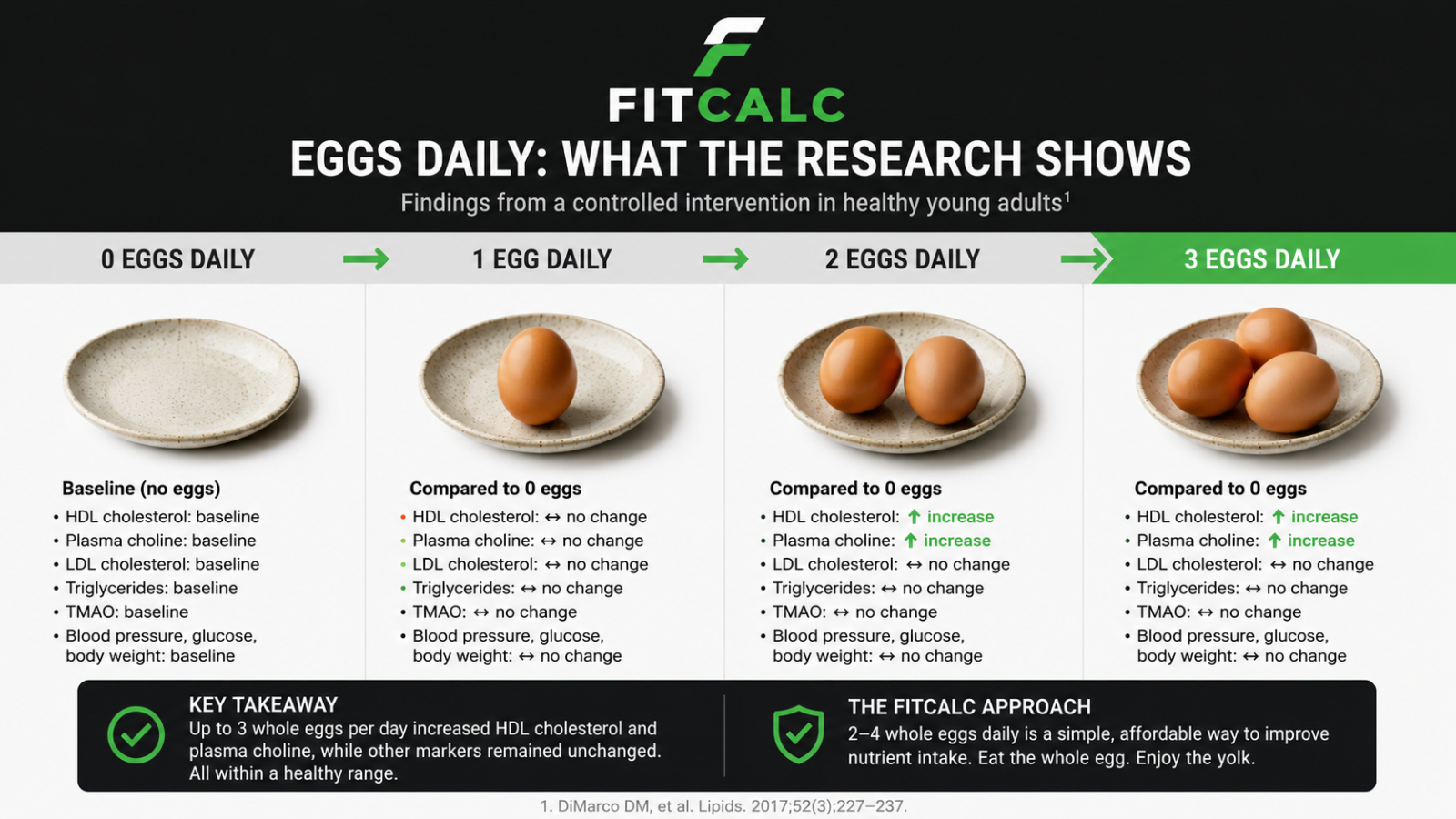
Controlled interventions have specifically examined people consuming multiple whole eggs every day. In one crossover trial, healthy young adults progressed through periods of eating zero, one, two, and three eggs per day. Three daily eggs increased HDL cholesterol and plasma choline, while bodyweight, waist circumference, blood pressure, glucose, triglycerides, and TMAO did not significantly change throughout the intervention.
Another intervention compared three eggs per day with a choline supplement in healthy young adults. Egg consumption increased both LDL and HDL cholesterol, but the LDL-to-HDL ratio did not change. The researchers also observed biological adaptations related to cholesterol synthesis, illustrating again that the body responds dynamically to increased dietary cholesterol rather than simply absorbing it without regulation.
Research involving adults with metabolic syndrome has also examined three whole eggs per day. In one 12-week trial conducted alongside a moderately carbohydrate-restricted diet, the whole-egg group experienced improvements in several aspects of its lipoprotein profile and insulin resistance compared with participants consuming yolk-free egg substitute.
These studies aren't proof that everybody needs three eggs every morning. They simply make it difficult to defend the idea that regularly eating several whole eggs is inherently unhealthy.
What Happens When You Eat 2–4 Eggs Every Day?
For most healthy people, the answer is considerably less dramatic than decades of cholesterol warnings might lead you to expect.
You'll consistently consume a substantial serving of complete, highly digestible protein. You'll increase your intake of choline and several vitamins and minerals. You'll get the nutrients contained in the yolk rather than relying exclusively on lean isolated protein sources. And because eggs are filling, inexpensive relative to many other animal proteins, and extremely versatile, they can make maintaining a nutrient-dense diet easier.
Your blood lipids may change somewhat. Some people experience increases in both LDL and HDL cholesterol when dietary cholesterol increases, while others respond very little. Individual response exists, which is precisely why sweeping claims about eggs and cholesterol have never described everyone particularly well.
For someone who enjoys eggs, there is little reason to fear eating two, three, or four whole eggs as part of an otherwise high-quality diet.
What about six?
Research becomes thinner as habitual intake gets that high, particularly when we're asking about six eggs every day for decades rather than short controlled interventions. We therefore wouldn't pretend there is a magic study proving six daily eggs is the ideal intake for every adult. At the same time, six eggs provide roughly 36 grams of high-quality protein and can reasonably fit into the diet of a healthy, active person whose overall calorie intake and food choices accommodate them.
Our recommendation is not that everyone must eat six eggs. It's that healthy people shouldn't be afraid of whole eggs simply because the yolks contain cholesterol.
What You Eat With Your Eggs Still Matters
There's an important problem with trying to determine whether a single food is "healthy" using observational nutrition data: people don't eat individual foods in isolation.
Consider two breakfasts. The first contains three eggs cooked in tallow with potatoes, berries, and perhaps some beef. The second contains three eggs alongside refined toast, sugary cereal, processed breakfast meat, fried hash browns cooked in repeatedly heated oil, and a large sweetened drink.
Both people ate three eggs. Their breakfasts are not nutritionally equivalent.
This is why we care so much about the overall dietary pattern. Eggs fit naturally into a diet centered on meat, fruit, vegetables, potatoes, quality dairy, and other whole or minimally processed foods. Adding eggs to an otherwise poor diet doesn't magically make the diet healthy, but removing eggs from a high-quality diet because of an outdated fear of dietary cholesterol doesn't make much sense either.
Keep the food simple. Cook the eggs in a quality fat such as beef tallow, butter, or ghee if tolerated. Pair them with other whole foods and eat the yolks rather than throwing away one of the most nutrient-dense portions of the meal.
The FitCalc Approach
For the average healthy adult who enjoys eggs, 2–4 whole eggs per day is an excellent range. It provides meaningful protein and micronutrients without requiring eggs to dominate every meal. Active people with higher calorie and protein requirements can reasonably eat more, and consuming four, five, or even six eggs on a given day isn't something we consider inherently concerning simply because of their cholesterol content.
We also don't recommend replacing whole eggs with egg whites as a default health strategy. Egg whites provide useful protein, but the yolk contains choline, carotenoids, fats, vitamins, minerals, and other components that make the whole egg nutritionally valuable.
People with diagnosed lipid disorders, familial hypercholesterolemia, cardiovascular disease, or specific medical dietary instructions have circumstances that extend beyond a general nutrition article and should evaluate their individual response appropriately. For everyone else, the evidence simply doesn't justify treating eggs like a food that needs to be rationed.
Eat the whole egg. Enjoy the yolk. Build the rest of your diet around quality whole foods.
Eggs have spent enough time being feared for one nutrient while everything else they provide was ignored.
Sources
Drouin-Chartier JP, Chen S, Li Y, et al. Egg consumption and risk of cardiovascular disease: three large prospective US cohort studies, systematic review, and updated meta-analysis. BMJ. 2020. More than 1.7 million participants were represented in the updated meta-analysis, which found no overall association between an additional egg per day and cardiovascular disease.
Khalighi Sikaroudi M, et al. Association Between Egg Consumption and Risk of Cardiovascular Outcomes: A Systematic Review and Meta-Analysis. American Journal of Medicine. 2020. Higher egg consumption was not associated with increased overall cardiovascular disease events in the pooled analysis.
Rouhani MH, et al. Effects of Egg Consumption on Blood Lipids: A Systematic Review and Meta-Analysis of Randomized Clinical Trials. Journal of the American College of Nutrition. Analysis of 28 randomized trials found modest increases in LDL and HDL cholesterol without significant changes in LDL or total-cholesterol ratios.
Carter S, Hill AM, Yandell C, et al. Impact of dietary cholesterol from eggs and saturated fat on LDL cholesterol levels: a randomized cross-over study. American Journal of Clinical Nutrition. 2025. The controlled trial independently examined dietary cholesterol and saturated fat, including a diet providing two eggs daily.
DiMarco DM, et al. Intake of up to 3 Eggs/Day Increases HDL Cholesterol and Plasma Choline While Plasma Trimethylamine-N-oxide is Unchanged in a Healthy Population. Lipids. 2017.
van Vliet S, Shy EL, Abou Sawan S, et al. Consumption of whole eggs promotes greater stimulation of postexercise muscle protein synthesis than consumption of isonitrogenous amounts of egg whites in young men. American Journal of Clinical Nutrition. 2017.
Pisciotta L, et al. Effect of egg consumption on health outcomes: An updated umbrella review of systematic reviews and meta-analysis of observational and intervention studies. Nutrition, Metabolism and Cardiovascular Diseases. 2025. The review found the evidence behind significant egg-health associations to be weak and concluded there was insufficient evidence to discourage egg consumption.