Beef Tallow vs. Seed Oils: Why We Prefer Tallow for Cooking
For decades, vegetable oils such as soybean, corn, canola, sunflower, and safflower oil have occupied a nearly permanent place in American kitchens. They are inexpensive, widely available, and commonly recommended as replacements for traditional animal fats because many contain relatively little saturated fat. Beef tallow, meanwhile, spent years being treated as an outdated cooking fat. Recently, that has begun to change. Tallow has returned to grocery shelves, restaurant kitchens, and home cooking as more people have taken an interest in traditional fats and questioned whether highly refined seed oils should automatically be considered the healthier choice.
At FitCalc, we prefer beef tallow over conventional seed oils for cooking, particularly when higher temperatures are involved. That preference is based largely on the chemistry of the fats themselves. Tallow contains a substantial proportion of saturated and monounsaturated fatty acids, which makes it comparatively resistant to oxidative degradation during heating. Many conventional seed oils contain considerably more polyunsaturated fatty acids, whose multiple double bonds make them more vulnerable to oxidation. We also prefer the simplicity of a traditional rendered animal fat within a diet built primarily around whole and minimally processed foods.
That does not mean every criticism of seed oils is scientifically established, nor does it mean beef tallow has been proven in long-term randomized trials to prevent cardiovascular disease. The evidence is more complicated than either side of the online debate often suggests. Understanding that evidence requires looking at how fats are structured, what happens to them when they are heated, and what cardiovascular research can and cannot tell us about replacing animal fats with vegetable oils.
What Is Beef Tallow?
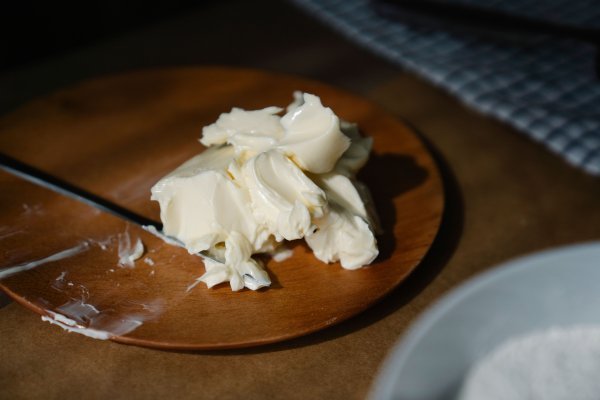
Beef tallow is rendered beef fat. Rendering involves slowly heating fatty tissue until the fat separates from water, proteins, and connective tissue. The liquid fat is then strained and allowed to cool, producing a firm cooking fat that can be stored and used for frying, roasting, sautéing, and baking. Historically, tallow and other animal fats were ordinary kitchen ingredients long before inexpensive industrial vegetable oils became widespread.
Describing tallow simply as "saturated fat" misses much of its actual composition. Beef fat contains a mixture of saturated and unsaturated fatty acids. Palmitic acid and stearic acid make up much of its saturated-fat content, while oleic acid contributes a substantial portion of its monounsaturated fat. Oleic acid is the same monounsaturated fatty acid that is abundant in olive oil. The exact composition varies with the animal, diet, and fat source, but tallow is not chemically equivalent to a block of pure saturated fat.
This mixture is one reason tallow performs so well in the kitchen. It remains stable at ordinary cooking temperatures, has a relatively long culinary history, and produces the crisp texture and rich flavor that made animal fats traditional choices for frying in the first place. Those practical qualities are useful, but the more important question for this discussion is what its fatty-acid structure means when heat and oxygen are introduced.

Why Fatty-Acid Structure Matters During Cooking
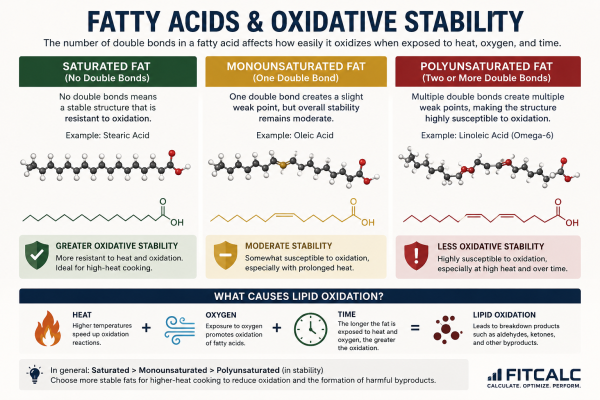
Fatty acids are commonly grouped as saturated, monounsaturated, or polyunsaturated according to the number of carbon-carbon double bonds in their structure. Saturated fatty acids contain none, monounsaturated fatty acids contain one, and polyunsaturated fatty acids contain two or more. Those double bonds are chemically important because they create sites that are more susceptible to oxidative reactions.
As the degree of unsaturation increases, a fat generally becomes more vulnerable to oxidation. This is why highly polyunsaturated oils require more consideration when they are exposed to substantial heat for extended periods. A 2024 review of vegetable oils used for frying identified fatty-acid composition as one of the major determinants of frying stability. Oils rich in polyunsaturated fatty acids tended to deteriorate more readily through oxidation and polymerization, while oils richer in monounsaturated or saturated fatty acids were generally more resistant.
This does not mean that every unsaturated oil is unstable or that every saturated fat is automatically ideal for every culinary use. High-oleic versions of sunflower and other oils, for example, contain much more monounsaturated oleic acid and can behave very differently from their conventional high-linoleic counterparts. Antioxidant content, processing, storage, temperature, oxygen exposure, and heating duration also influence how an oil behaves. The relevant point is narrower: the number and arrangement of double bonds materially affect oxidative stability, and tallow's fatty-acid profile gives it an advantage when heat stability is the goal.
What Happens When Cooking Oils Are Heated?
Heating fat initiates a series of chemical reactions rather than a single event that begins at one exact temperature. Exposure to heat and oxygen can promote lipid oxidation, while sufficiently intense or prolonged heating can also cause hydrolysis, polymerization, and other forms of degradation. Primary oxidation products can subsequently break down into secondary compounds, including aldehydes and other volatile or nonvolatile products.
This is also why smoke point should not be treated as a complete measure of whether a fat is suitable for cooking. Smoke point tells us when visible smoke begins to appear under particular conditions, but it does not fully describe oxidative stability. Modern frying research considers the fatty-acid profile of the oil, antioxidant content, temperature, duration of heating, repeated use, and exposure to oxygen. An oil can undergo chemical changes before a dramatic plume of smoke appears.
Research examining repeatedly or intensely heated vegetable oils consistently demonstrates that these changes become more pronounced as heating continues. A 2025 review examined potentially harmful aldehydes produced during high-temperature cooking with vegetable oils, while a 2026 study of sunflower, cottonseed, and flaxseed oils heated between 180 and 250 degrees Celsius documented changes in unsaturated fatty acids, depletion of protective compounds such as tocopherols, and formation of oxidation products including aldehydes.
Context still matters. Briefly sautéing vegetables in fresh oil at home is not equivalent to keeping the same batch of fryer oil hot for hours and repeatedly exposing it to food, oxygen, and heat. It would be misleading to treat those situations as identical. Nevertheless, the underlying chemistry provides a sensible reason to prefer a cooking fat that is comparatively resistant to oxidation, especially for frying, roasting, searing, or other higher-temperature applications.
Why FitCalc Prefers Tallow Over Seed Oils
Our preference for tallow does not depend on claiming that a small amount of canola or soybean oil is acutely toxic. We simply see little reason to make highly refined, polyunsaturated seed oils our default cooking fats when stable traditional alternatives are readily available. Beef tallow performs exceptionally well under heat, has a straightforward ingredient profile, and fits naturally into the kind of whole-food diet we advocate.
The term seed oil also deserves some precision. Soybean, corn, sunflower, safflower, cottonseed, and canola oils do not share an identical fatty-acid profile, and high-oleic versions of some of these oils are considerably more resistant to oxidation than conventional varieties. The strongest scientific argument is therefore not that a fat becomes harmful merely because it came from a seed. The more relevant issue is the combination of fatty-acid composition, refinement, storage, and exposure to heat.
For everyday cooking, we would rather use tallow, butter or ghee for those who tolerate dairy, and appropriate minimally processed oils such as extra-virgin olive oil depending on the application. That choice is consistent with a broader dietary principle: build meals around recognizable foods and use simple ingredients to prepare them. A plate of beef, potatoes, eggs, fruit, or vegetables cooked at home does not require an industrially refined cooking oil simply because that oil has become conventional.
The Saturated Fat and LDL Question
The main argument against beef tallow is its saturated-fat content. Certain saturated fatty acids can raise LDL cholesterol when they replace unsaturated fats in the diet, and LDL-containing apoB particles have a well-supported role in atherosclerosis. Ignoring that evidence would make the case for tallow weaker, not stronger. At the same time, the relationship between dietary fat, blood lipids, and cardiovascular outcomes is more complicated than saying that a food contains saturated fat and is therefore unhealthy.
One reason is that saturated fatty acids are not metabolically identical. Stearic acid, which is present in meaningful amounts in beef fat, has a different effect on blood cholesterol from saturated fatty acids such as palmitic, myristic, and lauric acid. Controlled feeding studies and reviews have generally found stearic acid to have a relatively neutral effect on total and LDL cholesterol compared with other saturated fatty acids. Tallow also contains substantial oleic acid, further illustrating why its physiological effects cannot be inferred from the words "saturated fat" alone.
None of this establishes tallow as a cholesterol-lowering food, and people with elevated apoB or significant cardiovascular risk should not assume that dietary saturated fat is irrelevant. The more reasonable conclusion is that cardiovascular risk cannot be reduced to a single nutrient label. Blood pressure, smoking, insulin resistance, blood glucose, triglycerides, apoB, body composition, physical activity, genetics, and overall dietary pattern all contribute to long-term risk. A biomarker matters, but the effect of a complete diet on actual clinical outcomes matters as well.
What Older Vegetable-Oil Trials Actually Found
Two older dietary experiments are especially relevant because they complicate the assumption that replacing animal fat with linoleic-acid-rich vegetable oil must improve cardiovascular outcomes simply because serum cholesterol falls. They do not prove that seed oils cause heart disease, but they are important pieces of evidence when evaluating how confidently dietary recommendations should be stated.
The Minnesota Coronary Experiment was a randomized dietary trial conducted in institutional settings during the late 1960s and early 1970s. The intervention replaced much of the saturated animal fat in the diet with linoleic-acid-rich corn oil and corn-oil margarine. Serum cholesterol decreased as expected. When previously unpublished data were recovered and reanalyzed decades later, however, the investigators found no mortality benefit from the intervention and no evidence of reduced coronary atherosclerosis or myocardial infarction in the available autopsy data.
The Sydney Diet Heart Study produced another result worth considering. Men who had experienced a coronary event were advised to replace saturated animal fats with safflower oil and safflower-oil margarine rich in omega-6 linoleic acid. A later analysis of recovered data found that the intervention lowered cholesterol but was associated with higher all-cause, cardiovascular, and coronary mortality. The trial had important limitations, involved a specific secondary-prevention population, and should not be generalized into a claim that all seed oils increase mortality.
These trials nevertheless illustrate an important principle. Improving a surrogate marker does not automatically demonstrate that a particular dietary intervention improves the clinical outcome that matters most. Modern evidence supporting the causal role of apoB-containing lipoproteins in atherosclerosis remains substantial, but that does not mean every dietary method that lowers cholesterol has been proven to produce the same health outcome. The distinction between a biological risk factor and the net effect of a complete dietary intervention is worth preserving.
Are Seed Oils Inflammatory?
One of the most common arguments against seed oils is that their omega-6 linoleic acid content inevitably promotes chronic inflammation. This claim is often repeated with far more certainty than the human evidence supports. A systematic review of randomized controlled trials found little evidence that increasing linoleic-acid intake raises commonly measured inflammatory markers in healthy people.
For that reason, we do not think the blanket claim that "omega-6 is inflammatory" is necessary to make the case for choosing tallow. Linoleic acid participates in biological pathways that can produce inflammatory mediators, but human physiology is more complicated than tracing one biochemical pathway and assuming the final clinical outcome. Controlled human evidence deserves more weight than a mechanism considered in isolation.
Our concern is instead centered on cooking stability, the susceptibility of highly polyunsaturated fats to oxidation, the effects of prolonged or repeated heating, and our preference for traditional minimally processed fats. Those arguments can stand on their own without exaggerating what has been established about dietary omega-6 and systemic inflammation.
Not Every Seed Oil Is the Same
Another reason to avoid overly broad claims is that modern cooking oils can differ dramatically even when they come from the same plant. Conventional sunflower oil, for example, can contain a high proportion of linoleic acid, whereas high-oleic sunflower oil has been selectively produced to contain much more monounsaturated oleic acid. The high-oleic version consequently has greater oxidative stability during heating.
Canola oil contains a different mixture again, with considerably more monounsaturated fat and less linoleic acid than several conventional high-PUFA seed oils. Processing methods, antioxidant content, freshness, and storage conditions introduce additional differences. It is therefore more scientifically accurate to discuss fatty-acid composition and processing than to assume every oil extracted from a seed behaves identically.
This nuance does not change our kitchen preference. If the choice is between a bottle of highly refined cooking oil and a simple traditional fat such as beef tallow, we always choose tallow. It does mean that the reasoning should be based on what the fats actually contain and how they behave rather than treating the phrase seed oil as a chemical category.
So, Is Beef Tallow Better for Cooking?
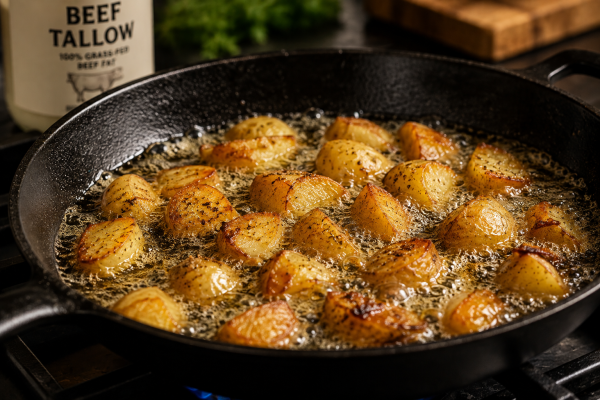
For our kitchen, yes. Beef tallow is one of our preferred cooking fats, particularly for frying, roasting, searing, and other applications involving substantial heat. Its combination of saturated and monounsaturated fatty acids gives it good oxidative stability, it performs exceptionally well in cooking, and it fits naturally into a diet centered on whole and minimally processed foods.
The scientific evidence does not justify every claim made in the anti-seed-oil movement. Normal consumption of linoleic acid has not been convincingly shown to cause systemic inflammation in controlled human trials, and observational research has often associated higher linoleic-acid intake or biomarkers with favorable cardiovascular outcomes. Likewise, long-term randomized trials have not established that replacing every tablespoon of vegetable oil with beef tallow prevents cardiovascular disease.
We are comfortable acknowledging those limitations because they do not erase the reasons we choose tallow. Polyunsaturated fatty acids are more susceptible to oxidative degradation than saturated and monounsaturated fats. Prolonged and repeated heating of cooking oils produces oxidation products. Tallow is comparatively stable, simple, traditional, and highly functional in the kitchen. For someone trying to build a diet around quality meat, eggs, fruit, vegetables, and other minimally processed foods, choosing a traditional cooking fat is a reasonable extension of that approach.
Nutrition rarely becomes clearer when every food is divided into "toxic" and "heart healthy." The better approach is to understand the chemistry, examine the human evidence, and then make a practical choice. After doing that, beef tallow remains the cooking fat we would reach for before conventional seed oils.